
Wristwatches · Wristwatch
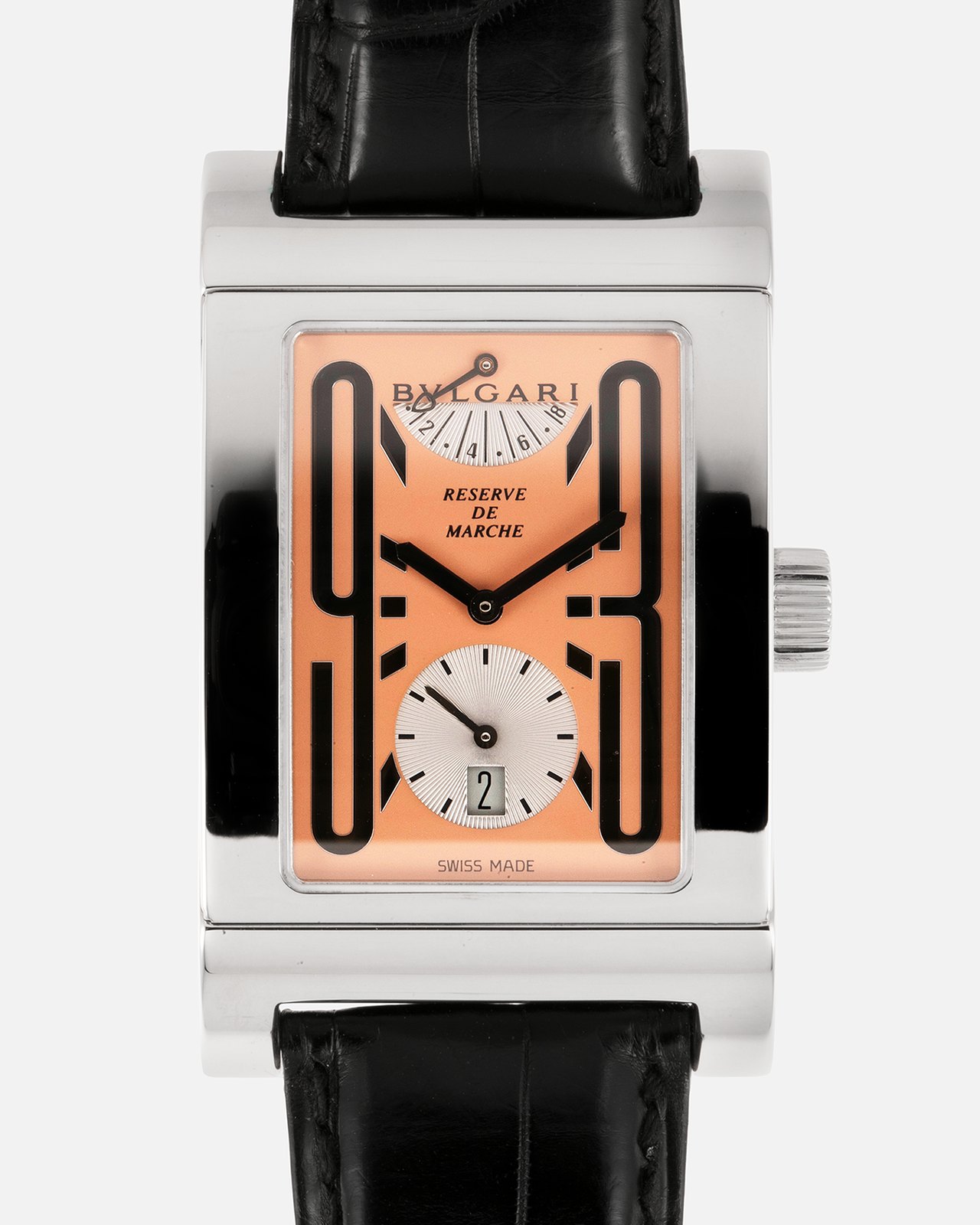
Bulgari Rettangolo Parmigiani Reserve de Marche Salmon, 2001
- Maker / attribution
- Bulgari (maker)
- Date
- 2001
- Historical period
- Mechanical Renaissance (1990 – 2010)
- Country of origin
- Switzerland
- Object type
- Wristwatch
- Dimensions
- Case 29 mm
- Stock no.
- Product 6880073252951
- Credit line
- Dealer listing, S.Song Watches (product 6880073252951)
- Catalogue title (original)
- Bulgari Rettangolo Parmigiani Reserve de Marche Salmon (English)
View the source record (dealer listing) ↗ (opens another website in a new tab)Suggest a correction
Record summary
Catalogued by S.Song Watches (dealer), Seattle (stock number Product 6880073252951), this is a wristwatch by Bulgari, made in Switzerland, dated 2001. The Atlas places it in the Mechanical Renaissance period (1990 – 2010) of its Wristwatches collection. Recorded dimensions: Case 29 mm. The record is illustrated with 6 photographs.
Assembled from the source record's structured fields. Dates and attributions are given as the source states them; where a field is missing the Atlas leaves it blank rather than estimating.
Catalogue description
Dealer description — S.Song Watches
It’s in the watch realm where Bulgari has seen an impressive amount of activity in recent years, thanks to the Octo Finissimo collection. The critically acclaimed line has established new benchmarks in the genre of ultra-thin watchmaking since 2014, including the thinnest automatic watch, thinnest minute repeater, thinnest tourbillon, and thinnest chronograph. With all these world firsts, Bulgari can no longer be looked at as a luxury goods brand dipping its toes into the world of watchmaking, they are now a respected watchmaker. Many of the designs in the Bulgari catalog can be traced back to legendary watch designer Gerald Genta, who designed the original Octo and the Bulgari Aluminum. Offered here today is not the Octo Finnisimo nor the Aluminium, in fact, it is somewhat of an outlier – a reference that we don’t often hear about nor see on the site. This is the Rettangolo Reserve de Marche, but not just any generic one, this particular example comes configured with a platinum case and a salmon dial, and it is a limited edition of 99 pieces worldwide. The Rettangolo Reserve de Marche features a hefty 29mm x 48mm platinum case which is polished to a nice shine and is complemented by a fixed smooth bezel. The front of the case features grooves running down the sides which can be felt when you brush your fingers over the case. The watch is operated via a sizable crown located on the right side. When it comes to case design, the Rettangolo’s rectangular case is both simple yet intricate in design, and in some ways, I believe resembles the Patek Philippe Gondolo 5200G which we have offered here in the past. As far as dial design goes, the salmon-colored dial on this watch has a very distinct and unique aesthetic to it; with an almost art-deco-like flavor being very apparent here, which is attributed to the symmetrically “exploded” arrangements of the 9 and 3 numerals at each side of the dial. The dial is also adorned with a power reserve indicator at 12 o ‘clock, a running seconds sub-dial at 6 with guilloche and a discreet date window aperture inside of it, as well as a set of white gold sword hands. When combined, these design elements create an elaborate and sophisticated dial. Encased within its polished platinum case and proudly displayed behind the Rettangolo’s exhibition caseback is, what I think, is the star of the show: the Bulgari Cal. 115; a unique movement that was actually made by legendary watchmaker Michael Parmigiani on commission for Bulgari. For those who do not know, Michael Parmigiani is one of the most celebrated independent watchmakers of all time, responsible for not only his eponymous brand but also for working and a myriad of calibers throughout the industry. This Cal. 115 is not only visually pleasing to look at, but also boasts impressive technical features, such as a variety of finishing techniques and an outstanding 8-day power reserve. For some reason, I find rectangular watches with well-crafted movements on display to be particularly captivating, although I can't quite pinpoint what exactly draws me to them. That being said, this Bulgari Rettangolo Reserve de Marche limited edition is an intriguing piece with an impressive movement to boot. It's not often that you come across an earlier work of the acclaimed Michael Parmigiani featured in a watch like this.
Historical context
Mechanical Renaissance (1990 – 2010)
Mechanical watches return as cultural objects; independent watchmaking flourishes.
Mechanical watches returned as cultural and luxury objects. Complications, tourbillons and new materials proliferated; independent watchmakers such as George Daniels, F.P. Journe and Philippe Dufour revived artisanal watchmaking; collecting vintage watches became a major field.
Read the period in the timelineMore wristwatches from this periodEarlier: Quartz Revolution
Atlas type guide
Wristwatches
Bracelet watches were worn by women from the early nineteenth century — Breguet made one for Caroline Murat, Queen of Naples, in 1810–12 — but the wristwatch only became a man's instrument with military use and aviation in the early twentieth century. Between the World Wars it overtook the pocket watch; the 1920s and 1930s brought rectangular Art Deco cases, water-resistant cases and the first automatic winding systems.
After 1945 the wristwatch became a carrier of identity — dress watches, sports and dive watches, chronographs, calendars — produced by Swiss, American, Japanese, German, Soviet and Chinese industries. The quartz revolution after 1969 and the mechanical renaissance since the 1990s, including the rise of independent watchmakers, complete the story.
What to look for
- The reference number (between the lugs or inside the case back) and serial number, the starting point for dating.
- The calibre: its maker and number are often stamped under the dial or on the bridge.
- Originality of dial, hands and crown — refinished ('redial') dials are common.
- Case material marks: 18K/750, 14K/585, stainless steel, gold-filled, plated.
Dating clues
- Wire-lug cases: before c. 1925.
- Water-resistant screw-down cases: from 1926.
- Quartz movements: from 1969; sapphire crystals widespread after c. 1980.
General guidance written by the Atlas editors about this kind of object. It is not a statement about this particular piece; for that, rely on the source record above and on physical examination.
Related records
Wristwatches · c. 2000s
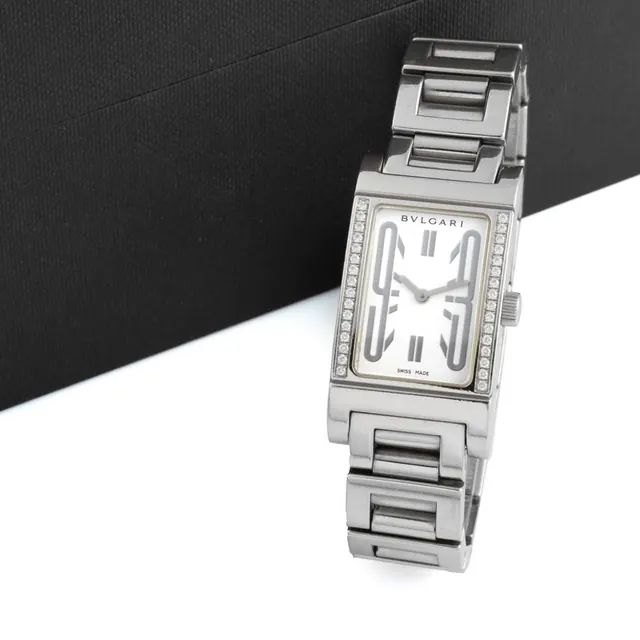
Bulgari wristwatch, ref. RT, Rettangolo, circa 2000's
Antiquorum auction archive, Geneva
Wristwatches · 1970s
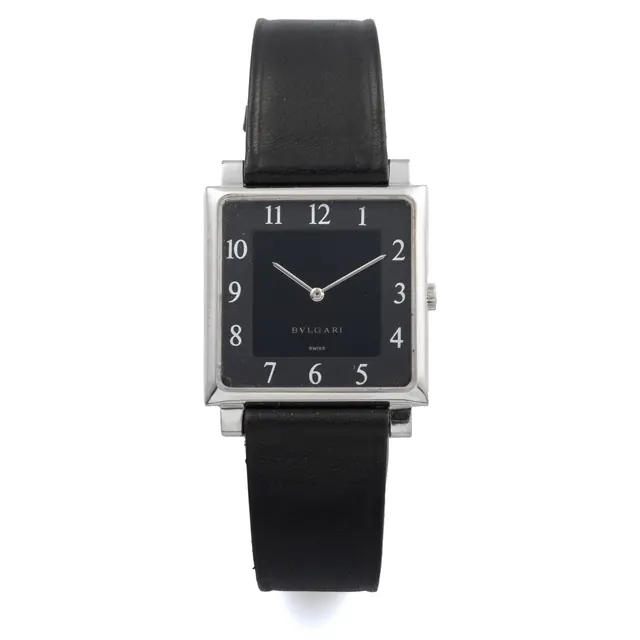
Bulgari wristwatch, ref. G-1475-2, 1970s
Antiquorum auction archive, Geneva
Wristwatches · c. 2012
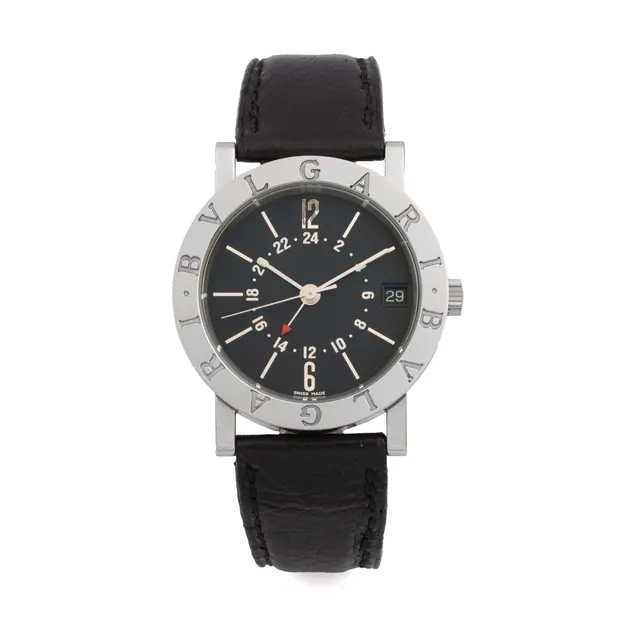
Bulgari wristwatch, ref. BB33SL, GMT Limited Edition “Prototype / Not for Sale”, circa 2012
Antiquorum auction archive, Geneva
Wristwatches · c. 2010
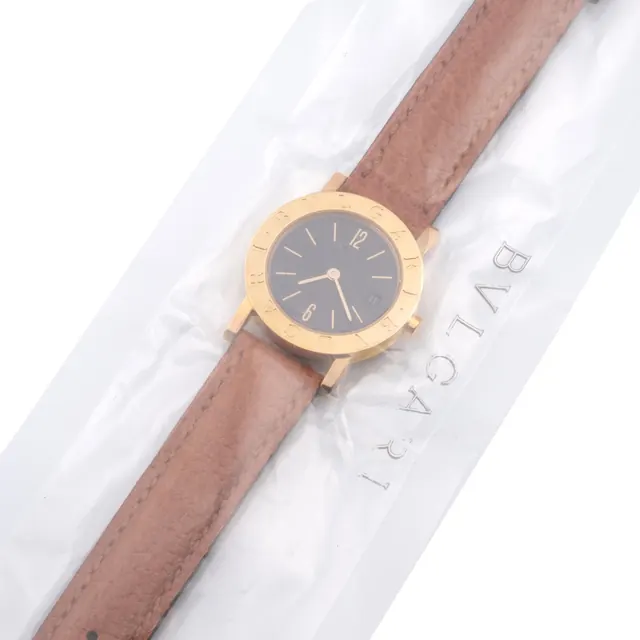
Bulgari wristwatch, ref. BB, circa 2010
Antiquorum auction archive, Geneva

Wristwatches · 2008
Wristwatch by Breitling?, 2008
Museum Rotterdam

Wristwatches · c. 1990s
Audemars Piguet Bamboo, c. 1990s
Antiquorum auction archive, Geneva

Wristwatches · c. 1990
Audemars Piguet Huitieme Perpetual Calendar, ref. 25696PT, c. 1990
Antiquorum auction archive, Geneva

Wristwatches · c. 1990
Breitling Chronomat, ref. b13050.1, c. 1990
Antiquorum auction archive, Geneva