
Wristwatches · Wristwatch
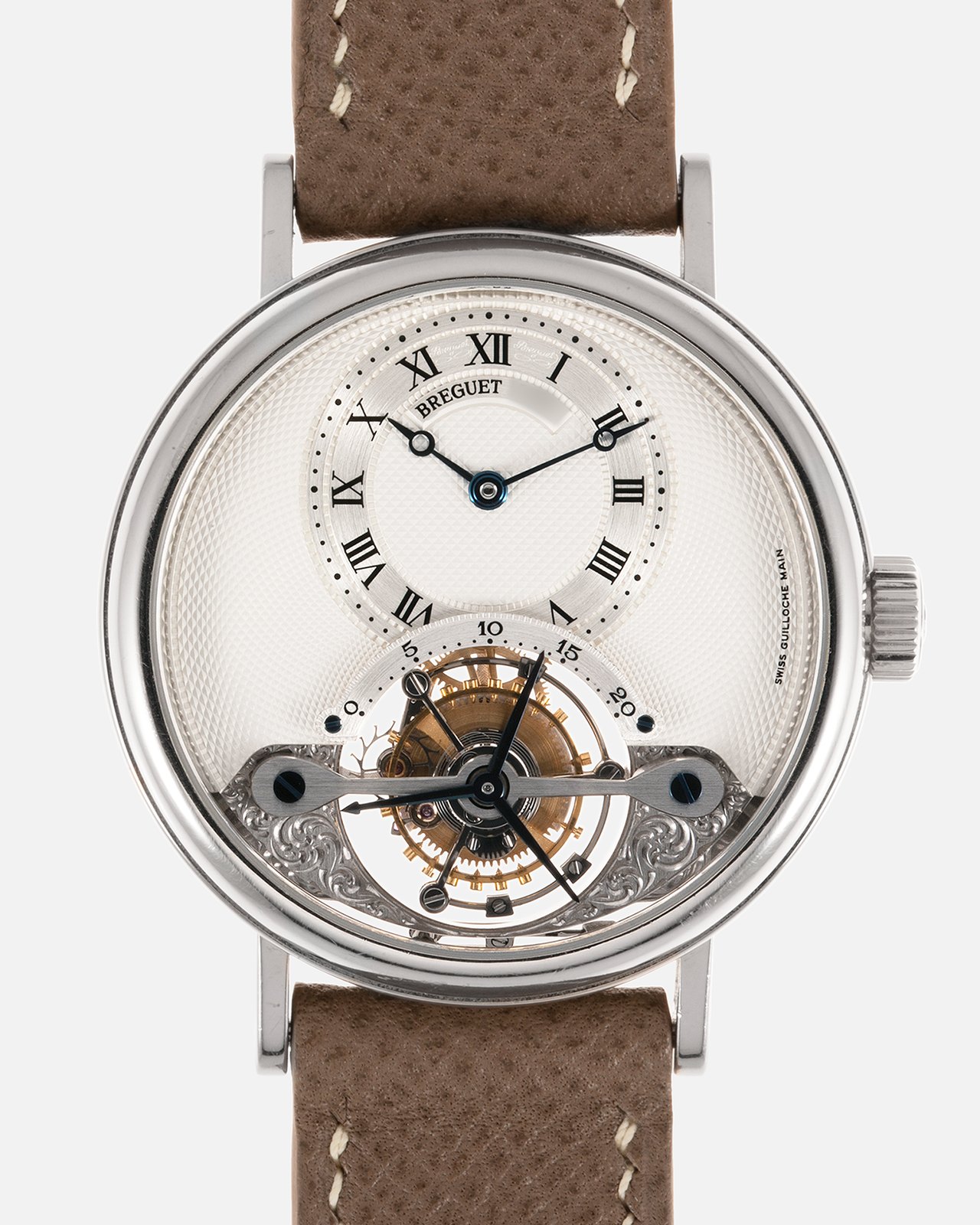
Breguet Classique Tourbillon 3357, 1990s
- Maker / attribution
- Breguet (maker)
- Date
- 1990s
- Historical period
- Mechanical Renaissance (1990 – 2010)
- Country of origin
- Switzerland
- Object type
- Wristwatch
- Dimensions
- Case 36 mm
- Stock no.
- Product 6865001873495
- Credit line
- Dealer listing, S.Song Watches (product 6865001873495)
- Catalogue title (original)
- Breguet Classique Tourbillon 3357 (English)
View the source record (dealer listing) ↗ (opens another website in a new tab)Suggest a correction
Record summary
Catalogued by S.Song Watches (dealer), Seattle (stock number Product 6865001873495), this is a wristwatch by Breguet, made in Switzerland, dated 1990s. The Atlas places it in the Mechanical Renaissance period (1990 – 2010) of its Wristwatches collection. Recorded dimensions: Case 36 mm. The record is illustrated with 6 photographs.
Assembled from the source record's structured fields. Dates and attributions are given as the source states them; where a field is missing the Atlas leaves it blank rather than estimating.
Catalogue description
Dealer description — S.Song Watches
Perhaps one of watchmaking's most overlooked industry titans, few brands can claim as many mechanical innovations and iconic pieces of design as Breguet can. Be it their Breguet hands, Breguet numerals, the tourbillon, the Breguet overcoil, or others; the industry has benefitted tremendously from Breguet's continuous evolution and the Classique Tourbillon Ref. 3357 is emblematic of everything Breguet has come to stand for in the modern watchmaking industry. For context, the Chaumet brothers and Daniel Roth spearheaded the revival of Breguet throughout the 1970s and 1980s, which eventually saw the introduction of the Ref. 3350 Tourbillon in 1988. The Ref. 3350 became the very first tourbillon wristwatch produced under the Breguet banner. During that period, while the tourbillon complication no longer served its once crucial function to improve time-keeping accuracy, its historical importance for Breguet and its visual appeal meant that the Ref. 3350 made perfect sense at the time. A few years later, the Ref. 3350 was then replaced with the Ref. 3357, which is the watch we are offering here today. Understated yet luxurious is how I would describe the Classique Tourbillon Ref. 3357’s aesthetics and design; it is, as its name suggests, classically styled. It features a conservative 36mm coin-like case with an elegant fluting wrapped around the case band and fine scalloped lugs that curve downwards ever so slightly. The Classique Tourbillon Ref. 3357 exudes a sophisticated aura of craftsmanship in Breguet’s very own unmistakable style. On the dial, you will find that it is gracefully adorned with hand-turned guilloche decoration, as indicated by the text “Swiss Guilloche Main” at the 3 o ‘clock position. The outer periphery of the dial is covered in the Grain D’orge motif. At 12 o ‘clock sits a subdial with brushed silver rings that feature the primary time-telling functions. The hour and minute are indicated by Breguet’s very own signature thermal-blued Breguet hands and Roman numerals painted in black. If you look closer, you will notice Breguet’s minimal signature between the XI and X11, and XII and I. The center of this subdial is beautifully covered by a contrasting Clou de Paris guilloche which offsets the silver brushed rings – creating a captivating visual contrast between both textures. At 6 o ‘clock lies the glorious one-minute tourbillon cage, which also holds a three-armed running seconds mechanism. Regarding its movement, the Ref. 3357 is powered by a manually wound, 21-jeweled Cal. 558, which is a movement produced by Nouvelle Lemania with the involvement of the legendary Daniel Roth and Francois Bodet during their respective tenures with Breguet. The Cal. 558 features a lateral level escapement, a balance adjusted to 6 positions, and a self-compensating Breguet balance spring. It also boasts a power reserve of 50 hours. As I have mentioned earlier, the Ref. 3357 was introduced in the early 1990s as the successor to the Ref. 3350. They were both almost identical in design, except for several cosmetic differences. The main difference is the “0” in Ref. 3350 indicates a closed caseback, whereas the “7” in Ref. 3357 indicates an open caseback. This is an important aspect of the Ref. 3357 because it allows us to peek into what makes the Ref. 3357 so alluring and beautiful. This a true testament to the extraordinary artisans who perfectly executed the “ciselage” (carving) on the backplate of the Lemania movement. Ciselage is a rare technique specially reserved for Breguet’s most precious models, and to see one here on this Tourbillon is an absolute treat to the eyes. The Breguet Classique Tourbillon Ref. 3357 is a unique watch, and it is not difficult to see why. Insane craftsmanship, impressive movement, intricate dial details, and an extremely wearable case. It has been an absolute pleasure to be able to handle and now offer this beautiful piece of art on the site.
Historical context
Mechanical Renaissance (1990 – 2010)
Mechanical watches return as cultural objects; independent watchmaking flourishes.
Mechanical watches returned as cultural and luxury objects. Complications, tourbillons and new materials proliferated; independent watchmakers such as George Daniels, F.P. Journe and Philippe Dufour revived artisanal watchmaking; collecting vintage watches became a major field.
Read the period in the timelineMore wristwatches from this periodEarlier: Quartz Revolution
Atlas type guide
Wristwatches
Bracelet watches were worn by women from the early nineteenth century — Breguet made one for Caroline Murat, Queen of Naples, in 1810–12 — but the wristwatch only became a man's instrument with military use and aviation in the early twentieth century. Between the World Wars it overtook the pocket watch; the 1920s and 1930s brought rectangular Art Deco cases, water-resistant cases and the first automatic winding systems.
After 1945 the wristwatch became a carrier of identity — dress watches, sports and dive watches, chronographs, calendars — produced by Swiss, American, Japanese, German, Soviet and Chinese industries. The quartz revolution after 1969 and the mechanical renaissance since the 1990s, including the rise of independent watchmakers, complete the story.
What to look for
- The reference number (between the lugs or inside the case back) and serial number, the starting point for dating.
- The calibre: its maker and number are often stamped under the dial or on the bridge.
- Originality of dial, hands and crown — refinished ('redial') dials are common.
- Case material marks: 18K/750, 14K/585, stainless steel, gold-filled, plated.
Dating clues
- Wire-lug cases: before c. 1925.
- Water-resistant screw-down cases: from 1926.
- Quartz movements: from 1969; sapphire crystals widespread after c. 1980.
General guidance written by the Atlas editors about this kind of object. It is not a statement about this particular piece; for that, rely on the source record above and on physical examination.
Related records
Pocket Watches · 1700–1799
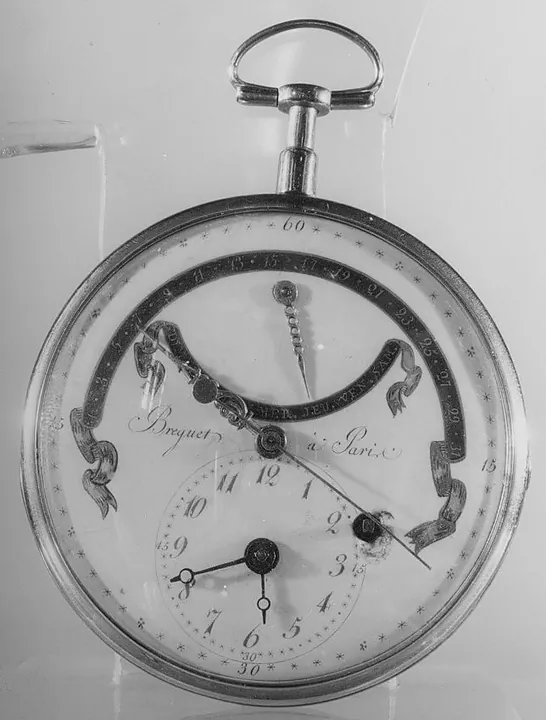
Pocket watch by Breguet, Belgium, 1700–1799
Royal Institute for Cultural Heritage
Pocket Watches · 1700–1799
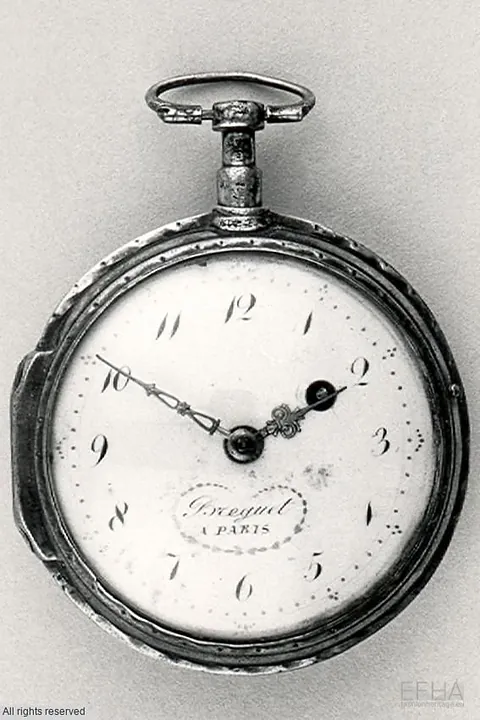
Pocket watch by Breguet, France, 1700–1799
Fashion Museum of Antwerp
Pocket Watches · c. 1790
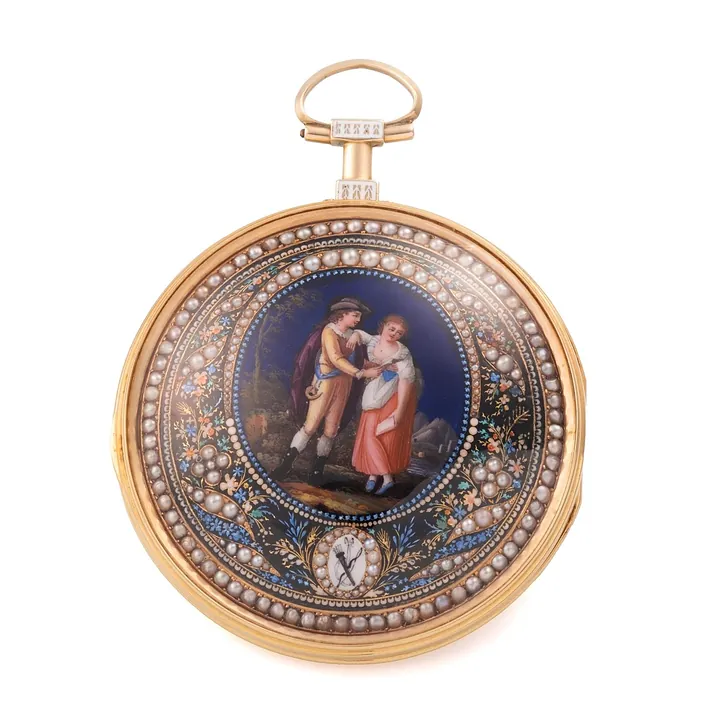
Breguet Love Letter, c. 1790
Antiquorum auction archive, Geneva
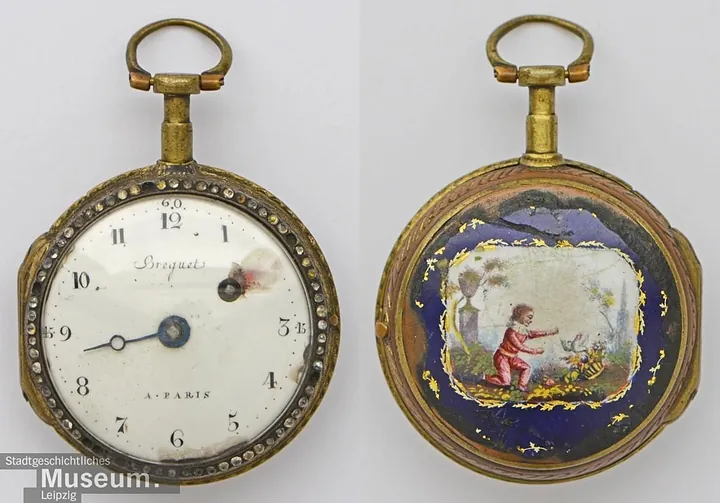
Pocket Watches · 1790
Pocket watch possibly by Breguet, France, 1790
Museum of City History Leipzig

Wristwatches · 2008
Wristwatch by Breitling?, 2008
Museum Rotterdam

Wristwatches · c. 1990s
Audemars Piguet Bamboo, c. 1990s
Antiquorum auction archive, Geneva

Wristwatches · c. 1990
Audemars Piguet Huitieme Perpetual Calendar, ref. 25696PT, c. 1990
Antiquorum auction archive, Geneva

Wristwatches · c. 1990
Breitling Chronomat, ref. b13050.1, c. 1990
Antiquorum auction archive, Geneva