
Wristwatches · Wristwatch
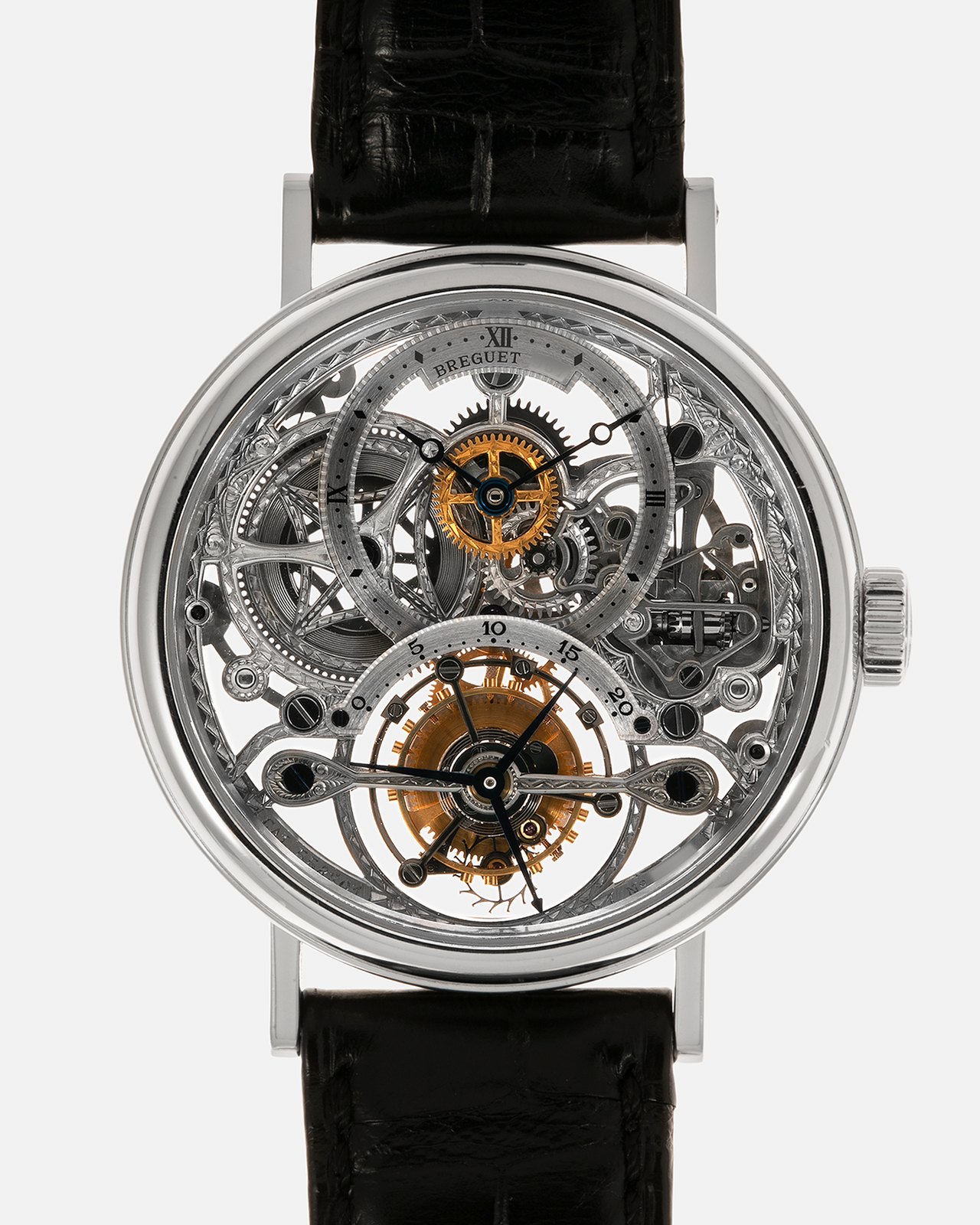
Breguet Classique Tourbillon 3355 Skeleton/Squelette Platinum, 2000s
- Maker / attribution
- Breguet (maker)
- Date
- 2000s
- Historical period
- Mechanical Renaissance (1990 – 2010)
- Country of origin
- Switzerland
- Object type
- Wristwatch
- Materials / technique
- platinum
- Dimensions
- Case 36 mm
- Stock no.
- Product 7450295009367
- Credit line
- Dealer listing, S.Song Watches (product 7450295009367)
- Catalogue title (original)
- Breguet Classique Tourbillon 3355 Skeleton/Squelette Platinum (English)
View the source record (dealer listing) ↗ (opens another website in a new tab)Suggest a correction
Record summary
Catalogued by S.Song Watches (dealer), Seattle (stock number Product 7450295009367), this is a wristwatch by Breguet, made in Switzerland, dated 2000s. The Atlas places it in the Mechanical Renaissance period (1990 – 2010) of its Wristwatches collection. Materials and techniques recorded by the source: platinum. Recorded dimensions: Case 36 mm. The record is illustrated with 6 photographs.
Assembled from the source record's structured fields. Dates and attributions are given as the source states them; where a field is missing the Atlas leaves it blank rather than estimating.
Catalogue description
Dealer description — S.Song Watches
Perhaps one of watchmaking's most overlooked industry titans, few brands can claim as many mechanical innovations and iconic pieces of design as Breguet can. Be it their Breguet hands, Breguet numerals, the tourbillon, the Breguet overcoil, or others, the industry has benefited tremendously from Breguet's continuous technical innovation throughout the decades. Among its standout creations, the Classique Tourbillon 3355 'Squelette', which is also the watch offered here today, epitomises Breguet's pinnacle in contemporary watchmaking excellence and showcases a very special complication—the Tourbillon. While we’re on the topic, I have to say that the tourbillon stands out as one of my all-time favourite horological complications. They are true mechanical marvels of horology and are incredibly dynamic, animated, and a sheer delight to both wear and behold. On that note, I think Breguet tourbillons deserve extra special attention, especially considering the remarkable legacy of the brand's founder, Abraham-Louis Breguet, who invented the complication in 1795. For context, the tourbillon is a complex horological mechanism enclosed within a rotating carriage, designed to counteract fluctuations and errors in timekeeping caused by gravitational forces acting on the moving components within a watch movement. Essentially, a watch's balance tends to oscillate at varying speeds depending on its position and orientation. By integrating a tourbillon into the mechanism, the balance and escapement are continuously rotated, effectively averaging out positional errors and thereby enhancing the overall accuracy of timekeeping. The Breguet Classique Tourbillon 3355 ‘Squelette‘ represents a refined and sophisticated evolution in Breguet’s storied legacy of tourbillon wristwatches. If you are familiar with the lineage, the story begins with the groundbreaking debut of the 3350 in 1988, Breguet’s very first tourbillon wristwatch. That initial model featured a solid caseback, with the final digit ‘0’ in its reference denoting its closed construction. Towards the late 1990s, this reference was eventually updated with an exhibition caseback (as indicated by the ‘7’ in its reference) and a modernised movement, officially becoming the 3357. The 3355 came in 1993 and was made available in two precious metals: 18-carat yellow gold and platinum 950, with the example offered here crafted in the latter. The 3355 marked a pivotal shift in Breguet’s aesthetic narrative at the time. With enhanced skeletonisation techniques, even finer finishing, and the brand’s signature neoclassical elegance, the 3355 fully embraced the visual drama and expressive spirit of the tourbillon, while preserving the technical sophistication that has long defined the house of Breguet. Featuring a svelte 36mm x 9mm circular case, the 3355 is defined by its mid-case adorned with a milled coin edge pattern, known in Breguet parlance as carrure cannelée (meaning fluted case band in French). This intricate fluting is more than just decoration; it is a signature design element that dates back to Breguet’s earliest pocket watches. Its tactile and visual texture adds depth to the otherwise restrained case profile and is further complemented by a set of thin straight lugs with a gentle downward curve that hugs the wrist nicely, lending the piece a poised and highly refined architectural silhouette. Aesthetically, the scintillating open-worked dial of the 3355 is nothing short of a showstopper. It is truly astonishing to observe the sheer level of detail and finishing techniques packed into such a compact and elegantly proportioned package. The solid gold ring on the primary timekeeping sub-dial at 12:00 is circularly brushed and hosts a black printed minute track, along with minimalist Roman numerals at 12, 3 and 9. These are complemented by a set of blued steel pomme de Breguet hour and minute hands. The running seconds at 6:00, by contrast, feature a partial scale that measures up to 20 seconds. Of particular note is the tri-armed blued steel small seconds hand mounted directly on the one-minute tourbillon cage at 6:00—an enduring piece of design flourish introduced during Daniel Roth’s tenure at Breguet, and one that continues to feature in the brand’s contemporary offerings. From an artistic and technical perspective, it is also worth highlighting the difficulty of finishing the sharp inner and outer angles found throughout the movement bridges, as achieving such crisp chamfers and bevelling requires a high level of skill and a deep understanding of traditional hand finishing. The 3355 is powered by the manual-winding Breguet Cal. 558 SQ1, a movement originally produced by Nouvelle Lemania with the involvement of both Daniel Roth and François Bodet during their respective tenures at Breguet. This calibre is a direct descendant of the original 558 movements that debuted in the inaugural 3350, and it remains a pillar of Breguet’s modern tourbillon lineage. A closer look at the 7:00 position on the dial reveals a hand-engraved inscription on the bridge denoting the calibre. The Cal. 558 SQ1 features a lateral lever escapement, a balance adjusted in five positions, and a self-compensating Breguet overcoil balance spring. It offers a power reserve of approximately 50 hours on a full wind. The Breguet Classique Tourbillon 3355 'Squelette' is a truly illustrative work of horological art, and it is not hard to see why. As the photos clearly show, Breguet held nothing back when it came to open-working and finishing. Every surface, angle, and detail has been executed with remarkable care and precision.
Historical context
Mechanical Renaissance (1990 – 2010)
Mechanical watches return as cultural objects; independent watchmaking flourishes.
Mechanical watches returned as cultural and luxury objects. Complications, tourbillons and new materials proliferated; independent watchmakers such as George Daniels, F.P. Journe and Philippe Dufour revived artisanal watchmaking; collecting vintage watches became a major field.
Read the period in the timelineMore wristwatches from this periodEarlier: Quartz Revolution
Atlas type guide
Wristwatches
Bracelet watches were worn by women from the early nineteenth century — Breguet made one for Caroline Murat, Queen of Naples, in 1810–12 — but the wristwatch only became a man's instrument with military use and aviation in the early twentieth century. Between the World Wars it overtook the pocket watch; the 1920s and 1930s brought rectangular Art Deco cases, water-resistant cases and the first automatic winding systems.
After 1945 the wristwatch became a carrier of identity — dress watches, sports and dive watches, chronographs, calendars — produced by Swiss, American, Japanese, German, Soviet and Chinese industries. The quartz revolution after 1969 and the mechanical renaissance since the 1990s, including the rise of independent watchmakers, complete the story.
What to look for
- The reference number (between the lugs or inside the case back) and serial number, the starting point for dating.
- The calibre: its maker and number are often stamped under the dial or on the bridge.
- Originality of dial, hands and crown — refinished ('redial') dials are common.
- Case material marks: 18K/750, 14K/585, stainless steel, gold-filled, plated.
Dating clues
- Wire-lug cases: before c. 1925.
- Water-resistant screw-down cases: from 1926.
- Quartz movements: from 1969; sapphire crystals widespread after c. 1980.
General guidance written by the Atlas editors about this kind of object. It is not a statement about this particular piece; for that, rely on the source record above and on physical examination.
Read next:Identification Centre
Related records
Pocket Watches · 1700–1799
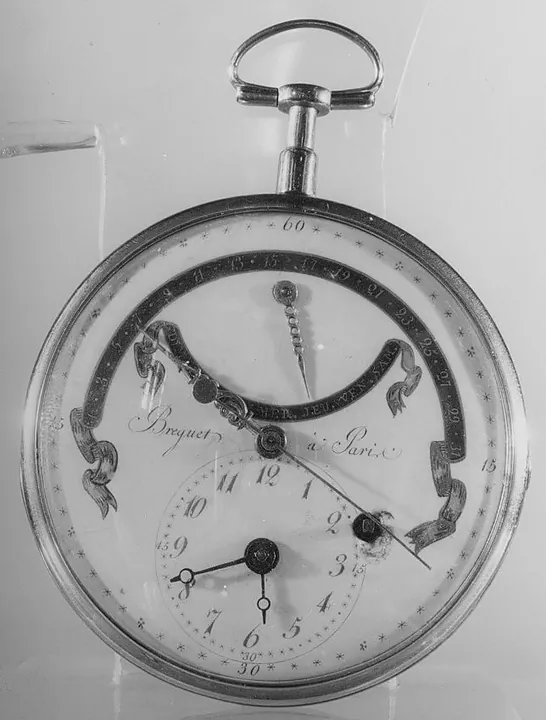
Pocket watch by Breguet, Belgium, 1700–1799
Royal Institute for Cultural Heritage
Pocket Watches · 1700–1799
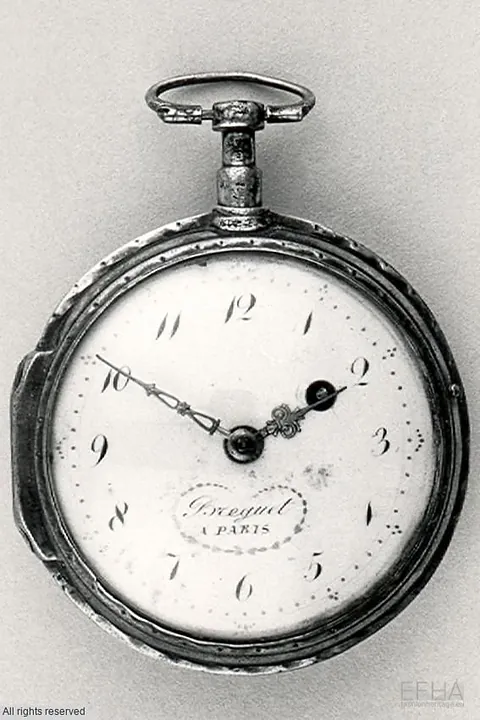
Pocket watch by Breguet, France, 1700–1799
Fashion Museum of Antwerp
Pocket Watches · c. 1790
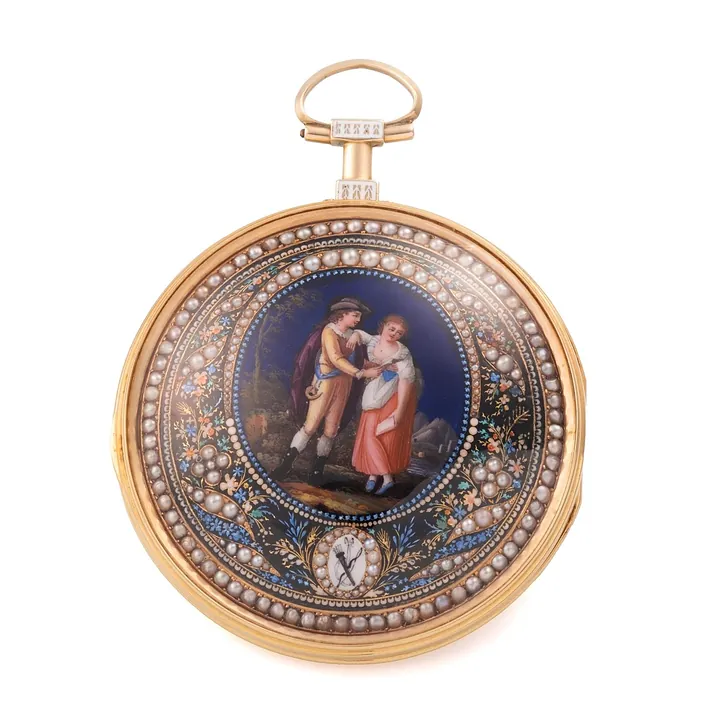
Breguet Love Letter, c. 1790
Antiquorum auction archive, Geneva
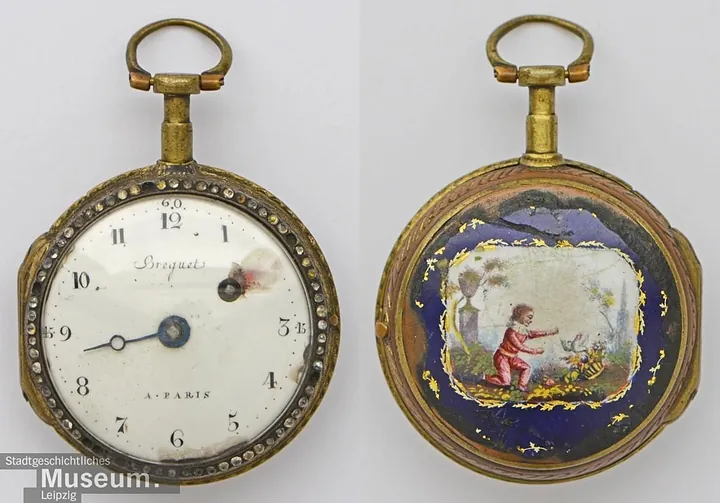
Pocket Watches · 1790
Pocket watch possibly by Breguet, France, 1790
Museum of City History Leipzig

Wristwatches · 2008
Wristwatch by Breitling?, 2008
Museum Rotterdam

Wristwatches · c. 1990s
Audemars Piguet Bamboo, c. 1990s
Antiquorum auction archive, Geneva

Wristwatches · c. 1990
Audemars Piguet Huitieme Perpetual Calendar, ref. 25696PT, c. 1990
Antiquorum auction archive, Geneva

Wristwatches · c. 1990
Breitling Chronomat, ref. b13050.1, c. 1990
Antiquorum auction archive, Geneva