
Wristwatches · Wristwatch
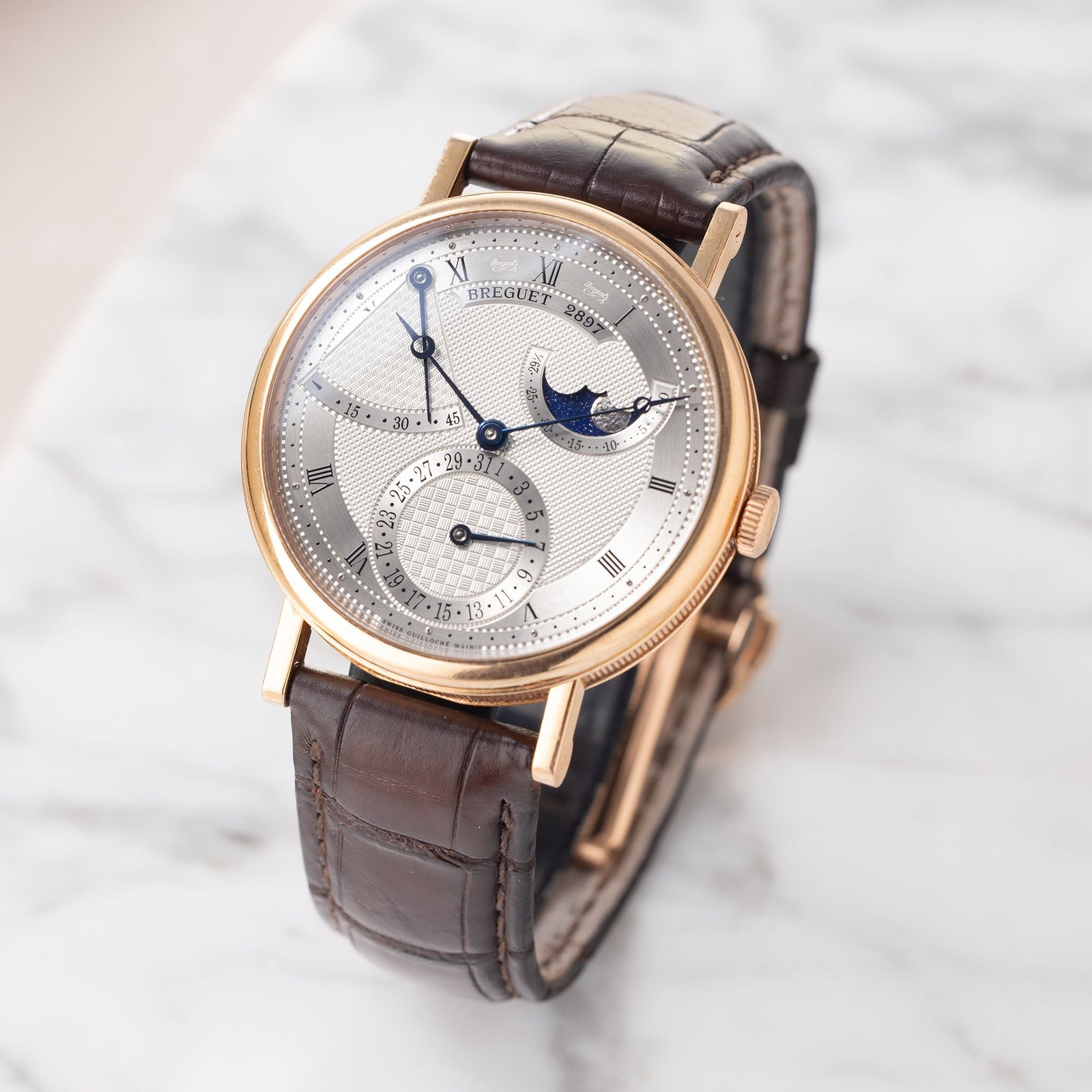
Breguet Classique Phase de Lune in 18 k Rose gold ref 7137, c. 2020
- Maker / attribution
- Breguet (maker)
- Date
- c. 2020
- Historical period
- Contemporary Horology (2010 – Present)
- Country of origin
- Switzerland
- Object type
- Wristwatch
- Materials / technique
- rose gold
- Dimensions
- Case 39 mm
- Stock no.
- W-3867
- Credit line
- Dealer listing, Bulang & Sons (W-3867)
- Catalogue title (original)
- Breguet Classique Phase de Lune in 18 k Rose gold ref 7137 (English)
View the source record (dealer listing) ↗ (opens another website in a new tab)Suggest a correction
Record summary
Catalogued by Bulang & Sons (dealer), Copenhagen (stock number W-3867), this is a wristwatch by Breguet, made in Switzerland, dated c. 2020. The Atlas places it in the Contemporary Horology period (2010 – Present) of its Wristwatches collection. Materials and techniques recorded by the source: rose gold. Recorded dimensions: Case 39 mm. The record is illustrated with 6 photographs.
Assembled from the source record's structured fields. Dates and attributions are given as the source states them; where a field is missing the Atlas leaves it blank rather than estimating.
Catalogue description
Dealer description — Bulang & Sons
Founded in Paris in 1775 by Swiss-born horologist Abraham-Louis Breguet, the House of Breguet is one of the oldest and most influential names in watchmaking. Often referred to as the "Leonardo da Vinci of watchmaking," Breguet transformed the art of horology with groundbreaking inventions, including the tourbillon and the self-winding movement. The design of this Breguet Classique 7137 can be traced back to the legendary Perpetuelle No. 5 , a quarter-repeating pocket watch completed by Abraham-Louis Breguet in 1794. Its modern interpretation began in 1983 with the introduction of the reference 3137, designed by the celebrated watchmaker Daniel Roth. Over the following decades, the model evolved into today's reference 7137 while faithfully preserving the timeless aesthetics and technical spirit of Breguet's original creation. The tasteful 39 mm case is crafted from 18k rose gold and features Breguet's signature fluted caseband, soldered straight lugs, and a sapphire display case back offering a view of the beautifully finished Calibre 502.3 DR1 automatic movement, complete with an off-centred solid gold oscillating weight. The silvered gold dial is a showcase of traditional engine-turning craftsmanship. The power reserve indicator is decorated with a panier maillé (basket-weave) guilloché, the date subdial features a damier (checkerboard) pattern, while the main dial is finished in the iconic clous de Paris (hobnail) motif. with a monnphase indicator .As is customary with Breguet, the individual serial number is proudly engraved on the dial, complemented by the brand's instantly recognizable blued open-tipped Breguet hands. The watch is paired with the shown slightly used original Breguet leather strap , fitted with a 18 k original 18k pink gold Breguet folding clasp. The watch has been fully serviced by our watchmaker ensuring years of enjoyment . Specifications: Breguet Classique Phase de Lune reference 7137 39mm 18k pink gold coin-edge case with display case back Serial 28xx dating to circa 2020 Three types of guilloché on the dial , moon phase indicator , date indicator and power reserve Solid gold silvered dial , blued Breguet type hands Automatic wound Caliber cal 502.3 DR1 with off set Gold rotor Comes on the pictured Breguet strap with Breguet 18k pink gold folding buckle Fully serviced by our watchmaker
Historical context
Contemporary Horology (2010 – Present)
Silicon components, connected watches, optical-lattice research clocks and a thriving independent scene.
Smartwatches became the world's best-selling watches, while mechanical watchmaking focuses on craft, innovation (silicon components, new escapements) and independent makers.
Read the period in the timelineMore wristwatches from this periodEarlier: Mechanical Renaissance
Atlas type guide
Calendar, moon-phase and perpetual calendar watches
Calendar complications range from a simple date to the perpetual calendar, which automatically allows for months of different lengths and leap years until 2100. Pocket watches with perpetual calendars were made in the eighteenth and nineteenth centuries; Patek Philippe made the first perpetual calendar wristwatch in 1925, and series production followed in 1941. The annual calendar (Patek Philippe, 1996) needs correction only once a year.
Moon-phase displays use a disc with two moons and 59 teeth advanced daily, approximating the 29.5-day lunation; more precise trains reduce the error to one day in over a century.
What to look for
- Apertures or subsidiary dials for day, date, month and leap year.
- Moon disc under a 'bosom' shaped aperture.
- Recessed correctors on the case band for setting the calendar.
Dating clues
- Triple-date wristwatches: popular c. 1940–1955.
- Perpetual calendar wristwatches: from 1925 (unique) and 1941 (series).
General guidance written by the Atlas editors about this kind of object. It is not a statement about this particular piece; for that, rely on the source record above and on physical examination.
Related records
Pocket Watches · 1700–1799
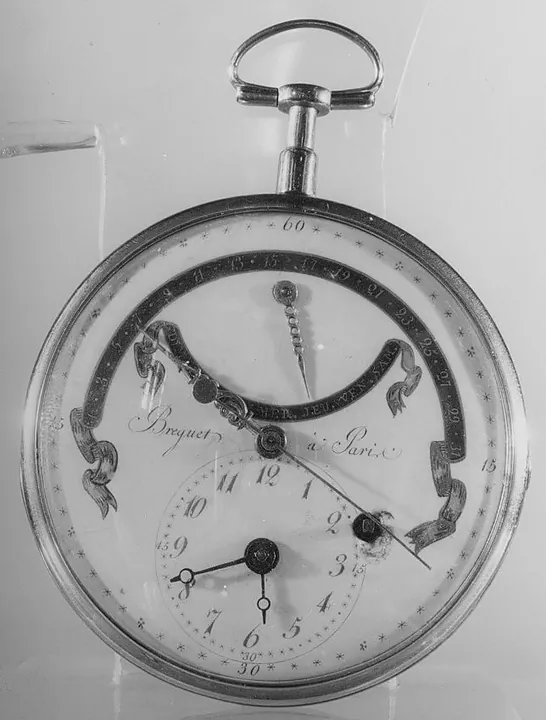
Pocket watch by Breguet, Belgium, 1700–1799
Royal Institute for Cultural Heritage
Pocket Watches · 1700–1799
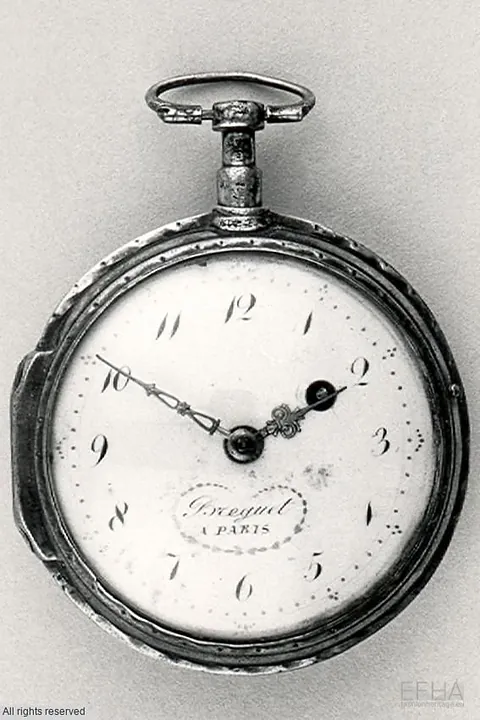
Pocket watch by Breguet, France, 1700–1799
Fashion Museum of Antwerp
Pocket Watches · c. 1790
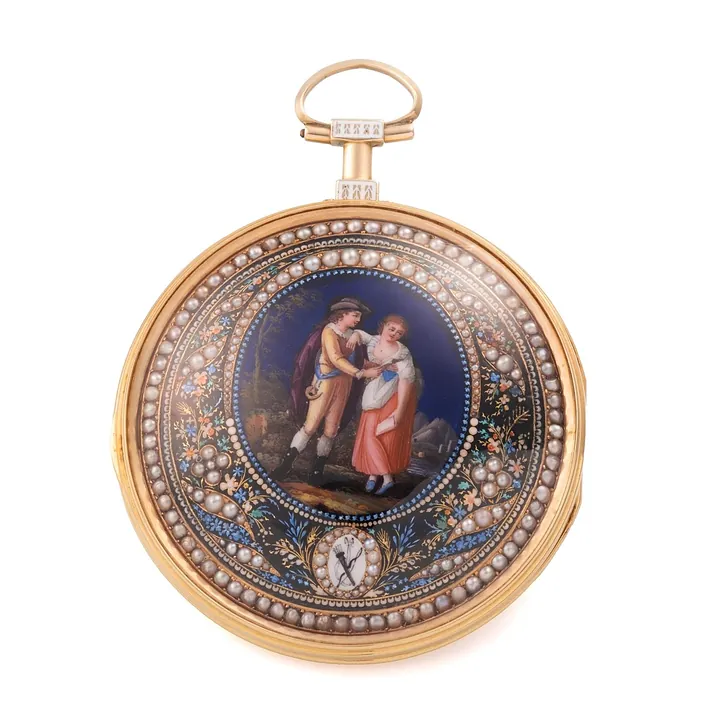
Breguet Love Letter, c. 1790
Antiquorum auction archive, Geneva
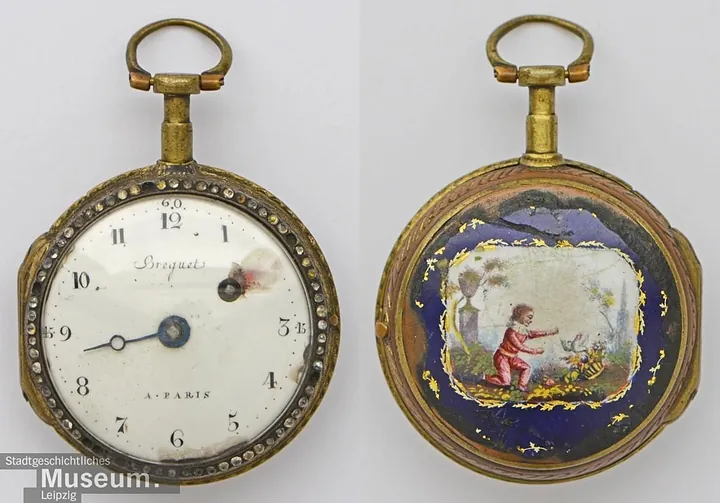
Pocket Watches · 1790
Pocket watch possibly by Breguet, France, 1790
Museum of City History Leipzig

Wristwatches · c. 2010s
Breguet Type XXI, ref. 3810, c. 2010s (Antiquorum Lot 381-24)
Antiquorum auction archive, Geneva

Wristwatches · c. 2010s
Breguet Type XXI, ref. 3810, c. 2010s (Antiquorum Lot 386-229)
Antiquorum auction archive, Geneva

Wristwatches · Sold in September 2010
Breitling Cosmonaute, ref. A 22322, Sold in September 2010
Antiquorum auction archive, Geneva

Wristwatches · c. 2010
Corum Bubble Chrono, ref. 396.150.20, c. 2010
Antiquorum auction archive, Geneva