
Wristwatches · Wristwatch
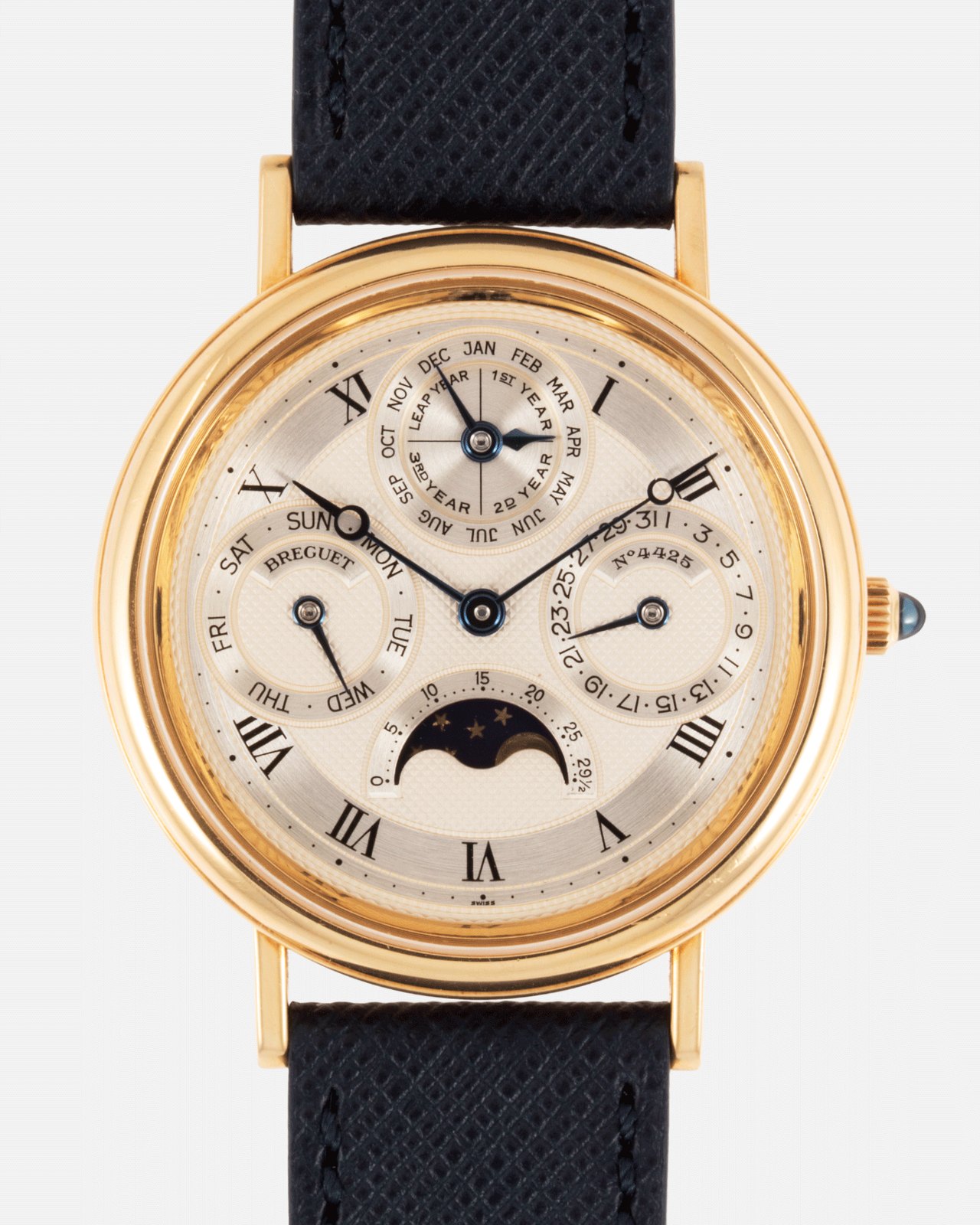
Breguet Classique Perpetual Calendar 3050BA, 1990s
- Maker / attribution
- Breguet (maker)
- Date
- 1990s
- Historical period
- Mechanical Renaissance (1990 – 2010)
- Country of origin
- Switzerland
- Object type
- Wristwatch
- Dimensions
- Case 36 mm
- Stock no.
- Product 6720043876439
- Credit line
- Dealer listing, S.Song Watches (product 6720043876439)
- Catalogue title (original)
- Breguet Classique Perpetual Calendar 3050BA (English)
View the source record (dealer listing) ↗ (opens another website in a new tab)Suggest a correction
Record summary
Catalogued by S.Song Watches (dealer), Seattle (stock number Product 6720043876439), this is a wristwatch by Breguet, made in Switzerland, dated 1990s. The Atlas places it in the Mechanical Renaissance period (1990 – 2010) of its Wristwatches collection. Recorded dimensions: Case 36 mm. The record is illustrated with 6 photographs.
Assembled from the source record's structured fields. Dates and attributions are given as the source states them; where a field is missing the Atlas leaves it blank rather than estimating.
Catalogue description
Dealer description — S.Song Watches
Perhaps one of watchmaking's most overlooked industry titans, few brands can claim as many mechanical innovations and iconic pieces of design as Breguet can. Be it their Breguet hands, Breguet numerals, the tourbillon, the Breguet overcoil, or others, the industry has benefitted tremendously from Breguet's continuous evolution and the Classique Perpetual Calendar 3050BA is emblematic of everything Breguet has come to stand for in the modern watchmaking industry. Starting with the Classique 3050’s design, it is, as its name suggests, classically styled. Featuring a svelte 36mm circular case with a domed bezel and cold-worked coin edge pattern marking its mid-case interrupted only by small pushers, the Classique 3050 exudes a sophisticated aura of craftsmanship and careful design in every facet of its execution. Standing just 8mm tall, this watch is elegant on the wrist and speaks to the nostalgic designs of old. Moving from the case, we find a stunning champagne-tinged silver dial with an incredibly vivid Clous de Paris Guilloche engraved throughout that Breguet's guilloche artisans achieve by hand using a rose lathe. Made from a plate of solid gold, the dial is worked before it is then silvered using a galvanization process to achieve the result as we see it here. As perpetual calendars go, I have to say that it is always a challenge to lay out all of the information but this Breguet 3050 does it fantastically. With a four sub-dial layout, the leap year and month are featured at 12 o’clock, with the day and the date at 9 and 3 o’clock respectively, followed by the Moonphase at 6 o’clock. All of this is framed within a brushed chapter ring that proportionately displays the Roman hour markers. Top this off with the ever-classic blued Breguet hands and what you get is a truly elegant and complicated timepiece. This Breguet Classique 3050BA is a Neo-vintage dress watch at its best. With sports watches going through the roof and taking all the attention, it is always nice to come back to pieces like this to remind you that there is still value out there.
Historical context
Mechanical Renaissance (1990 – 2010)
Mechanical watches return as cultural objects; independent watchmaking flourishes.
Mechanical watches returned as cultural and luxury objects. Complications, tourbillons and new materials proliferated; independent watchmakers such as George Daniels, F.P. Journe and Philippe Dufour revived artisanal watchmaking; collecting vintage watches became a major field.
Read the period in the timelineMore wristwatches from this periodEarlier: Quartz Revolution
Atlas type guide
Calendar, moon-phase and perpetual calendar watches
Calendar complications range from a simple date to the perpetual calendar, which automatically allows for months of different lengths and leap years until 2100. Pocket watches with perpetual calendars were made in the eighteenth and nineteenth centuries; Patek Philippe made the first perpetual calendar wristwatch in 1925, and series production followed in 1941. The annual calendar (Patek Philippe, 1996) needs correction only once a year.
Moon-phase displays use a disc with two moons and 59 teeth advanced daily, approximating the 29.5-day lunation; more precise trains reduce the error to one day in over a century.
What to look for
- Apertures or subsidiary dials for day, date, month and leap year.
- Moon disc under a 'bosom' shaped aperture.
- Recessed correctors on the case band for setting the calendar.
Dating clues
- Triple-date wristwatches: popular c. 1940–1955.
- Perpetual calendar wristwatches: from 1925 (unique) and 1941 (series).
General guidance written by the Atlas editors about this kind of object. It is not a statement about this particular piece; for that, rely on the source record above and on physical examination.
Related records
Pocket Watches · 1700–1799
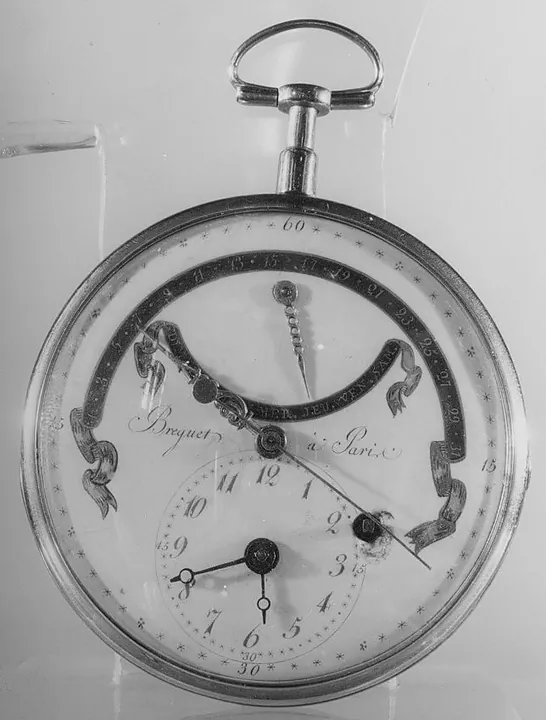
Pocket watch by Breguet, Belgium, 1700–1799
Royal Institute for Cultural Heritage
Pocket Watches · 1700–1799
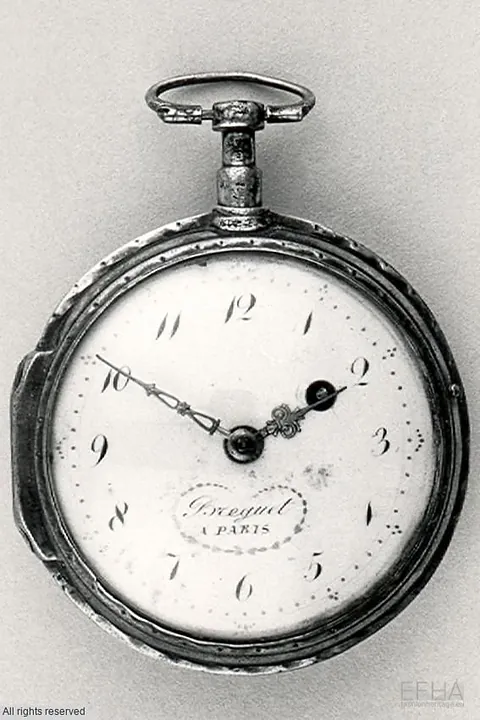
Pocket watch by Breguet, France, 1700–1799
Fashion Museum of Antwerp
Pocket Watches · c. 1790
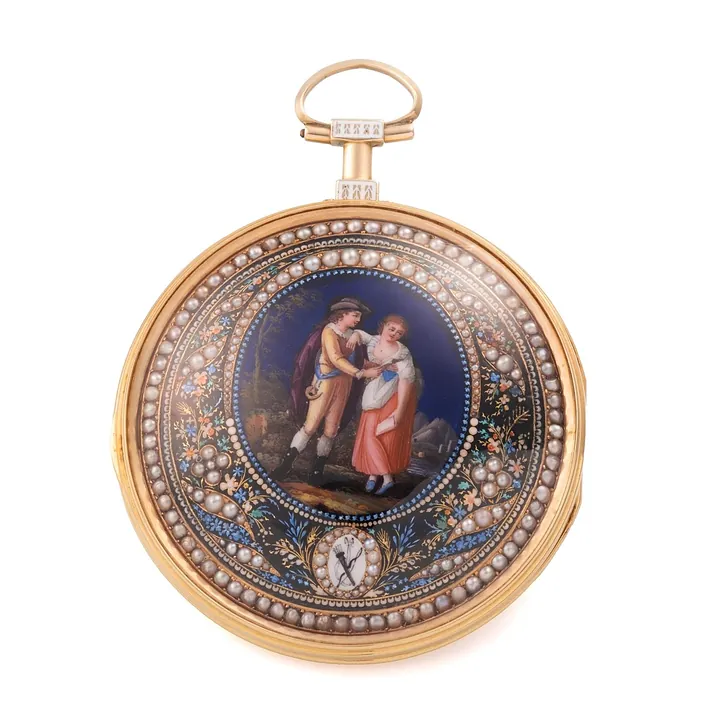
Breguet Love Letter, c. 1790
Antiquorum auction archive, Geneva
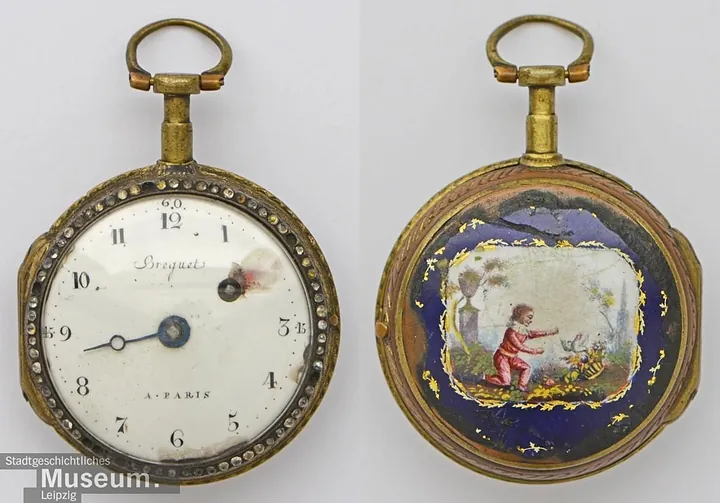
Pocket Watches · 1790
Pocket watch possibly by Breguet, France, 1790
Museum of City History Leipzig

Wristwatches · 2008
Wristwatch by Breitling?, 2008
Museum Rotterdam

Wristwatches · c. 1990s
Audemars Piguet Bamboo, c. 1990s
Antiquorum auction archive, Geneva

Wristwatches · c. 1990
Audemars Piguet Huitieme Perpetual Calendar, ref. 25696PT, c. 1990
Antiquorum auction archive, Geneva

Wristwatches · c. 1990
Breitling Chronomat, ref. b13050.1, c. 1990
Antiquorum auction archive, Geneva