
Clocks · Bracket clock
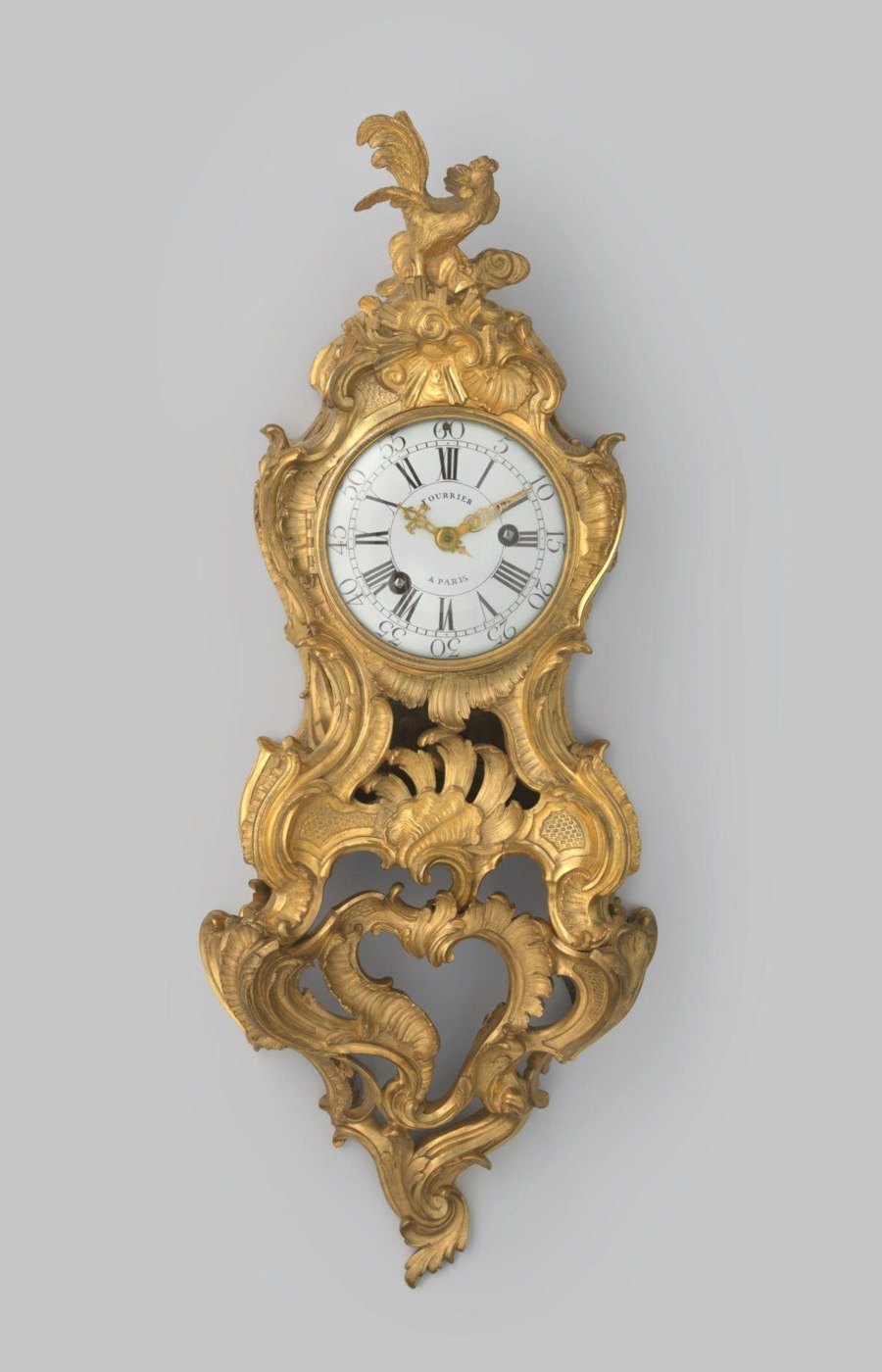
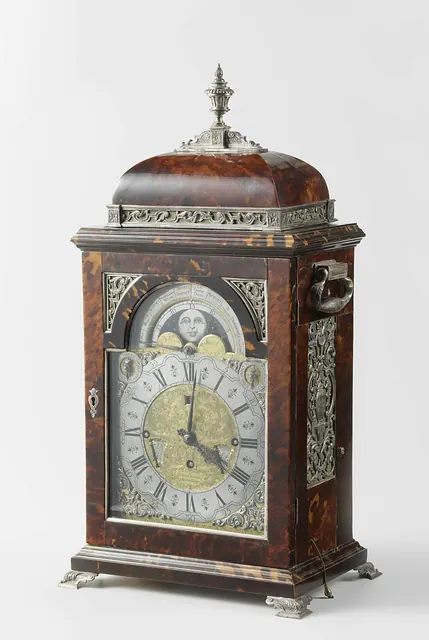
Bracket clock of gilded and chased bronze
- Maker / attribution
- Jean Joseph de Saint-Germain (source attribution (attributed))
- Date
- c. 1745 - c. 1749
- Historical period
- Early Modern Horology (1600 – 1750)
- Country of origin
- Netherlands
- Place
- Amsterdam
- Object type
- Bracket clock
- Dimensions
- 69 cm x 27.5 cm x 15 cm
- Holding institution
- Rijksmuseum
- Accession / object no.
- BK-NM-12289-3
- Credit line
- Rijksmuseum
- Catalogue title (original)
- Bracket clock of gilded and chased bronze, c. 1745–c. 1749 (Rijksmuseum, Amsterdam, BK-NM-12289-3) (English)
View the source record ↗ (opens another website in a new tab)Suggest a correction
Record summary
Held and catalogued by Rijksmuseum (object number BK-NM-12289-3), this is a bracket clock attributed to Jean Joseph de Saint-Germain, made in Amsterdam, Netherlands, dated c. 1745 - c. 1749. The Atlas places it in the Early Modern Horology period (1600 – 1750) of its Clocks collection. Recorded dimensions: 69 cm x 27.5 cm x 15 cm. The record is illustrated with 1 photograph.
Assembled from the source record's structured fields. Dates and attributions are given as the source states them; where a field is missing the Atlas leaves it blank rather than estimating.
Catalogue description
Original object description
Produced in France between circa 1745 and 1749, this bracket clock in chased and gilded bronze stands 69 cm tall, 27.5 cm wide, and 15 cm deep. The asymmetrical rocaille housing, attributed to Jean Joseph de Saint-Germain, rests upon an equilateral triangular bracket fitted with corner C-scrolls and ascending S-volutes of foliate form flanking the dial, pierced lateral diamond-pattern grilles, and a finial grouping showing a crowing cock atop cloud-enshrouded solar rays. The console displays the French 'crowned C' bronze tax stamp in two locations: under the upper right pierced panel and directly on the lower right volute. Its movement is assigned to Fourrier of Paris, with his signature placed on the dial mounting plate as well as the movement's backplate, while the spring carries the uncertain mark 'Richard (?) 785'. Produced by the enameler J. Boullé le Jeune, the white enamel dial is inscribed 'FOURRIER A PARIS'. With support from the Vereniging Rembrandt, the timepiece entered the Rijksmuseum's collection in 1912 under inventory number BK-NM-12289-3.
Historical context
Early Modern Horology (1600 – 1750)
Huygens' pendulum and balance spring transform accuracy; English makers develop the anchor and deadbeat escapements.
Huygens's pendulum (1656–57) improved clock accuracy from about a quarter of an hour to under a minute a day. The anchor escapement (c. 1670) and the long seconds pendulum created the longcase clock; London makers such as Fromanteel, Knibb, Tompion and Quare led European clockmaking, and French makers created the Boulle pendule.
Read the period in the timelineMore clocks from this periodEarlier: Renaissance Horology
Atlas type guide
Bracket, table and spring-driven clocks
Spring-driven clocks freed timekeeping from the hanging weight. The coiled mainspring, documented from the fifteenth century, made portable table clocks possible; to even out its declining force, makers used the fusee, a conical pulley connected to the barrel by a gut line or chain. Renaissance table clocks from Augsburg and Nuremberg — drum-shaped, square or tower-shaped in gilt brass — were luxury scientific objects, often with astronomical dials and alarms.
After the pendulum, English makers developed the bracket clock: a wooden case with a carrying handle, a short pendulum with a verge escapement, and often repeating work to sound the hours on demand at night. Later examples use the anchor escapement. In the nineteenth century, 'table clock' became a broad term for spring clocks of every nationality.
What to look for
- A fusee in the movement (cone-shaped pulley) and the type of line — gut or chain.
- Verge escapement with a short bob pendulum, often with a decoratively engraved backplate.
- Repeat cords or buttons that make the clock strike again on demand.
- Gilt-brass engraved cases and horizontal dials on Renaissance pieces.
- Case shapes: inverted bell, bell top, break-arch, lancet or balloon.
Dating clues
- Drum and tower table clocks: c. 1520–1650.
- Ebony veneered English bracket clocks with verge escapements: c. 1670–1800.
- Engraved backplates were usual on English clocks until c. 1800, then generally plain.
General guidance written by the Atlas editors about this kind of object. It is not a statement about this particular piece; for that, rely on the source record above and on physical examination.
Related records
Clocks · 1650
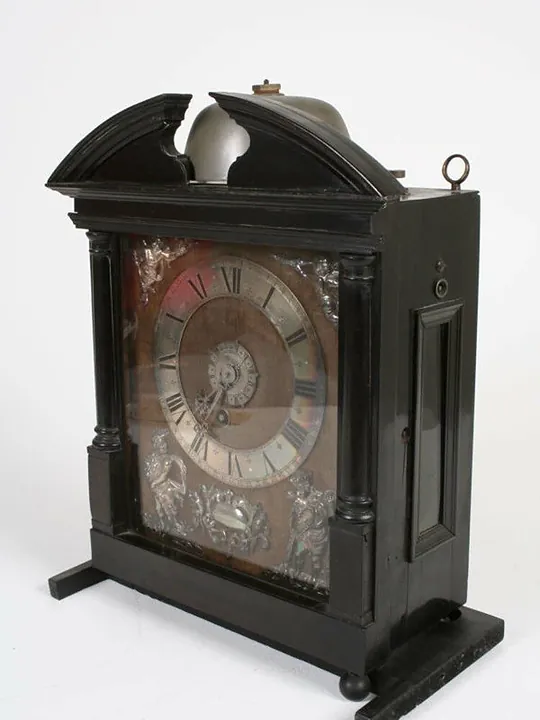
Clock by J.J. van Leeuwaarden, Netherlands, 1650
City Museum Zutphen
Clocks · 1680
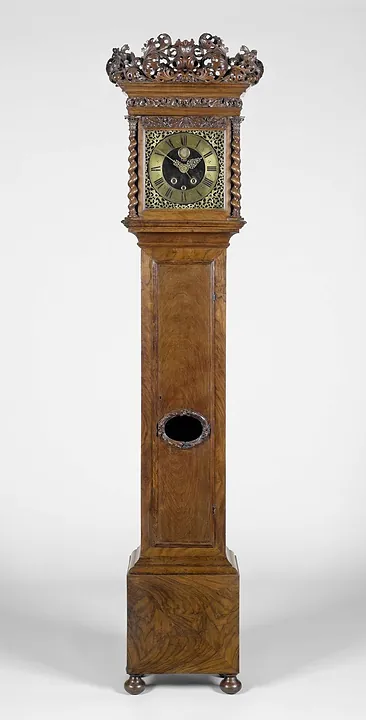
Longcase clock, Netherlands, 1680
Rijksmuseum
Clocks · c. 1690–94
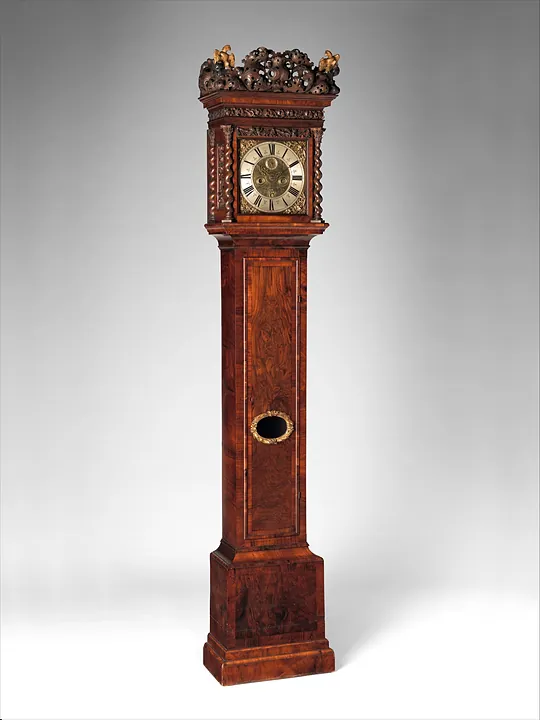
Longcase clock, movement by Ahasuerus II Fromanteel, Netherlands, c. 1690–94
The Metropolitan Museum of Art, New York
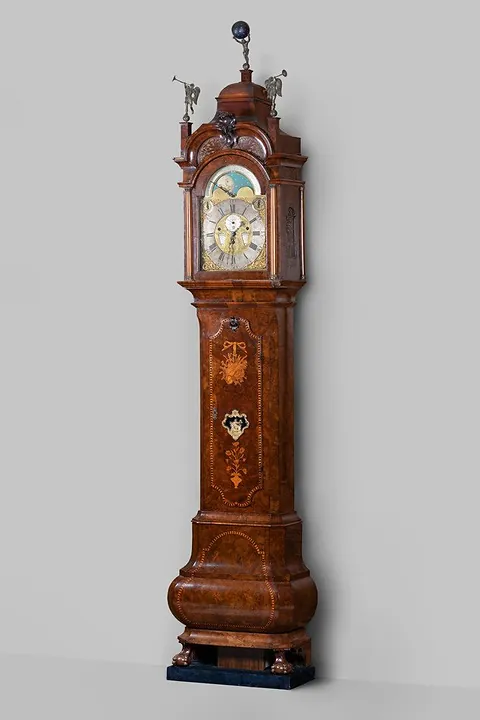
Clocks · 1715
Longcase clock by Paulus Bramer, Netherlands, 1715
Geldersch Landschap & Kasteelen
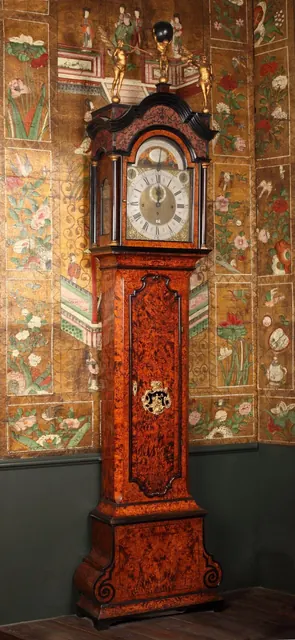
Clocks · 1715–1725
Longcase clock by Roger Dunster, Netherlands, 1715–1725
Victoria and Albert Museum, London
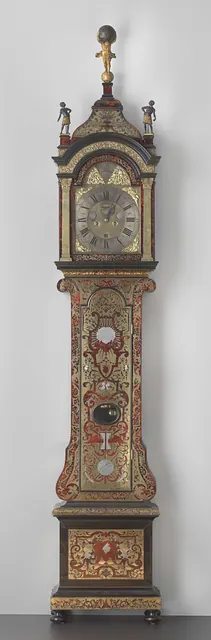
Clocks · c.1715 - c.1725
Longcase clock
Rijksmuseum
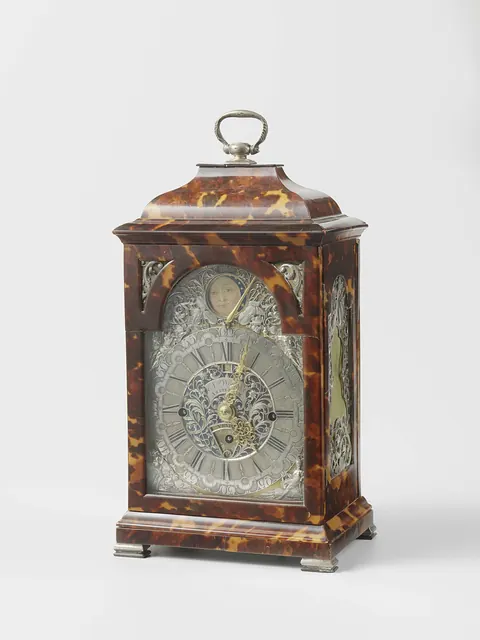
Clocks · c.1730 - c.1750
Mechanical clock, Netherlands, c.1730 - c.1750
Rijksmuseum
Clocks · c.1700 - c.1725
Furniture, Netherlands, c.1700 - c.1725
Rijksmuseum