
Clocks · Bracket clock
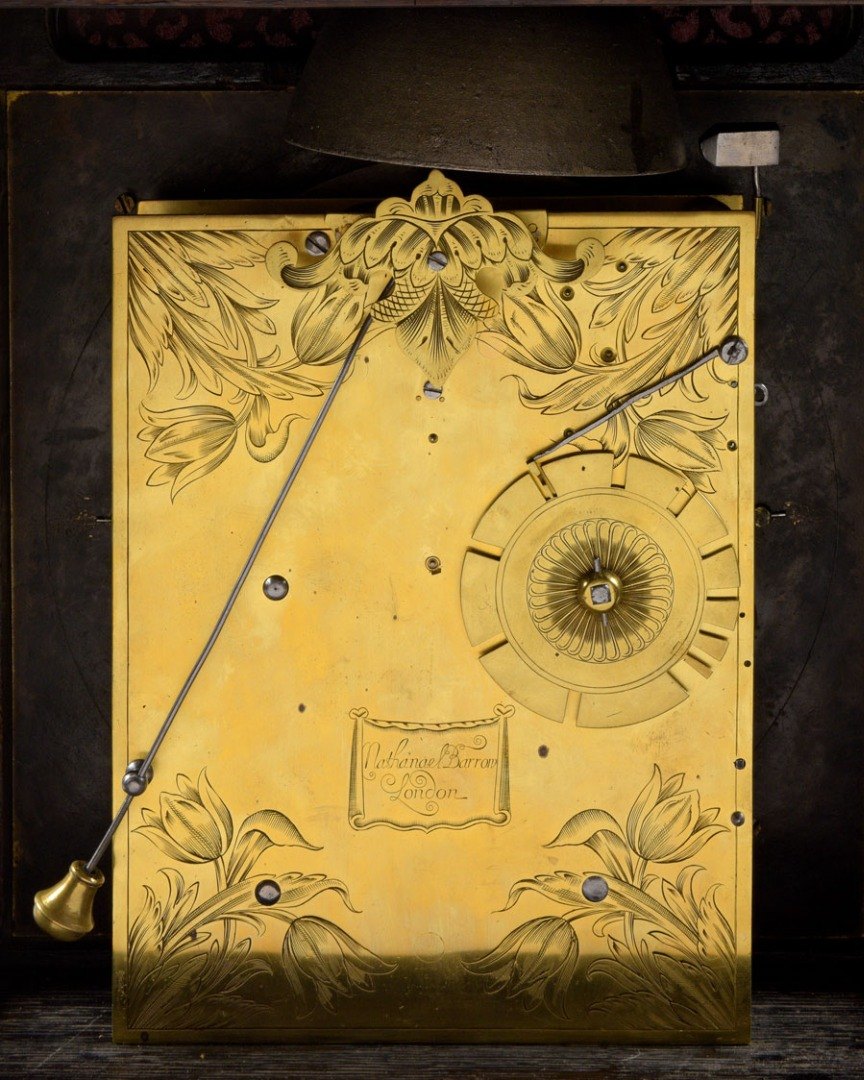
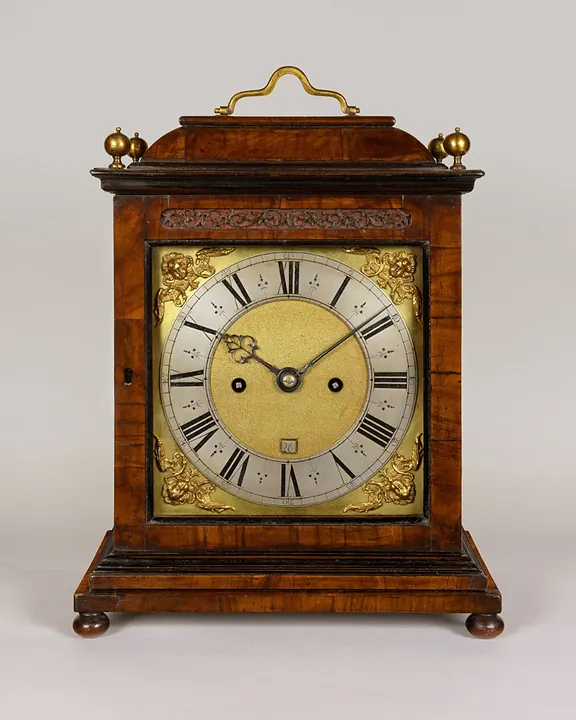
Bracket clock by Nathanael Barrow, London, c. 1675
- Maker / attribution
- Nathanael Barrow (maker)
- Date
- c. 1675
- Historical period
- Early Modern Horology (1600 – 1750)
- Country of origin
- England
- Place
- London
- Object type
- Bracket clock
- Dimensions
- Height 43.5 cm
- Stock no.
- SKU 417
- Credit line
- Dealer listing, Howard Walwyn (SKU 417)
- Catalogue title (original)
- NATHANAEL BARROW. A rare James II period olivewood table clock. (English)
View the source record (dealer listing) ↗ (opens another website in a new tab)Suggest a correction
Record summary
Catalogued by Howard Walwyn Fine Antique Clocks (dealer), London (stock number SKU 417), this is a bracket clock by Nathanael Barrow, made in London, England, dated c. 1675. The Atlas places it in the Early Modern Horology period (1600 – 1750) of its Clocks collection. Recorded dimensions: Height 43.5 cm. The record is illustrated with 1 photograph.
Assembled from the source record's structured fields. Dates and attributions are given as the source states them; where a field is missing the Atlas leaves it blank rather than estimating.
Catalogue description
Dealer description — Howard Walwyn
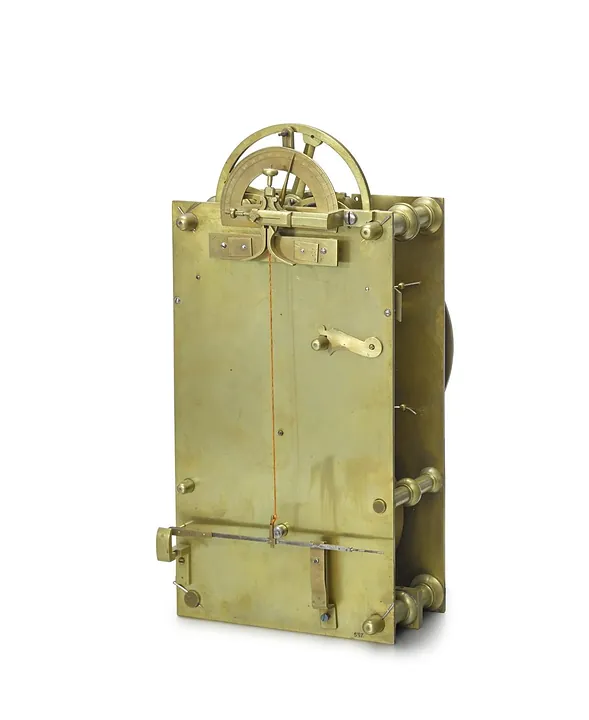
A rare James II period olivewood table clock with its original turntable base by this fine early maker. The eight day movement which strikes the hours on a single bell on an outside countwheel has a verge escapement and short bob pendulum. The beautiful fire gilt 9 inch dial has the early type of winged cherub corner spandrels and a chapter ring with narrow inside quarter marker band and a similar outer band for the minutes. The blued steel hands are finely wrought and facetted. The date work is inset above VI o’ clock. The elegant shallow dome top case is constructed primarily of cariniana wood and veneered with highly patinated olivewood and ebonised mouldings. It sits on its original turntable base. The square dial is surmounted by a finely pierced wooden fret to the entablature. The shallow top has a and four turned brass ball finials. The superb backplate and apron are exquisitely engraved with tulips and foliage which are typical of the best engravers’ work of the early period. The maker’s signature Nathanael Barrow London is also inscribed within a beautiful lambrequin on the backplate. Height : 17 in (43.5 cm) excl. handle & including turntable Height of case : 15 ½ in (39.5 cm) Width : 13 ¾ in (35 cm) including turntable Width of case : 12 ¾ in (32.5 cm) Depth : 8 ½ in (22 cm) including turntable Depth of clock : 7 ½ in (19 cm) * Nathanael Barrow was born circa 1639 and served his apprenticeship with John Betts from 1653 until 1660 when he was ‘freed’ of The Clockmakers’ Company . He had his own workshops until his death in 1700. In 1685 he was made Warden of the Clockmakers’ Company and in 1689 he became Master. Early turntable clocks were only made over a very short period and this example is a rare survivor particularly due to the fact that its turntable is original. HW6055
Historical context
Early Modern Horology (1600 – 1750)
Huygens' pendulum and balance spring transform accuracy; English makers develop the anchor and deadbeat escapements.
Huygens's pendulum (1656–57) improved clock accuracy from about a quarter of an hour to under a minute a day. The anchor escapement (c. 1670) and the long seconds pendulum created the longcase clock; London makers such as Fromanteel, Knibb, Tompion and Quare led European clockmaking, and French makers created the Boulle pendule.
Read the period in the timelineMore clocks from this periodEarlier: Renaissance Horology
Atlas type guide
Bracket, table and spring-driven clocks
Spring-driven clocks freed timekeeping from the hanging weight. The coiled mainspring, documented from the fifteenth century, made portable table clocks possible; to even out its declining force, makers used the fusee, a conical pulley connected to the barrel by a gut line or chain. Renaissance table clocks from Augsburg and Nuremberg — drum-shaped, square or tower-shaped in gilt brass — were luxury scientific objects, often with astronomical dials and alarms.
After the pendulum, English makers developed the bracket clock: a wooden case with a carrying handle, a short pendulum with a verge escapement, and often repeating work to sound the hours on demand at night. Later examples use the anchor escapement. In the nineteenth century, 'table clock' became a broad term for spring clocks of every nationality.
What to look for
- A fusee in the movement (cone-shaped pulley) and the type of line — gut or chain.
- Verge escapement with a short bob pendulum, often with a decoratively engraved backplate.
- Repeat cords or buttons that make the clock strike again on demand.
- Gilt-brass engraved cases and horizontal dials on Renaissance pieces.
- Case shapes: inverted bell, bell top, break-arch, lancet or balloon.
Dating clues
- Drum and tower table clocks: c. 1520–1650.
- Ebony veneered English bracket clocks with verge escapements: c. 1670–1800.
- Engraved backplates were usual on English clocks until c. 1800, then generally plain.
General guidance written by the Atlas editors about this kind of object. It is not a statement about this particular piece; for that, rely on the source record above and on physical examination.
Read next:FuseeAnchor (recoil) escapement
Related records
Clocks · c. 1675
Bracket clock by Nathanael Barrow, London, c. 1675
Howard Walwyn Fine Antique Clocks (dealer), London
Clocks · 1598–1603
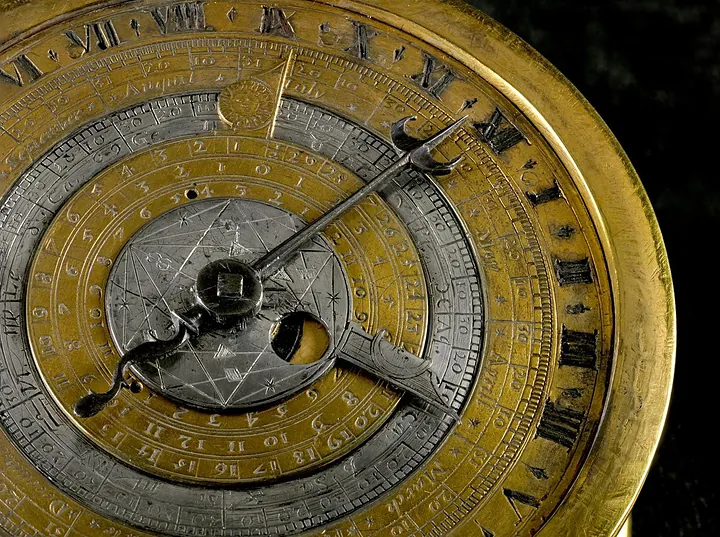
Circular table-clock with calendrical and lunar indications made by Nicholas Vallin in London between 1598 and 1603.
Science Museum Group, London
Clocks · 1611
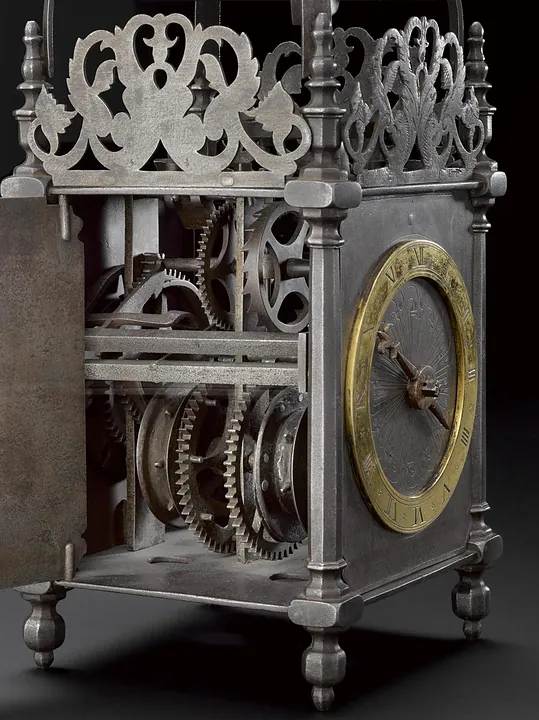
English iron lantern clock, with wheel balance, by John Holloway, Market Lavington, Wiltshire, England, 1611.
Science Museum Group, London
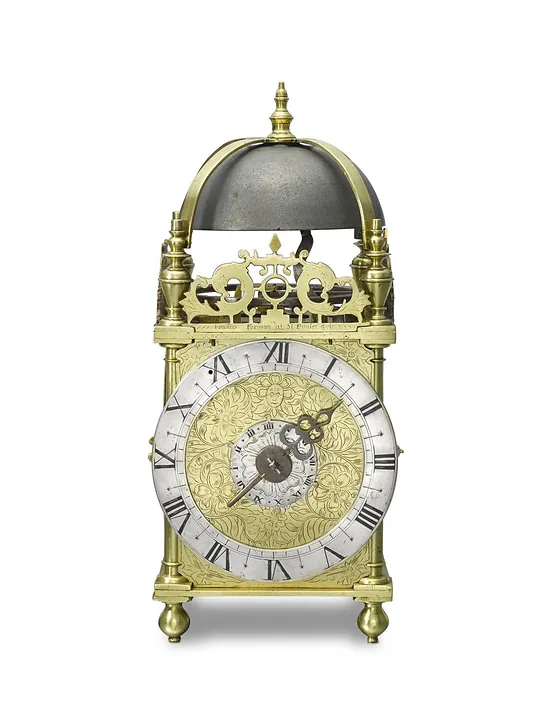
Clocks · 1630
Lantern clock by Francis Forman, England, 1630
Science Museum Group, London
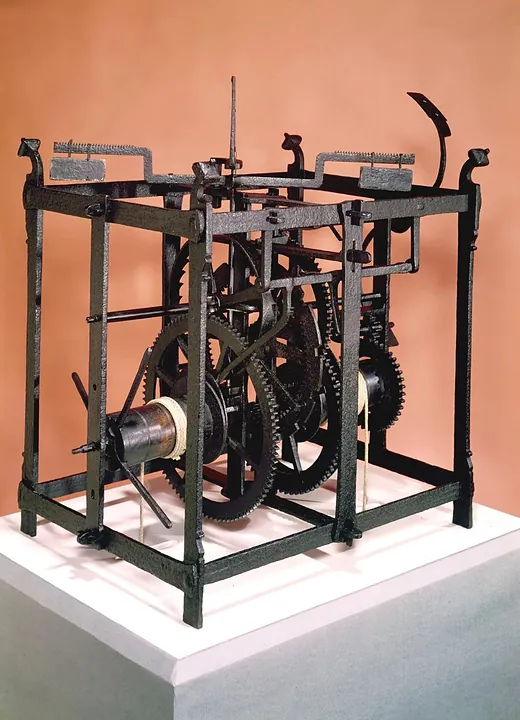
Clocks · 1632–1640
Turret clock, England, 1632–1640
Science Museum Group, London
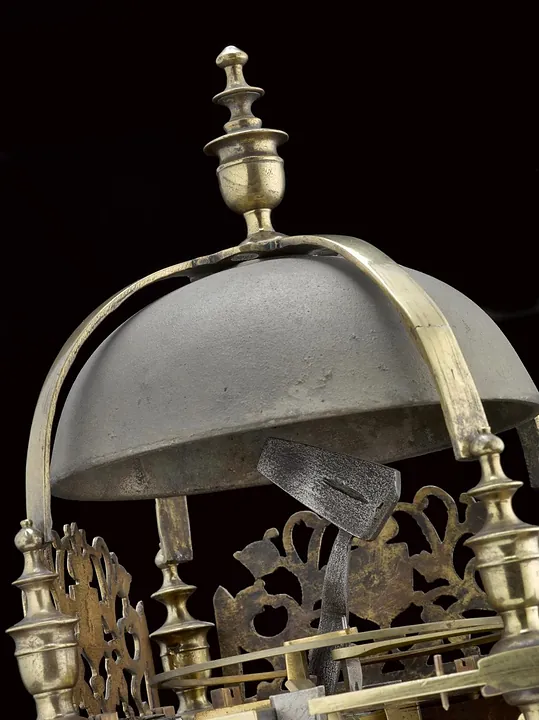
Clocks · 1645–1655
Balance-wheel brass lantern clock, with two driving weights and one counterweight, by Thomas Knifton, Cross Keys, Lothbury, London, England, 1645–1655.
Science Museum Group, London
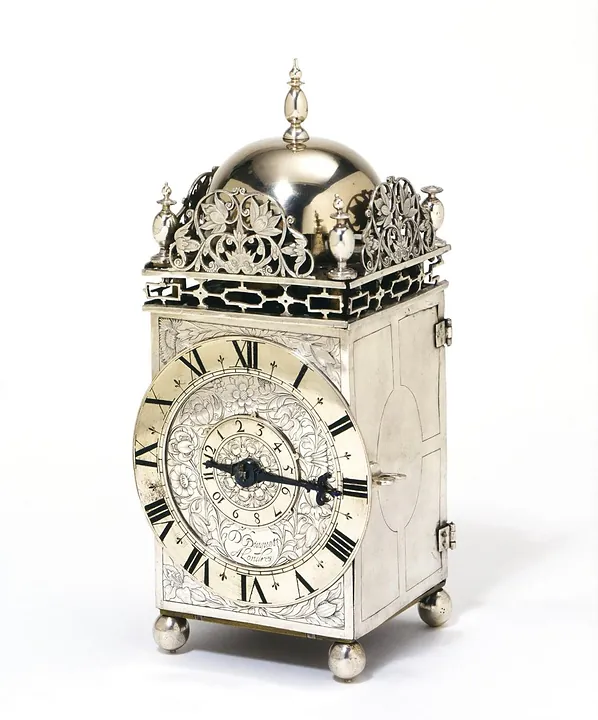
Clocks · c. 1650
Lantern alarm clock, silver, by David Bouquet, circa 1650
Victoria and Albert Museum, London
Clocks · 1650–1660
Lantern clock by Peter Closon, England, 1650–1660
Science Museum Group, London