
Wristwatches · Calendar watch
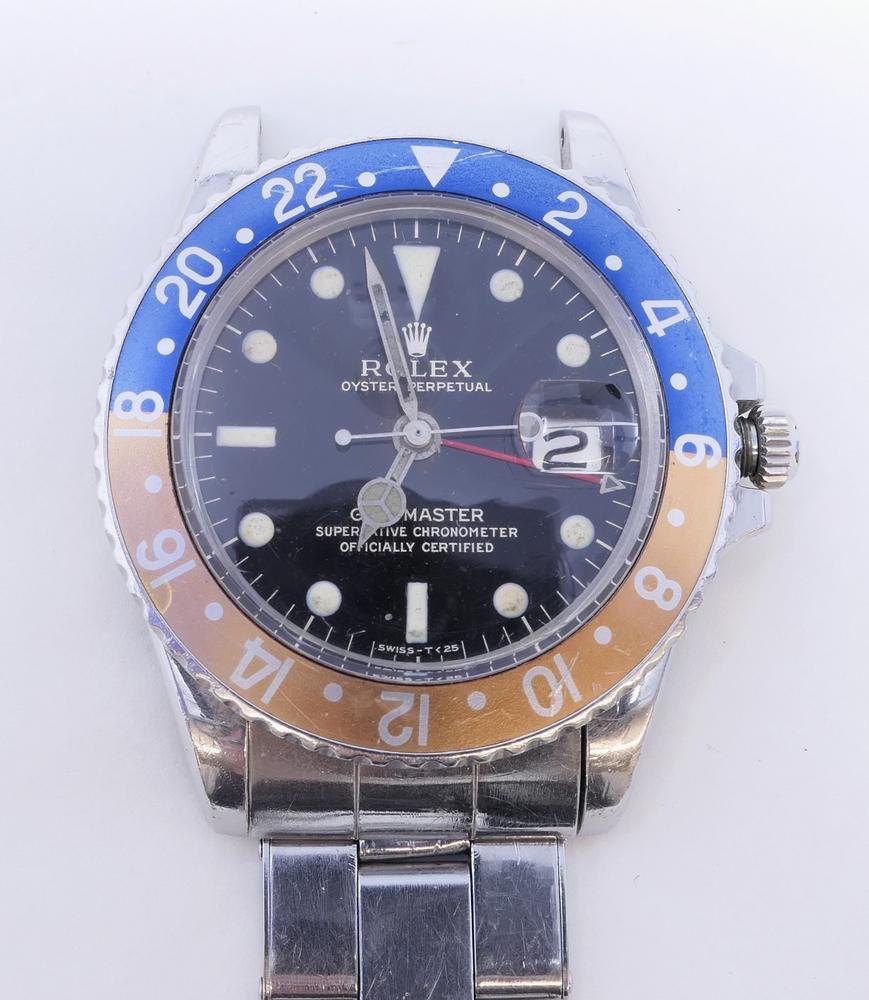
Automatic waterproof centre-seconds wrist-watch with date mechanism
- Maker / attribution
- Rolex (Made by)
- Date
- 1966–1967
- Historical period
- Modern Mechanical Horology (1945 – 1969)
- Country of origin
- Switzerland
- Place
- Geneva (city)
- Object type
- Calendar watch
- Materials / technique
- stainless steel
- Dimensions
- Diameter: 39.40 millimetres (case) Diameter: 29.50 millimetres (dial) Length: 255 millimetres (bracelet) Thickness: 13.50 millimetres Width: 17.50 millimetres (bracelet)
- Holding institution
- British Museum
- Accession / object no.
- 1988,1013.3
- Credit line
- British Museum, London
- Catalogue title (original)
- Automatic waterproof centre-seconds wrist-watch with date mechanism (English)
View the source record ↗ (opens another website in a new tab)Suggest a correction
Record summary
Held and catalogued by British Museum (object number 1988,1013.3), this is a calendar watch by Rolex, made in Geneva (city), Switzerland, dated 1966–1967. The Atlas places it in the Modern Mechanical Horology period (1945 – 1969) of its Wristwatches collection. Materials and techniques recorded by the source: stainless steel. Recorded dimensions: Diameter: 39.40 millimetres (case) Diameter: 29.50 millimetres (dial) Length: 255 millimetres (bracelet) Thickness: 13.50 millimetres Width: 17.50 millimetres (bracelet). The record is illustrated with 6 photographs.
Assembled from the source record's structured fields. Dates and attributions are given as the source states them; where a field is missing the Atlas leaves it blank rather than estimating.
Catalogue description
Description — British Museum
Automatic waterproof centre-seconds wrist-watch with date mechanism Stainless-steel case with screw-on back. Stainless-steel bracelet. Black dial with luminous-painted hour markers; triangle at 12, bars at 6 and 9 and dots for remainder; rectangular date aperture at 3 o'clock; around outside a rotating ring, manually operated, calibrated for 24 hours.Luminous-painted hour, minute and centre-seconds hands. Movement, 26 jewels, rotary automatic winding and club-tooth lever escapement.
Curator's comments — British Museum
The Rolex GMT Master wristwatch, (this version sometimes known as the 'pepsi' watch, for its red and blue bezel). This watch was originally released in 1954, and is said to have been designed in collaboration with Pan AmericanAirways, and issued to crews of long haul flights. The rotating bezel makes the watch ideal for use with multiple time zone.
Inscriptions & marks
inscription; MONTRES ROLEX SA GENEVA SWITZERLAND PATENTED STAINLESS STEEL 1675 11.6 [case]; inscription; ROLEX OYSTER PERPETUAL GMT-MASTER SUPERLATIVE CHRONOMETER OFFICIALLY CERTIFIED SWISS -T<25 [dial]; inscription; MONTRES ROLEX S.A. TWENTY-SIX 26 JEWELS ADJUSTED 5 POSITIONS AND TEMPERATURE SWISS 1570 [back-plate]; mark; D35913 RB [front-plate]; mark; ROLEX USA C*I 1-71 [bracelet clasp]; inscription; edge of case, near 12 o'clock; REGISTERED DESIGN; 1675; inscription; edge of case, near 6 o'clock; 1594907; Serial Number; Top part of numeral '5' is missing, slim chance it could be a '3'
Provenance
Purchased from:, James Dowling
Historical context
Modern Mechanical Horology (1945 – 1969)
Tool watches for divers, pilots and astronauts; electric watches anticipate the electronic age.
The classic era of the mechanical wristwatch: dive watches, chronographs for motor racing and space flight, GMT watches for jet travel, slim dress watches, automatic calendars, and the rise of Japanese manufacturers alongside Swiss, American, German and Soviet industries.
Read the period in the timelineMore wristwatches from this periodEarlier: Golden Age of Mechanical Watchmaking
Atlas type guide
Calendar, moon-phase and perpetual calendar watches
Calendar complications range from a simple date to the perpetual calendar, which automatically allows for months of different lengths and leap years until 2100. Pocket watches with perpetual calendars were made in the eighteenth and nineteenth centuries; Patek Philippe made the first perpetual calendar wristwatch in 1925, and series production followed in 1941. The annual calendar (Patek Philippe, 1996) needs correction only once a year.
Moon-phase displays use a disc with two moons and 59 teeth advanced daily, approximating the 29.5-day lunation; more precise trains reduce the error to one day in over a century.
What to look for
- Apertures or subsidiary dials for day, date, month and leap year.
- Moon disc under a 'bosom' shaped aperture.
- Recessed correctors on the case band for setting the calendar.
Dating clues
- Triple-date wristwatches: popular c. 1940–1955.
- Perpetual calendar wristwatches: from 1925 (unique) and 1941 (series).
General guidance written by the Atlas editors about this kind of object. It is not a statement about this particular piece; for that, rely on the source record above and on physical examination.
Related records

Movements & Components · c. 1970s
Rolex watch movement, c. 1970s
Antiquorum auction archive, Geneva

Pocket Watches · 1982
Fake Rolex watch, gold coloured metal, possibly made in Taiwan, 1982; part of a casual outfit, UK, 1982-84.
Victoria and Albert Museum, London

Wristwatches · c. 1920s
Rolex wristwatch, c. 1920s
Antiquorum auction archive, Geneva

Wristwatches · c. 1920s
Rolex wristwatch, ref. 6194, c. 1920s
Antiquorum auction archive, Geneva

Wristwatches · 1945
Wristwatch by Eterna, 1945
Museum Rotterdam

Wristwatches · c. 1945
Breitling Premier, ref. 790, c. 1945
Antiquorum auction archive, Geneva

Wristwatches · c. 1945
Universal Genève Uni-Compax, ref. 22492, c. 1945
Antiquorum auction archive, Geneva

Wristwatches · c. 1950s
Baume & Mercier wristwatch, c. 1950s
Antiquorum auction archive, Geneva