
Wristwatches · Wristwatch
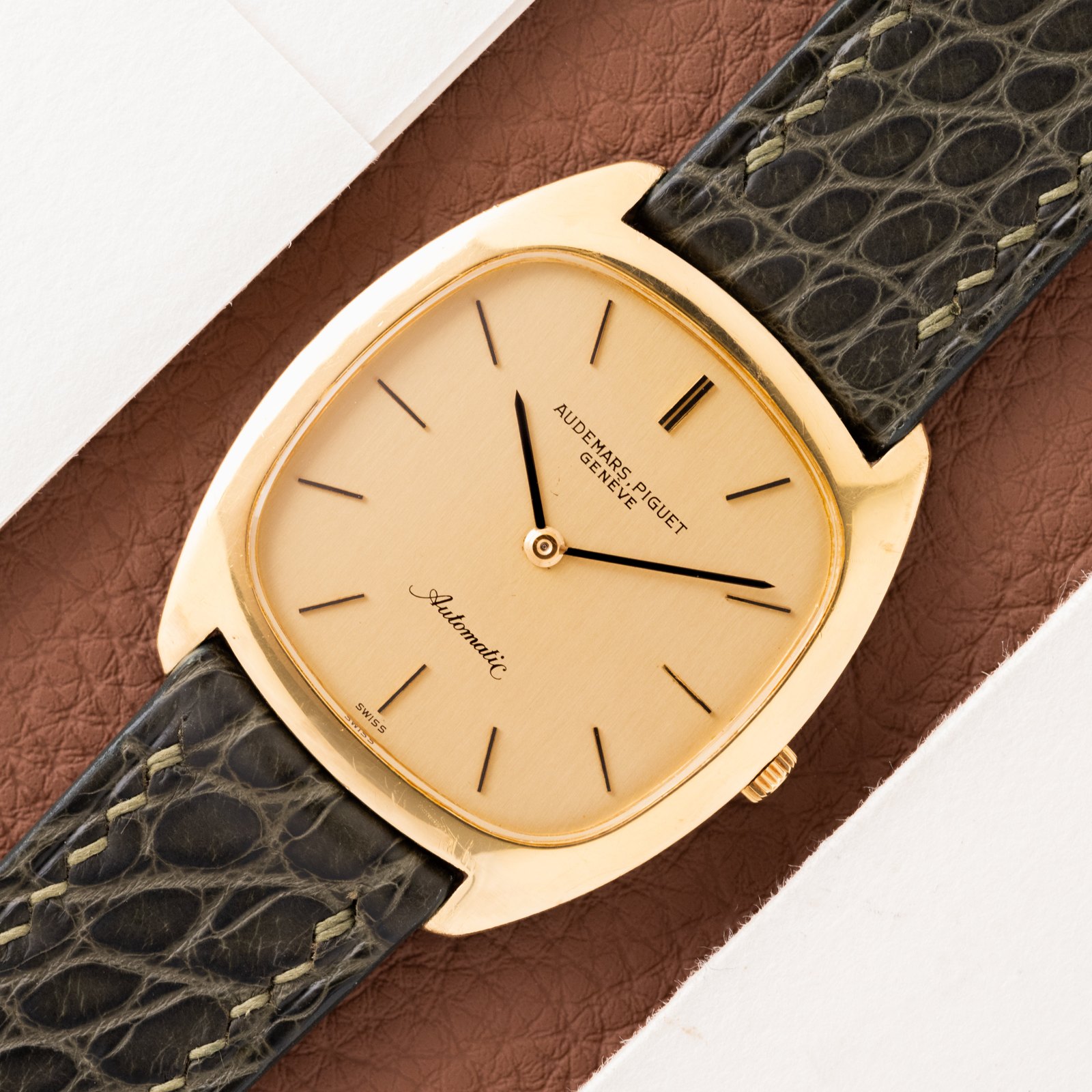
Audemars Piguet Tonneau Automatic Yellow Gold (Ref. BA 5279), 1973
- Maker / attribution
- Audemars Piguet (maker)
- Date
- 1973
- Historical period
- Quartz Revolution (1969 – 1990)
- Country of origin
- Switzerland
- Object type
- Wristwatch
- Materials / technique
- yellow gold
- Dimensions
- Case 32 mm
- Stock no.
- Product 15887217721527
- Credit line
- Dealer listing, Huntington Company (product 15887217721527)
- Catalogue title (original)
- 1973 Audemars Piguet Tonneau Automatic Yellow Gold - Papers (Ref. BA 5279) (English)
View the source record (dealer listing) ↗ (opens another website in a new tab)Suggest a correction
Record summary
Catalogued by Huntington Company (dealer) (stock number Product 15887217721527), this is a wristwatch by Audemars Piguet, made in Switzerland, dated 1973. The Atlas places it in the Quartz Revolution period (1969 – 1990) of its Wristwatches collection. Materials and techniques recorded by the source: yellow gold. Recorded dimensions: Case 32 mm. The record is illustrated with 6 photographs.
Assembled from the source record's structured fields. Dates and attributions are given as the source states them; where a field is missing the Atlas leaves it blank rather than estimating.
Catalogue description
Dealer description — Huntington Company
History and Significance 1973 was an extraordinary time for Audemars Piguet. Just one year earlier, the manufacturer had introduced the Royal Oak, a watch that would fundamentally change the direction of luxury watchmaking. Yet alongside that revolutionary stainless steel sports watch, Audemars Piguet continued producing some of the most interesting traditional dress watches of the period. These watches rarely receive the same attention as the Royal Oak, despite sharing much of the manufacturer's technical expertise and creative approach to design. The reference BA5279 is a fascinating example of this lesser-known side of Audemars Piguet, combining an unusual yellow gold case with one of the most important automatic movements of the twentieth century. The caliber K2120 is central to the appeal of the reference 5279. Based on the Jaeger-LeCoultre caliber 920 ébauche, the movement was developed during an era when manufacturers were competing to create increasingly thin automatic calibers. Its construction incorporates a full-sized winding rotor supported by a peripheral roller system, allowing the movement to maintain an exceptionally slim profile without sacrificing the advantages of automatic winding. The movement became closely associated with some of the most celebrated watches of the period, including the original Audemars Piguet Royal Oak and the Patek Philippe Nautilus, which used related versions of the same movement architecture. Vacheron Constantin also employed the caliber family in several important references. Few automatic movements have enjoyed such a distinguished history across multiple prestigious manufacturers. What makes the reference 5279 particularly interesting is the way Audemars Piguet used this sophisticated movement in a watch that looks nothing like the Royal Oak. The yellow gold case follows a broad cushion-shaped design, with softly rounded corners and substantial surfaces surrounding the dial. Its architecture is distinctly characteristic of the early 1970s, when manufacturers were exploring unconventional shapes that departed from the restrained round dress watches of previous decades. The relatively compact 32mm measurement tells only part of the story, as the broad case design creates a considerably stronger visual presence than the dimensions suggest. The dial provides a beautiful contrast to the more expressive case. Finished in a warm champagne tone, it incorporates a finely brushed surface, slender applied hour markers, and understated hands. There is very little unnecessary decoration, allowing the relationship between the dial and the surrounding gold case to define the watch's appearance. The automatic designation is discreetly positioned beneath the Audemars Piguet signature, offering a subtle reference to the exceptional movement inside. This combination of an unconventional exterior and restrained dial design is one of the most appealing characteristics of Audemars Piguet's dress watches from the period. Writer’s Thoughts The reference 5279 is a wonderful reminder that some of the most interesting vintage Audemars Piguet watches have little resemblance to the Royal Oak. The broad yellow gold case has an unmistakable 1970s personality, with its soft cushion shape and substantial surfaces creating a watch that feels considerably larger than 32mm. There is something particularly attractive about the contrast between that expressive case and the simplicity of the champagne dial. The watch has a strong visual identity without relying on a complicated display or elaborate decoration. The caliber K2120 makes the reference even more compelling. A movement associated with some of the most historically important luxury sports watches of the twentieth century is housed inside a remarkably different interpretation of Audemars Piguet's design philosophy. That contrast is part of what makes these lesser-known references so enjoyable to discover. The same technical achievement that helped make the original Royal Oak possible was also being used in elegant gold dress watches with entirely different personalities. For collectors interested in the manufacturer's history beyond its most recognizable collection, the reference 5279 offers an especially rewarding perspective. Our Promise Every watch is thoroughly vetted, carefully described with complete transparency, and guaranteed authentic. Each piece is offered in honest condition, ensuring collectors receive a timepiece that reflects both originality and integrity. Specifications Brand: Audemars Piguet Model: Automatic Cushion Case Reference: BA 5279 Year: 1973 Case Material: 18k Yellow Gold Case Size: 32mm Dial: Champagne Brushed Dial with Applied Gold Hour Markers Movement: Audemars Piguet Caliber K2120, Automatic Strap/Buckle: Alligator Leather Strap Buckle/Clasp: Generic Pin Buckle Contents: Watch and Papers Condition Case: Yellow gold case remains in beautiful vintage condition with light surface wear consistent with age and use. The broad cushion-shaped case retains attractive definition. Dial: Champagne dial remains in excellent condition with well-preserved brushed finishing, applied hour markers, and clear printing. Some marks on the dial are only noticeable in certain light. Hands: Gold hands remain in good condition with light aging consistent with the watch. Crystal: Crystal remains in good condition with light surface wear. Strap/Buckle: Olive alligator leather strap is new. Buckle/Clasp: Pin buckle is new.
Historical context
Quartz Revolution (1969 – 1990)
Seiko's Astron begins mass quartz timekeeping; traditional industries contract sharply.
Quartz and digital watches transformed the market after 1969. Swiss employment collapsed, Japanese and Hong Kong production soared, and the Swatch (1983) helped the Swiss industry recover; mechanical watches survived as luxury goods.
Read the period in the timelineMore wristwatches from this periodEarlier: Modern Mechanical Horology
Atlas type guide
Automatic (self-winding) watches
Self-winding watches use the wearer's motion to wind the mainspring. Abraham-Louis Perrelet and Breguet made 'perpétuelle' pocket watches with oscillating weights in the late eighteenth century, but the principle only became practical in the wristwatch. John Harwood patented a bumper automatic in 1923; Rolex's Perpetual rotor (1931) winding in one direction, and later bidirectional rotors (Eterna, Felsa Bidynator), established the modern form. Micro-rotors (Universal Genève, Buren) and peripheral rotors made automatic watches thinner.
What to look for
- A semicircular rotor turning 360° over the movement, or a 'bumper' weight that rebounds between springs.
- 'Automatic', 'Perpetual' or 'Self-winding' on the dial.
- A sealed screw-back case, since automatic watches are wound less often by the crown.
Dating clues
- Bumper automatics: 1923–c. 1955.
- Full rotors: from 1931 (Rolex); widespread after c. 1950.
- Micro-rotors: from 1954–1958.
General guidance written by the Atlas editors about this kind of object. It is not a statement about this particular piece; for that, rely on the source record above and on physical examination.
Related records
Clocks · c. 1990s
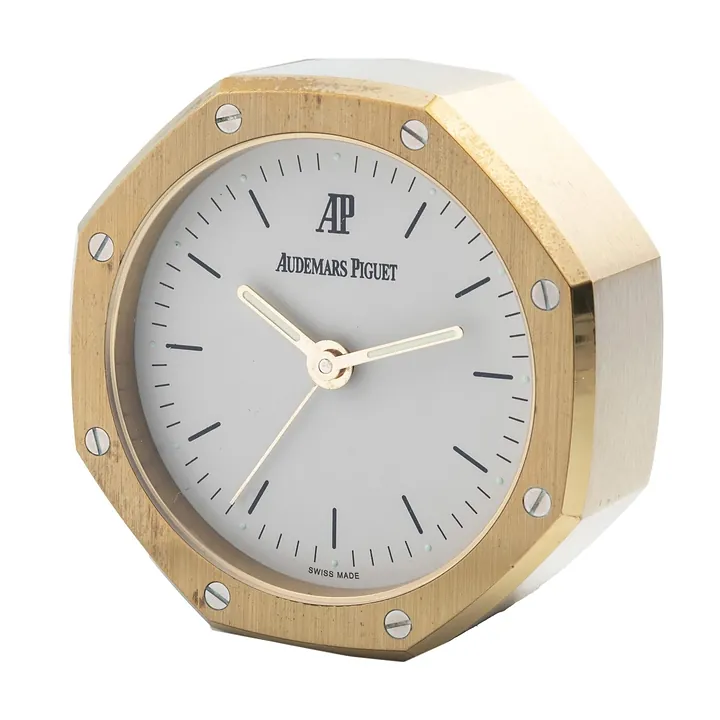
Audemars Piguet Royal Oak, c. 1990s
Antiquorum auction archive, Geneva
Pocket Watches · c. 1960
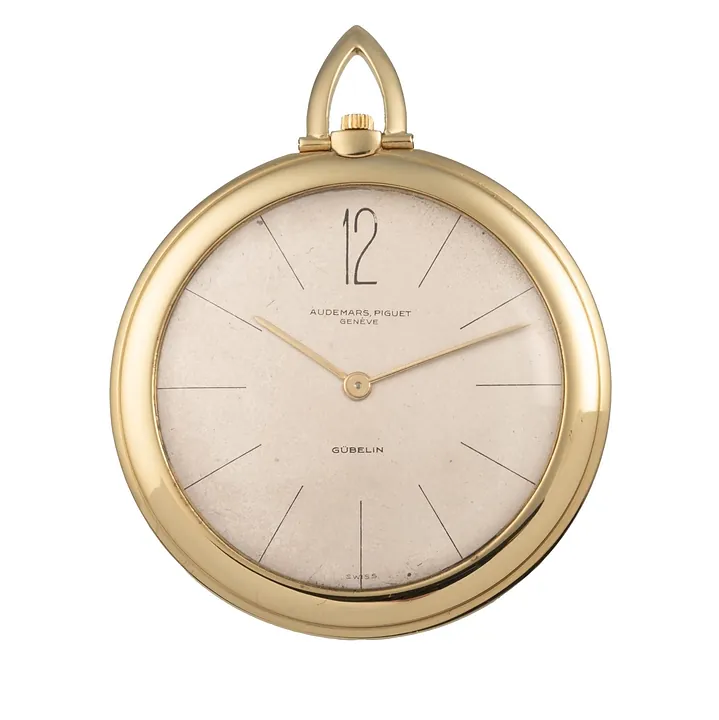
Audemars Piguet ''couteau'', c. 1960
Antiquorum auction archive, Geneva
Pocket Watches · originally sold in November 1961 (per the lot record)
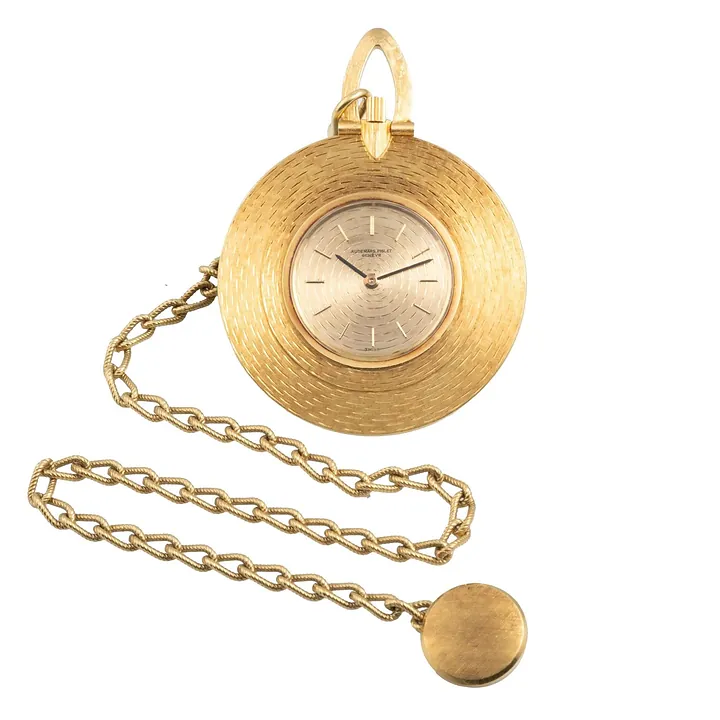
Audemars Piguet "extra Plate", ref. 5633 BA, originally sold in November 1961
Antiquorum auction archive, Geneva
Pocket Watches · c. 1980
Audemars Piguet pocket watch, c. 1980
Antiquorum auction archive, Geneva

Wristwatches · 1970
Wristwatch by Heno, Switzerland, 1970
Museum Rotterdam

Wristwatches · 1960–1986
'Tri-Compax' calendar chronograph wristwatch in gold case, by Universal, Geneva, Switzerland, 1960–1986.
Science Museum Group, London

Wristwatches · 1969–1970
Beta 21 Quartz wristwatch movement, made in Switzerland, 1970.
Science Museum Group, London

Wristwatches · c. 1969
Omega Speedmaster Moonwatch, ref. 145022-69st, c. 1969
Antiquorum auction archive, Geneva