
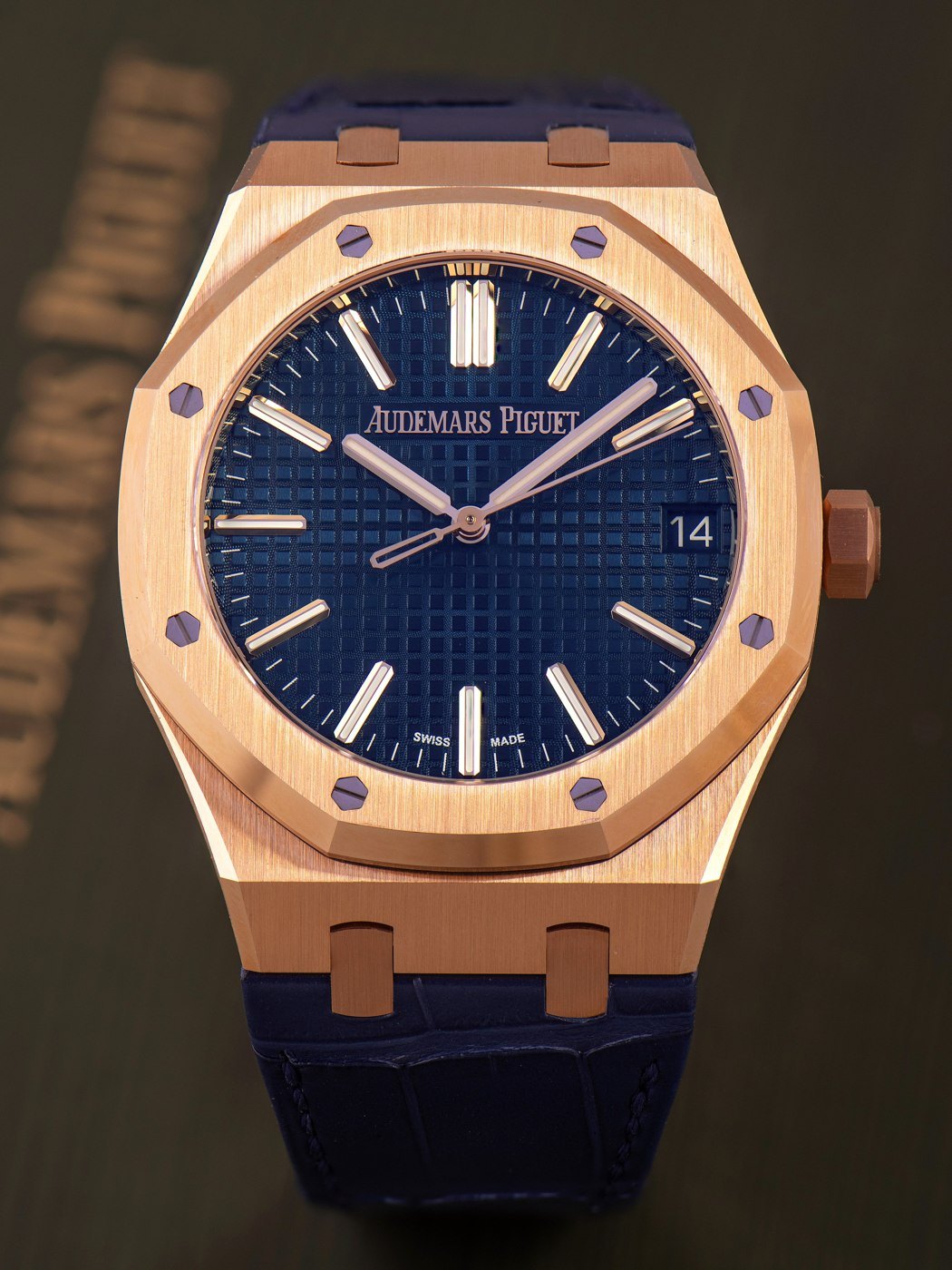
Wristwatches · Self-winding wristwatch with date
Audemars Piguet Royal Oak Ref. 15510OR
- Maker / attribution
- Audemars Piguet (source attribution)
- Date
- 2022
- Historical period
- Contemporary Horology (2010 – Present)
- Country of origin
- Switzerland
- Object type
- Self-winding wristwatch with date
- Materials / technique
- 18K pink gold
- Dimensions
- 41mm
- Holding institution
- Craft & Tailored
- Accession / object no.
- APRO15510OR
- Credit line
- Craft & Tailored
- Catalogue title (original)
- ساعت اودمار پیگه Royal Oak مدل ۲۰۲۲، رفرنس 15510OR، رزگلد ۱۸ عیار با صفحه آبی و مجموعه کامل؛ وضعیت در حد نو طبق منبع (English)
View the source record ↗ (opens another website in a new tab)Suggest a correction
Record summary
Held and catalogued by Craft & Tailored (object number APRO15510OR), this is a self-winding wristwatch with date attributed to Audemars Piguet, made in Switzerland, dated 2022. The Atlas places it in the Contemporary Horology period (2010 – Present) of its Wristwatches collection. Materials and techniques recorded by the source: 18K pink gold. Recorded dimensions: 41mm. The record is illustrated with 1 photograph.
Assembled from the source record's structured fields. Dates and attributions are given as the source states them; where a field is missing the Atlas leaves it blank rather than estimating.
Catalogue description
Original object description
Produced in 2022, this Audemars Piguet Royal Oak reference 15510OR features a 41 mm case of 18K pink gold with integrated lugs and an eight-screw polished octagonal bezel. The dial is rendered in "Bleu Nuit, Nuage 50" with a "Grande Tapisserie" guilloché pattern, furnished with faceted pink gold baton indices, matching hands, and a date window situated at 3 o'clock. Visible through a sapphire display caseback is the in-house automatic Calibre 4302, which provides an estimated power reserve of 70 hours. The watch is fitted with a blue alligator leather strap—a non-standard pairing for this reference—and fastens with an 18K pink gold deployant clasp. Documented in mint operational condition without signs of wear across its components, the watch is accompanied by its inner and outer presentation boxes, original retail sales receipt, and Certificat d'Origine et de Garantie.
Historical context
Contemporary Horology (2010 – Present)
Silicon components, connected watches, optical-lattice research clocks and a thriving independent scene.
Smartwatches became the world's best-selling watches, while mechanical watchmaking focuses on craft, innovation (silicon components, new escapements) and independent makers.
Read the period in the timelineMore wristwatches from this periodEarlier: Mechanical Renaissance
Atlas type guide
Automatic (self-winding) watches
Self-winding watches use the wearer's motion to wind the mainspring. Abraham-Louis Perrelet and Breguet made 'perpétuelle' pocket watches with oscillating weights in the late eighteenth century, but the principle only became practical in the wristwatch. John Harwood patented a bumper automatic in 1923; Rolex's Perpetual rotor (1931) winding in one direction, and later bidirectional rotors (Eterna, Felsa Bidynator), established the modern form. Micro-rotors (Universal Genève, Buren) and peripheral rotors made automatic watches thinner.
What to look for
- A semicircular rotor turning 360° over the movement, or a 'bumper' weight that rebounds between springs.
- 'Automatic', 'Perpetual' or 'Self-winding' on the dial.
- A sealed screw-back case, since automatic watches are wound less often by the crown.
Dating clues
- Bumper automatics: 1923–c. 1955.
- Full rotors: from 1931 (Rolex); widespread after c. 1950.
- Micro-rotors: from 1954–1958.
General guidance written by the Atlas editors about this kind of object. It is not a statement about this particular piece; for that, rely on the source record above and on physical examination.
Related records

Clocks · c. 1990s
Audemars Piguet Royal Oak, c. 1990s
Antiquorum auction archive, Geneva

Pocket Watches · c. 1960
Audemars Piguet ''couteau'', c. 1960
Antiquorum auction archive, Geneva
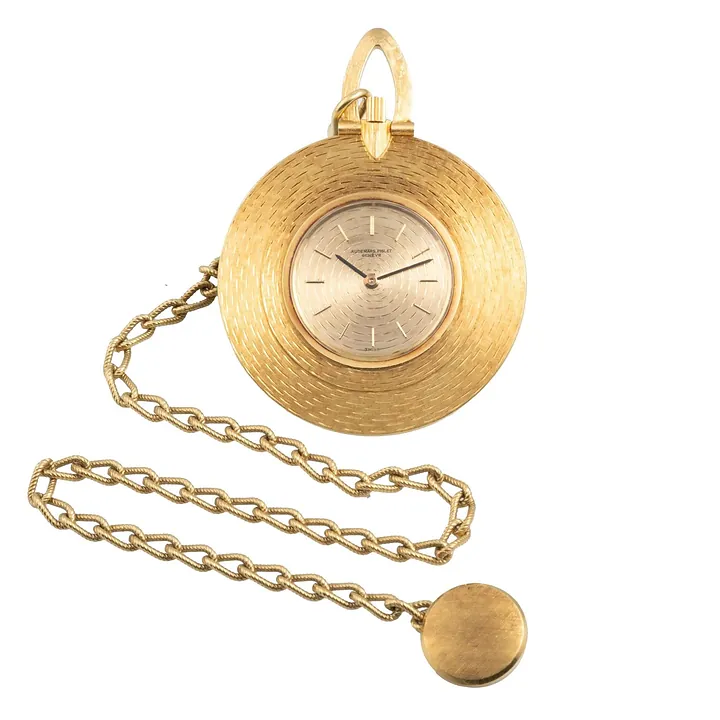
Pocket Watches · originally sold in November 1961 (per the lot record)
Audemars Piguet "extra Plate", ref. 5633 BA, originally sold in November 1961
Antiquorum auction archive, Geneva

Pocket Watches · c. 1980
Audemars Piguet pocket watch, c. 1980
Antiquorum auction archive, Geneva

Wristwatches · c. 2010s
Breguet Type XXI, ref. 3810, c. 2010s (Antiquorum Lot 381-24)
Antiquorum auction archive, Geneva

Wristwatches · c. 2010s
Breguet Type XXI, ref. 3810, c. 2010s (Antiquorum Lot 386-229)
Antiquorum auction archive, Geneva

Wristwatches · Sold in September 2010
Breitling Cosmonaute, ref. A 22322, Sold in September 2010
Antiquorum auction archive, Geneva

Wristwatches · c. 2010
Corum Bubble Chrono, ref. 396.150.20, c. 2010
Antiquorum auction archive, Geneva