
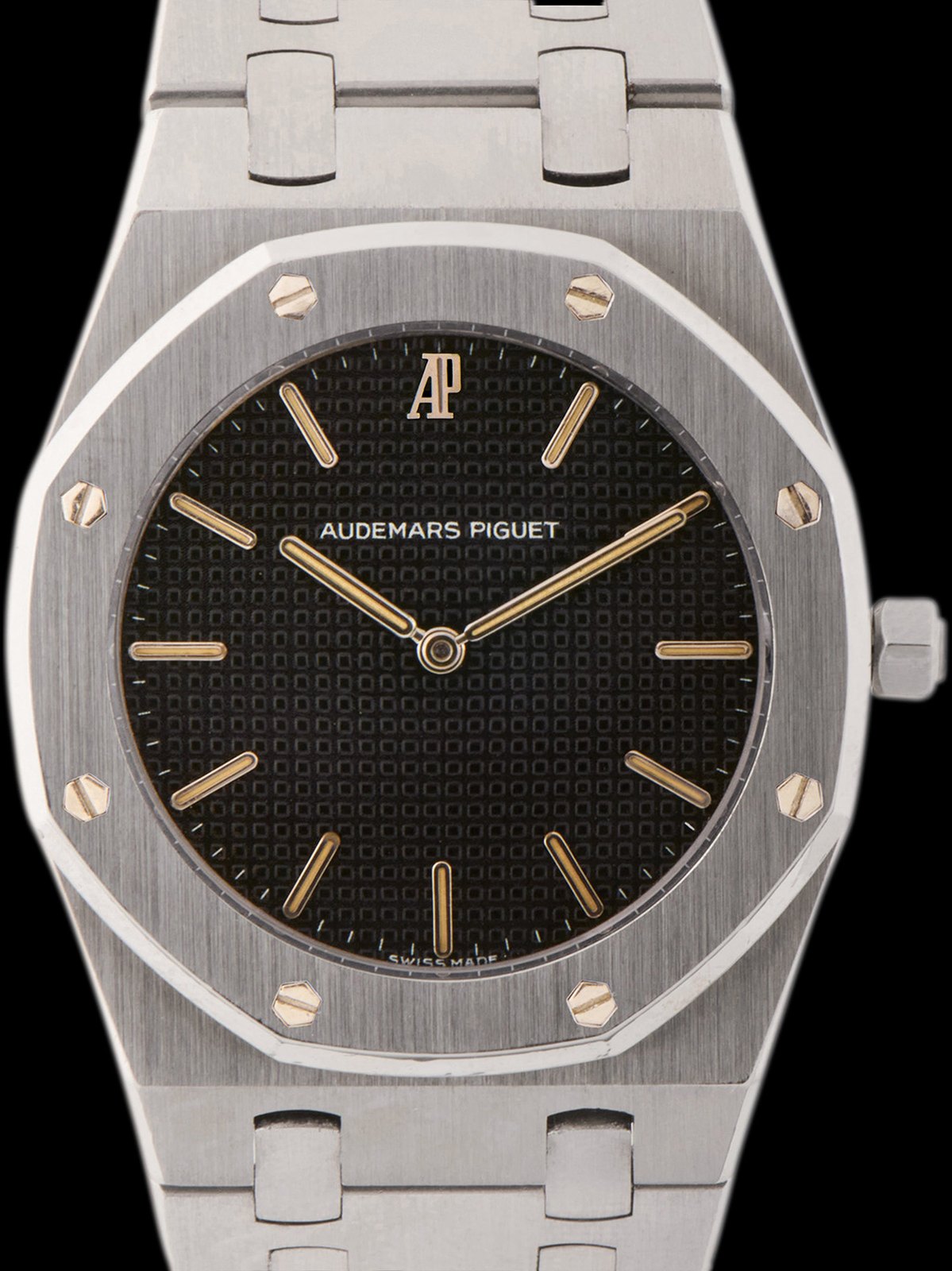
Wristwatches · Wristwatch
Audemars Piguet Royal Oak Quartz (Ref. 56303ST) Black Dial, 1990s
- Maker / attribution
- Audemars Piguet (maker)
- Date
- 1990s
- Historical period
- Mechanical Renaissance (1990 – 2010)
- Country of origin
- Switzerland
- Object type
- Wristwatch
- Dimensions
- Case 33 mm
- Stock no.
- AP56303ST
- Credit line
- Dealer listing, Craft & Tailored (AP56303ST)
- Catalogue title (original)
- 1990s Audemars Piguet Royal Oak Quartz (Ref. 56303ST) Black Dial (English)
View the source record (dealer listing) ↗ (opens another website in a new tab)Suggest a correction
Record summary
Catalogued by Craft & Tailored (dealer), Los Angeles (stock number AP56303ST), this is a wristwatch by Audemars Piguet, made in Switzerland, dated 1990s. The Atlas places it in the Mechanical Renaissance period (1990 – 2010) of its Wristwatches collection. Recorded dimensions: Case 33 mm. The record is illustrated with 6 photographs.
Assembled from the source record's structured fields. Dates and attributions are given as the source states them; where a field is missing the Atlas leaves it blank rather than estimating.
Catalogue description
Dealer description — Craft & Tailored
The Royal Oak was designed by the legendary Gerald Genta for Audemars Piguet in 1972. That original piece, the ref. 5402 was the most expensive steel watch ever made at the time and was the brand's attempt to shake the standards by introducing a luxury watch in steel that was oversized and pushed the boundaries of the current design trends of the era. The risk obviously paid off, as the steel Royal Oak has become an icon that perfectly strikes a balance between utilitarian function and timeless design. Featuring a beautifully finished case and bracelet, with angular, beveled, and polished edges, plus a polished bezel, screws, and case edge that fantastically contrast with the brushed surface of the case and bracelet to make for one of the most intriguing watches to come out of the era. Naturally, the Royal Oak was refined through the 20th century, and in the late 1980s, Audemars Piguet introduced a new line of mid-size Royal Oaks featuring quartz movements. These ultra-thin and remarkably wearable models technically measure in at 33mm; however, with the integrated bracelet and overall very long mid-case design, they retain the classic substantiality one would expect from a Royal Oak. SPECS Stock # AP56303ST Brand Audemars Piguet Style Royal Oak 'Quartz' Model 56303ST Serial No. 33X Size Men's / Unisex Material Stainless Steel Dial Black Tapisserie Millimeters 33 Bracelet Audemars Piguet Integrated Bracelet CASE & BRACELET The well-preserved case retains sharp bevels and well-defined finishing throughout, with light signs of use and nominal evidence of prior polishing. The octagonal bezel remains in excellent condition, displaying distinct edges, strong finishing, and only light wear. The unsigned octagonal crown is original to the watch. The caseback is equally well preserved, retaining deep factory engravings. The integrated bracelet retains 20 links, exhibits almost no stretch, and accommodates a wrist of approximately 7 inches. DIAL & HANDS The original black tapisserie dial is simply stunning and remains in virtually perfect condition, with no damage or age present. The tritium lume within the dial markers and within the hands has achieved a matching cream patina and exhibits no degradation under UV light inspection. ACCESSORIES None. The watch just received a new battery and is keeping time perfectly.
Historical context
Mechanical Renaissance (1990 – 2010)
Mechanical watches return as cultural objects; independent watchmaking flourishes.
Mechanical watches returned as cultural and luxury objects. Complications, tourbillons and new materials proliferated; independent watchmakers such as George Daniels, F.P. Journe and Philippe Dufour revived artisanal watchmaking; collecting vintage watches became a major field.
Read the period in the timelineMore wristwatches from this periodEarlier: Quartz Revolution
Atlas type guide
Quartz, digital and electronic watches
Electronic watches arrived in three steps. The Hamilton Electric 500 (1957) was the first battery-powered wristwatch, still with a balance; Bulova's Accutron (1960) used a tuning fork. On 25 December 1969 Seiko released the Astron 35SQ, the first quartz wristwatch, closely followed by the Swiss Beta 21 group. In 1972 Hamilton's Pulsar introduced the LED digital watch, and LCD displays soon made digital watches cheap.
The 'Quartz Crisis' that followed devastated the Swiss mechanical industry, which lost two-thirds of its workforce between 1970 and 1984 before recovering with the Swatch (1983) and the luxury mechanical revival. Solar, radio-controlled, kinetic and connected smartwatches continue the electronic line.
What to look for
- Battery hatch in the case back and calibre markings with 'Quartz' or a crystal frequency.
- Display technology: LED (red, push-button) versus LCD (always-on).
- Tuning-fork hum and a smoothly sweeping seconds hand on Accutrons.
- Model and reference numbers, often printed on the back.
Dating clues
- Electric balance watches: from 1957.
- Tuning-fork watches: 1960–c. 1977.
- Quartz analogue: from December 1969; LED digital: 1972–c. 1978; LCD from 1973.
General guidance written by the Atlas editors about this kind of object. It is not a statement about this particular piece; for that, rely on the source record above and on physical examination.
Read next:Seiko calibre 35A (Astron)
Related records
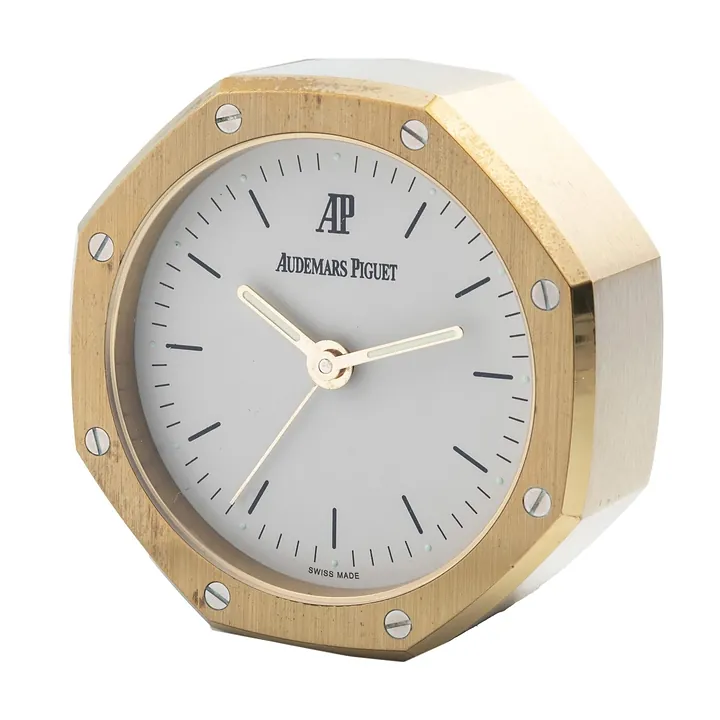
Clocks · c. 1990s
Audemars Piguet Royal Oak, c. 1990s
Antiquorum auction archive, Geneva
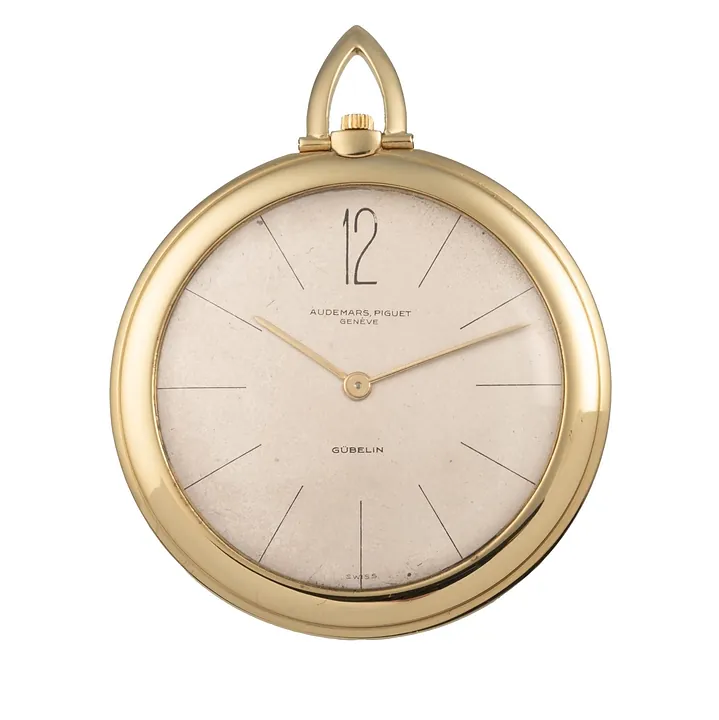
Pocket Watches · c. 1960
Audemars Piguet ''couteau'', c. 1960
Antiquorum auction archive, Geneva
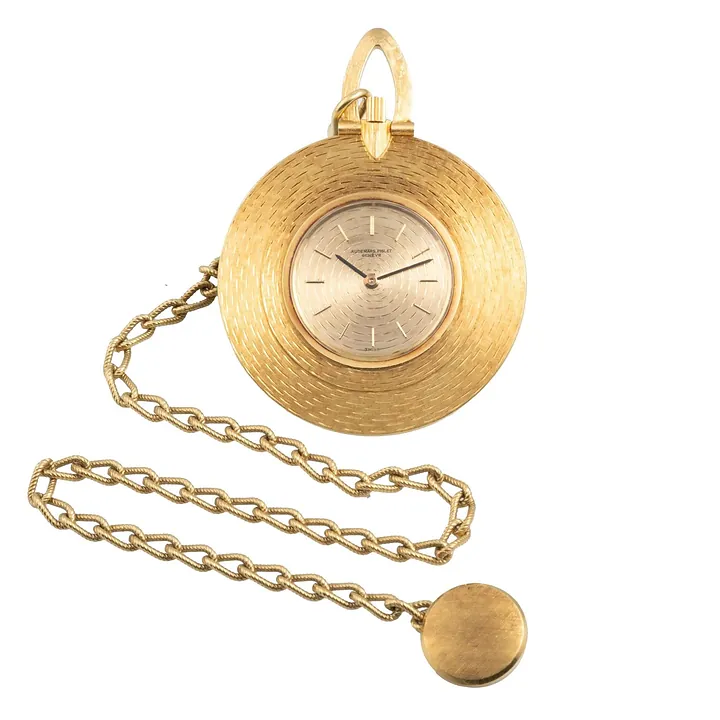
Pocket Watches · originally sold in November 1961 (per the lot record)
Audemars Piguet "extra Plate", ref. 5633 BA, originally sold in November 1961
Antiquorum auction archive, Geneva
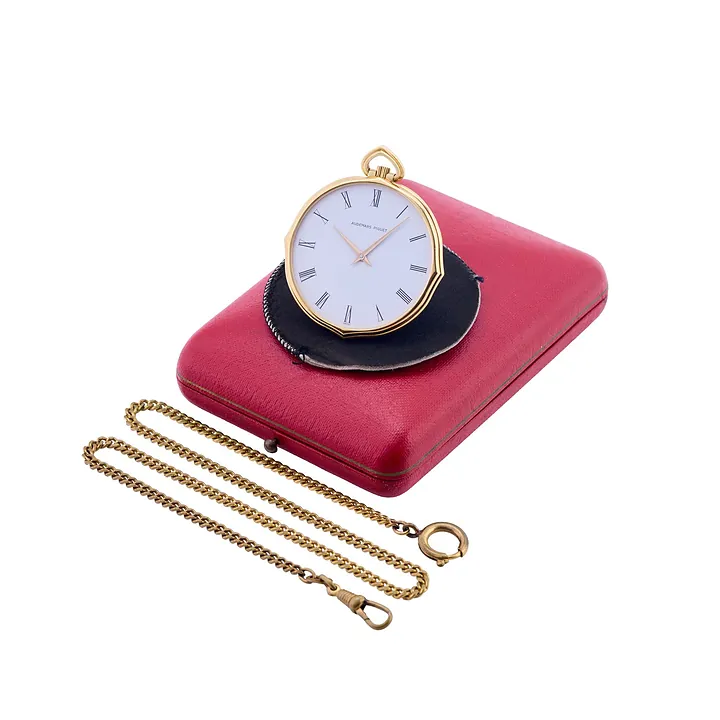
Pocket Watches · c. 1980
Audemars Piguet pocket watch, c. 1980
Antiquorum auction archive, Geneva

Wristwatches · 2008
Wristwatch by Breitling?, 2008
Museum Rotterdam

Wristwatches · c. 1990s
Audemars Piguet Bamboo, c. 1990s
Antiquorum auction archive, Geneva

Wristwatches · c. 1990
Audemars Piguet Huitieme Perpetual Calendar, ref. 25696PT, c. 1990
Antiquorum auction archive, Geneva

Wristwatches · c. 1990
Breitling Chronomat, ref. b13050.1, c. 1990
Antiquorum auction archive, Geneva