
Wristwatches · Wristwatch
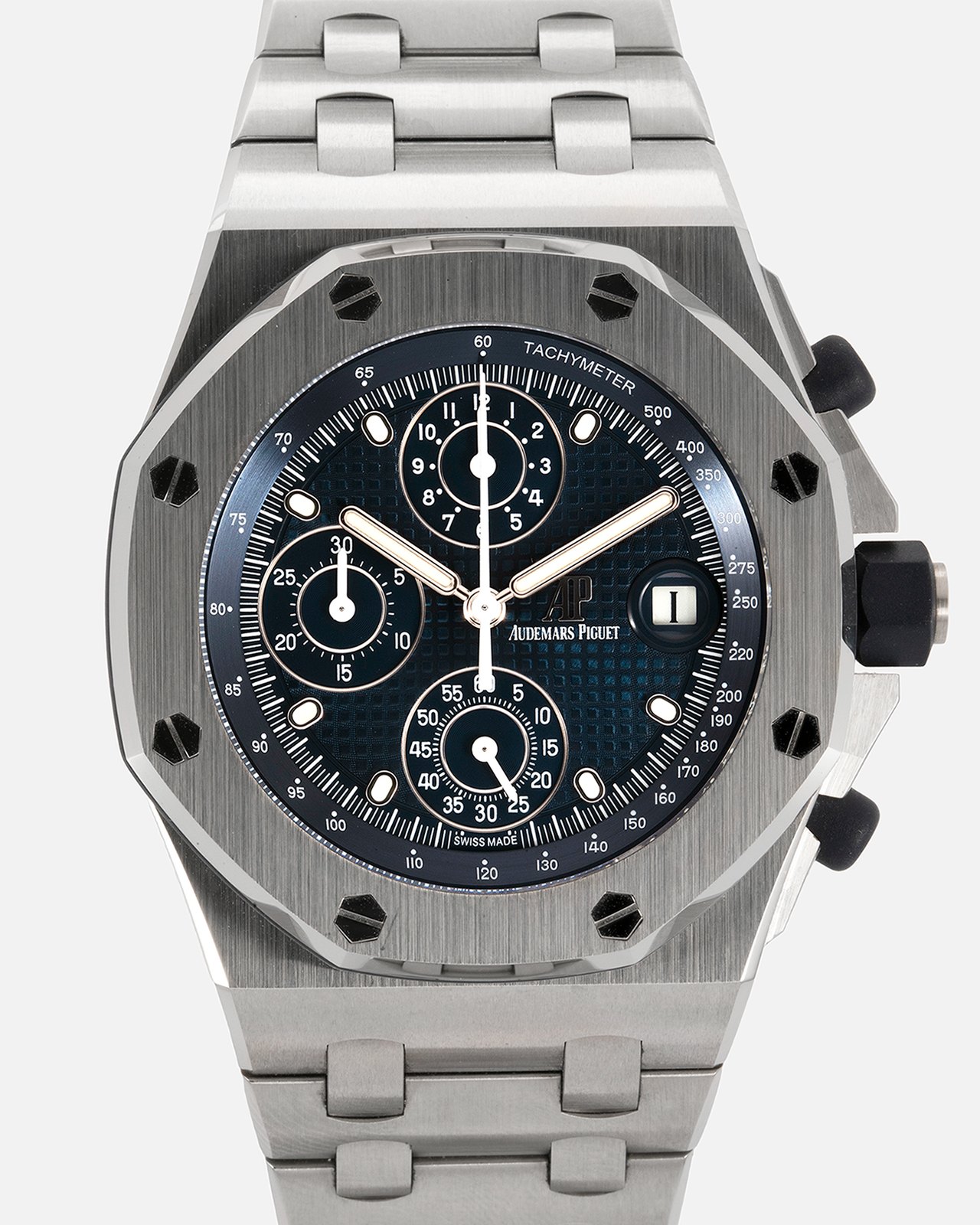
Audemars Piguet Royal Oak Offshore Beast 26238ST, 2021
- Maker / attribution
- Audemars Piguet (maker)
- Date
- 2021
- Historical period
- Contemporary Horology (2010 – Present)
- Country of origin
- Switzerland
- Object type
- Wristwatch
- Dimensions
- Case 42 mm
- Stock no.
- Product 6875174535255
- Credit line
- Dealer listing, S.Song Watches (product 6875174535255)
- Catalogue title (original)
- Audemars Piguet Royal Oak Offshore Beast 26238ST (English)
View the source record (dealer listing) ↗ (opens another website in a new tab)Suggest a correction
Record summary
Catalogued by S.Song Watches (dealer), Seattle (stock number Product 6875174535255), this is a wristwatch by Audemars Piguet, made in Switzerland, dated 2021. The Atlas places it in the Contemporary Horology period (2010 – Present) of its Wristwatches collection. Recorded dimensions: Case 42 mm. The record is illustrated with 6 photographs.
Assembled from the source record's structured fields. Dates and attributions are given as the source states them; where a field is missing the Atlas leaves it blank rather than estimating.
Catalogue description
Dealer description — S.Song Watches
Riding on this wave, the Royal Oak had a reincarnation in 1993 as Audemars Piguet introduced a whole new variant of the model with an integrated design - the Royal Oak Offshore. Designed by then-22-year-old watch designer, Emmanuel Gueit, the Offshore's raison d'etre was to establish a foothold in the increasingly youth-oriented luxury sports watch market that was opening up. As Audemars Piguet had recognized that younger collectors were beginning to spend more money, they decided they needed a watch to market to these individuals, and the Offshore was that watch. Nicknamed ‘The Beast’ by watch enthusiasts, it was basically a more-sporty extension of the Royal Oak (a Royal Oak on steroids, if you will). Although it divided opinion during its initial release (even Gerald Genta wasn’t a fan), the Offshore still went on to win the hearts of many other enthusiasts over the years that followed. Offered here is a particularly interesting Offshore reference, at least in my books. Based on the original Ref. 26721ST from 1993, this is the Audemars Piguet Royal Oak Offshore Chronograph Ref. 26238ST. Visually, this reference looks nearly identical to the original, featuring a raised octagonal bezel with screws, an exposed blue rubber gasket at the mid-case section, a blue rubber-clad crown and chronograph pushers, as well as a combination of vertically brushed surfaces accompanied by highly polished bevels at the edges of the stainless-steel case. As far as case proportion goes, it is essentially the same as the original which measures 42mm in diameter and 15.2mm in thickness. The dial execution on the Ref. 26238ST is nothing short of exquisite. Just like its older brother, the charming “Petit Tapisserie’ motif on the dreamy blue dial is executed to a very high level. You will also find a 30-minute counter on the 9 o ‘clock position, a seconds sub-dial at 6 o ‘clock, and a chronograph hour-register at 12 o ‘clock. On the right side of the dial, there is an applied AP logo and a tiny date window aperture which is further magnified with a cyclops for better legibility. What separates this reference from the original is the movement powering it from within. Here, we have the new in-house, self-winding flyback chronograph Cal. 4404 – an automatic chronograph caliber with a column wheel and vertical clutch, beating away at 4hz from behind the exhibition caseback. From an aesthetic standpoint, the Cal. 4404 is beautiful. It features a myriad of familiar decorations such as the Côtes de Genève, straight/circular satin brushing, perlage as well as highly polished chamfers, etc. What’s also interesting about this caliber is that it was first introduced via the Code 11.59 collection, which Audemars Piguet further developed specifically to be adapted into this reference. It also features an impressive 70-hour power reserve and a 22-carat gold oscillating rotor at the center. In my opinion, the Cal. 4404 is a technically impressive caliber all around, and a movement worthy of powering the “Beast”. After nearly 30 years since its inception, the Offshore has proven itself to be a successful recipe of watch design from Audemars Piguet that still remains culturally relevant to this very day. After all, we are seeing more and more derivative variations of the Offshore being introduced as time goes on, and it is not hard to see why it is considered a design staple. For me, the Offshore was a piece of watch design that demonstrated Audemars Piguet’s foresight in anticipating the category of high-end experimental sport watches. If you are someone who has a preference for watches that command the presence of the room (and if your wrist size permits), I’d say that this particular reference would be THE Offshore to own, because it retains the soul and spirit of the original that inaugurated the Offshore collection in 1993.
Historical context
Contemporary Horology (2010 – Present)
Silicon components, connected watches, optical-lattice research clocks and a thriving independent scene.
Smartwatches became the world's best-selling watches, while mechanical watchmaking focuses on craft, innovation (silicon components, new escapements) and independent makers.
Read the period in the timelineMore wristwatches from this periodEarlier: Mechanical Renaissance
Atlas type guide
Wristwatches
Bracelet watches were worn by women from the early nineteenth century — Breguet made one for Caroline Murat, Queen of Naples, in 1810–12 — but the wristwatch only became a man's instrument with military use and aviation in the early twentieth century. Between the World Wars it overtook the pocket watch; the 1920s and 1930s brought rectangular Art Deco cases, water-resistant cases and the first automatic winding systems.
After 1945 the wristwatch became a carrier of identity — dress watches, sports and dive watches, chronographs, calendars — produced by Swiss, American, Japanese, German, Soviet and Chinese industries. The quartz revolution after 1969 and the mechanical renaissance since the 1990s, including the rise of independent watchmakers, complete the story.
What to look for
- The reference number (between the lugs or inside the case back) and serial number, the starting point for dating.
- The calibre: its maker and number are often stamped under the dial or on the bridge.
- Originality of dial, hands and crown — refinished ('redial') dials are common.
- Case material marks: 18K/750, 14K/585, stainless steel, gold-filled, plated.
Dating clues
- Wire-lug cases: before c. 1925.
- Water-resistant screw-down cases: from 1926.
- Quartz movements: from 1969; sapphire crystals widespread after c. 1980.
General guidance written by the Atlas editors about this kind of object. It is not a statement about this particular piece; for that, rely on the source record above and on physical examination.
Related records

Clocks · c. 1990s
Audemars Piguet Royal Oak, c. 1990s
Antiquorum auction archive, Geneva

Pocket Watches · c. 1960
Audemars Piguet ''couteau'', c. 1960
Antiquorum auction archive, Geneva
Pocket Watches · originally sold in November 1961 (per the lot record)
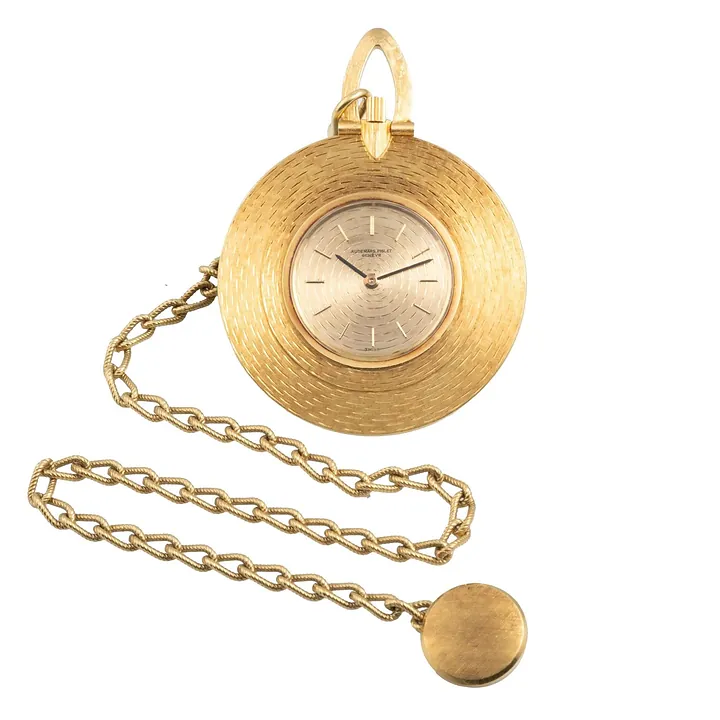
Audemars Piguet "extra Plate", ref. 5633 BA, originally sold in November 1961
Antiquorum auction archive, Geneva

Pocket Watches · c. 1980
Audemars Piguet pocket watch, c. 1980
Antiquorum auction archive, Geneva

Wristwatches · c. 2010s
Breguet Type XXI, ref. 3810, c. 2010s (Antiquorum Lot 381-24)
Antiquorum auction archive, Geneva

Wristwatches · c. 2010s
Breguet Type XXI, ref. 3810, c. 2010s (Antiquorum Lot 386-229)
Antiquorum auction archive, Geneva

Wristwatches · Sold in September 2010
Breitling Cosmonaute, ref. A 22322, Sold in September 2010
Antiquorum auction archive, Geneva

Wristwatches · c. 2010
Corum Bubble Chrono, ref. 396.150.20, c. 2010
Antiquorum auction archive, Geneva