
Wristwatches · Wristwatch
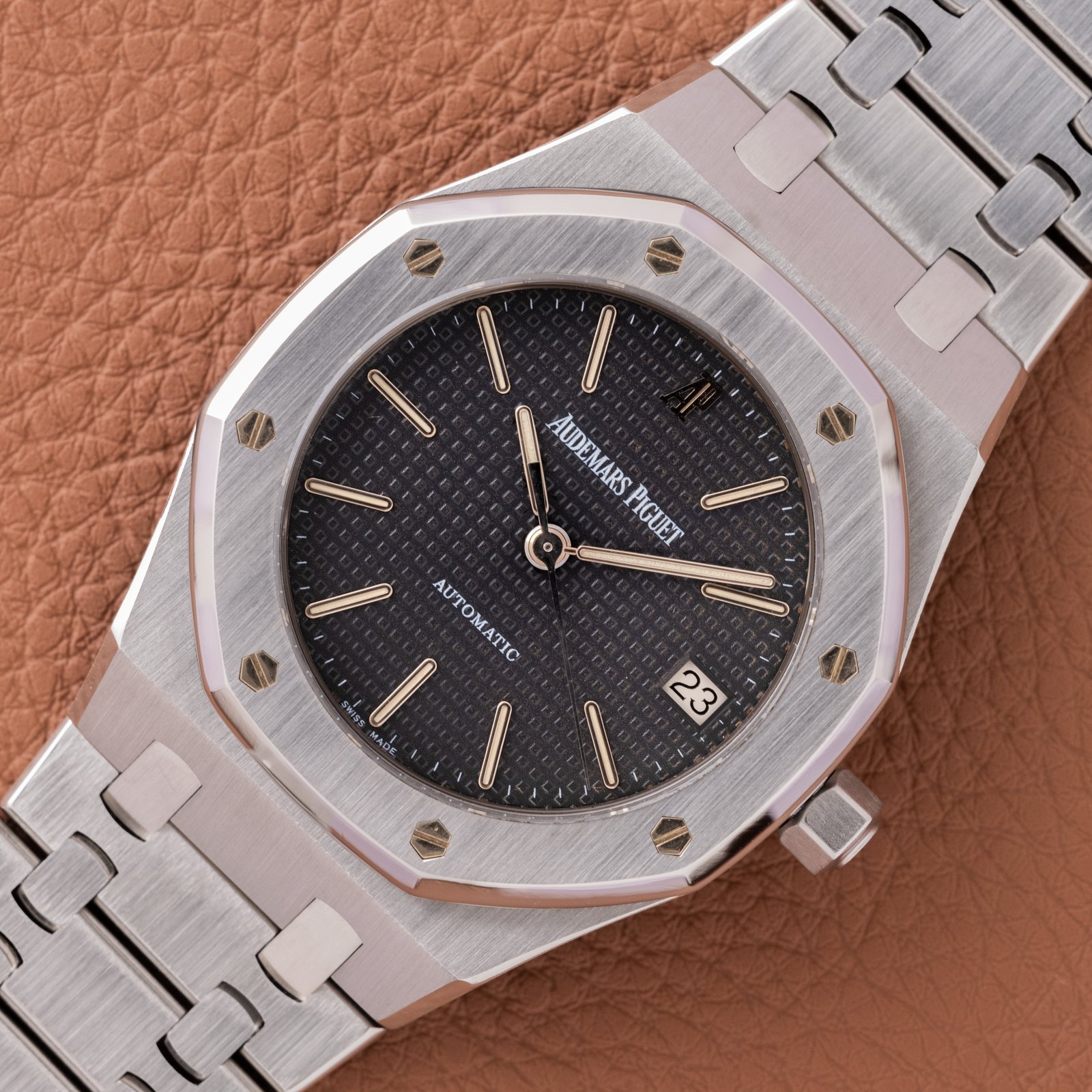
Audemars Piguet Royal Oak Mark 2 Blue Dial (Ref. 14790ST), 1990s
- Maker / attribution
- Audemars Piguet (maker)
- Date
- 1990s
- Historical period
- Mechanical Renaissance (1990 – 2010)
- Country of origin
- Switzerland
- Object type
- Wristwatch
- Dimensions
- Case 36 mm
- Stock no.
- Product 8743997538487
- Credit line
- Dealer listing, Huntington Company (product 8743997538487)
- Catalogue title (original)
- 1990s Audemars Piguet Royal Oak Mark 2 Blue Dial (Ref. 14790ST) (English)
View the source record (dealer listing) ↗ (opens another website in a new tab)Suggest a correction
Record summary
Catalogued by Huntington Company (dealer) (stock number Product 8743997538487), this is a wristwatch by Audemars Piguet, made in Switzerland, dated 1990s. The Atlas places it in the Mechanical Renaissance period (1990 – 2010) of its Wristwatches collection. Recorded dimensions: Case 36 mm. The record is illustrated with 6 photographs.
Assembled from the source record's structured fields. Dates and attributions are given as the source states them; where a field is missing the Atlas leaves it blank rather than estimating.
Catalogue description
Dealer description — Huntington Company
History and Significance The reference 14790ST represents one of the most appealing proportions from the neo-vintage Royal Oak catalog. Its 36mm stainless steel case sits between the earliest full-size Royal Oaks and the smaller versions that followed, giving the watch substantial presence without losing the thin, architectural quality of the original design. The integrated bracelet extends naturally from the case and makes the watch wear larger than its stated diameter. This balance of compact dimensions and unmistakable Royal Oak presence has become one of the defining characteristics of the reference 14790ST. This example features the later Mark 2 dial, giving it a very different character from the earlier military-dial version of the same reference. The black Petite Tapisserie surface provides the familiar texture associated with the Royal Oak, while slim applied baton markers keep the dial clean and restrained. A date aperture at three o’clock adds everyday practicality without disturbing the symmetry of the design. Against the stainless steel case and bracelet, the black dial creates a classic monochromatic configuration that places the emphasis back on the Royal Oak’s finishing and proportions. The case has recently been polished and presents in particularly nice condition. Brushed surfaces across the case, bezel, and bracelet contrast with the polished bevels that define the geometry of the Royal Oak, giving the exterior the sharp visual separation the design depends upon. At 36mm, those details remain concentrated into a compact package that feels more restrained than the larger Royal Oaks that followed. The reference 14790ST is a particularly strong example of how little the fundamental Royal Oak formula needed to change in order to remain relevant decades after its introduction. Writer's Thoughts The Mark 2 dial is arguably the configuration that allows the proportions of the reference 14790ST to do most of the talking. The black Petite Tapisserie dial, narrow baton markers, and simple date window create a much quieter watch than the more unusual dial variations found within the same reference. That restraint works exceptionally well with the 36mm case because the integrated bracelet supplies plenty of presence without requiring a larger diameter. The recently polished exterior also presents the alternating brushed and polished surfaces particularly well, making this a very clean example of the classic neo-vintage Royal Oak formula. Our Promise Every watch is thoroughly vetted, carefully described with complete transparency, and guaranteed authentic. Each piece is offered in honest condition, ensuring collectors receive a timepiece that reflects both originality and integrity. Specifications Brand: Audemars Piguet Model: Royal Oak Reference: 14790ST Year: Circa 1990s Case Material: Stainless steel Case Size: 36mm Dial: Black Mark 2 Petite Tapisserie dial with applied baton hour markers Movement: Automatic Strap/Bracelet: Audemars Piguet integrated stainless steel bracelet Buckle/Clasp: Audemars Piguet folding clasp Contents: Watch only Condition Case: The stainless steel case has recently been polished and presents in very good overall condition. The brushed and polished surfaces remain well defined, with the characteristic geometry of the Royal Oak presenting attractively throughout. Dial: The black Mark 2 Petite Tapisserie dial presents in very good condition with a clean surface, crisp printing, and well-preserved applied hour markers. Some signs of age on the edge. Hands: The hands present very well and remain clean and highly legible against the black dial. Crystal: The crystal presents well overall with only minor signs of wear consistent with use. Strap/Bracelet: The integrated stainless steel bracelet has recently been polished and presents in very good condition with light signs of handling. Buckle/Clasp: The Audemars Piguet folding clasp presents well with light surface wear consistent with use.
Historical context
Mechanical Renaissance (1990 – 2010)
Mechanical watches return as cultural objects; independent watchmaking flourishes.
Mechanical watches returned as cultural and luxury objects. Complications, tourbillons and new materials proliferated; independent watchmakers such as George Daniels, F.P. Journe and Philippe Dufour revived artisanal watchmaking; collecting vintage watches became a major field.
Read the period in the timelineMore wristwatches from this periodEarlier: Quartz Revolution
Atlas type guide
Wristwatches
Bracelet watches were worn by women from the early nineteenth century — Breguet made one for Caroline Murat, Queen of Naples, in 1810–12 — but the wristwatch only became a man's instrument with military use and aviation in the early twentieth century. Between the World Wars it overtook the pocket watch; the 1920s and 1930s brought rectangular Art Deco cases, water-resistant cases and the first automatic winding systems.
After 1945 the wristwatch became a carrier of identity — dress watches, sports and dive watches, chronographs, calendars — produced by Swiss, American, Japanese, German, Soviet and Chinese industries. The quartz revolution after 1969 and the mechanical renaissance since the 1990s, including the rise of independent watchmakers, complete the story.
What to look for
- The reference number (between the lugs or inside the case back) and serial number, the starting point for dating.
- The calibre: its maker and number are often stamped under the dial or on the bridge.
- Originality of dial, hands and crown — refinished ('redial') dials are common.
- Case material marks: 18K/750, 14K/585, stainless steel, gold-filled, plated.
Dating clues
- Wire-lug cases: before c. 1925.
- Water-resistant screw-down cases: from 1926.
- Quartz movements: from 1969; sapphire crystals widespread after c. 1980.
General guidance written by the Atlas editors about this kind of object. It is not a statement about this particular piece; for that, rely on the source record above and on physical examination.
Related records

Clocks · c. 1990s
Audemars Piguet Royal Oak, c. 1990s
Antiquorum auction archive, Geneva
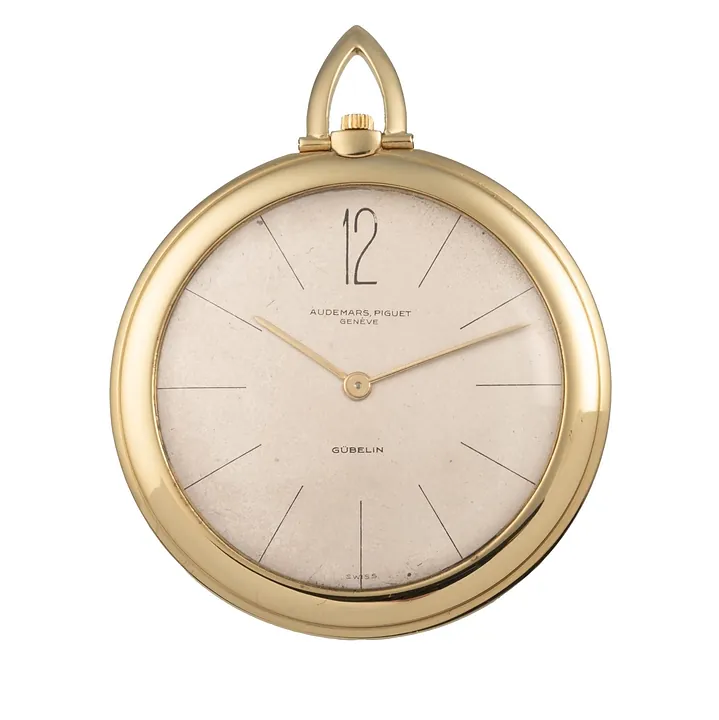
Pocket Watches · c. 1960
Audemars Piguet ''couteau'', c. 1960
Antiquorum auction archive, Geneva
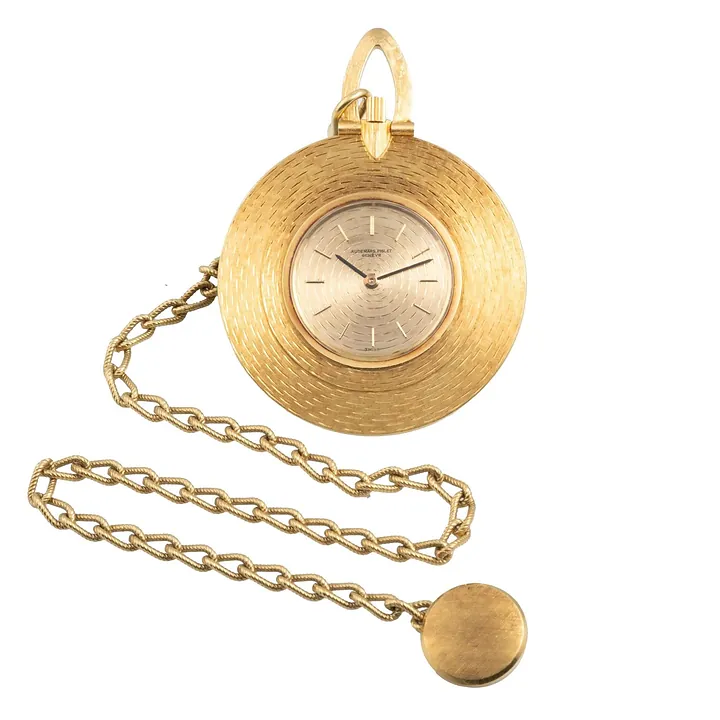
Pocket Watches · originally sold in November 1961 (per the lot record)
Audemars Piguet "extra Plate", ref. 5633 BA, originally sold in November 1961
Antiquorum auction archive, Geneva
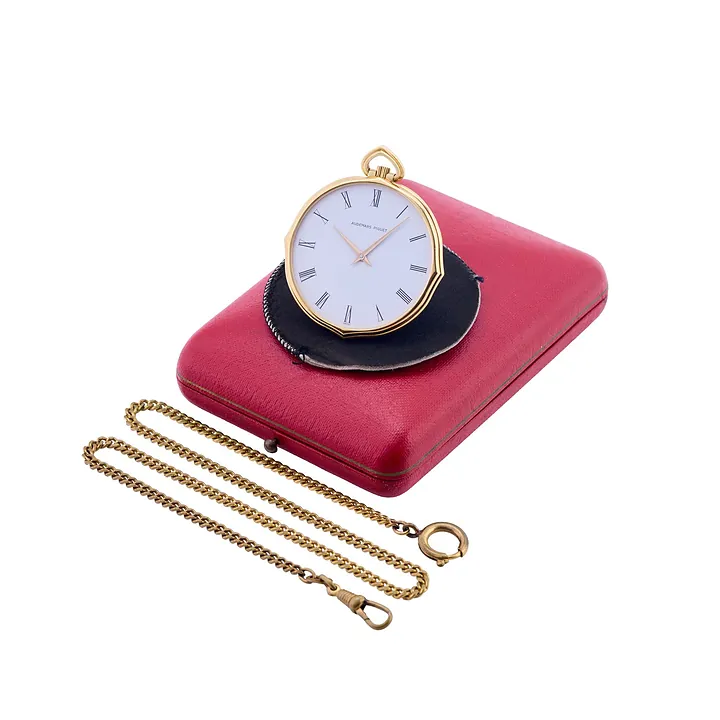
Pocket Watches · c. 1980
Audemars Piguet pocket watch, c. 1980
Antiquorum auction archive, Geneva

Wristwatches · 2008
Wristwatch by Breitling?, 2008
Museum Rotterdam

Wristwatches · c. 1990s
Audemars Piguet Bamboo, c. 1990s
Antiquorum auction archive, Geneva

Wristwatches · c. 1990
Audemars Piguet Huitieme Perpetual Calendar, ref. 25696PT, c. 1990
Antiquorum auction archive, Geneva

Wristwatches · c. 1990
Breitling Chronomat, ref. b13050.1, c. 1990
Antiquorum auction archive, Geneva