
Wristwatches · Wristwatch
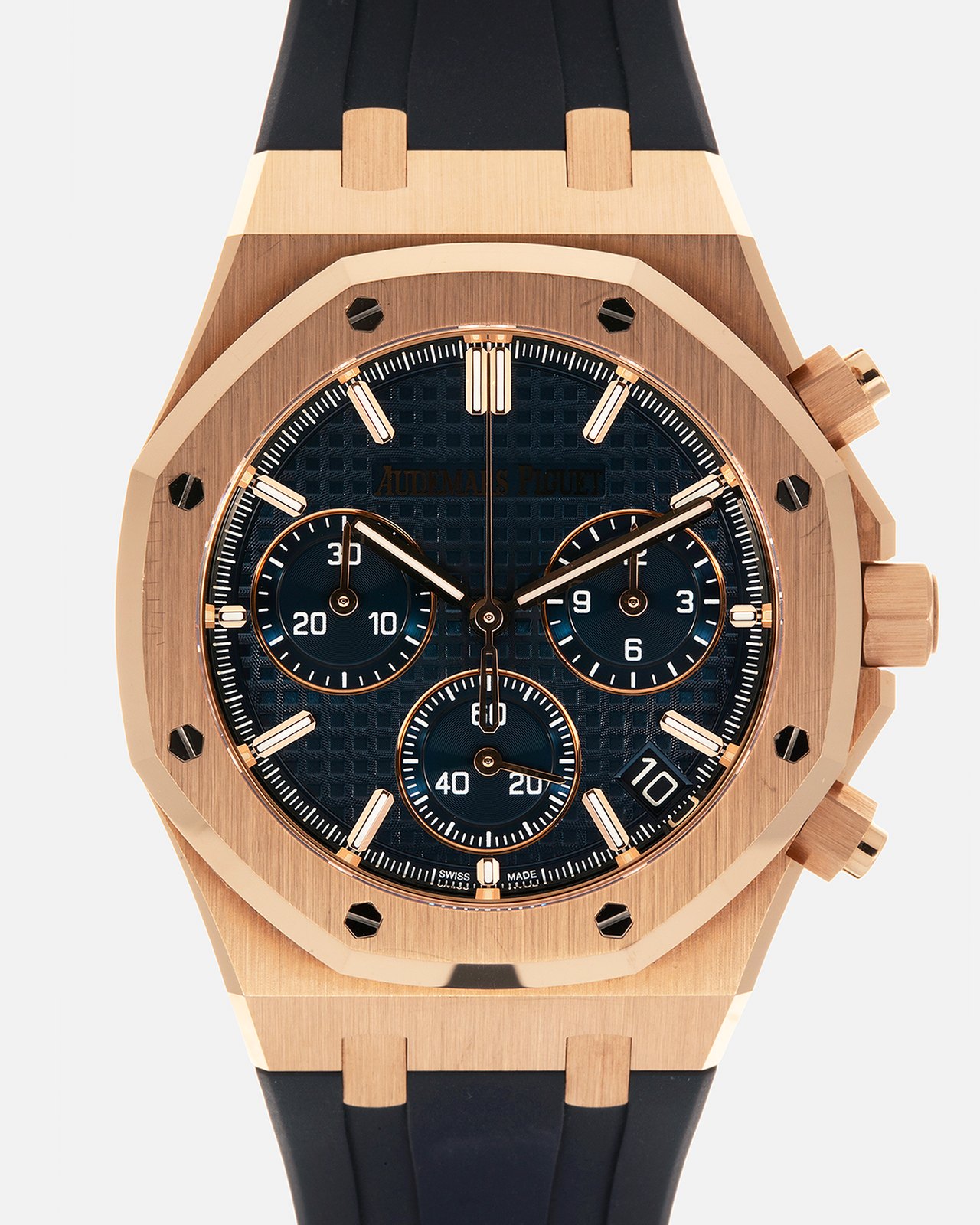
Audemars Piguet Royal Oak Chronograph Ref. 26240OR 50th Anniversary, 2022
- Maker / attribution
- Audemars Piguet (maker)
- Date
- 2022
- Historical period
- Contemporary Horology (2010 – Present)
- Country of origin
- Switzerland
- Object type
- Wristwatch
- Dimensions
- Case 41 mm
- Stock no.
- Product 7208799305815
- Credit line
- Dealer listing, S.Song Watches (product 7208799305815)
- Catalogue title (original)
- Audemars Piguet Royal Oak Chronograph Ref. 26240OR 50th Anniversary (English)
View the source record (dealer listing) ↗ (opens another website in a new tab)Suggest a correction
Record summary
Catalogued by S.Song Watches (dealer), Seattle (stock number Product 7208799305815), this is a wristwatch by Audemars Piguet, made in Switzerland, dated 2022. The Atlas places it in the Contemporary Horology period (2010 – Present) of its Wristwatches collection. Recorded dimensions: Case 41 mm. The record is illustrated with 6 photographs.
Assembled from the source record's structured fields. Dates and attributions are given as the source states them; where a field is missing the Atlas leaves it blank rather than estimating.
Catalogue description
Dealer description — S.Song Watches
The Royal Oak, with its masculine octagonal case, exposed screws and integrated bracelet is one of the most distinctive watches in the market today. It is aesthetically imposing and recognisable, and in my opinion, one of the best statement watches money can buy. As mentioned earlier, characterized by a striking case design that seamlessly blends a rounded octagonal bezel, a circular dial, and a tonneau shape, the Royal Oak stands out unmistakably, even amidst a dense crowd. That said, what we have here today isn’t just any Royal Oak. This is the Royal Oak Chronograph Ref. 26240OR “50th Anniversary” edition, a commemorative edition released by Audemars Piguet in 2022 to celebrate the remarkable 50-year legacy of this model in production. Starting with its strong and contemporarily sized 41mm 18-carat rose gold case, the finishing here is superb. For those unfamiliar, Royal Oak cases are a product of a particularly meticulous manufacturing process which starts with the shaping of the octagonal bezel and the circular aperture of the mid-case. The mid-case is then sandblasted, including the areas where the bracelet (or strap) will be attached. The signature octagonal bezel is then painstakingly polished to reveal its distinctive shine. Finally, the bezel undergoes satin brushing and is secured to the mid-case using the iconic hexagonal screws. Moving on to its exquisite dial, the Ref. 26240OR showcases an enticing hue of Midnight Blue (termed " bleu nuit nuage 50 " by Audemars Piguet, a.k.a “Midnight Blue Nuage 50”), enhanced by a 'Grande Tappisserie' motif, which lends the dial a subtle yet elegant shimmer when viewed under certain lighting conditions. Additionally, it features a 30-minute counter at 9:00, a 12-hour counter at 3:00, a running small seconds at 6:00, and a date window aperture placed at the 4:30 position. Powering the Ref. 26240OR from within is Audemars Piguet’s very own self-winding Cal. 4401 flyback chronograph. Through its exhibition caseback, you’ll be treated to an appealing display of the Cal. 4401 which features a myriad of exquisite finishes such as your usual Côte de Genève striping, perlage detailing, meticulously bevelled and polished edges, and a unique 22-carat rose gold rotor featuring open-worked '50 Years' design, alluding to the Royal Oak’s 50th anniversary. It is also worth noting that this special rotor is only exclusively fitted on Royal Oaks produced in 2022. As far as the power reserve is concerned, the Cal. 4401 carries an impressive total capacity of 70 hours on a full wind. Just like the other Royal Oaks we’ve handled and listed previously, there's always an enchanting allure to each one that's difficult to articulate in mere words. Similarly, with this Ref. 26240OR, I experienced that same mesmerizing effect, with its 'Grande Tappisserie' motif shimmering in the light, revealing a spectrum of hypnotic deep blue tones depending on the ambient lighting. It is truly a stunning watch. During my time with it, I frequently find myself entranced by the dial, utterly captivated by its beauty, often losing all sense of time as I gaze upon it.
Historical context
Contemporary Horology (2010 – Present)
Silicon components, connected watches, optical-lattice research clocks and a thriving independent scene.
Smartwatches became the world's best-selling watches, while mechanical watchmaking focuses on craft, innovation (silicon components, new escapements) and independent makers.
Read the period in the timelineMore wristwatches from this periodEarlier: Mechanical Renaissance
Atlas type guide
Chronographs and split-seconds watches
A chronograph is a watch with an additional seconds hand that can be started, stopped and returned to zero independently of the timekeeping. Louis Moinet built an early example in 1816 and Nicolas Rieussec a recording 'chronographe' in 1821; Adolphe Nicole's heart-shaped reset cam (patented 1862) made the modern return-to-zero possible. Split-seconds (rattrapante) chronographs add a second hand that can be stopped for intermediate times; flyback chronographs restart instantly.
Chronographs were essential tools for doctors (pulsometer scales), artillery (telemeter), engineers and sport. In wristwatches, Valjoux, Venus, Lemania and later the automatic chronographs of 1969 (Zenith El Primero, the Chronomatic Calibre 11 group and Seiko 6139) are milestones.
What to look for
- Push-pieces on the case band or a single button in the crown (monopusher).
- Subsidiary registers for minutes and hours; tachymeter, telemeter or pulsometer scales.
- Column wheel versus cam control visible in the movement.
- Calibre markings of specialist makers (Valjoux, Lemania, Venus, Landeron).
Dating clues
- Pocket chronographs with heart cam reset: after 1862.
- Wrist chronographs: from c. 1910; two-button designs from the 1930s.
- Automatic chronographs: from 1969.
General guidance written by the Atlas editors about this kind of object. It is not a statement about this particular piece; for that, rely on the source record above and on physical examination.
Read next:Chronograph
Related records

Clocks · c. 1990s
Audemars Piguet Royal Oak, c. 1990s
Antiquorum auction archive, Geneva

Pocket Watches · c. 1960
Audemars Piguet ''couteau'', c. 1960
Antiquorum auction archive, Geneva
Pocket Watches · originally sold in November 1961 (per the lot record)
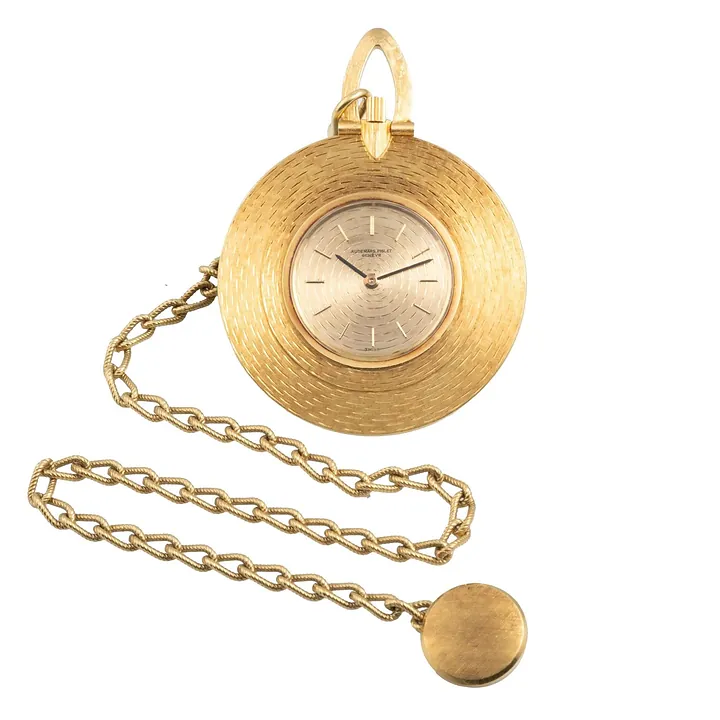
Audemars Piguet "extra Plate", ref. 5633 BA, originally sold in November 1961
Antiquorum auction archive, Geneva

Pocket Watches · c. 1980
Audemars Piguet pocket watch, c. 1980
Antiquorum auction archive, Geneva

Wristwatches · c. 2010s
Breguet Type XXI, ref. 3810, c. 2010s (Antiquorum Lot 381-24)
Antiquorum auction archive, Geneva

Wristwatches · c. 2010s
Breguet Type XXI, ref. 3810, c. 2010s (Antiquorum Lot 386-229)
Antiquorum auction archive, Geneva

Wristwatches · Sold in September 2010
Breitling Cosmonaute, ref. A 22322, Sold in September 2010
Antiquorum auction archive, Geneva

Wristwatches · c. 2010
Corum Bubble Chrono, ref. 396.150.20, c. 2010
Antiquorum auction archive, Geneva