
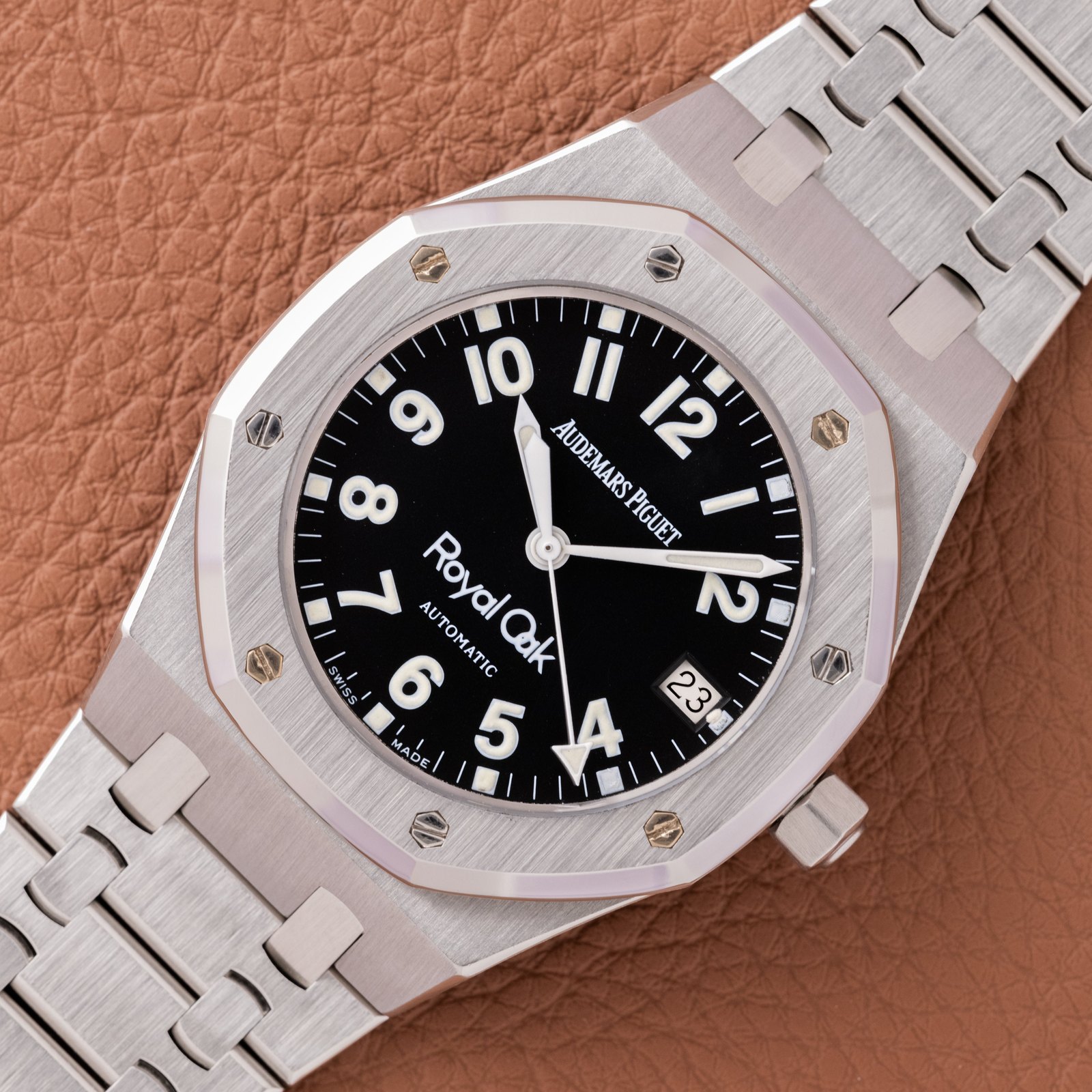
Wristwatches · Wristwatch
Audemars Piguet Royal Oak Black Military Dial (Ref. 14790ST), 1990s
- Maker / attribution
- Audemars Piguet (maker)
- Date
- 1990s
- Historical period
- Mechanical Renaissance (1990 – 2010)
- Country of origin
- Switzerland
- Object type
- Wristwatch
- Dimensions
- Case 36 mm
- Stock no.
- Product 8737785938103
- Credit line
- Dealer listing, Huntington Company (product 8737785938103)
- Catalogue title (original)
- 1990s Audemars Piguet Royal Oak Black Military Dial (Ref. 14790ST) (English)
View the source record (dealer listing) ↗ (opens another website in a new tab)Suggest a correction
Record summary
Catalogued by Huntington Company (dealer) (stock number Product 8737785938103), this is a wristwatch by Audemars Piguet, made in Switzerland, dated 1990s. The Atlas places it in the Mechanical Renaissance period (1990 – 2010) of its Wristwatches collection. Recorded dimensions: Case 36 mm. The record is illustrated with 6 photographs.
Assembled from the source record's structured fields. Dates and attributions are given as the source states them; where a field is missing the Atlas leaves it blank rather than estimating.
Catalogue description
Dealer description — Huntington Company
History and Significance The Audemars Piguet Royal Oak reference 14790ST has become one of the most interesting places to look within the neo-vintage Royal Oak family. At 36mm, it retains the thin proportions and compact feeling that made earlier Royal Oaks so elegant, while still having enough presence to feel unmistakably like a sports watch. This particular example takes that formula in an entirely different direction with the highly recognizable Mark 1 military dial. Instead of the traditional tapisserie pattern most collectors associate with the Royal Oak, the dial is deep black with oversized luminous Arabic numerals, giving the watch an unexpectedly utilitarian character. These early military dials are especially distinctive because of how dramatically they change the personality of the 14790ST. The large Arabic numerals dominate the dial, while the simple luminous hands and minute track make the watch extremely legible. Against the brushed steel case and integrated bracelet, the black dial feels almost severe compared with a conventional Royal Oak. It is one of those small-production variations that makes you look twice even if you already know the reference well. This example is a Mark 1 configuration from the 1990s and shows some honest aging to the luminous material. There is visible lume loss and wear around the plots at approximately one, two, three, and four o'clock. Rather than hiding that, we think it is an important part of understanding the condition of an uncommon dial like this. The remaining luminous material has also taken on some age, giving the otherwise monochromatic dial a bit more character. The case has recently been polished and presents in very nice condition, with the Royal Oak's combination of brushed surfaces and polished bevels showing clearly throughout. At 36mm, the reference 14790ST also represents a proportion of Royal Oak that has become increasingly difficult to find in the modern catalog. Put everything together and this is not simply another neo-vintage Royal Oak. It is a genuinely unusual version of one, with a dial that gives the familiar Gérald Genta design an entirely different identity. Writer's Thoughts There are plenty of Royal Oaks that I like, but the military-dial 14790 has always felt like something separate from the rest of them. You still have everything that makes a Royal Oak recognizable from across the room, yet the moment you get close, the dial completely changes the watch. The oversized numerals almost feel wrong inside such an elegant case, and that contrast is exactly what makes it interesting. I also think 36mm is one of the best sizes Audemars Piguet ever used for this design. There is wear and some loss to the lume plots, especially between one and four o'clock, and those details are plainly visible. The case, on the other hand, has recently been polished and presents extremely well, so there is an interesting contrast between the aged dial and refreshed exterior. If I were choosing a 14790 because I wanted something noticeably different from the standard examples, the Mark 1 military dial is exactly where I would look. Our Promise Every watch is thoroughly vetted, carefully described with complete transparency, and guaranteed authentic. Each piece is offered in honest condition, ensuring collectors receive a timepiece that reflects both originality and integrity. Specifications Brand: Audemars Piguet Model: Royal Oak Reference: 14790ST Year: Circa 1990s Case Material: Stainless steel Case Size: 36mm Dial: Black military dial with luminous Arabic numerals Movement: Automatic Strap/Bracelet: Audemars Piguet integrated stainless steel bracelet Buckle/Clasp: Audemars Piguet folding clasp Contents: Watch only Condition Case: The stainless steel case has recently been polished and presents in very nice overall condition. The characteristic brushed and polished surfaces of the Royal Oak remain clearly defined, with light signs of handling consistent with wear. Dial: The military dial remains attractive and highly legible. There is visible loss and wear to the luminous plots, most notably at the one, two, three, and four o'clock positions, which should be noted as part of the watch's condition. Hands: The hands present well overall and remain highly legible against the black dial. Crystal: The crystal presents well overall with only minor signs of wear. Strap/Bracelet: The integrated stainless steel bracelet presents in very good condition with light signs of use throughout. Buckle/Clasp: The Audemars Piguet folding clasp is in very good condition with light surface wear consistent with use.
Historical context
Mechanical Renaissance (1990 – 2010)
Mechanical watches return as cultural objects; independent watchmaking flourishes.
Mechanical watches returned as cultural and luxury objects. Complications, tourbillons and new materials proliferated; independent watchmakers such as George Daniels, F.P. Journe and Philippe Dufour revived artisanal watchmaking; collecting vintage watches became a major field.
Read the period in the timelineMore wristwatches from this periodEarlier: Quartz Revolution
Atlas type guide
Military, pilot and travel watches
The wristwatch owes much of its adoption by men to warfare and aviation. Wristlets — small pocket watches soldered with lugs and worn on a strap — were used in colonial campaigns and became standard equipment in the First World War, with protective grilles over the crystal ('shrapnel guards'). Louis Cartier's Santos (1904), designed for the aviator Alberto Santos-Dumont, is often cited as an early purpose-made pilot's watch.
In the Second World War governments specified watches in detail: the German B-Uhr observation watches, the American A-11, and the British 'W.W.W.' (the 'Dirty Dozen' set of 1945). After the war, jet travel brought GMT and world-time watches, which show two or more time zones at once — Louis Cottier's world-time mechanism and the Rolex GMT-Master (1955) are examples.
What to look for
- Military markings on the case back: broad arrow, issue numbers, 'W.W.W.', 'A.T.P.'
- High-legibility black dials with luminous Arabic numerals; oversized crowns for gloved hands.
- 24-hour hands and rotating 24-hour bezels or city rings on GMT/world-time watches.
- Wire lugs on early wristlets converted from pocket watches.
Dating clues
- Wire-lug wristlets: c. 1900–1925.
- Military specifications of the Second World War: 1939–1945.
- GMT and world-time wristwatches: mainly after 1950.
General guidance written by the Atlas editors about this kind of object. It is not a statement about this particular piece; for that, rely on the source record above and on physical examination.
Related records

Clocks · c. 1990s
Audemars Piguet Royal Oak, c. 1990s
Antiquorum auction archive, Geneva

Pocket Watches · c. 1960
Audemars Piguet ''couteau'', c. 1960
Antiquorum auction archive, Geneva
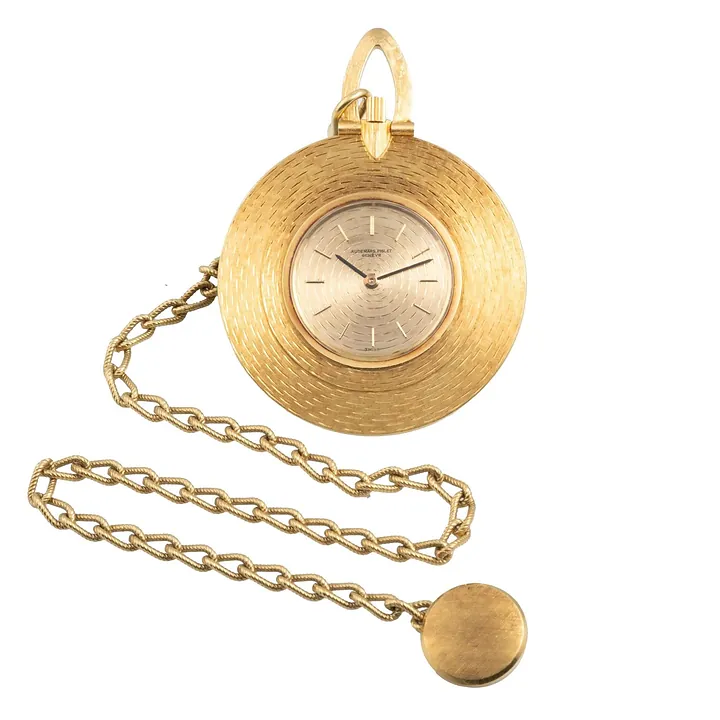
Pocket Watches · originally sold in November 1961 (per the lot record)
Audemars Piguet "extra Plate", ref. 5633 BA, originally sold in November 1961
Antiquorum auction archive, Geneva

Pocket Watches · c. 1980
Audemars Piguet pocket watch, c. 1980
Antiquorum auction archive, Geneva

Wristwatches · 2008
Wristwatch by Breitling?, 2008
Museum Rotterdam

Wristwatches · c. 1990s
Audemars Piguet Bamboo, c. 1990s
Antiquorum auction archive, Geneva

Wristwatches · c. 1990
Audemars Piguet Huitieme Perpetual Calendar, ref. 25696PT, c. 1990
Antiquorum auction archive, Geneva

Wristwatches · c. 1990
Breitling Chronomat, ref. b13050.1, c. 1990
Antiquorum auction archive, Geneva