
Wristwatches · Wristwatch
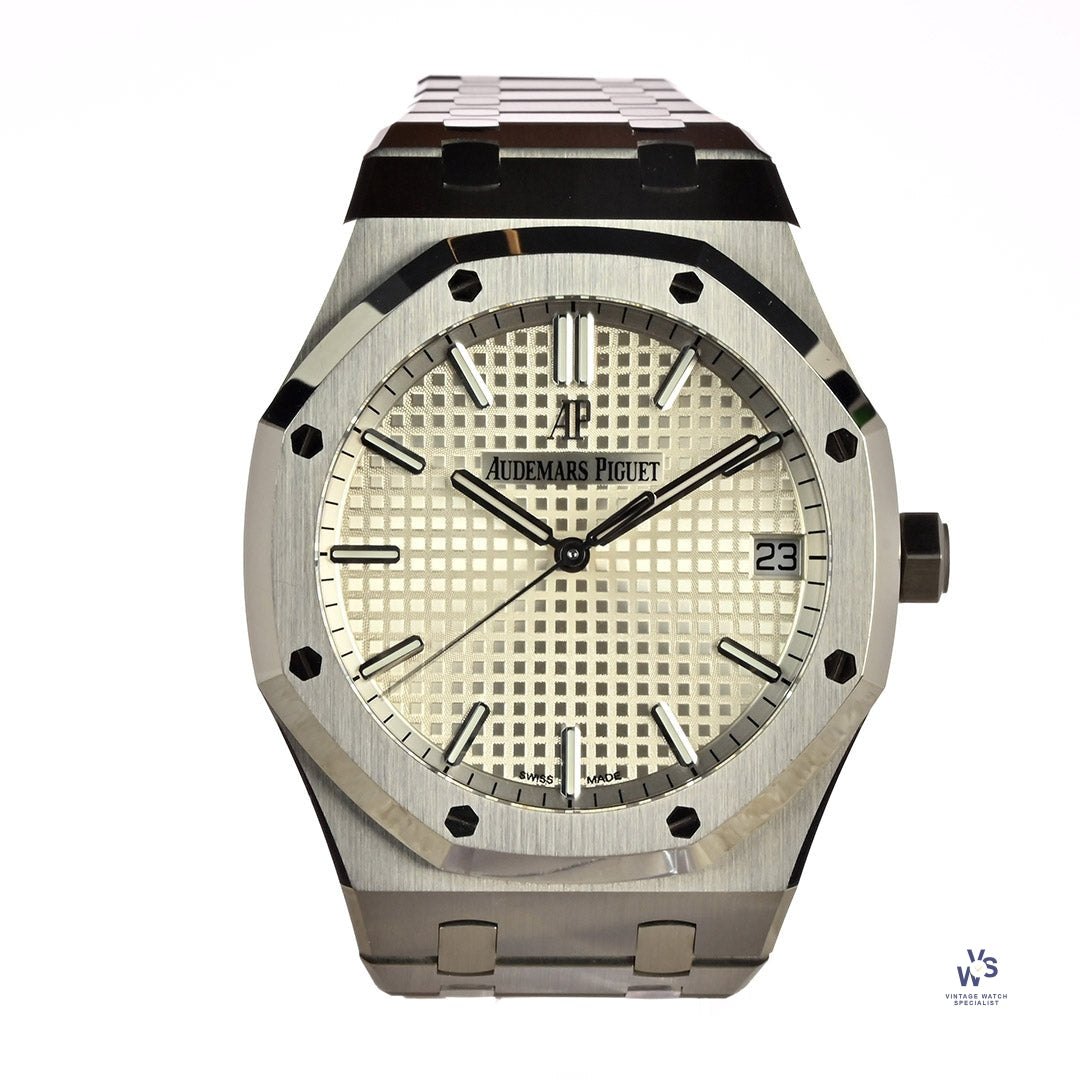
Audemars Piguet Royal Oak, Automatic, 15500ST.OO.122OST.04, 41mm, Stainless Steel, 2020
- Maker / attribution
- Audemars Piguet (maker)
- Date
- 2020
- Historical period
- Contemporary Horology (2010 – Present)
- Country of origin
- Switzerland
- Object type
- Wristwatch
- Materials / technique
- stainless steel
- Dimensions
- Case 41 mm
- Stock no.
- VWS1544
- Credit line
- Dealer listing, Vintage Watch Specialist (VWS1544)
- Catalogue title (original)
- Audemars Piguet - Royal Oak - Automatic - 15500ST.OO.122OST.04 - 41mm - Stainless Steel - Box & Papers - 2020 (English)
View the source record (dealer listing) ↗ (opens another website in a new tab)Suggest a correction
Record summary
Catalogued by Vintage Watch Specialist (dealer), United Kingdom (stock number VWS1544), this is a wristwatch by Audemars Piguet, made in Switzerland, dated 2020. The Atlas places it in the Contemporary Horology period (2010 – Present) of its Wristwatches collection. Materials and techniques recorded by the source: stainless steel. Recorded dimensions: Case 41 mm. The record is illustrated with 6 photographs.
Assembled from the source record's structured fields. Dates and attributions are given as the source states them; where a field is missing the Atlas leaves it blank rather than estimating.
Catalogue description
Dealer description — Vintage Watch Specialist
A Sublime 41mm Audemars Piguet Royal Oak Automatic With A Tapestry Dial, Sold With Box & Papers 2020 In 1875, Jules-Louis Audemars and his friend, Edward-Auguste Piguet, first joined forces in watchmaking having both grown up in the Vallee de Joux, a place with deep horological roots. The pair established their first workshop on the Audemars family farm in their hometown of Le Brassus, Switzerland. In 1881, the duo officially registered their business as Audemars Piguet & Cie., Manufacture d’Horlogerie. The brand made its first truly groundbreaking creation in 1892 with the development of the first-minute repeater wristwatch. They have continued to pioneer throughout the last century and have of course become one of the most recognisable brands in the world, and as such, their timepieces are very much sought after. What’s on Offer We are very pleased to be able to offer this exquisite Audemars Piguet Royal Oak in stainless steel with a stunning tapestry dial for sale - in fact, it has come out of our personal collection so you know it's a wonderful example in superb condition. (The boss just doesn't have the occasion to wear it and enjoy it enough). An iconic reference famous throughout the world, the Royal Oak has become highly sought after by collectors all over the globe. Crafted from the highest quality stainless steel case with an integrated bracelet, this watch exudes luxury and opulence. Although the watch is robust and certainly has a presence on the wrist, it is surprisingly comfortable and wears beautifully - a real head-turner! The jewel in the crown of this watch is almost certainly its textured tapestry dial which reflects the light beautifully and boasts applied hour markers with luminous inserts and corresponding hands which also have luminous inserts for elevated visibility in low light. The display case back is another delightful detail offering a glimpse of the beautifully presented calibre 4302 which offers a lengthy power reserve of 70 hours and a jewel count of 32.
Historical context
Contemporary Horology (2010 – Present)
Silicon components, connected watches, optical-lattice research clocks and a thriving independent scene.
Smartwatches became the world's best-selling watches, while mechanical watchmaking focuses on craft, innovation (silicon components, new escapements) and independent makers.
Read the period in the timelineMore wristwatches from this periodEarlier: Mechanical Renaissance
Atlas type guide
Automatic (self-winding) watches
Self-winding watches use the wearer's motion to wind the mainspring. Abraham-Louis Perrelet and Breguet made 'perpétuelle' pocket watches with oscillating weights in the late eighteenth century, but the principle only became practical in the wristwatch. John Harwood patented a bumper automatic in 1923; Rolex's Perpetual rotor (1931) winding in one direction, and later bidirectional rotors (Eterna, Felsa Bidynator), established the modern form. Micro-rotors (Universal Genève, Buren) and peripheral rotors made automatic watches thinner.
What to look for
- A semicircular rotor turning 360° over the movement, or a 'bumper' weight that rebounds between springs.
- 'Automatic', 'Perpetual' or 'Self-winding' on the dial.
- A sealed screw-back case, since automatic watches are wound less often by the crown.
Dating clues
- Bumper automatics: 1923–c. 1955.
- Full rotors: from 1931 (Rolex); widespread after c. 1950.
- Micro-rotors: from 1954–1958.
General guidance written by the Atlas editors about this kind of object. It is not a statement about this particular piece; for that, rely on the source record above and on physical examination.
Related records

Clocks · c. 1990s
Audemars Piguet Royal Oak, c. 1990s
Antiquorum auction archive, Geneva

Pocket Watches · c. 1960
Audemars Piguet ''couteau'', c. 1960
Antiquorum auction archive, Geneva
Pocket Watches · originally sold in November 1961 (per the lot record)
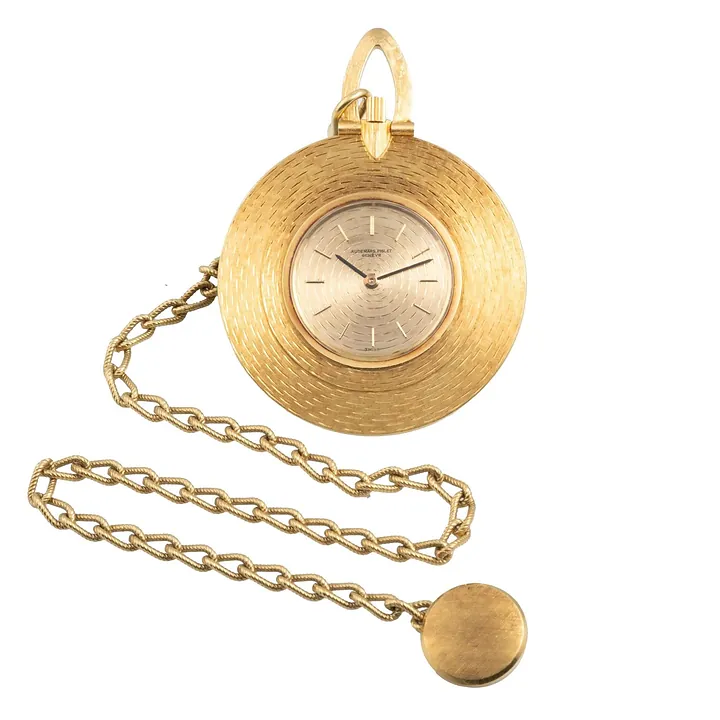
Audemars Piguet "extra Plate", ref. 5633 BA, originally sold in November 1961
Antiquorum auction archive, Geneva

Pocket Watches · c. 1980
Audemars Piguet pocket watch, c. 1980
Antiquorum auction archive, Geneva

Wristwatches · c. 2010s
Breguet Type XXI, ref. 3810, c. 2010s (Antiquorum Lot 381-24)
Antiquorum auction archive, Geneva

Wristwatches · c. 2010s
Breguet Type XXI, ref. 3810, c. 2010s (Antiquorum Lot 386-229)
Antiquorum auction archive, Geneva

Wristwatches · Sold in September 2010
Breitling Cosmonaute, ref. A 22322, Sold in September 2010
Antiquorum auction archive, Geneva

Wristwatches · c. 2010
Corum Bubble Chrono, ref. 396.150.20, c. 2010
Antiquorum auction archive, Geneva