

Wristwatches · Wristwatch
Audemars Piguet Royal-Oak 5402ST Ultra Thin Jumbo C-Series Logo Down Tropical Dial, c. 1980
- Maker / attribution
- Audemars Piguet (maker)
- Date
- c. 1980
- Historical period
- Quartz Revolution (1969 – 1990)
- Country of origin
- Switzerland
- Object type
- Wristwatch
- Dimensions
- Case 39 mm
- Stock no.
- W-3864
- Credit line
- Dealer listing, Bulang & Sons (W-3864)
- Catalogue title (original)
- Audemars Piguet Royal-Oak 5402ST Ultra Thin Jumbo C-Series Logo Down Tropical Dial (English)
View the source record (dealer listing) ↗ (opens another website in a new tab)Suggest a correction
Record summary
Catalogued by Bulang & Sons (dealer), Copenhagen (stock number W-3864), this is a wristwatch by Audemars Piguet, made in Switzerland, dated c. 1980. The Atlas places it in the Quartz Revolution period (1969 – 1990) of its Wristwatches collection. Recorded dimensions: Case 39 mm. The record is illustrated with 6 photographs.
Assembled from the source record's structured fields. Dates and attributions are given as the source states them; where a field is missing the Atlas leaves it blank rather than estimating.
Catalogue description
Dealer description — Bulang & Sons
Audemars Piguet was founded in 1875 by two childhood friends, Jules Louis Audemars and Edward Auguste Piguet. Contrary to popular belief, “Audemars Piguet” is not the first and last name of a single person, but a combination of the founders’ surnames. Although the two friends followed separate paths in their early years, they reunited in their twenties to establish what would become one of the world’s most prestigious watch manufactures. The company was formally incorporated as Audemars Piguet & Cie in 1881. The manufacture was established in Switzerland’s Vallée de Joux, a region regarded as the cradle of fine watchmaking and home to some of the industry’s greatest technical innovations. Fast forward to 1972, and the Audemars Piguet Royal Oak changed the course of modern watchmaking. Designed by the legendary Gérald Genta, it was the world’s first luxury sports watch crafted in stainless steel, combining haute horlogerie finishing with an integrated bracelet and a bold octagonal bezel secured by eight exposed hexagonal screws. Offered here is one of the most important Royal Oaks ever produced: the ref. 5402ST, the very first “Jumbo”. Fun fact: the nickname “Jumbo” originates from Jumbo, the famous African bush elephant who became the world’s first animal celebrity in the late nineteenth century. Measuring over 13 feet (4 metres) tall and weighing around six tons, his extraordinary size made “jumbo” synonymous with anything exceptionally large — a term that later found its way into expressions such as “jumbo jet”. Ironically, the original Royal Oak measured just 39 mm, yet in 1972 it was considered exceptionally large for a luxury sports watch, earning it the nickname “Jumbo” among collectors. The iconic 39 mm stainless steel case remains in excellent condition, retaining its sharp lines and beautifully finished surfaces. The signature octagonal bezel is equally well preserved, while the integrated bracelet remains in lovely condition and currently fits wrists up to 18.5 cm. The earliest Royal Oak “Jumbo” models — the A-series, B-series and early C-series — feature the coveted applied AP logo positioned in the lower half of the dial. Later examples moved the logo to the 12 o’clock position. We are delighted to find this desirable “logo-down” configuration on our watch, confirming its status as an early C-series example. The applied logo sits proudly on the iconic Petite Tapisserie dial, which has developed a wonderfully sympathetic fade over the decades, revealing an attractive tropical hue. The applied hour markers and signature baton hands have acquired a warm beige lume patina, perfectly complementing the character of the dial. As documented by Audemars Piguet: “On December 1, 1976, the first C-series Royal Oak emerged from the workshop, followed by 952 others, numbered from C1000 to C2000 and sold until 1987.” Powering this Royal Oak is the legendary ultra-thin automatic calibre 2121, derived from Jaeger-LeCoultre’s calibre 920 and regarded as one of the finest automatic movements ever produced. It has been fully serviced by our watchmaker and is ready to be enjoyed for many years to come. A watch that forever changed the course of modern watchmaking. With its desirable “logo-down” configuration, beautifully faded Petite Tapisserie dial and legendary calibre 2121, this early Royal Oak 5402ST represents one of the purest expressions of Gérald Genta’s original vision. We’d be delighted to hear from you! Specifications: Audemars Piguet Royal-Oak Reference 5402ST “Jumbo” Steel 39mm case, hexagonal bezel, integrated bracelet Case no. C12xx, dating to circa 1980 "Nuage" Petite Tapisserie dial with correct applied "logo down " faded to a tropical-hue Steel integrated bracelet, fitting wrists up to 18.5 cm currently Calibre automatic 2121 movement Fully serviced by our watchmaker
Historical context
Quartz Revolution (1969 – 1990)
Seiko's Astron begins mass quartz timekeeping; traditional industries contract sharply.
Quartz and digital watches transformed the market after 1969. Swiss employment collapsed, Japanese and Hong Kong production soared, and the Swatch (1983) helped the Swiss industry recover; mechanical watches survived as luxury goods.
Read the period in the timelineMore wristwatches from this periodEarlier: Modern Mechanical Horology
Atlas type guide
Wristwatches
Bracelet watches were worn by women from the early nineteenth century — Breguet made one for Caroline Murat, Queen of Naples, in 1810–12 — but the wristwatch only became a man's instrument with military use and aviation in the early twentieth century. Between the World Wars it overtook the pocket watch; the 1920s and 1930s brought rectangular Art Deco cases, water-resistant cases and the first automatic winding systems.
After 1945 the wristwatch became a carrier of identity — dress watches, sports and dive watches, chronographs, calendars — produced by Swiss, American, Japanese, German, Soviet and Chinese industries. The quartz revolution after 1969 and the mechanical renaissance since the 1990s, including the rise of independent watchmakers, complete the story.
What to look for
- The reference number (between the lugs or inside the case back) and serial number, the starting point for dating.
- The calibre: its maker and number are often stamped under the dial or on the bridge.
- Originality of dial, hands and crown — refinished ('redial') dials are common.
- Case material marks: 18K/750, 14K/585, stainless steel, gold-filled, plated.
Dating clues
- Wire-lug cases: before c. 1925.
- Water-resistant screw-down cases: from 1926.
- Quartz movements: from 1969; sapphire crystals widespread after c. 1980.
General guidance written by the Atlas editors about this kind of object. It is not a statement about this particular piece; for that, rely on the source record above and on physical examination.
Related records

Clocks · c. 1990s
Audemars Piguet Royal Oak, c. 1990s
Antiquorum auction archive, Geneva

Pocket Watches · c. 1960
Audemars Piguet ''couteau'', c. 1960
Antiquorum auction archive, Geneva
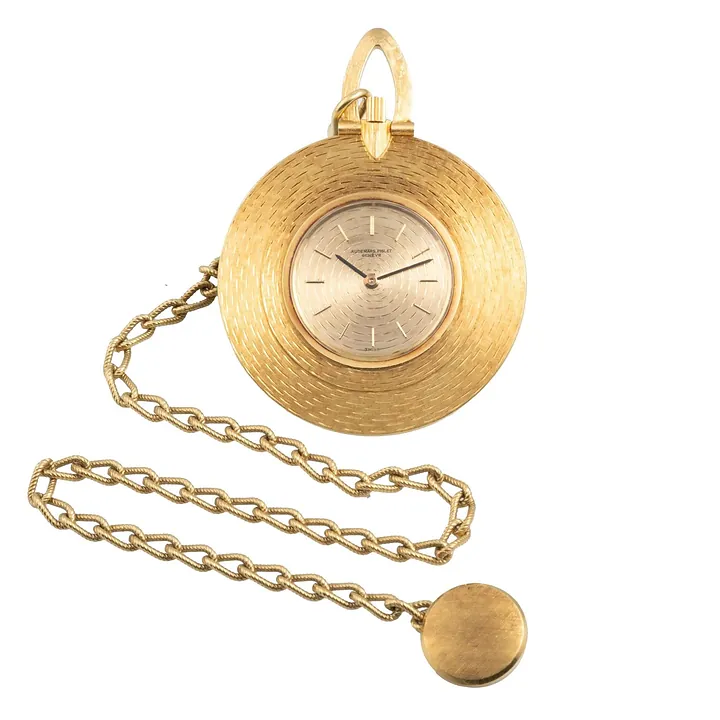
Pocket Watches · originally sold in November 1961 (per the lot record)
Audemars Piguet "extra Plate", ref. 5633 BA, originally sold in November 1961
Antiquorum auction archive, Geneva

Pocket Watches · c. 1980
Audemars Piguet pocket watch, c. 1980
Antiquorum auction archive, Geneva

Wristwatches · 1970
Wristwatch by Heno, Switzerland, 1970
Museum Rotterdam

Wristwatches · 1960–1986
'Tri-Compax' calendar chronograph wristwatch in gold case, by Universal, Geneva, Switzerland, 1960–1986.
Science Museum Group, London

Wristwatches · 1969–1970
Beta 21 Quartz wristwatch movement, made in Switzerland, 1970.
Science Museum Group, London

Wristwatches · c. 1969
Omega Speedmaster Moonwatch, ref. 145022-69st, c. 1969
Antiquorum auction archive, Geneva