

Wristwatches · Wristwatch
Audemars Piguet Royal Oak 25572ST Day-Date Owl White MK1 Dial, 1985
- Maker / attribution
- Audemars Piguet (maker)
- Date
- 1985
- Historical period
- Quartz Revolution (1969 – 1990)
- Country of origin
- Switzerland
- Object type
- Wristwatch
- Dimensions
- Case 36 mm
- Stock no.
- W-3824
- Credit line
- Dealer listing, Bulang & Sons (W-3824)
- Catalogue title (original)
- Audemars Piguet Royal Oak 25572ST Day-Date Owl White MK1 Dial (English)
View the source record (dealer listing) ↗ (opens another website in a new tab)Suggest a correction
Record summary
Catalogued by Bulang & Sons (dealer), Copenhagen (stock number W-3824), this is a wristwatch by Audemars Piguet, made in Switzerland, dated 1985. The Atlas places it in the Quartz Revolution period (1969 – 1990) of its Wristwatches collection. Recorded dimensions: Case 36 mm. The record is illustrated with 6 photographs.
Assembled from the source record's structured fields. Dates and attributions are given as the source states them; where a field is missing the Atlas leaves it blank rather than estimating.
Catalogue description
Dealer description — Bulang & Sons
On the eve of the 1972 Basel Fair, the managing director of Audemars Piguet contacted legendary designer Gérald Gentawith what seemed like an impossible request: to create a completely new kind of luxury sports watch in stainless steel — overnight. Presented here is the exceptional Audemars Piguet Royal Oak Reference 25572ST, a 36 mm Royal Oak reference that we have always particularly admired for its balanced proportions and the wonderfully quirky yet elegant day-date display. This reference was the first Royal Oak to feature a calendar complication, initially introduced in 1983 under reference 5572 before being renamed 25572 one year later. Production numbers remained extremely limited, with only approximately 1,770 examples manufactured in total — of which just 576 were produced in stainless steel — making this a genuinely rare Royal Oak reference. Combined with its slightly thicker case profile and crisp white dial, this remains one of our favourite Royal Oaks currently available on the market. The white Petite Tapisserie dial is preserved in outstanding condition and offers beautiful symmetry through the placement of the sub-dials and signature AP details. The case and bezel remain sharp throughout, while the integrated bracelet is also presented in excellent condition and comfortably fits wrists up to approximately 18.5 cm. Powering the watch is the automatic Audemars Piguet Calibre 2124, which has been fully serviced by our watchmaker and is ready to be enjoyed for years to come. It’s no secret that we are long-term fans of the 36mm AP Royal Oaks – read about our love for them here . A wonderfully charismatic Royal Oak that perfectly balances sportiness and elegance , we love these ! Specifications: Audemars Piguet Royal Oak Reference 25572ST 36mm steel case with integrated bracelet Production number 12xx / D-27xxx dating to 1985 MK1 white Petit tapisserie dial Day and date indicator sub dials Calibre 2124 automatic movement Fully serviced by our watchmaker
Historical context
Quartz Revolution (1969 – 1990)
Seiko's Astron begins mass quartz timekeeping; traditional industries contract sharply.
Quartz and digital watches transformed the market after 1969. Swiss employment collapsed, Japanese and Hong Kong production soared, and the Swatch (1983) helped the Swiss industry recover; mechanical watches survived as luxury goods.
Read the period in the timelineMore wristwatches from this periodEarlier: Modern Mechanical Horology
Atlas type guide
Calendar, moon-phase and perpetual calendar watches
Calendar complications range from a simple date to the perpetual calendar, which automatically allows for months of different lengths and leap years until 2100. Pocket watches with perpetual calendars were made in the eighteenth and nineteenth centuries; Patek Philippe made the first perpetual calendar wristwatch in 1925, and series production followed in 1941. The annual calendar (Patek Philippe, 1996) needs correction only once a year.
Moon-phase displays use a disc with two moons and 59 teeth advanced daily, approximating the 29.5-day lunation; more precise trains reduce the error to one day in over a century.
What to look for
- Apertures or subsidiary dials for day, date, month and leap year.
- Moon disc under a 'bosom' shaped aperture.
- Recessed correctors on the case band for setting the calendar.
Dating clues
- Triple-date wristwatches: popular c. 1940–1955.
- Perpetual calendar wristwatches: from 1925 (unique) and 1941 (series).
General guidance written by the Atlas editors about this kind of object. It is not a statement about this particular piece; for that, rely on the source record above and on physical examination.
Related records

Clocks · c. 1990s
Audemars Piguet Royal Oak, c. 1990s
Antiquorum auction archive, Geneva
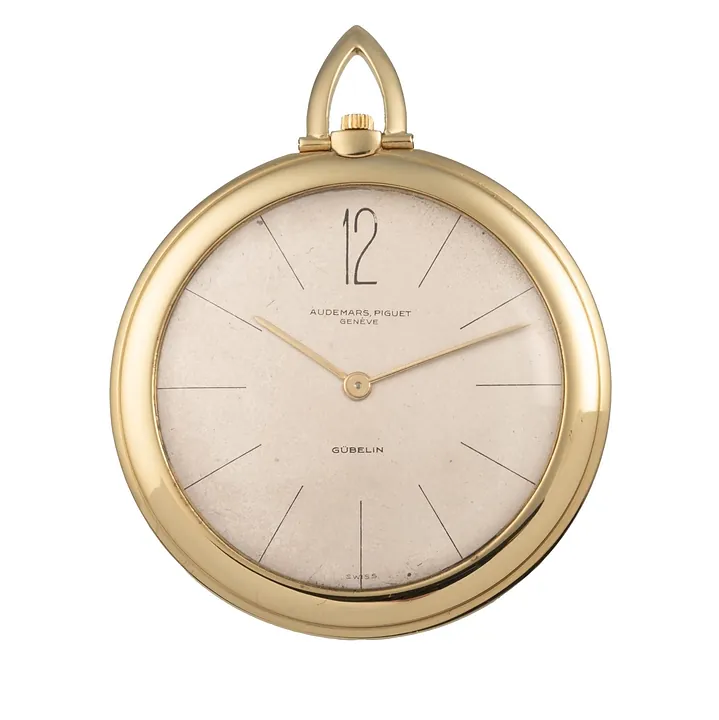
Pocket Watches · c. 1960
Audemars Piguet ''couteau'', c. 1960
Antiquorum auction archive, Geneva
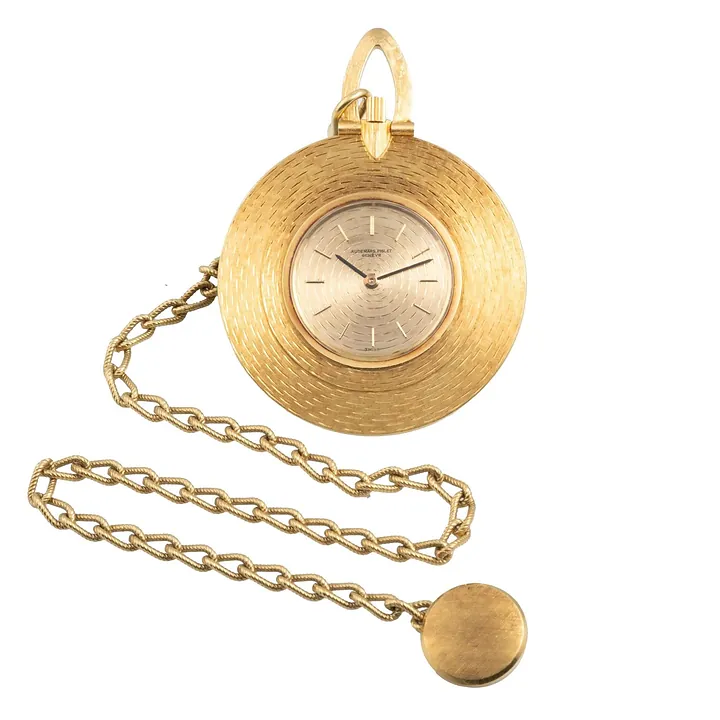
Pocket Watches · originally sold in November 1961 (per the lot record)
Audemars Piguet "extra Plate", ref. 5633 BA, originally sold in November 1961
Antiquorum auction archive, Geneva
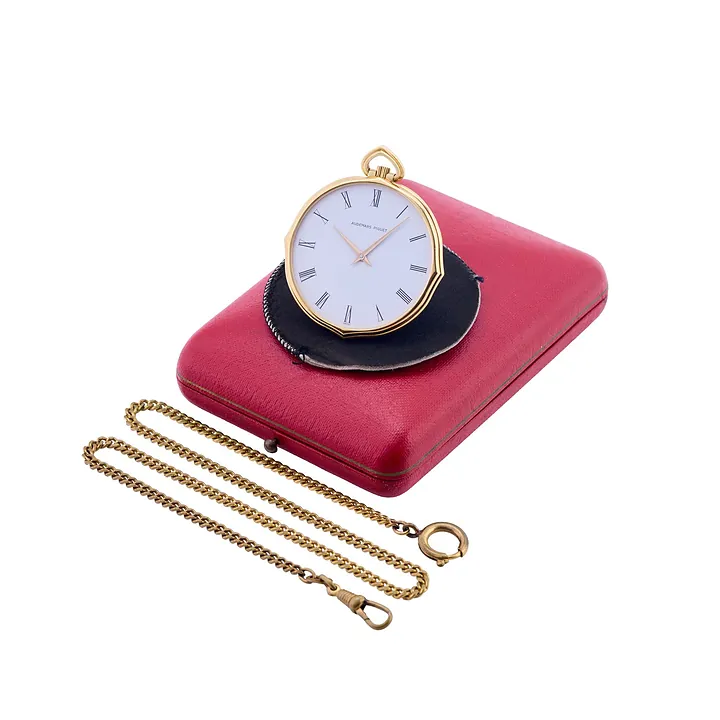
Pocket Watches · c. 1980
Audemars Piguet pocket watch, c. 1980
Antiquorum auction archive, Geneva

Wristwatches · 1970
Wristwatch by Heno, Switzerland, 1970
Museum Rotterdam

Wristwatches · 1960–1986
'Tri-Compax' calendar chronograph wristwatch in gold case, by Universal, Geneva, Switzerland, 1960–1986.
Science Museum Group, London

Wristwatches · 1969–1970
Beta 21 Quartz wristwatch movement, made in Switzerland, 1970.
Science Museum Group, London

Wristwatches · c. 1969
Omega Speedmaster Moonwatch, ref. 145022-69st, c. 1969
Antiquorum auction archive, Geneva