
Wristwatches · Wristwatch
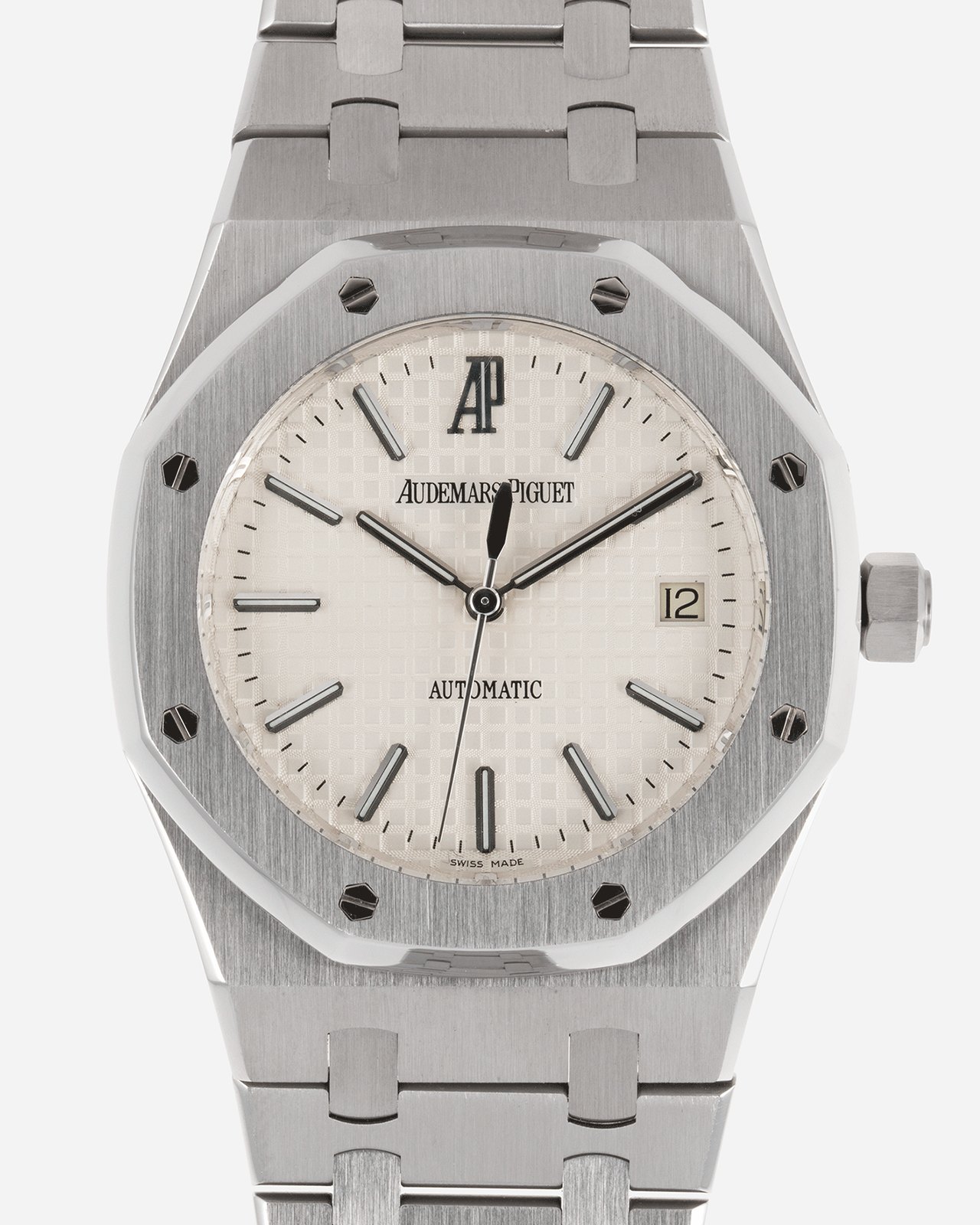
Audemars Piguet Royal Oak 15300ST White, 2012
- Maker / attribution
- Audemars Piguet (maker)
- Date
- 2012
- Historical period
- Contemporary Horology (2010 – Present)
- Country of origin
- Switzerland
- Object type
- Wristwatch
- Dimensions
- Case 39 mm
- Stock no.
- Product 6615370661975
- Credit line
- Dealer listing, S.Song Watches (product 6615370661975)
- Catalogue title (original)
- Audemars Piguet Royal Oak 15300ST White (English)
View the source record (dealer listing) ↗ (opens another website in a new tab)Suggest a correction
Record summary
Catalogued by S.Song Watches (dealer), Seattle (stock number Product 6615370661975), this is a wristwatch by Audemars Piguet, made in Switzerland, dated 2012. The Atlas places it in the Contemporary Horology period (2010 – Present) of its Wristwatches collection. Recorded dimensions: Case 39 mm. The record is illustrated with 6 photographs.
Assembled from the source record's structured fields. Dates and attributions are given as the source states them; where a field is missing the Atlas leaves it blank rather than estimating.
Catalogue description
Dealer description — S.Song Watches
Arguably one of the most iconic watches of all time, the Audemars Piguet Royal Oak's reputation precedes itself within watch collecting circles. Released to fight the Quartz Crisis in the 70s, the Royal Oak's avant-garde design and unconventional case as a stainless steel luxury sports watch from a traditional member of the Holy Trinity shocked the watchmaking world enough that brands quickly followed and brought out their own versions. Originally weighing in at 39mm, the Royal Oak's massive, for the time case was a hard pill to swallow for a customer base used to smaller dress watches. But, alas, the Royal Oak eventually found widespread success as collectors began to see the merit in its unusual integrated bracelet, exposed screw-laden octagonal bezel, and Petite Tapisserie dial. Following its success, Audemars Piguet has continued the collection with several evolutions through the decades, with the ref. 15300ST merging the collection's original design with modern watchmaking mechanics. Released in the early 2000s, the ref. 15300ST introduced an in-house movement for the first time in the collection's history while retaining the original's 39mm case size and Petite Tapisserie dial. Powered by the cal. 3120, the ref. 15300ST was a serious engineering step-up from the Royal Oaks of the past with an impressive 60-hours of power reserve stemming from a single barrel and a Gyromax balance. Featuring a balance bridge – not a balance cock as was used in the past (and still to this day in models like the ref. 15202), the cal. 3120 is suitable as a genuine sports watch movement. As the balance assembly is anchored to two points in the movement, the cal. 3120 is a significant improvement on the single-anchor design that balance cock-set movements employ as it is far more stable. Furthermore, the cal. 3120 features a date mechanism equipped with a safety system that prevents the date disk from malfunctioning if the user resets the date at midnight. Featuring a bright white dial, the variant I have here is a monochromatic stunner as its finely polished and satin-brushed stainless steel construction highlights the array of shapes and shadows case by its "Petite Tapisserie" pattern. A modern take on an iconic design, the ref. 15300ST blends legendary design with modern creature comforts with great effect. While since then the 15300 has been succeeded by the 15400 and the most recent 15500, the original 39mm sizing remains a collector favorite as supposed to the newer 41mm sizing. I do believe that this is because it is not only faithful to the original but also because the proportions seem to work much better in this dimension.
Historical context
Contemporary Horology (2010 – Present)
Silicon components, connected watches, optical-lattice research clocks and a thriving independent scene.
Smartwatches became the world's best-selling watches, while mechanical watchmaking focuses on craft, innovation (silicon components, new escapements) and independent makers.
Read the period in the timelineMore wristwatches from this periodEarlier: Mechanical Renaissance
Atlas type guide
Wristwatches
Bracelet watches were worn by women from the early nineteenth century — Breguet made one for Caroline Murat, Queen of Naples, in 1810–12 — but the wristwatch only became a man's instrument with military use and aviation in the early twentieth century. Between the World Wars it overtook the pocket watch; the 1920s and 1930s brought rectangular Art Deco cases, water-resistant cases and the first automatic winding systems.
After 1945 the wristwatch became a carrier of identity — dress watches, sports and dive watches, chronographs, calendars — produced by Swiss, American, Japanese, German, Soviet and Chinese industries. The quartz revolution after 1969 and the mechanical renaissance since the 1990s, including the rise of independent watchmakers, complete the story.
What to look for
- The reference number (between the lugs or inside the case back) and serial number, the starting point for dating.
- The calibre: its maker and number are often stamped under the dial or on the bridge.
- Originality of dial, hands and crown — refinished ('redial') dials are common.
- Case material marks: 18K/750, 14K/585, stainless steel, gold-filled, plated.
Dating clues
- Wire-lug cases: before c. 1925.
- Water-resistant screw-down cases: from 1926.
- Quartz movements: from 1969; sapphire crystals widespread after c. 1980.
General guidance written by the Atlas editors about this kind of object. It is not a statement about this particular piece; for that, rely on the source record above and on physical examination.
Related records

Clocks · c. 1990s
Audemars Piguet Royal Oak, c. 1990s
Antiquorum auction archive, Geneva

Pocket Watches · c. 1960
Audemars Piguet ''couteau'', c. 1960
Antiquorum auction archive, Geneva
Pocket Watches · originally sold in November 1961 (per the lot record)
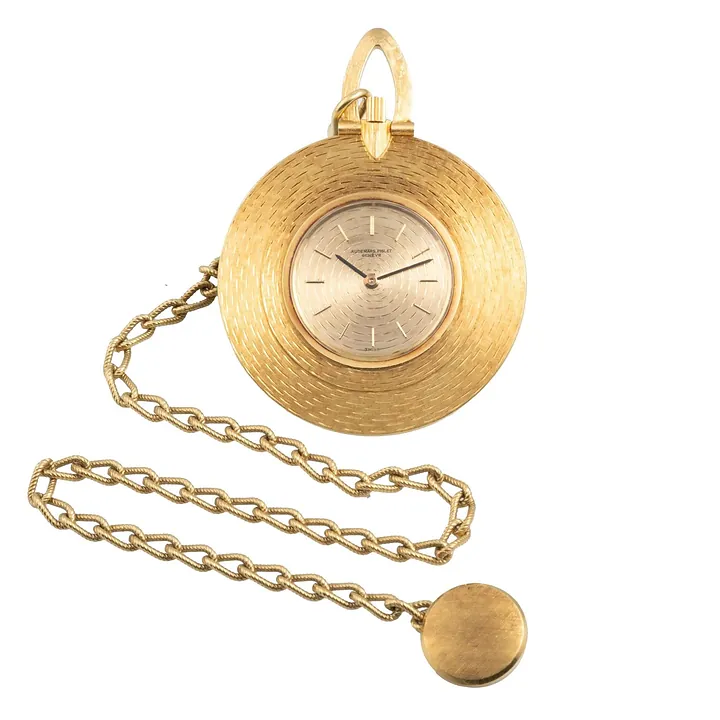
Audemars Piguet "extra Plate", ref. 5633 BA, originally sold in November 1961
Antiquorum auction archive, Geneva

Pocket Watches · c. 1980
Audemars Piguet pocket watch, c. 1980
Antiquorum auction archive, Geneva

Wristwatches · c. 2010s
Breguet Type XXI, ref. 3810, c. 2010s (Antiquorum Lot 381-24)
Antiquorum auction archive, Geneva

Wristwatches · c. 2010s
Breguet Type XXI, ref. 3810, c. 2010s (Antiquorum Lot 386-229)
Antiquorum auction archive, Geneva

Wristwatches · Sold in September 2010
Breitling Cosmonaute, ref. A 22322, Sold in September 2010
Antiquorum auction archive, Geneva

Wristwatches · c. 2010
Corum Bubble Chrono, ref. 396.150.20, c. 2010
Antiquorum auction archive, Geneva