

Wristwatches · Wristwatch
Audemars Piguet Royal Oak, ref. 14790ST, Mk 1, 1992
- Maker / attribution
- Audemars Piguet (maker)
- Date
- 1992
- Historical period
- Mechanical Renaissance (1990 – 2010)
- Country of origin
- Switzerland
- Object type
- Wristwatch
- Dimensions
- Case 36 mm
- Stock no.
- W-2462
- Credit line
- Dealer listing, Bulang & Sons (W-2462)
- Catalogue title (original)
- Audemars Piguet Royal Oak 14790ST rare MK1 Box and Papers Set (English)
Editor's note
Dealer sales wording ('rare', 'box and papers set') removed from the title.View the source record (dealer listing) ↗ (opens another website in a new tab)Suggest a correction
Record summary
Catalogued by Bulang & Sons (dealer), Copenhagen (stock number W-2462), this is a wristwatch by Audemars Piguet, made in Switzerland, dated 1992. The Atlas places it in the Mechanical Renaissance period (1990 – 2010) of its Wristwatches collection. Recorded dimensions: Case 36 mm. The record is illustrated with 6 photographs.
Assembled from the source record's structured fields. Dates and attributions are given as the source states them; where a field is missing the Atlas leaves it blank rather than estimating.
Catalogue description
Dealer description — Bulang & Sons
We make no secret of our love for what are known as the mid-size Royal Oaks. Especially when they are a little more special, like this very rare MK1, the first and rarest of all the three generations and was only in production for one year! This specific example even comes with the original guarantee booklet, boxes and even the hangtag! This Royal Oak 14790ST is a steel execution remaining in really great condition with a super minty case. The Mk1 black petit tapisserie dial is beautiful and features the small straight AUDEMARS PIGUET signature that defines the MK1 from the later versions. This is still the old style dial seen in earlier references like the ref 4100. They are super cool on the wrist and are still a good buy in this market. We love the bold sporty look of these watches, that wear much larger than the 36mm size would suggest. The bracelet is in great condition and will fit a wrist size up to 18.5cm. This funky AP comes with both inner and outer boxes, hangtag , booklets and original guarantee book. The watch has the calibre 2225 automatic movement, a modified Jaeger LeCoultre movement, which has been fully serviced by our watchmaker. You should check out our magazine article about these lovely Royal Oaks here . Be quick though, this won’t hang around for long! Specifications: - Reference 14790ST - 36mm steel case - Serial D17xxx movement serial 377xxx - dating to 1992 - Black MK1 petit tapisserie dial - Original guarantee booklet - Inner and outer boxes , hangtag, booklets - Steel integrated bracelet - Calibre 2225 automatic movement - Fully serviced by our watchmaker - Includes a handmade leather watch pouch
Historical context
Mechanical Renaissance (1990 – 2010)
Mechanical watches return as cultural objects; independent watchmaking flourishes.
Mechanical watches returned as cultural and luxury objects. Complications, tourbillons and new materials proliferated; independent watchmakers such as George Daniels, F.P. Journe and Philippe Dufour revived artisanal watchmaking; collecting vintage watches became a major field.
Read the period in the timelineMore wristwatches from this periodEarlier: Quartz Revolution
Atlas type guide
Wristwatches
Bracelet watches were worn by women from the early nineteenth century — Breguet made one for Caroline Murat, Queen of Naples, in 1810–12 — but the wristwatch only became a man's instrument with military use and aviation in the early twentieth century. Between the World Wars it overtook the pocket watch; the 1920s and 1930s brought rectangular Art Deco cases, water-resistant cases and the first automatic winding systems.
After 1945 the wristwatch became a carrier of identity — dress watches, sports and dive watches, chronographs, calendars — produced by Swiss, American, Japanese, German, Soviet and Chinese industries. The quartz revolution after 1969 and the mechanical renaissance since the 1990s, including the rise of independent watchmakers, complete the story.
What to look for
- The reference number (between the lugs or inside the case back) and serial number, the starting point for dating.
- The calibre: its maker and number are often stamped under the dial or on the bridge.
- Originality of dial, hands and crown — refinished ('redial') dials are common.
- Case material marks: 18K/750, 14K/585, stainless steel, gold-filled, plated.
Dating clues
- Wire-lug cases: before c. 1925.
- Water-resistant screw-down cases: from 1926.
- Quartz movements: from 1969; sapphire crystals widespread after c. 1980.
General guidance written by the Atlas editors about this kind of object. It is not a statement about this particular piece; for that, rely on the source record above and on physical examination.
Related records
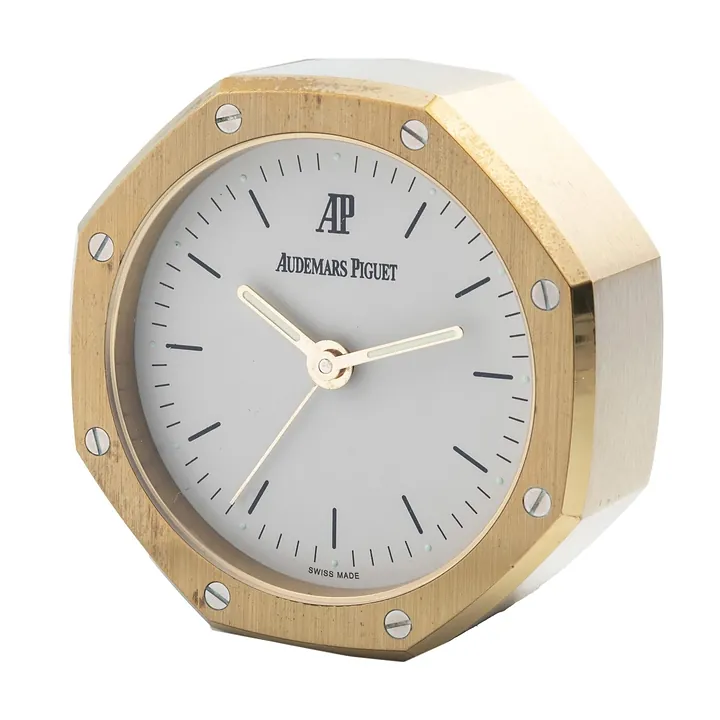
Clocks · c. 1990s
Audemars Piguet Royal Oak, c. 1990s
Antiquorum auction archive, Geneva
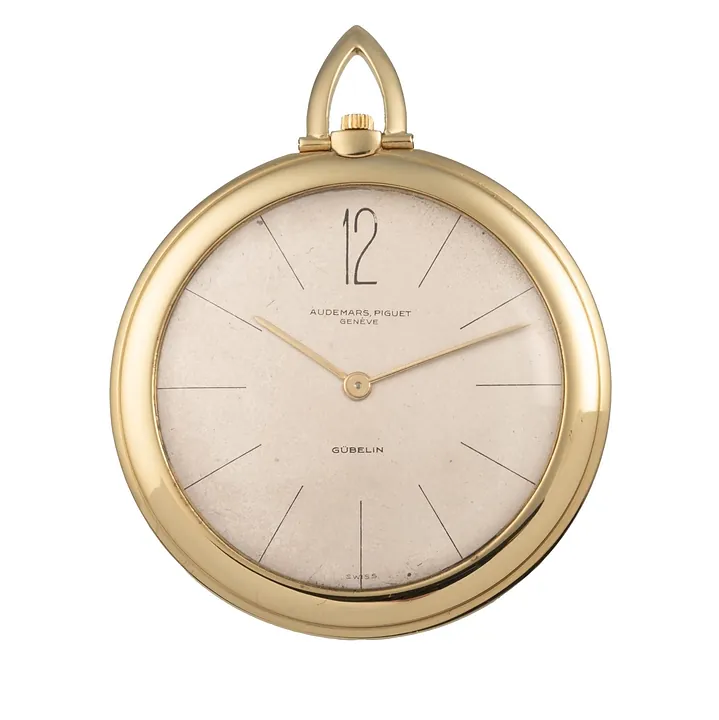
Pocket Watches · c. 1960
Audemars Piguet ''couteau'', c. 1960
Antiquorum auction archive, Geneva
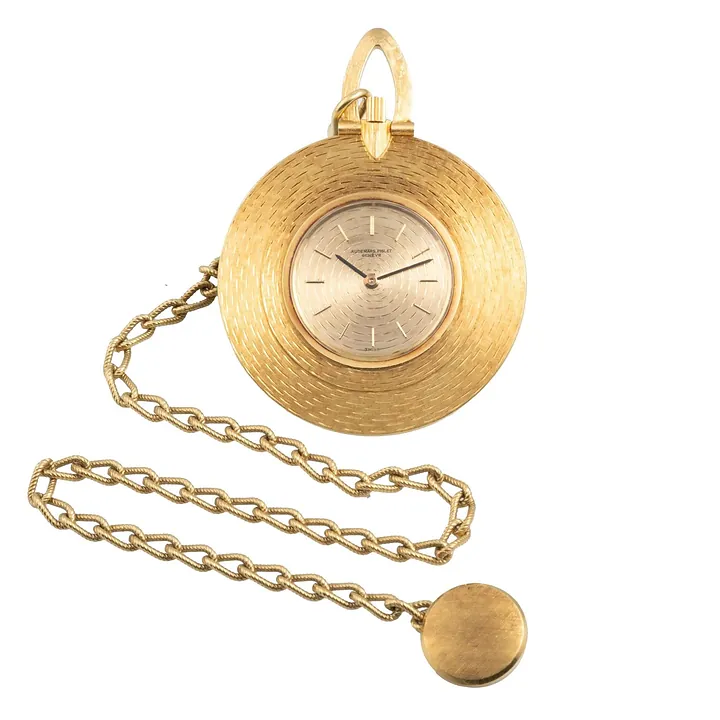
Pocket Watches · originally sold in November 1961 (per the lot record)
Audemars Piguet "extra Plate", ref. 5633 BA, originally sold in November 1961
Antiquorum auction archive, Geneva
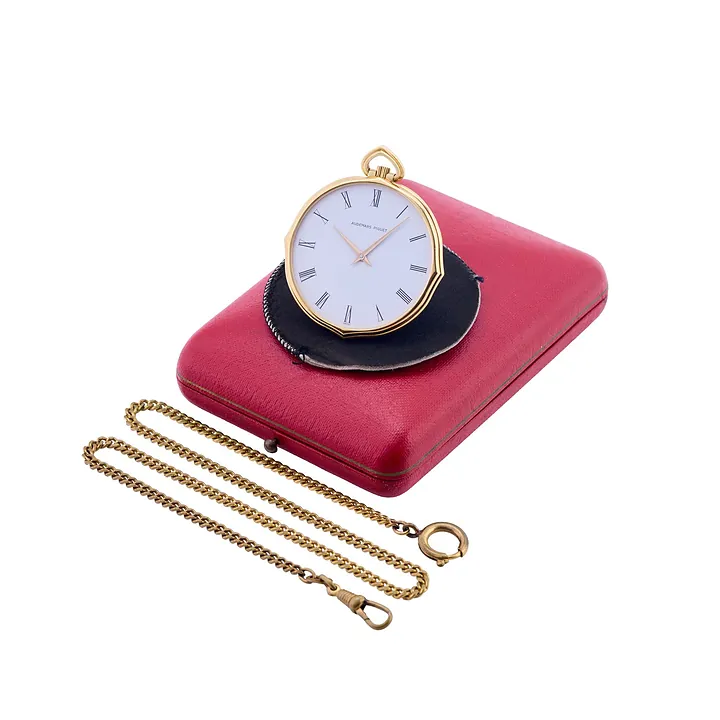
Pocket Watches · c. 1980
Audemars Piguet pocket watch, c. 1980
Antiquorum auction archive, Geneva

Wristwatches · 2008
Wristwatch by Breitling?, 2008
Museum Rotterdam

Wristwatches · c. 1990s
Audemars Piguet Bamboo, c. 1990s
Antiquorum auction archive, Geneva

Wristwatches · c. 1990
Audemars Piguet Huitieme Perpetual Calendar, ref. 25696PT, c. 1990
Antiquorum auction archive, Geneva

Wristwatches · c. 1990
Breitling Chronomat, ref. b13050.1, c. 1990
Antiquorum auction archive, Geneva