
Wristwatches · Wristwatch
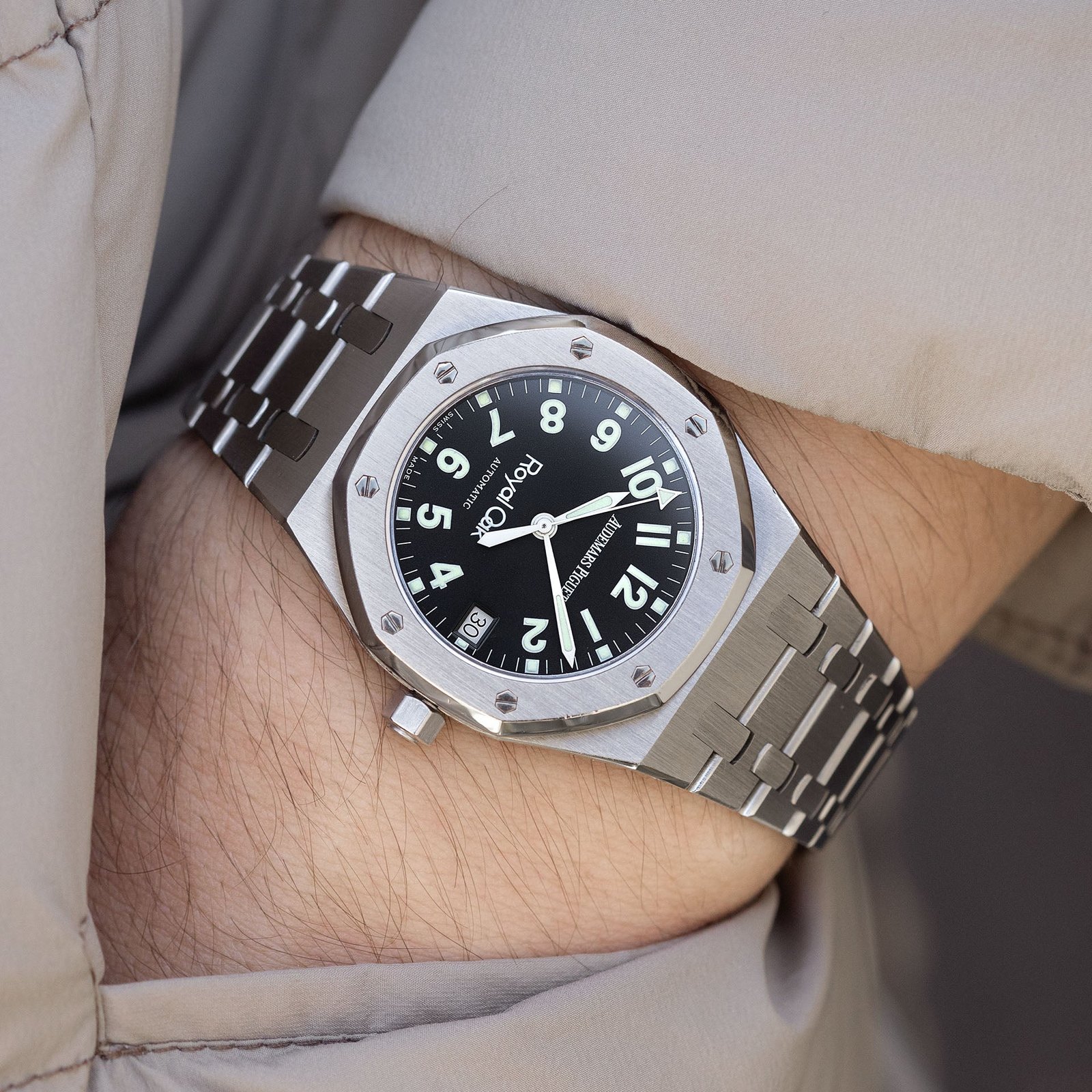
Audemars Piguet Royal-Oak 14790ST Military Dial, late 1990s
- Maker / attribution
- Audemars Piguet (maker)
- Date
- late 1990s
- Historical period
- Mechanical Renaissance (1990 – 2010)
- Country of origin
- Switzerland
- Object type
- Wristwatch
- Dimensions
- Case 39 mm
- Stock no.
- W-3984
- Credit line
- Dealer listing, Bulang & Sons (W-3984)
- Catalogue title (original)
- Audemars Piguet Royal-Oak 14790ST Military Dial (English)
View the source record (dealer listing) ↗ (opens another website in a new tab)Suggest a correction
Record summary
Catalogued by Bulang & Sons (dealer), Copenhagen (stock number W-3984), this is a wristwatch by Audemars Piguet, made in Switzerland, dated late 1990s. The Atlas places it in the Mechanical Renaissance period (1990 – 2010) of its Wristwatches collection. Recorded dimensions: Case 39 mm. The record is illustrated with 6 photographs.
Assembled from the source record's structured fields. Dates and attributions are given as the source states them; where a field is missing the Atlas leaves it blank rather than estimating.
Catalogue description
Dealer description — Bulang & Sons
The Royal Oak ref. 14790 is one of those watches that proves you don't need 39mm to make a statement. This steel example remains in really beautiful condition, with a sharp case and strong lines throughout. What sets this one apart is the so-called military dial, featuring bold luminous Arabic numerals arranged radially around the dial and a set of seriously cool sword hands. An unusual configuration that gives the watch a distinctly sporty character. Even more interesting, the dial bears the Royal Oak name, a detail found on only a small number of these models. We have a real soft spot for these mid-size Royal Oaks. Despite measuring 36mm, the combination of the angular case, integrated bracelet and bold dial gives them a surprisingly substantial wrist presence. Under the hood sits the automatic calibre 2225, based on a Jaeger-LeCoultre movement and fully serviced by our watchmaker. The integrated bracelet is in excellent, tight condition and currently fits wrists up to approximately 18.5cm. A seriously cool and somewhat unconventional take on the Royal Oak. We have never hidden our love for the mid-size references, and this military-dial example is exactly the kind of watch that reminds us why. A military dial, sharp steel and serious wrist presence. A Royal Oak with a difference. Specifications: Audemars Piguet Royal Oak Reference 14790ST 36mm steel case Serial 46xx and E-29xxx dates to the late 1990s Black bold Arabic numerals dial Steel integrated bracelet Calibre 2225 automatic movement Fully serviced by our watchmaker
Historical context
Mechanical Renaissance (1990 – 2010)
Mechanical watches return as cultural objects; independent watchmaking flourishes.
Mechanical watches returned as cultural and luxury objects. Complications, tourbillons and new materials proliferated; independent watchmakers such as George Daniels, F.P. Journe and Philippe Dufour revived artisanal watchmaking; collecting vintage watches became a major field.
Read the period in the timelineMore wristwatches from this periodEarlier: Quartz Revolution
Atlas type guide
Military, pilot and travel watches
The wristwatch owes much of its adoption by men to warfare and aviation. Wristlets — small pocket watches soldered with lugs and worn on a strap — were used in colonial campaigns and became standard equipment in the First World War, with protective grilles over the crystal ('shrapnel guards'). Louis Cartier's Santos (1904), designed for the aviator Alberto Santos-Dumont, is often cited as an early purpose-made pilot's watch.
In the Second World War governments specified watches in detail: the German B-Uhr observation watches, the American A-11, and the British 'W.W.W.' (the 'Dirty Dozen' set of 1945). After the war, jet travel brought GMT and world-time watches, which show two or more time zones at once — Louis Cottier's world-time mechanism and the Rolex GMT-Master (1955) are examples.
What to look for
- Military markings on the case back: broad arrow, issue numbers, 'W.W.W.', 'A.T.P.'
- High-legibility black dials with luminous Arabic numerals; oversized crowns for gloved hands.
- 24-hour hands and rotating 24-hour bezels or city rings on GMT/world-time watches.
- Wire lugs on early wristlets converted from pocket watches.
Dating clues
- Wire-lug wristlets: c. 1900–1925.
- Military specifications of the Second World War: 1939–1945.
- GMT and world-time wristwatches: mainly after 1950.
General guidance written by the Atlas editors about this kind of object. It is not a statement about this particular piece; for that, rely on the source record above and on physical examination.
Related records
Clocks · c. 1990s
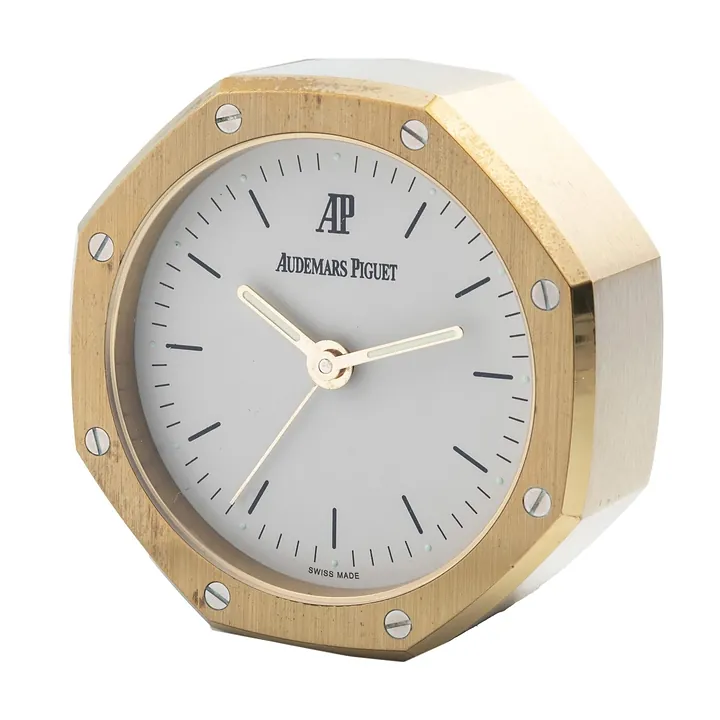
Audemars Piguet Royal Oak, c. 1990s
Antiquorum auction archive, Geneva
Pocket Watches · c. 1960
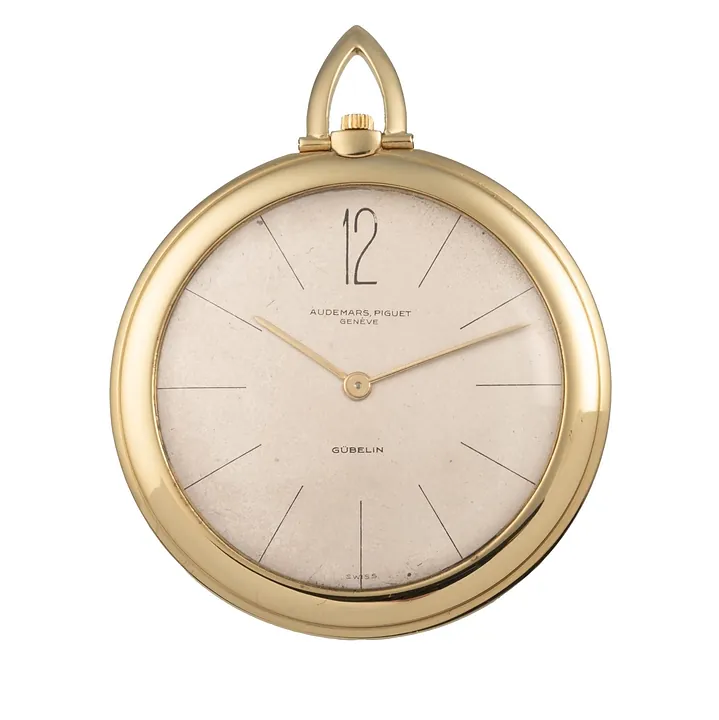
Audemars Piguet ''couteau'', c. 1960
Antiquorum auction archive, Geneva
Pocket Watches · originally sold in November 1961 (per the lot record)
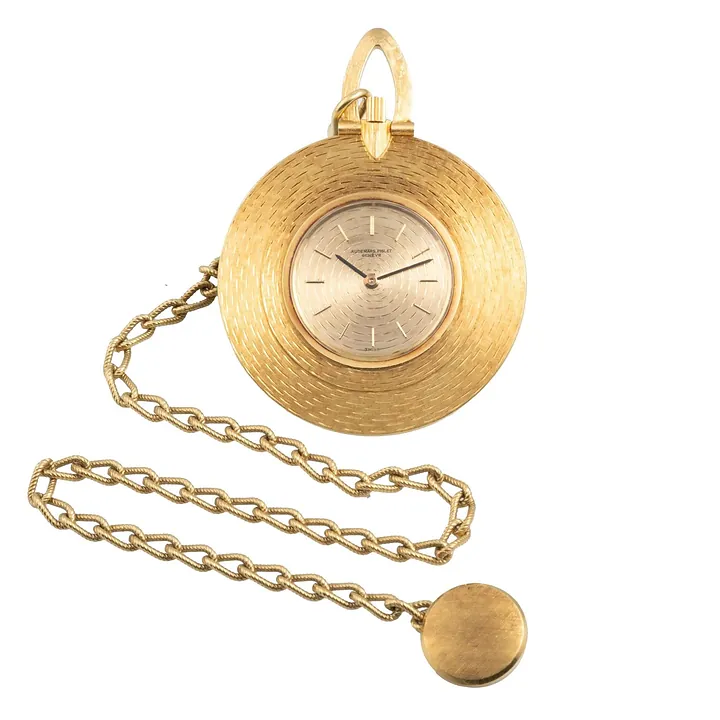
Audemars Piguet "extra Plate", ref. 5633 BA, originally sold in November 1961
Antiquorum auction archive, Geneva
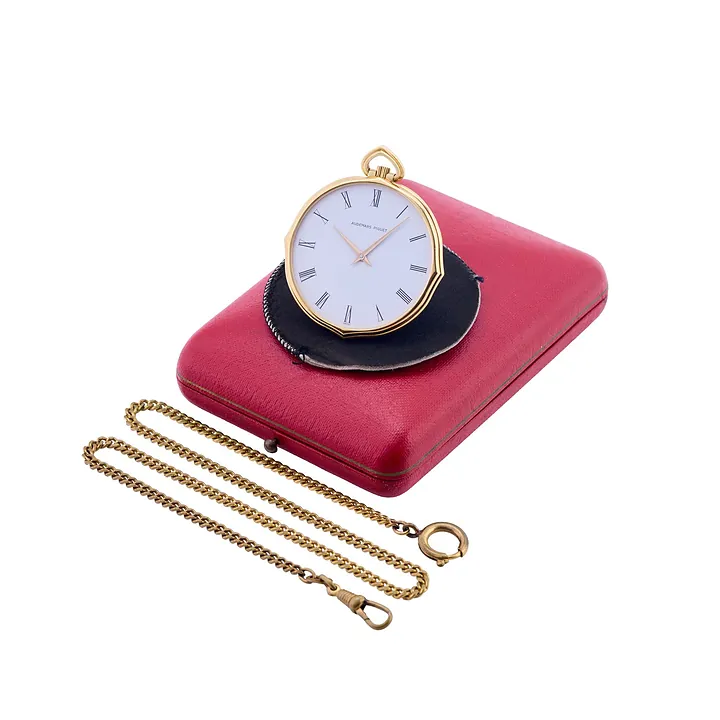
Pocket Watches · c. 1980
Audemars Piguet pocket watch, c. 1980
Antiquorum auction archive, Geneva

Wristwatches · 2008
Wristwatch by Breitling?, 2008
Museum Rotterdam

Wristwatches · c. 1990s
Audemars Piguet Bamboo, c. 1990s
Antiquorum auction archive, Geneva

Wristwatches · c. 1990
Audemars Piguet Huitieme Perpetual Calendar, ref. 25696PT, c. 1990
Antiquorum auction archive, Geneva

Wristwatches · c. 1990
Breitling Chronomat, ref. b13050.1, c. 1990
Antiquorum auction archive, Geneva