
Wristwatches · Wristwatch
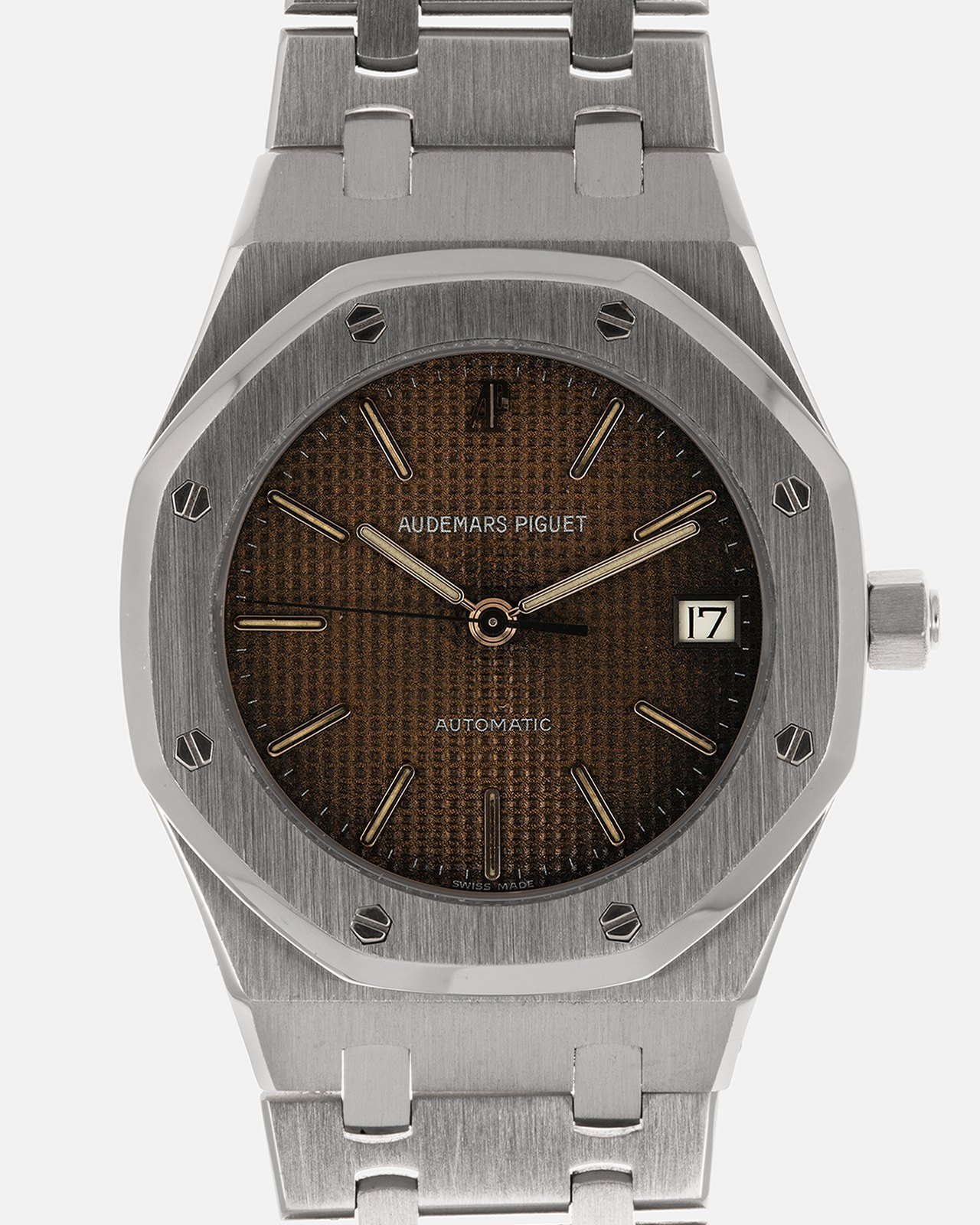
Audemars Piguet Royal Oak 14790ST First Series Tropical, 1990s
- Maker / attribution
- Audemars Piguet (maker)
- Date
- 1990s
- Historical period
- Mechanical Renaissance (1990 – 2010)
- Country of origin
- Switzerland
- Object type
- Wristwatch
- Dimensions
- Case 36 mm
- Stock no.
- Product 7354479018071
- Credit line
- Dealer listing, S.Song Watches (product 7354479018071)
- Catalogue title (original)
- Audemars Piguet Royal Oak 14790ST First Series Tropical (English)
View the source record (dealer listing) ↗ (opens another website in a new tab)Suggest a correction
Record summary
Catalogued by S.Song Watches (dealer), Seattle (stock number Product 7354479018071), this is a wristwatch by Audemars Piguet, made in Switzerland, dated 1990s. The Atlas places it in the Mechanical Renaissance period (1990 – 2010) of its Wristwatches collection. Recorded dimensions: Case 36 mm. The record is illustrated with 6 photographs.
Assembled from the source record's structured fields. Dates and attributions are given as the source states them; where a field is missing the Atlas leaves it blank rather than estimating.
Catalogue description
Dealer description — S.Song Watches
The Royal Oak, with its masculine octagonal case, exposed screws, and integrated bracelet is one of the most distinctive watches in the market today. It is imposing and recognizable, and in my opinion, one of the best statement watches money can buy. On top of this, with the current craze for integrated bracelet sports watches and many brands producing their own version, it was the Royal Oak that started it all. While it has always been about the ‘Jumbo’ or larger-sized Royal Oaks, in recent times, there has been a growing appreciation for mid-sized examples, namely what you see here today, the Ref. 14790. This is certainly in line with the large watch trend ending as collectors are beginning to appreciate proportionate and more elegantly sized watches. Released in 1992, the Ref. 14790 was the poster child reference of mid-size Royal Oaks, staying in production far longer than any others, only being discontinued in 2006. Featuring a beautifully balanced 36mm case, the Ref. 14790 sits fantastically on the wrist and is certainly not too small even by modern standards. Diving deeper into what makes this particular example especially unique, this is a Ref. 14790ST in stainless steel. It is identified as an early first-series Royal Oak with a D serial, featuring a Mk 1 dial with its distinct signature text font, long applied indices, the ‘Swiss Made’ stamping at 6:00, and the petite tapisserie motif. It is worth noting, however, that the handset fitted on this example is a thicker variant, typically found in the subsequent series. That being said, these thicker handsets were also used as service parts by Audemars Piguet, which explains why they sometimes appear fitted on some earlier examples of the Ref. 14790ST, possibly including this one. As for its iconic integrated bracelet, the links on first-series Ref. 14790STs are typically held together by two individual screws on each side and feature a hollow-style clasp resembling a ladder. The outer part of the clasp is stamped with ‘Swiss Made’ and ‘Steel Inox,’ along with the Gay Frères logo between the two stamps. For those who may not be aware, Gay Frères is considered one of the most legendary bracelet makers of the 20th century, having produced some of the most beautiful bracelets for the famous Royal Oak and Nautilus, as well as more classic designs that accompanied some of the most sought-after Patek Philippe references. Powered by the in-house Audemars Piguet Cal. 2125 movement, the Ref. 14790ST features a 21-carat gold winding bidirectional winding rotor and a 40-hour power reserve on a full wind. Another point worth discussing is the Ref. 14790ST’s tropical dial. For those unfamiliar, the dials fitted to Ref. 14790STs were anodized, rather than painted, to achieve a grey-bluish hue. This anodization process makes the dial more susceptible to tropicalization, which leads to a dramatic colour change. In this case, the dial has transitioned from its original colour to a stunning mix of bronze and gold. In general, tropicalized dials on watches are quite sought after, though their desirability depends on the colour shade and overall condition. It’s important to note that no two tropical dials are identical, as the colour change is largely influenced by the environment in which the watch was kept and the elements it was exposed to, such as UV exposure, and tritium burns, among others. With its exceedingly rare provenance, beautifully tropicalized dial, and stunning proportions, this first series D-serial Ref. 14790ST will undoubtedly be an exquisite addition to even the most discerning Royal Oak collections. At a glance, one can tell that this 14790ST has likely lived a wild life—ah if only watches could talk; I'm sure this one would have plenty of stories to tell.
Historical context
Mechanical Renaissance (1990 – 2010)
Mechanical watches return as cultural objects; independent watchmaking flourishes.
Mechanical watches returned as cultural and luxury objects. Complications, tourbillons and new materials proliferated; independent watchmakers such as George Daniels, F.P. Journe and Philippe Dufour revived artisanal watchmaking; collecting vintage watches became a major field.
Read the period in the timelineMore wristwatches from this periodEarlier: Quartz Revolution
Atlas type guide
Wristwatches
Bracelet watches were worn by women from the early nineteenth century — Breguet made one for Caroline Murat, Queen of Naples, in 1810–12 — but the wristwatch only became a man's instrument with military use and aviation in the early twentieth century. Between the World Wars it overtook the pocket watch; the 1920s and 1930s brought rectangular Art Deco cases, water-resistant cases and the first automatic winding systems.
After 1945 the wristwatch became a carrier of identity — dress watches, sports and dive watches, chronographs, calendars — produced by Swiss, American, Japanese, German, Soviet and Chinese industries. The quartz revolution after 1969 and the mechanical renaissance since the 1990s, including the rise of independent watchmakers, complete the story.
What to look for
- The reference number (between the lugs or inside the case back) and serial number, the starting point for dating.
- The calibre: its maker and number are often stamped under the dial or on the bridge.
- Originality of dial, hands and crown — refinished ('redial') dials are common.
- Case material marks: 18K/750, 14K/585, stainless steel, gold-filled, plated.
Dating clues
- Wire-lug cases: before c. 1925.
- Water-resistant screw-down cases: from 1926.
- Quartz movements: from 1969; sapphire crystals widespread after c. 1980.
General guidance written by the Atlas editors about this kind of object. It is not a statement about this particular piece; for that, rely on the source record above and on physical examination.
Related records

Clocks · c. 1990s
Audemars Piguet Royal Oak, c. 1990s
Antiquorum auction archive, Geneva

Pocket Watches · c. 1960
Audemars Piguet ''couteau'', c. 1960
Antiquorum auction archive, Geneva
Pocket Watches · originally sold in November 1961 (per the lot record)
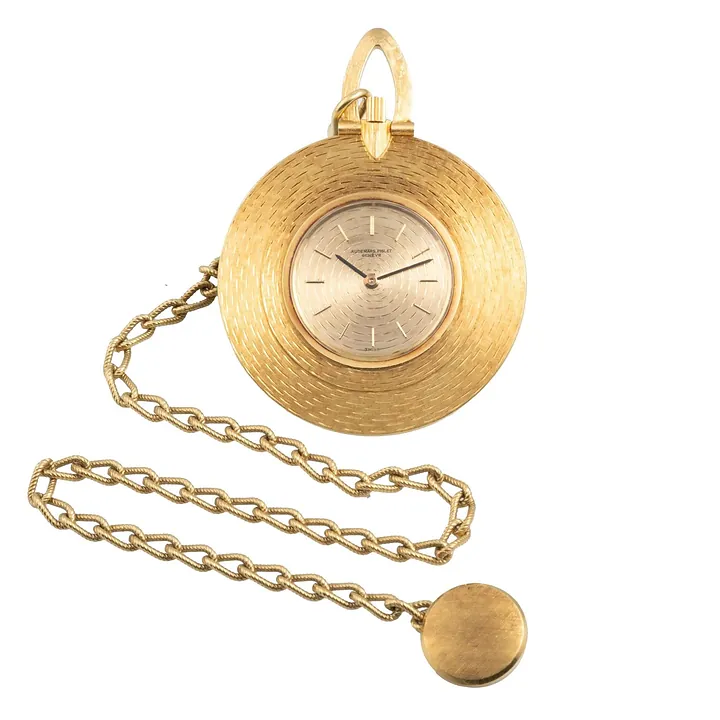
Audemars Piguet "extra Plate", ref. 5633 BA, originally sold in November 1961
Antiquorum auction archive, Geneva

Pocket Watches · c. 1980
Audemars Piguet pocket watch, c. 1980
Antiquorum auction archive, Geneva

Wristwatches · 2008
Wristwatch by Breitling?, 2008
Museum Rotterdam

Wristwatches · c. 1990s
Audemars Piguet Bamboo, c. 1990s
Antiquorum auction archive, Geneva

Wristwatches · c. 1990
Audemars Piguet Huitieme Perpetual Calendar, ref. 25696PT, c. 1990
Antiquorum auction archive, Geneva

Wristwatches · c. 1990
Breitling Chronomat, ref. b13050.1, c. 1990
Antiquorum auction archive, Geneva