
Wristwatches · Wristwatch
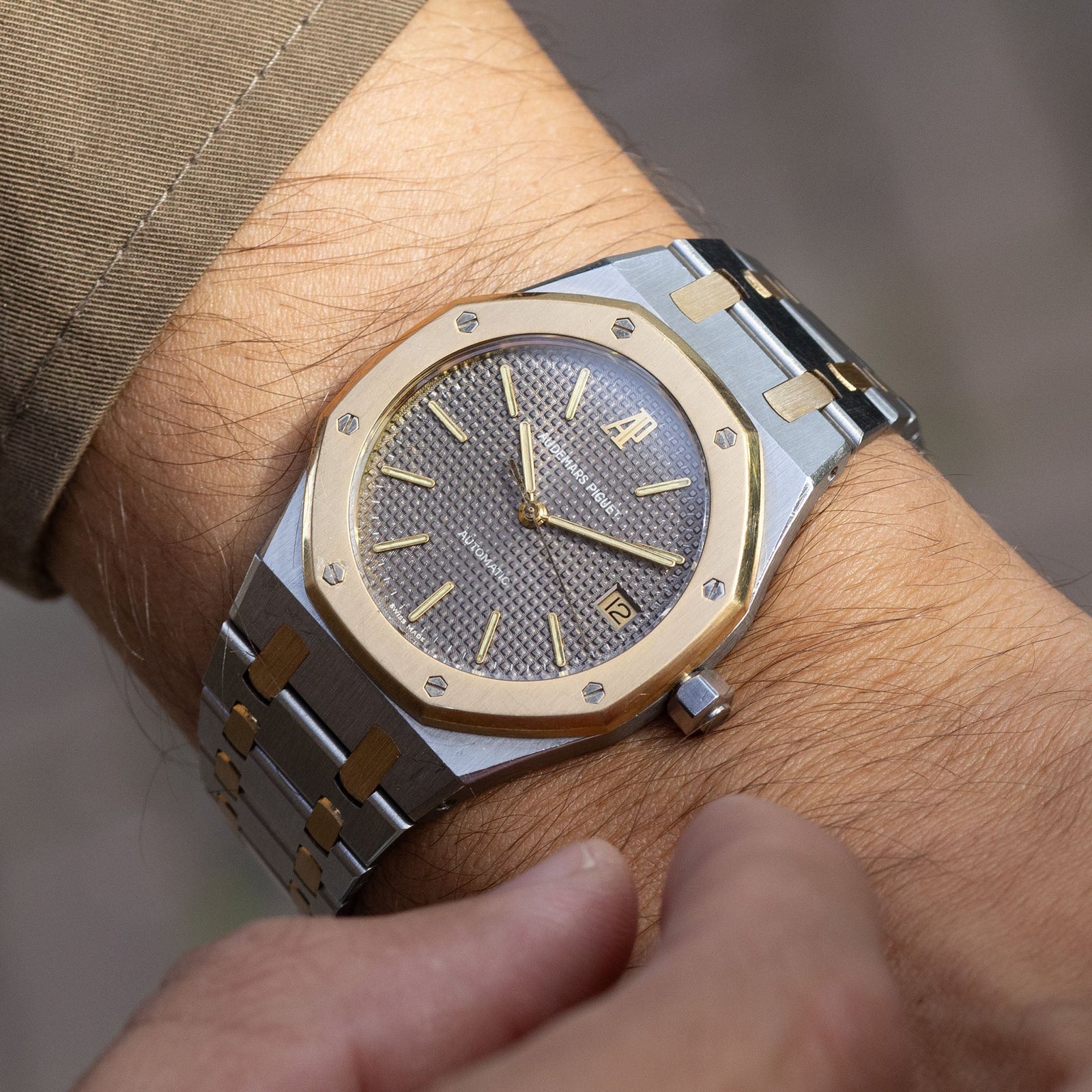
Audemars Piguet Royal Oak 14700SA Mini Jumbo Grey Dial in Steel and Yellow Gold, early 1990
- Maker / attribution
- Audemars Piguet (maker)
- Date
- early 1990
- Historical period
- Mechanical Renaissance (1990 – 2010)
- Country of origin
- Switzerland
- Object type
- Wristwatch
- Materials / technique
- yellow gold
- Dimensions
- Case 39 mm
- Stock no.
- W-3865
- Credit line
- Dealer listing, Bulang & Sons (W-3865)
- Catalogue title (original)
- Audemars Piguet Royal Oak 14700SA Mini Jumbo Grey Dial in Steel and Yellow Gold (English)
View the source record (dealer listing) ↗ (opens another website in a new tab)Suggest a correction
Record summary
Catalogued by Bulang & Sons (dealer), Copenhagen (stock number W-3865), this is a wristwatch by Audemars Piguet, made in Switzerland, dated early 1990. The Atlas places it in the Mechanical Renaissance period (1990 – 2010) of its Wristwatches collection. Materials and techniques recorded by the source: yellow gold. Recorded dimensions: Case 39 mm. The record is illustrated with 6 photographs.
Assembled from the source record's structured fields. Dates and attributions are given as the source states them; where a field is missing the Atlas leaves it blank rather than estimating.
Catalogue description
Dealer description — Bulang & Sons
To create this revolutionary model, Audemars Piguet’s Managing Director, Georges Golay, commissioned the legendary watch designer Gérald Genta. According to watchmaking lore, Genta completed the initial design in a single night. He drew inspiration from a traditional diver’s helmet, a theme reflected in the instantly recognisable octagonal bezel secured by eight exposed white-gold screws. The name “Royal Oak” was borrowed from the famous British Royal Navy warships, themselves named after the oak tree in which King Charles II hid while escaping capture during the English Civil War. The original Royal Oak, ref. 5402ST, debuted in 1972 with a 39 mm case. At a time when most dress watches measured between 34 and 36 mm, its dimensions were considered enormous, earning it the now-legendary nickname “Jumbo”. Fun fact: The nickname “Jumbo” originates from Jumbo, the famous African bush elephant who became a sensation in the late 19th century. Measuring over 13 feet (4 metres) tall and weighing around six tons, his extraordinary size made “jumbo” synonymous with anything exceptionally large — a term that later found its way into expressions such as “jumbo jet”. Ironically, the original Royal Oak measured just 39 mm, yet in 1972 it was considered exceptionally large for a luxury watch. Offered here is the Royal Oak ref. 14700SA, a fascinating transitional 36 mm model produced between 1990 and 1992. Often nicknamed the “Mini Jumbo”, it forms an important bridge between the earlier ref. 4100 and the long-running ref. 14790. What makes the ref. 14700 particularly interesting is a detail often overlooked by non-collectors. Unlike other 35 and 36 mm Royal Oak models, it features a noticeably thinner bezel and a proportionally larger dial. This clever design gives the watch considerably more wrist presence than its dimensions suggest, making it wear remarkably close to the original 39 mm Jumbo. In fact, its dial measures only around 1 mm less in diameter than that of the legendary ref. 5402, which explains why collectors affectionately refer to it as the “Mini Jumbo”. The 36 mm stainless steel and yellow-gold case remains in excellent condition, with its original factory finishing still beautifully preserved. The brushed surfaces contrast wonderfully with the polished bezel, white-gold screws and crisp chamfered edges, highlighting Gérald Genta’s timeless design. Measuring just 7.8 mm thick, this Royal Oak wears wonderfully slim and elegant on the wrist. The grey Petite Tapisserie dial features the classic small Audemars Piguet signature in white, applied baton hour markers and the characteristic Royal Oak handset, giving the watch the clean, balanced appearance that has become an icon of modern watchmaking. The integrated bracelet is equally well preserved and currently fits wrists up to approximately 17.5 cm. It features a folding clasp stamped “GF”, the hallmark of Gay Frères, the renowned bracelet manufacturer responsible for producing these beautifully crafted bracelets. Powering this Royal Oak is the ultra-thin Audemars Piguet calibre 2225, derived from Jaeger-LeCoultre’s celebrated calibre 889. It has been fully serviced by our watchmaker and is ready to be enjoyed for many years to come. Overshadowed by the Jumbo only in name, the ref. 14700 has earned its own loyal following among Royal Oak enthusiasts. With its larger dial, slim profile and beautifully balanced proportions, it may just be one of the sweetest-wearing Royal Oaks ever made. An increasingly sought-after transitional model, ready to be enjoyed by its next caretaker. Get in touch! Specifications: Audemars Piguet Royal Oak reference 14700SA “Mini Jumbo” 36mm 18k Gold / Steel case Grey colour Petite Tapisserie dial, white text Serial No 6xx dating to the early 1990’s Integrated 18k gold/ steel bracelet, stamped “GF” Ultra thin cal. 2225 automatic Fully serviced by our watch maker
Historical context
Mechanical Renaissance (1990 – 2010)
Mechanical watches return as cultural objects; independent watchmaking flourishes.
Mechanical watches returned as cultural and luxury objects. Complications, tourbillons and new materials proliferated; independent watchmakers such as George Daniels, F.P. Journe and Philippe Dufour revived artisanal watchmaking; collecting vintage watches became a major field.
Read the period in the timelineMore wristwatches from this periodEarlier: Quartz Revolution
Atlas type guide
Wristwatches
Bracelet watches were worn by women from the early nineteenth century — Breguet made one for Caroline Murat, Queen of Naples, in 1810–12 — but the wristwatch only became a man's instrument with military use and aviation in the early twentieth century. Between the World Wars it overtook the pocket watch; the 1920s and 1930s brought rectangular Art Deco cases, water-resistant cases and the first automatic winding systems.
After 1945 the wristwatch became a carrier of identity — dress watches, sports and dive watches, chronographs, calendars — produced by Swiss, American, Japanese, German, Soviet and Chinese industries. The quartz revolution after 1969 and the mechanical renaissance since the 1990s, including the rise of independent watchmakers, complete the story.
What to look for
- The reference number (between the lugs or inside the case back) and serial number, the starting point for dating.
- The calibre: its maker and number are often stamped under the dial or on the bridge.
- Originality of dial, hands and crown — refinished ('redial') dials are common.
- Case material marks: 18K/750, 14K/585, stainless steel, gold-filled, plated.
Dating clues
- Wire-lug cases: before c. 1925.
- Water-resistant screw-down cases: from 1926.
- Quartz movements: from 1969; sapphire crystals widespread after c. 1980.
General guidance written by the Atlas editors about this kind of object. It is not a statement about this particular piece; for that, rely on the source record above and on physical examination.
Related records

Clocks · c. 1990s
Audemars Piguet Royal Oak, c. 1990s
Antiquorum auction archive, Geneva

Pocket Watches · c. 1960
Audemars Piguet ''couteau'', c. 1960
Antiquorum auction archive, Geneva
Pocket Watches · originally sold in November 1961 (per the lot record)
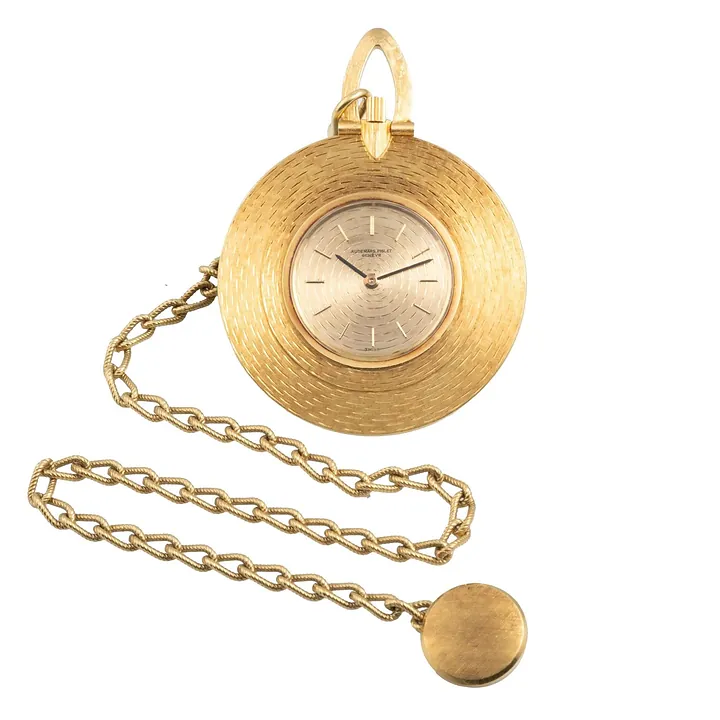
Audemars Piguet "extra Plate", ref. 5633 BA, originally sold in November 1961
Antiquorum auction archive, Geneva

Pocket Watches · c. 1980
Audemars Piguet pocket watch, c. 1980
Antiquorum auction archive, Geneva

Wristwatches · 2008
Wristwatch by Breitling?, 2008
Museum Rotterdam

Wristwatches · c. 1990s
Audemars Piguet Bamboo, c. 1990s
Antiquorum auction archive, Geneva

Wristwatches · c. 1990
Audemars Piguet Huitieme Perpetual Calendar, ref. 25696PT, c. 1990
Antiquorum auction archive, Geneva

Wristwatches · c. 1990
Breitling Chronomat, ref. b13050.1, c. 1990
Antiquorum auction archive, Geneva