
Wristwatches · Wristwatch
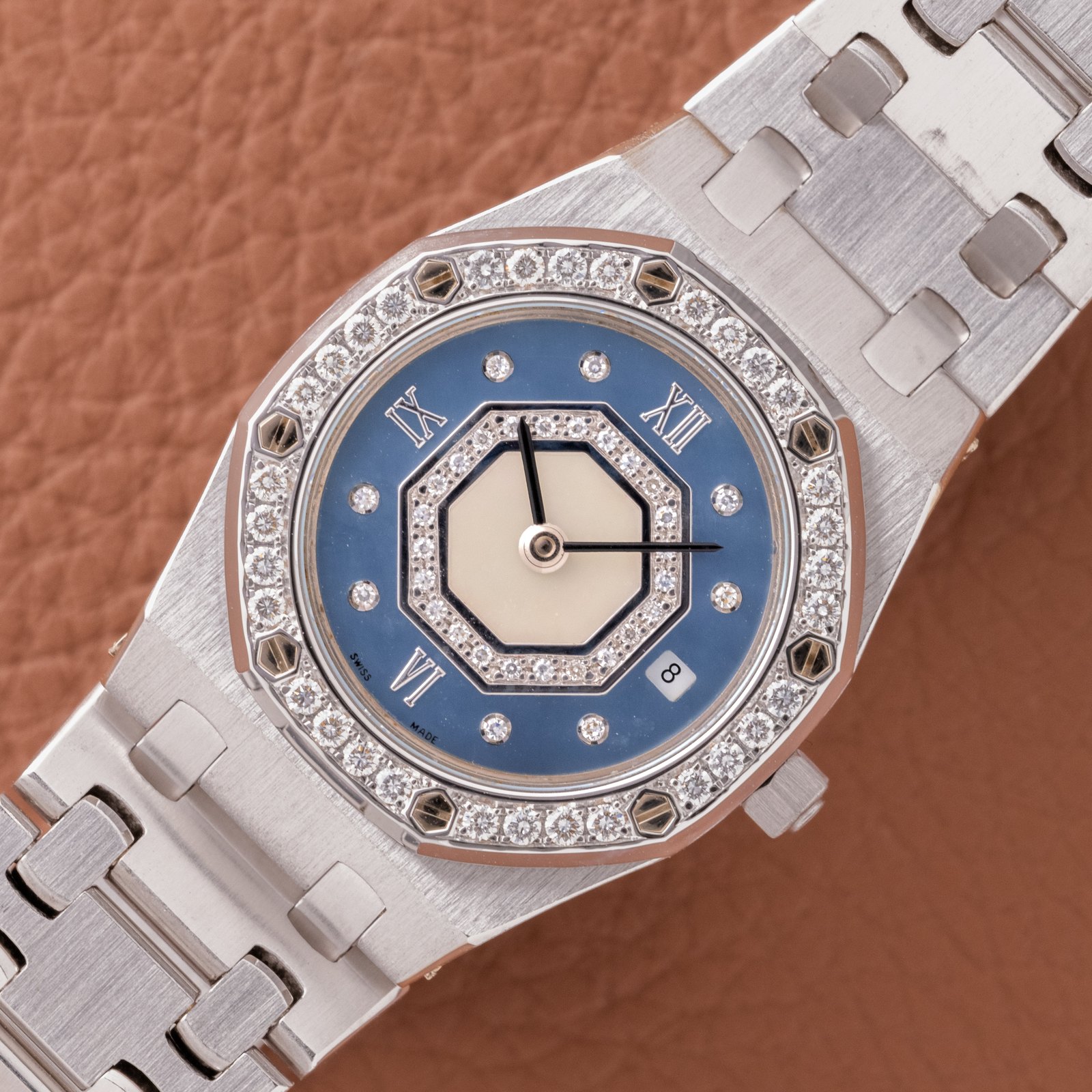
Audemars Piguet Mini Royal Oak Gold Blue Pearl Diamond Dial (Ref. 67371BA), 2000s
- Maker / attribution
- Audemars Piguet (maker)
- Date
- 2000s
- Historical period
- Mechanical Renaissance (1990 – 2010)
- Country of origin
- Switzerland
- Object type
- Wristwatch
- Materials / technique
- gold
- Dimensions
- Case 25 mm
- Stock no.
- Product 8834676031671
- Credit line
- Dealer listing, Huntington Company (product 8834676031671)
- Catalogue title (original)
- 2000s Audemars Piguet Mini Royal Oak Gold Blue Pearl Diamond Dial (Ref. 67371BA) (English)
View the source record (dealer listing) ↗ (opens another website in a new tab)Suggest a correction
Record summary
Catalogued by Huntington Company (dealer) (stock number Product 8834676031671), this is a wristwatch by Audemars Piguet, made in Switzerland, dated 2000s. The Atlas places it in the Mechanical Renaissance period (1990 – 2010) of its Wristwatches collection. Materials and techniques recorded by the source: gold. Recorded dimensions: Case 25 mm. The record is illustrated with 6 photographs.
Assembled from the source record's structured fields. Dates and attributions are given as the source states them; where a field is missing the Atlas leaves it blank rather than estimating.
Catalogue description
Dealer description — Huntington Company
History and Significance The Royal Oak has always occupied an unusual position in watchmaking, existing somewhere between a traditional luxury watch and an entirely new category of sports-inspired design. While the original 1972 model established the blueprint, Audemars Piguet spent the following decades exploring just how far that design could be taken. The smaller precious-metal Royal Oaks became an especially interesting part of that evolution, offering combinations of materials and decorative techniques rarely associated with the original steel model. The reference 67371BC is a wonderful example of this more expressive side of the collection. White gold gives the Royal Oak a remarkably different personality from yellow gold, particularly when paired with a blue mother-of-pearl dial. The cool tone of the metal creates a beautiful relationship with the shifting blue colors of the dial, allowing the natural iridescence of the mother of pearl to become the focal point. Unlike a conventional blue dial, mother of pearl produces variations in tone and reflection that depend entirely on the surrounding light. The addition of factory diamonds brings another dimension to the composition without overwhelming the underlying Royal Oak design. What makes these smaller Royal Oaks particularly compelling is the way Audemars Piguet approached them as complete designs rather than simplified versions of larger watches. The octagonal bezel, exposed screws, integrated bracelet, and distinctive case geometry remain fundamental to the identity of the collection. Even at 25mm, the design carries the same visual language that made the original Royal Oak so influential. The result is a watch that feels equally connected to the history of the Royal Oak and the tradition of fine jewelry. The early 2000s were also an interesting period for Audemars Piguet, with the Royal Oak collection encompassing everything from restrained traditional configurations to highly decorative precious-metal executions. These smaller references capture a side of the brand that often receives less attention than the larger mechanical sports watches. Their appeal comes from the combination of familiar design, unusual materials, and a distinctly different approach to luxury. The reference 67371BC represents that philosophy particularly well, offering a Royal Oak with an identity entirely its own. Writer’s Thoughts There is something especially attractive about a white gold Royal Oak with a blue mother-of-pearl dial. The reference 67371BC feels considerably more understated than its yellow gold counterparts at first glance, but the dial introduces an unexpected amount of color and personality. The factory diamonds work beautifully with the cooler palette, creating a combination that feels elegant without becoming overly decorative. It is exactly the kind of unusual Royal Oak configuration that makes exploring the smaller references so rewarding. The fantastic overall condition is another important part of the appeal. A well-preserved precious-metal Royal Oak retains the visual contrast between its geometric surfaces, allowing the original design to remain crisp and expressive. Combined with the blue mother of pearl, the reference 67371BC has a particularly refined presence that separates it from more conventional ladies' watches. Few designs manage to feel so distinctly like a sports watch and a piece of fine jewelry at the same time. The most interesting aspect is perhaps how different this watch feels from the traditional perception of a Royal Oak. There is no need for an oversized case or complicated movement to make the design compelling. The materials, proportions, and color do the work instead. It is a beautiful reminder that some of the most distinctive Royal Oaks are also among the smallest. Our Promise Every watch is thoroughly vetted, carefully described with complete transparency, and guaranteed authentic. Each piece is offered in honest condition, ensuring collectors receive a timepiece that reflects both originality and integrity. Specifications Brand: Audemars Piguet Model: Royal Oak Reference: 67371BC Year: Early 2000s Case Material: 18k white gold Case Size: 25mm Dial: Factory blue mother-of-pearl dial with diamond hour markers Movement: Quartz Strap/Buckle: Integrated 18k white gold Royal Oak bracelet Buckle/Clasp: Audemars Piguet folding clasp Contents: Watch only Condition Case: 18k white gold case presents in fantastic overall condition with well-defined Royal Oak architecture and light surface wear consistent with careful use. Dial: Factory blue mother-of-pearl dial presents beautifully, with attractive natural iridescence and well-preserved diamond hour markers. Hands: Hands are clean and well preserved, with no notable imperfections. Crystal: Crystal presents in excellent overall condition with no visible imperfections. Strap/Buckle: Integrated white gold Royal Oak bracelet presents in fantastic overall condition with light signs of careful use. Buckle/Clasp: Audemars Piguet folding clasp presents very well with minor surface wear consistent with age.
Historical context
Mechanical Renaissance (1990 – 2010)
Mechanical watches return as cultural objects; independent watchmaking flourishes.
Mechanical watches returned as cultural and luxury objects. Complications, tourbillons and new materials proliferated; independent watchmakers such as George Daniels, F.P. Journe and Philippe Dufour revived artisanal watchmaking; collecting vintage watches became a major field.
Read the period in the timelineMore wristwatches from this periodEarlier: Quartz Revolution
Atlas type guide
Wristwatches
Bracelet watches were worn by women from the early nineteenth century — Breguet made one for Caroline Murat, Queen of Naples, in 1810–12 — but the wristwatch only became a man's instrument with military use and aviation in the early twentieth century. Between the World Wars it overtook the pocket watch; the 1920s and 1930s brought rectangular Art Deco cases, water-resistant cases and the first automatic winding systems.
After 1945 the wristwatch became a carrier of identity — dress watches, sports and dive watches, chronographs, calendars — produced by Swiss, American, Japanese, German, Soviet and Chinese industries. The quartz revolution after 1969 and the mechanical renaissance since the 1990s, including the rise of independent watchmakers, complete the story.
What to look for
- The reference number (between the lugs or inside the case back) and serial number, the starting point for dating.
- The calibre: its maker and number are often stamped under the dial or on the bridge.
- Originality of dial, hands and crown — refinished ('redial') dials are common.
- Case material marks: 18K/750, 14K/585, stainless steel, gold-filled, plated.
Dating clues
- Wire-lug cases: before c. 1925.
- Water-resistant screw-down cases: from 1926.
- Quartz movements: from 1969; sapphire crystals widespread after c. 1980.
General guidance written by the Atlas editors about this kind of object. It is not a statement about this particular piece; for that, rely on the source record above and on physical examination.
Related records
Clocks · c. 1990s
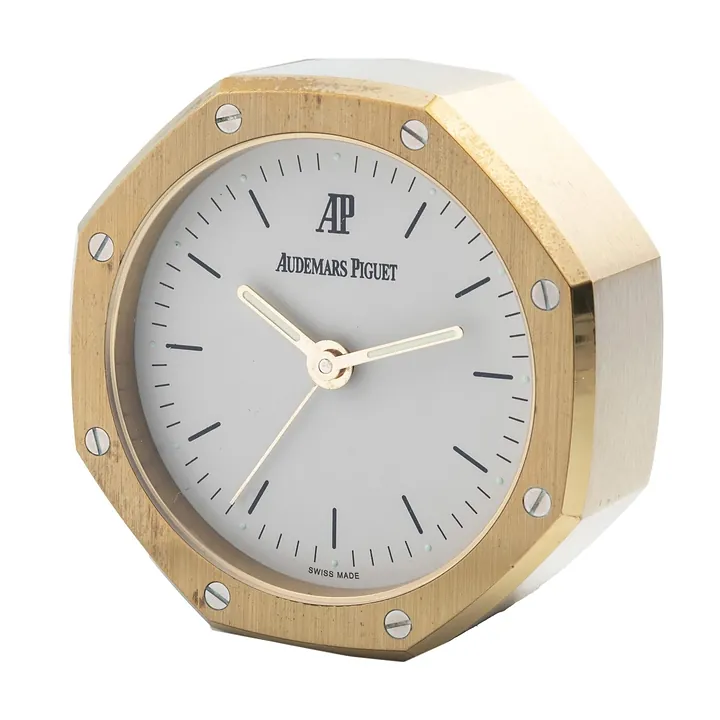
Audemars Piguet Royal Oak, c. 1990s
Antiquorum auction archive, Geneva
Pocket Watches · c. 1960
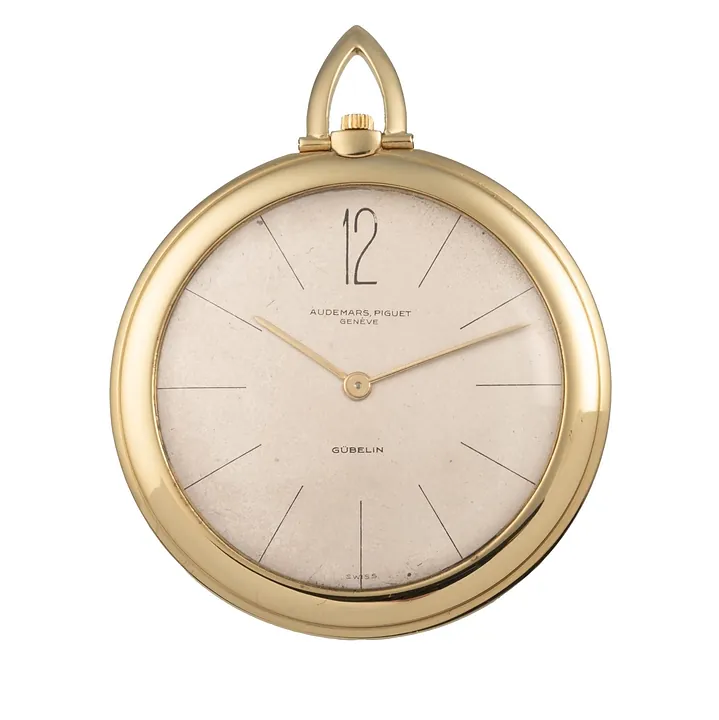
Audemars Piguet ''couteau'', c. 1960
Antiquorum auction archive, Geneva
Pocket Watches · originally sold in November 1961 (per the lot record)
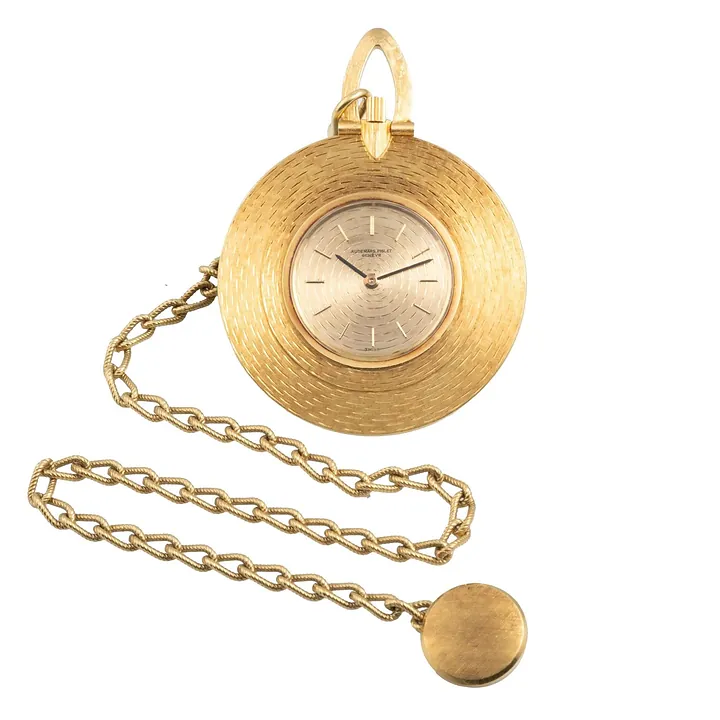
Audemars Piguet "extra Plate", ref. 5633 BA, originally sold in November 1961
Antiquorum auction archive, Geneva
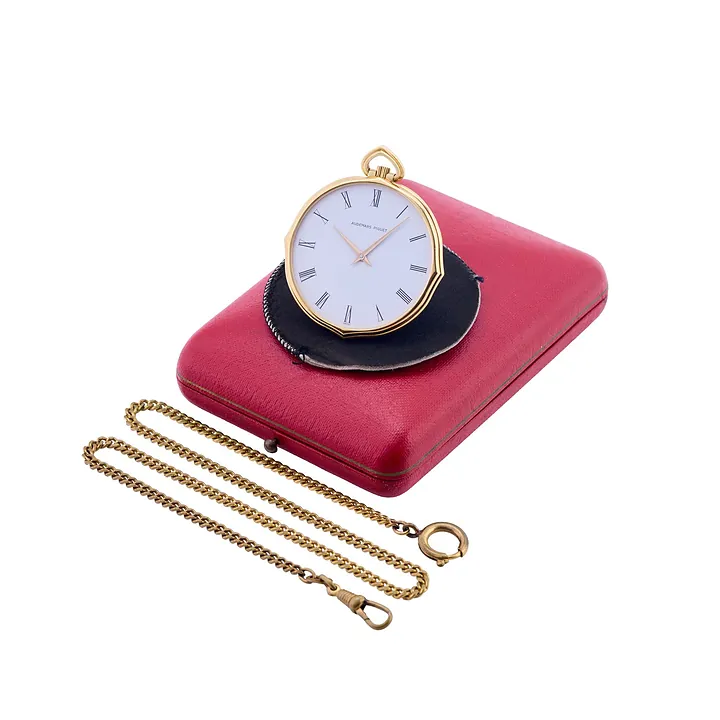
Pocket Watches · c. 1980
Audemars Piguet pocket watch, c. 1980
Antiquorum auction archive, Geneva

Wristwatches · 2008
Wristwatch by Breitling?, 2008
Museum Rotterdam

Wristwatches · c. 1990s
Audemars Piguet Bamboo, c. 1990s
Antiquorum auction archive, Geneva

Wristwatches · c. 1990
Audemars Piguet Huitieme Perpetual Calendar, ref. 25696PT, c. 1990
Antiquorum auction archive, Geneva

Wristwatches · c. 1990
Breitling Chronomat, ref. b13050.1, c. 1990
Antiquorum auction archive, Geneva