
Wristwatches · Wristwatch
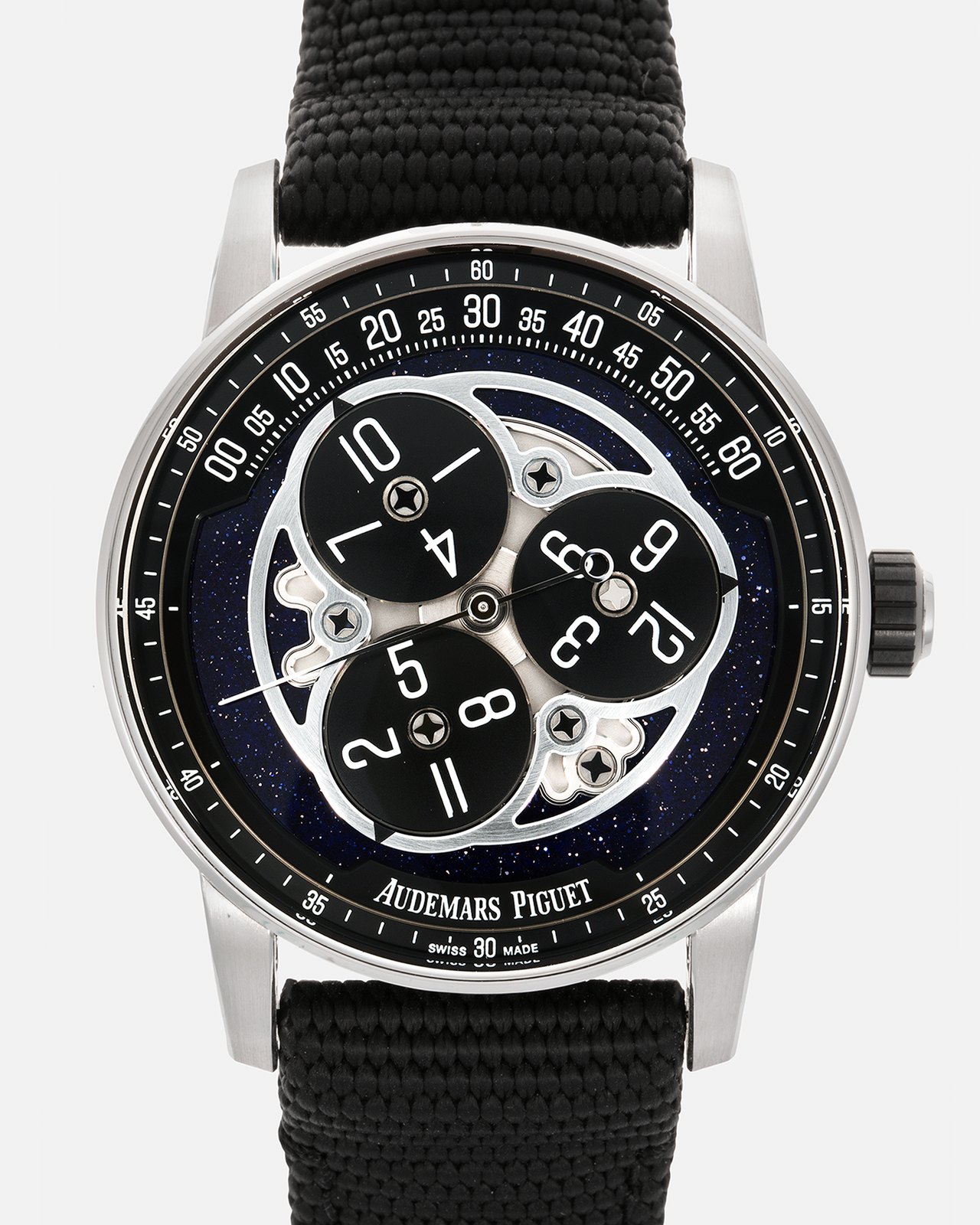
Audemars Piguet Code 11.59 Star Wheel 15212NB, 2023
- Maker / attribution
- Audemars Piguet (maker)
- Date
- 2023
- Historical period
- Contemporary Horology (2010 – Present)
- Country of origin
- Switzerland
- Object type
- Wristwatch
- Dimensions
- Case 41 mm
- Stock no.
- Product 6923654103127
- Credit line
- Dealer listing, S.Song Watches (product 6923654103127)
- Catalogue title (original)
- Audemars Piguet Code 11.59 Star Wheel 15212NB (English)
View the source record (dealer listing) ↗ (opens another website in a new tab)Suggest a correction
Record summary
Catalogued by S.Song Watches (dealer), Seattle (stock number Product 6923654103127), this is a wristwatch by Audemars Piguet, made in Switzerland, dated 2023. The Atlas places it in the Contemporary Horology period (2010 – Present) of its Wristwatches collection. Recorded dimensions: Case 41 mm. The record is illustrated with 6 photographs.
Assembled from the source record's structured fields. Dates and attributions are given as the source states them; where a field is missing the Atlas leaves it blank rather than estimating.
Catalogue description
Dealer description — S.Song Watches
Famed as one of watchmaking's most successful risk-takers, Audemars Piguet is renowned for incredible avant-garde timepieces pushing horological boundaries far beyond what most would consider reasonable. When the Code 11.59 collection debuted in 2019, it garnered a lot of criticism from enthusiasts and connoisseurs, akin to the initial reception of the iconic Royal Oak upon its release in 1972. Much of this criticism centered around its somewhat underwhelming dial design and overall concept. However, what we have here today is, at least in my mind, probably one of the most intriguing and compelling models within the Code 11.59 series to date. Introducing the Audemars Piguet Code 11.59 Star Wheel—a continuative design rooted in the 1990s when Audemars Piguet first introduced their pioneering take on the traditional wandering-hours complication (we have had a handful of these listed on the site before, if you’re wondering). This concept is reimagined within the modern design confines of the ultra-contemporary Code 11.59 collection. However, it's crucial to acknowledge that this iteration stands as a distinct and unique creation on its own. Let me explain. Visually, there's a lot to unpack here due to the diversity of materials used in its construction. Starting off, we have a 41mm x 10.7mm case made from a combination of a black ceramic mid-section and an 18-carat white gold bezel, lugs, and caseback. As we shift our attention to the dial, you'll notice the wandering hours mechanism is gracefully positioned above an alluring aventurine background. In some ways, this nuanced display bears a resemblance to planets gracefully orbiting on their respective axes within a mini-universe. This is further complemented by a minute track on the upper side and a seconds hand in the middle. The hour discs themselves are crafted from aluminum, coated in a sleek black PVD, and treated to an opaline sandblasted finish which greatly contributes to its overall legibility. For those unfamiliar with the origins of the wandering-hours complication, it is fascinating to note that it was first invented in 1655, at the behest of Pope Alexander VII. His request for this innovation stemmed from his struggle with insomnia, which was aggravated by the audible ticking of his clock. The wandering hours may initially appear complex, however, its concept is actually quite straightforward. The minute track, spanning 120 degrees, is displayed on a separate linear track positioned at the upper part of the dial, easily discerned by the arched sector at the top portion of the dial’s periphery. As each hour disc progresses beneath the chapter ring, it vividly illustrates the passage of time through the use of an indication arrow fitted on each disc. This dynamic display results in the subsequent hour smoothly taking the place of the previous one along the chapter ring as time moves forward. Powering the Star Wheel from within is Audemars Piguet’s very own self-winding Cal. 4310, a caliber that was derived from the Cal. 4309 with a wandering hours module added above it. Through its open caseback, you’ll be treated to an appealing display of the Cal. 4310 which features a myriad of exquisite finishes such as your usual Côte de Genève striping, perlage detailing, meticulously bevelled and polished edges, and a 22-carat pink gold rotor with an openwork design. It also holds an impressive power reserve of 70 hours. Like many others, I wasn't particularly impressed when Audemars Piguet unveiled the Code 11.59 collection a few years ago. However, when I had the opportunity to handle this Star Wheel, it became evident that my perception of this collection had shifted somewhat. I constantly found myself staring at the gorgeous aventurine dial, which transitions between blue and subtle shades of purple under certain lighting conditions. I must say, there is something about the visual balance and its dial symmetry that made the Star Wheel immensely satisfying to look at. The case construction was no slouch either, especially with the wealth of materials being used, which I thought further accentuated the meticulous finishing and construction of the Code 11.59 style case. Overall, the combination of materials and the incorporation of a wandering hours complication in a case like this is exceptionally well-executed. This is one of those timepieces that truly requires an in-person experience to fully appreciate its aesthetic brilliance. If, like me, you had reservations about the original Code 11.59 design, a closer examination of the Star Wheel might just alter your perspective.
Historical context
Contemporary Horology (2010 – Present)
Silicon components, connected watches, optical-lattice research clocks and a thriving independent scene.
Smartwatches became the world's best-selling watches, while mechanical watchmaking focuses on craft, innovation (silicon components, new escapements) and independent makers.
Read the period in the timelineMore wristwatches from this periodEarlier: Mechanical Renaissance
Atlas type guide
Wristwatches
Bracelet watches were worn by women from the early nineteenth century — Breguet made one for Caroline Murat, Queen of Naples, in 1810–12 — but the wristwatch only became a man's instrument with military use and aviation in the early twentieth century. Between the World Wars it overtook the pocket watch; the 1920s and 1930s brought rectangular Art Deco cases, water-resistant cases and the first automatic winding systems.
After 1945 the wristwatch became a carrier of identity — dress watches, sports and dive watches, chronographs, calendars — produced by Swiss, American, Japanese, German, Soviet and Chinese industries. The quartz revolution after 1969 and the mechanical renaissance since the 1990s, including the rise of independent watchmakers, complete the story.
What to look for
- The reference number (between the lugs or inside the case back) and serial number, the starting point for dating.
- The calibre: its maker and number are often stamped under the dial or on the bridge.
- Originality of dial, hands and crown — refinished ('redial') dials are common.
- Case material marks: 18K/750, 14K/585, stainless steel, gold-filled, plated.
Dating clues
- Wire-lug cases: before c. 1925.
- Water-resistant screw-down cases: from 1926.
- Quartz movements: from 1969; sapphire crystals widespread after c. 1980.
General guidance written by the Atlas editors about this kind of object. It is not a statement about this particular piece; for that, rely on the source record above and on physical examination.
Related records

Clocks · c. 1990s
Audemars Piguet Royal Oak, c. 1990s
Antiquorum auction archive, Geneva

Pocket Watches · c. 1960
Audemars Piguet ''couteau'', c. 1960
Antiquorum auction archive, Geneva
Pocket Watches · originally sold in November 1961 (per the lot record)
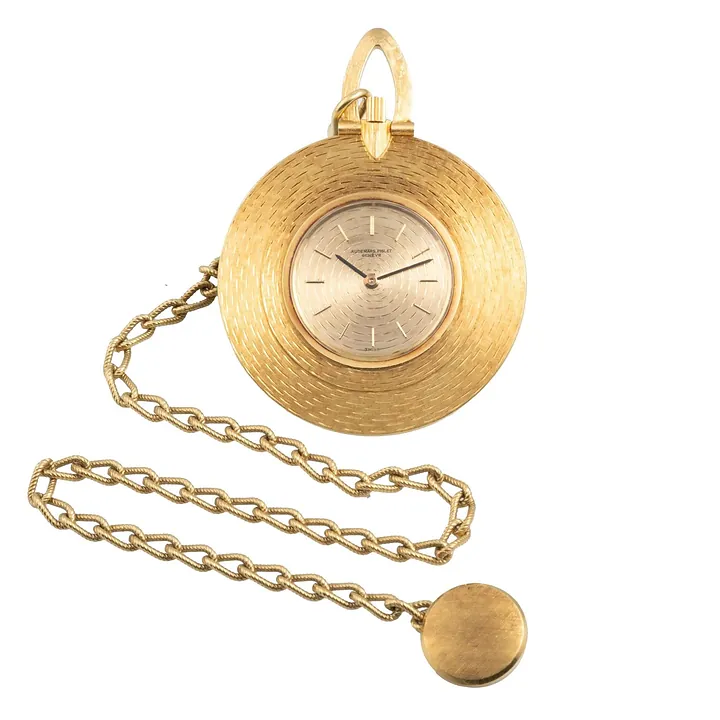
Audemars Piguet "extra Plate", ref. 5633 BA, originally sold in November 1961
Antiquorum auction archive, Geneva

Pocket Watches · c. 1980
Audemars Piguet pocket watch, c. 1980
Antiquorum auction archive, Geneva

Wristwatches · c. 2010s
Breguet Type XXI, ref. 3810, c. 2010s (Antiquorum Lot 381-24)
Antiquorum auction archive, Geneva

Wristwatches · c. 2010s
Breguet Type XXI, ref. 3810, c. 2010s (Antiquorum Lot 386-229)
Antiquorum auction archive, Geneva

Wristwatches · Sold in September 2010
Breitling Cosmonaute, ref. A 22322, Sold in September 2010
Antiquorum auction archive, Geneva

Wristwatches · c. 2010
Corum Bubble Chrono, ref. 396.150.20, c. 2010
Antiquorum auction archive, Geneva