
Wristwatches · Wristwatch
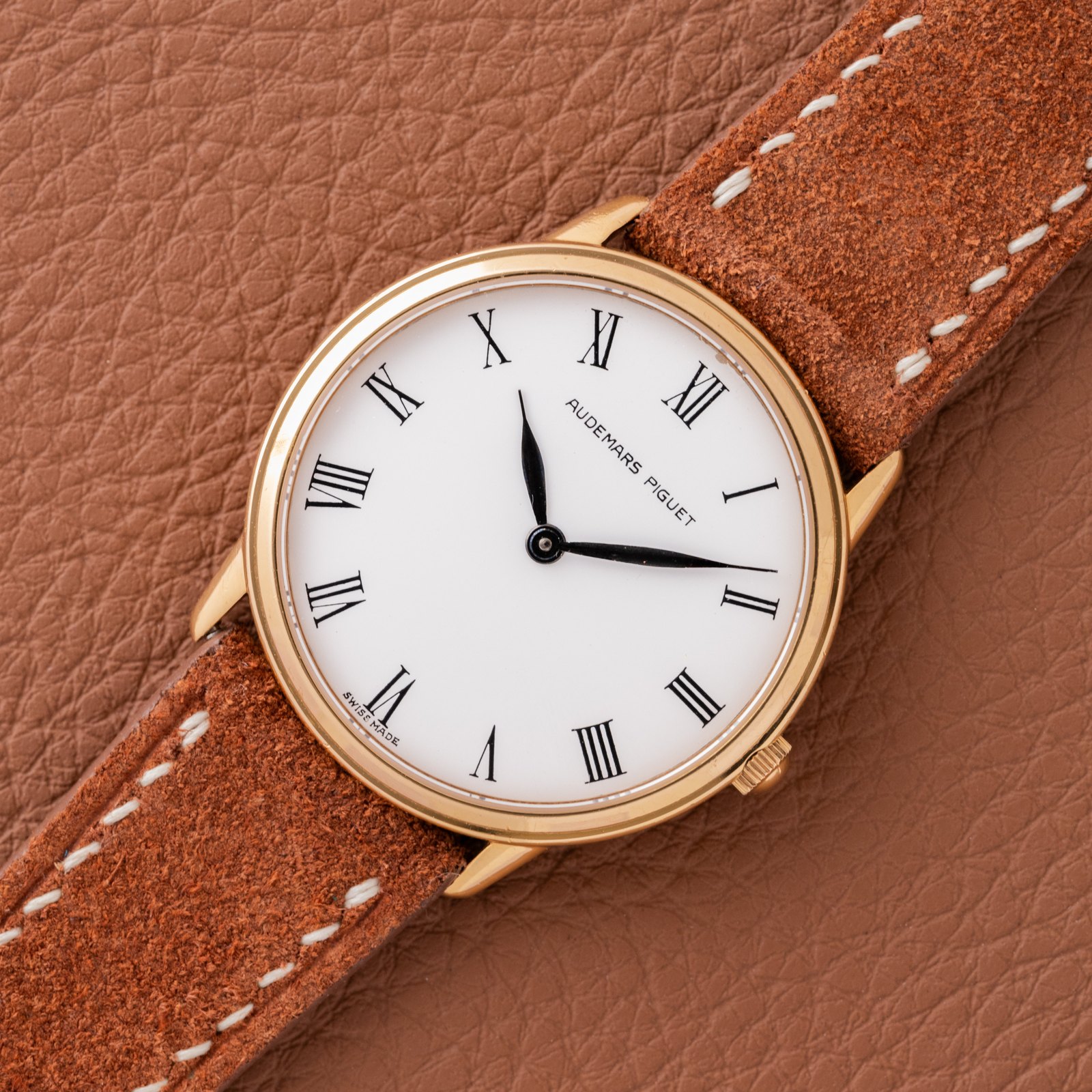
Audemars Piguet Classique Ultra-Slim - Rose Gold, 1980s
- Maker / attribution
- Audemars Piguet (maker)
- Date
- 1980s
- Historical period
- Quartz Revolution (1969 – 1990)
- Country of origin
- Switzerland
- Object type
- Wristwatch
- Materials / technique
- rose gold
- Dimensions
- Case 31 mm
- Stock no.
- Product 8653383172279
- Credit line
- Dealer listing, Huntington Company (product 8653383172279)
- Catalogue title (original)
- 1980s Audemars Piguet Classique Ultra-Slim - Rose Gold (English)
View the source record (dealer listing) ↗ (opens another website in a new tab)Suggest a correction
Record summary
Catalogued by Huntington Company (dealer) (stock number Product 8653383172279), this is a wristwatch by Audemars Piguet, made in Switzerland, dated 1980s. The Atlas places it in the Quartz Revolution period (1969 – 1990) of its Wristwatches collection. Materials and techniques recorded by the source: rose gold. Recorded dimensions: Case 31 mm. The record is illustrated with 6 photographs.
Assembled from the source record's structured fields. Dates and attributions are given as the source states them; where a field is missing the Atlas leaves it blank rather than estimating.
Catalogue description
Dealer description — Huntington Company
History and Significance The Classique collection reflects Audemars Piguet at its most restrained. Long before oversized sports watches became synonymous with the brand, AP quietly produced some of the finest ultra-thin dress watches in Switzerland, placing elegance and movement finishing above all else. Ultra-thin watchmaking has always been one of Audemars Piguet's greatest strengths. Building a movement that is exceptionally slim while remaining reliable requires extraordinary precision, and the manufacture became one of the industry's leaders in the category throughout the twentieth century. This rose gold example has a character quite different from modern pink gold alloys. Rather than displaying a vivid copper tone, the alloy has mellowed over time into a warm golden hue with just enough rosy warmth to distinguish itself from yellow gold. It feels understated rather than flashy, perfectly matching the minimalist Roman numeral dial. Finding these watches, complete with their original rose gold buckle, has become increasingly uncommon, making this an especially attractive example for collectors. Writer’s Thoughts The beauty of this watch isn't found in complexity; it's found in restraint. Every line, every proportion, and every detail feels deliberate. The subtle warmth of the vintage rose gold gives it just enough personality without ever demanding attention, which is exactly what a great dress watch should do. Our Promise Every watch is thoroughly vetted, carefully described with complete transparency, and guaranteed authentic. Each piece is offered in honest condition, ensuring collectors receive a timepiece that reflects both originality and integrity. Specifications Brand: Audemars Piguet Model: Classique Ultra-Thin Year: Circa 1980s Case Material: Rose gold Case Size: 31mm Dial: White Roman numeral Movement: Quartz Strap/Bracelet: Suede leather strap Buckle/Clasp: Original Audemars Piguet rose gold pin buckle Contents: Watch only Condition Case: Unpolished with sharp hallmarks. Dial: Very clean with minor edge wear at 12 o'clock. Hands: Black leaf hands in excellent condition. Crystal: Clean overall. Strap/Bracelet: Leather strap in excellent condition. Buckle/Clasp: Original rose gold buckle in excellent condition.
Historical context
Quartz Revolution (1969 – 1990)
Seiko's Astron begins mass quartz timekeeping; traditional industries contract sharply.
Quartz and digital watches transformed the market after 1969. Swiss employment collapsed, Japanese and Hong Kong production soared, and the Swatch (1983) helped the Swiss industry recover; mechanical watches survived as luxury goods.
Read the period in the timelineMore wristwatches from this periodEarlier: Modern Mechanical Horology
Atlas type guide
Wristwatches
Bracelet watches were worn by women from the early nineteenth century — Breguet made one for Caroline Murat, Queen of Naples, in 1810–12 — but the wristwatch only became a man's instrument with military use and aviation in the early twentieth century. Between the World Wars it overtook the pocket watch; the 1920s and 1930s brought rectangular Art Deco cases, water-resistant cases and the first automatic winding systems.
After 1945 the wristwatch became a carrier of identity — dress watches, sports and dive watches, chronographs, calendars — produced by Swiss, American, Japanese, German, Soviet and Chinese industries. The quartz revolution after 1969 and the mechanical renaissance since the 1990s, including the rise of independent watchmakers, complete the story.
What to look for
- The reference number (between the lugs or inside the case back) and serial number, the starting point for dating.
- The calibre: its maker and number are often stamped under the dial or on the bridge.
- Originality of dial, hands and crown — refinished ('redial') dials are common.
- Case material marks: 18K/750, 14K/585, stainless steel, gold-filled, plated.
Dating clues
- Wire-lug cases: before c. 1925.
- Water-resistant screw-down cases: from 1926.
- Quartz movements: from 1969; sapphire crystals widespread after c. 1980.
General guidance written by the Atlas editors about this kind of object. It is not a statement about this particular piece; for that, rely on the source record above and on physical examination.
Related records
Clocks · c. 1990s
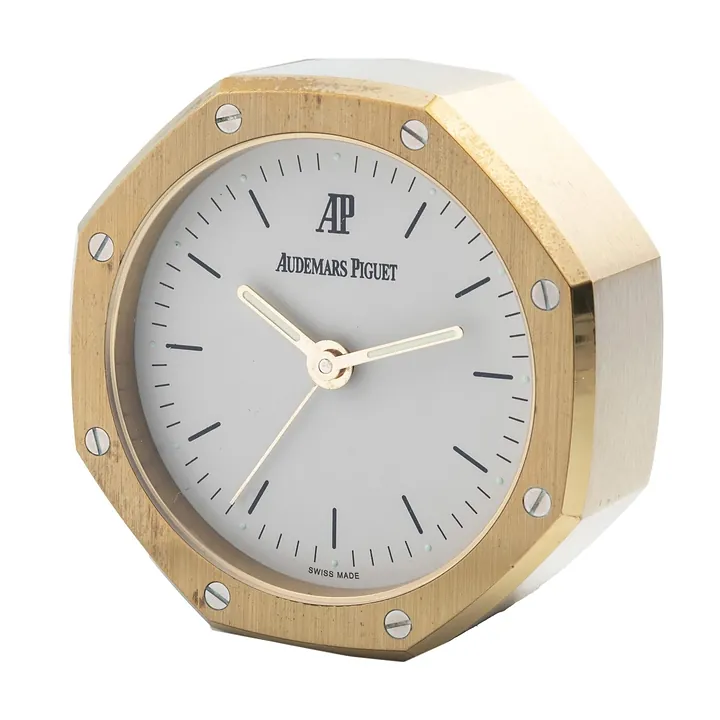
Audemars Piguet Royal Oak, c. 1990s
Antiquorum auction archive, Geneva
Pocket Watches · c. 1960
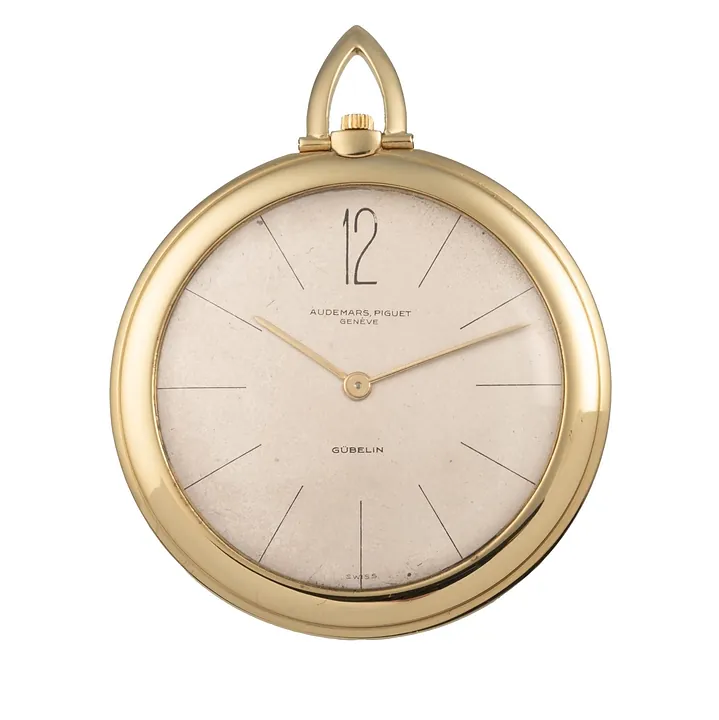
Audemars Piguet ''couteau'', c. 1960
Antiquorum auction archive, Geneva
Pocket Watches · originally sold in November 1961 (per the lot record)
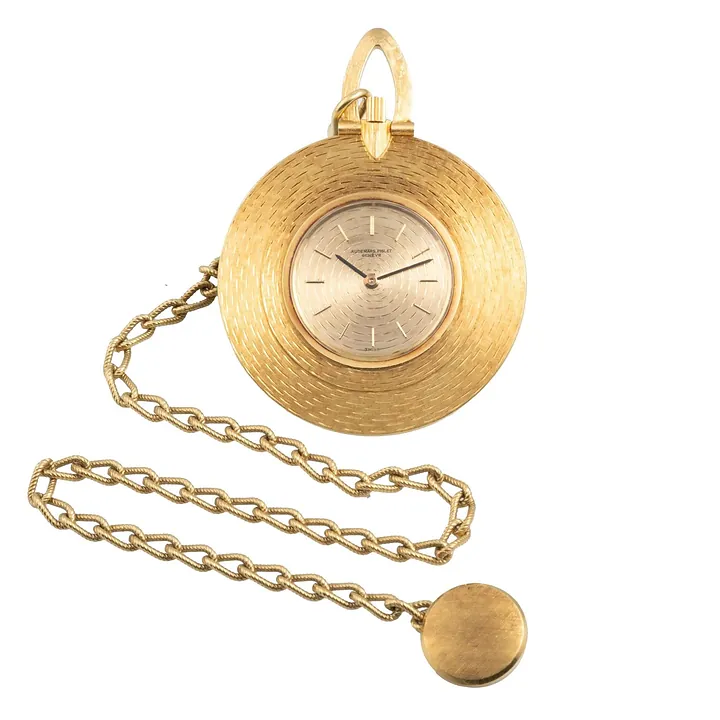
Audemars Piguet "extra Plate", ref. 5633 BA, originally sold in November 1961
Antiquorum auction archive, Geneva
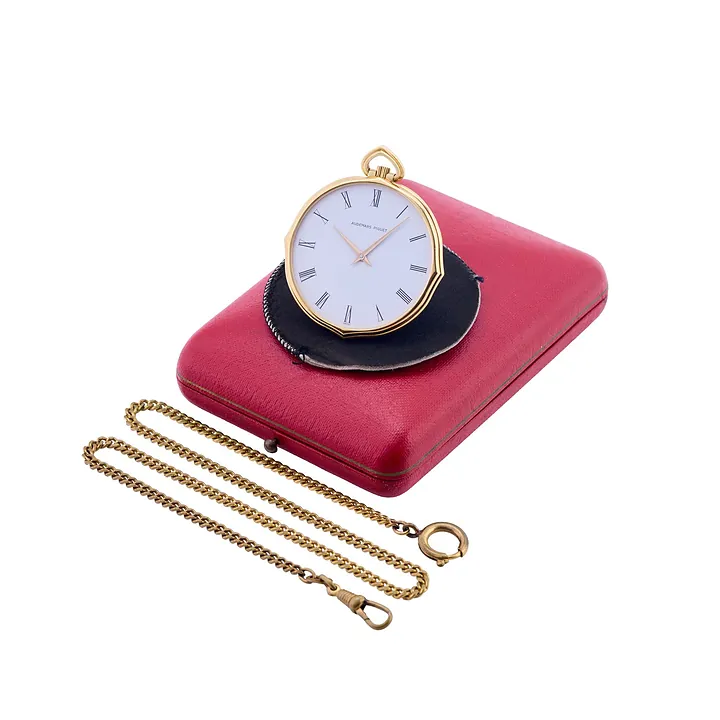
Pocket Watches · c. 1980
Audemars Piguet pocket watch, c. 1980
Antiquorum auction archive, Geneva

Wristwatches · 1970
Wristwatch by Heno, Switzerland, 1970
Museum Rotterdam

Wristwatches · 1960–1986
'Tri-Compax' calendar chronograph wristwatch in gold case, by Universal, Geneva, Switzerland, 1960–1986.
Science Museum Group, London

Wristwatches · 1969–1970
Beta 21 Quartz wristwatch movement, made in Switzerland, 1970.
Science Museum Group, London

Wristwatches · c. 1969
Omega Speedmaster Moonwatch, ref. 145022-69st, c. 1969
Antiquorum auction archive, Geneva