
Wristwatches · Wristwatch
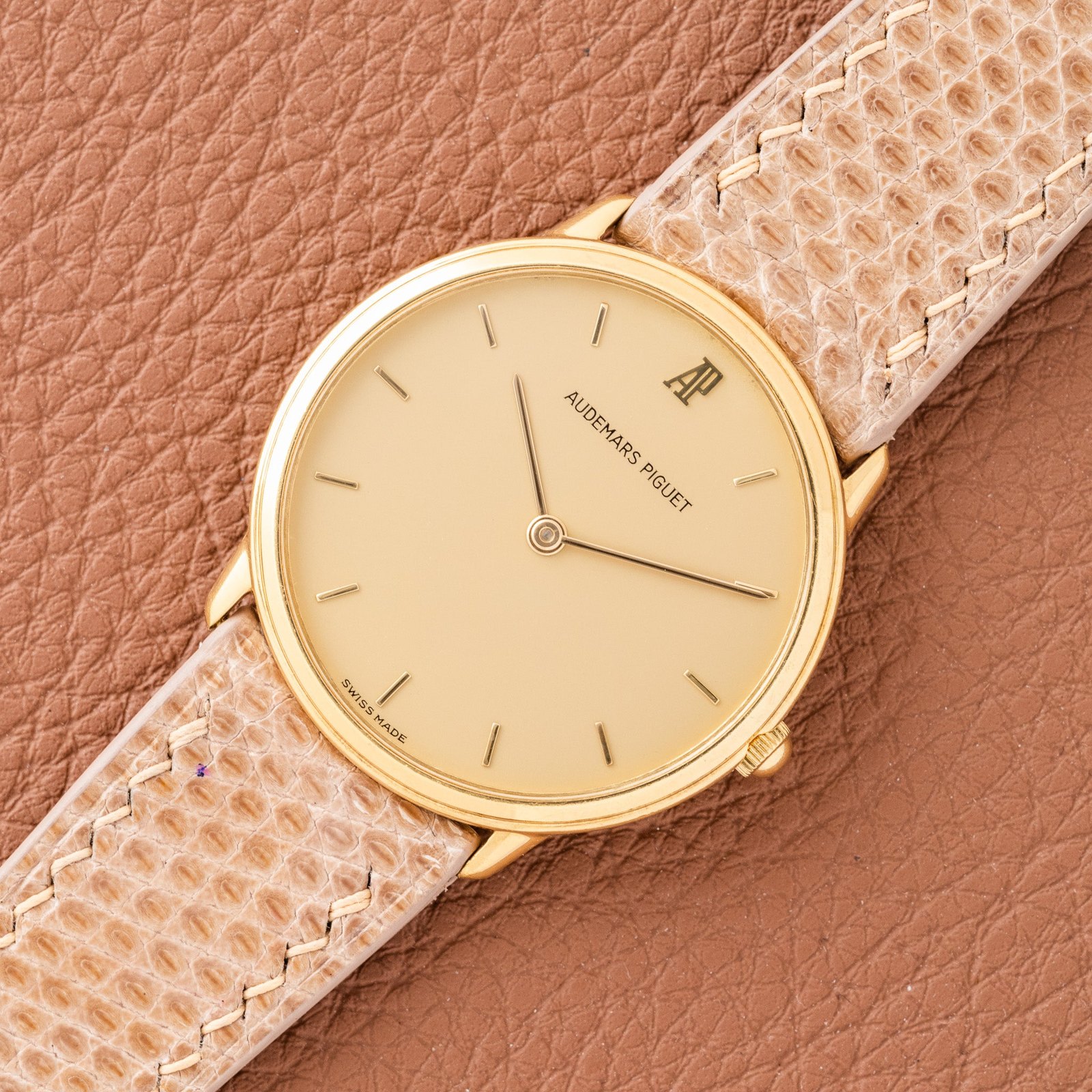
Audemars Piguet Classic Ultra-Slim Quartz, 1980s
- Maker / attribution
- Audemars Piguet (maker)
- Date
- 1980s
- Historical period
- Quartz Revolution (1969 – 1990)
- Country of origin
- Switzerland
- Object type
- Wristwatch
- Dimensions
- Case 33 mm
- Stock no.
- Product 8355900588215
- Credit line
- Dealer listing, Huntington Company (product 8355900588215)
- Catalogue title (original)
- 1980s Audemars Piguet Classic Ultra-Slim Quartz (English)
View the source record (dealer listing) ↗ (opens another website in a new tab)Suggest a correction
Record summary
Catalogued by Huntington Company (dealer) (stock number Product 8355900588215), this is a wristwatch by Audemars Piguet, made in Switzerland, dated 1980s. The Atlas places it in the Quartz Revolution period (1969 – 1990) of its Wristwatches collection. Recorded dimensions: Case 33 mm. The record is illustrated with 6 photographs.
Assembled from the source record's structured fields. Dates and attributions are given as the source states them; where a field is missing the Atlas leaves it blank rather than estimating.
Catalogue description
Dealer description — Huntington Company
History and Significance During the late 1970s and 1980s, Audemars Piguet quietly produced some of the most elegant ultra-thin dress watches of the era. While the brand is often associated today with complicated mechanical movements and the Royal Oak, these minimalist quartz references represent a different chapter in AP’s history, one focused on restraint, proportion, and finishing. This particular Ultra-Slim model exemplifies that philosophy. The solid yellow gold case is exceptionally thin and well balanced on the wrist, allowing the watch to disappear under a cuff while still carrying unmistakable presence. The dial is intentionally sparse, featuring applied stick markers, slim hands, and the AP monogram at 12 o’clock. There is no date, no seconds, and no excess text, just a clean, symmetrical layout that highlights Audemars Piguet’s design discipline. Powered by a high-grade quartz movement, these watches were positioned as precision instruments during a time when quartz technology represented the pinnacle of accuracy. Today, they stand as refined neo-vintage dress watches that prioritize design and wearability over complication. Writer’s Thoughts This is the kind of watch that rewards subtlety. The ultra-thin yellow gold case feels light and elegant on the wrist, and the proportions remain timeless decades later. The champagne dial pairs beautifully with the new light-toned strap, while the original Audemars Piguet gold buckle preserves the integrity of the piece. It is an ideal option for someone looking for a true dress watch that does not rely on size or branding to make its point. Our Promise Every watch is thoroughly vetted, carefully described with complete transparency, and guaranteed authentic. Each piece is offered in honest condition, ensuring collectors receive a timepiece that reflects both originality and integrity. Specifications Brand: Audemars Piguet Model: Classic Ultra-Slim Year: circa 1980s Case Material: Solid yellow gold Case Size: Approximately 33mm Dial: Champagne with applied stick markers Crystal: Sapphire Movement: Quartz Strap: New leather strap Buckle/Clasp: Original Audemars Piguet yellow gold tang buckle Contents: Watch only Condition Case: Solid yellow gold case shows light surface wear consistent with age and careful use. The case remains well proportioned. Crystal: Clean, with no visible chips or cracks. Dial: Champagne dial is clean with even color and well-preserved printing. Hands: Original hands are in excellent condition with no corrosion or damage. Strap: New leather strap. Buckle/Clasp: Original Audemars Piguet yellow gold buckle shows light handling marks and functions properly.
Historical context
Quartz Revolution (1969 – 1990)
Seiko's Astron begins mass quartz timekeeping; traditional industries contract sharply.
Quartz and digital watches transformed the market after 1969. Swiss employment collapsed, Japanese and Hong Kong production soared, and the Swatch (1983) helped the Swiss industry recover; mechanical watches survived as luxury goods.
Read the period in the timelineMore wristwatches from this periodEarlier: Modern Mechanical Horology
Atlas type guide
Quartz, digital and electronic watches
Electronic watches arrived in three steps. The Hamilton Electric 500 (1957) was the first battery-powered wristwatch, still with a balance; Bulova's Accutron (1960) used a tuning fork. On 25 December 1969 Seiko released the Astron 35SQ, the first quartz wristwatch, closely followed by the Swiss Beta 21 group. In 1972 Hamilton's Pulsar introduced the LED digital watch, and LCD displays soon made digital watches cheap.
The 'Quartz Crisis' that followed devastated the Swiss mechanical industry, which lost two-thirds of its workforce between 1970 and 1984 before recovering with the Swatch (1983) and the luxury mechanical revival. Solar, radio-controlled, kinetic and connected smartwatches continue the electronic line.
What to look for
- Battery hatch in the case back and calibre markings with 'Quartz' or a crystal frequency.
- Display technology: LED (red, push-button) versus LCD (always-on).
- Tuning-fork hum and a smoothly sweeping seconds hand on Accutrons.
- Model and reference numbers, often printed on the back.
Dating clues
- Electric balance watches: from 1957.
- Tuning-fork watches: 1960–c. 1977.
- Quartz analogue: from December 1969; LED digital: 1972–c. 1978; LCD from 1973.
General guidance written by the Atlas editors about this kind of object. It is not a statement about this particular piece; for that, rely on the source record above and on physical examination.
Read next:Seiko calibre 35A (Astron)
Related records
Clocks · c. 1990s
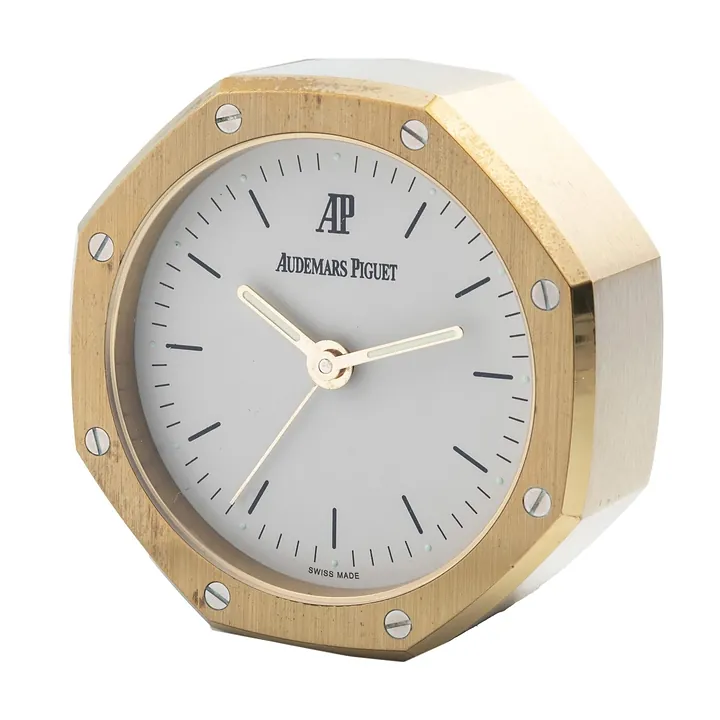
Audemars Piguet Royal Oak, c. 1990s
Antiquorum auction archive, Geneva
Pocket Watches · c. 1960
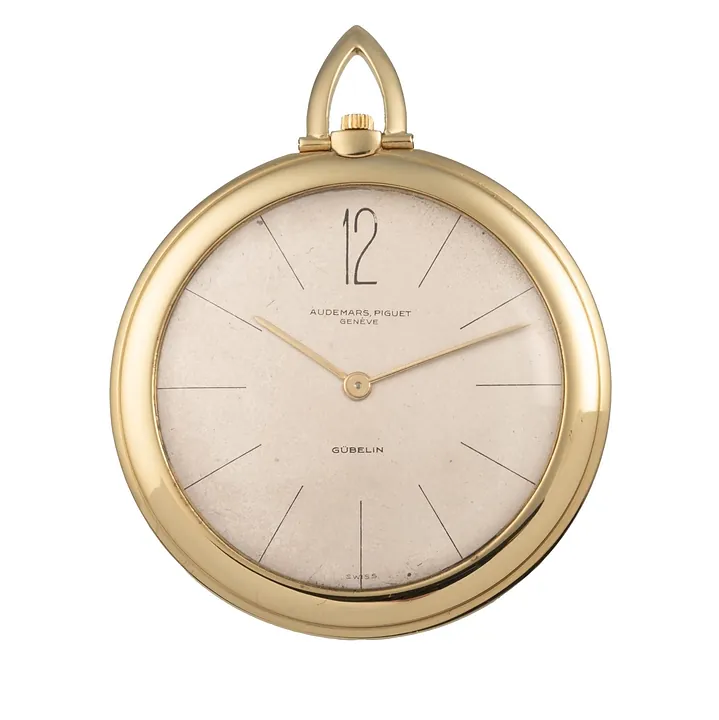
Audemars Piguet ''couteau'', c. 1960
Antiquorum auction archive, Geneva
Pocket Watches · originally sold in November 1961 (per the lot record)
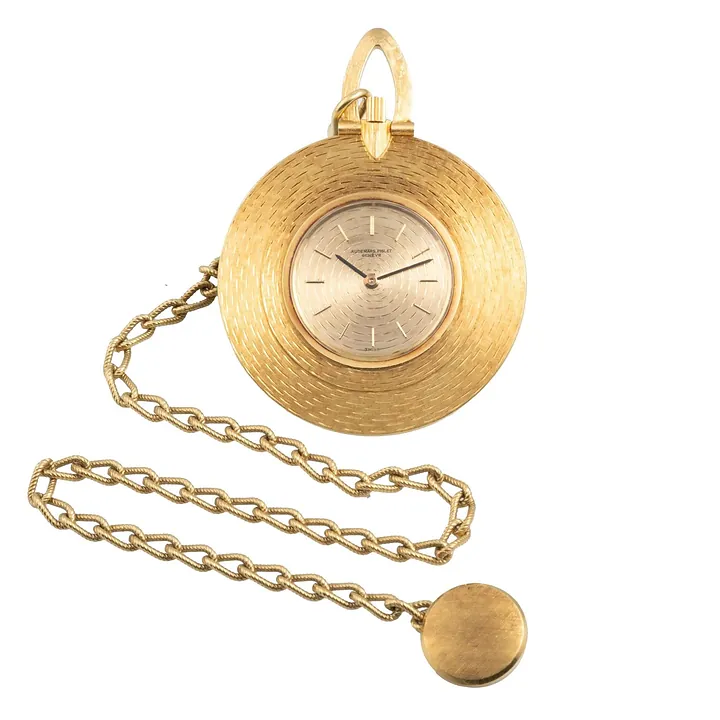
Audemars Piguet "extra Plate", ref. 5633 BA, originally sold in November 1961
Antiquorum auction archive, Geneva
Pocket Watches · c. 1980
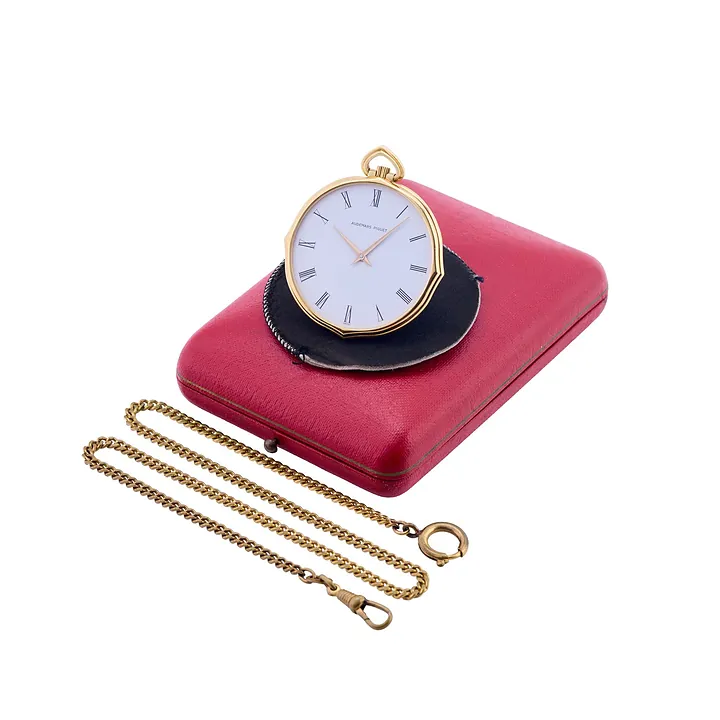
Audemars Piguet pocket watch, c. 1980
Antiquorum auction archive, Geneva

Wristwatches · 1970
Wristwatch by Heno, Switzerland, 1970
Museum Rotterdam

Wristwatches · 1960–1986
'Tri-Compax' calendar chronograph wristwatch in gold case, by Universal, Geneva, Switzerland, 1960–1986.
Science Museum Group, London

Wristwatches · 1969–1970
Beta 21 Quartz wristwatch movement, made in Switzerland, 1970.
Science Museum Group, London

Wristwatches · c. 1969
Omega Speedmaster Moonwatch, ref. 145022-69st, c. 1969
Antiquorum auction archive, Geneva