
Wristwatches · Wristwatch
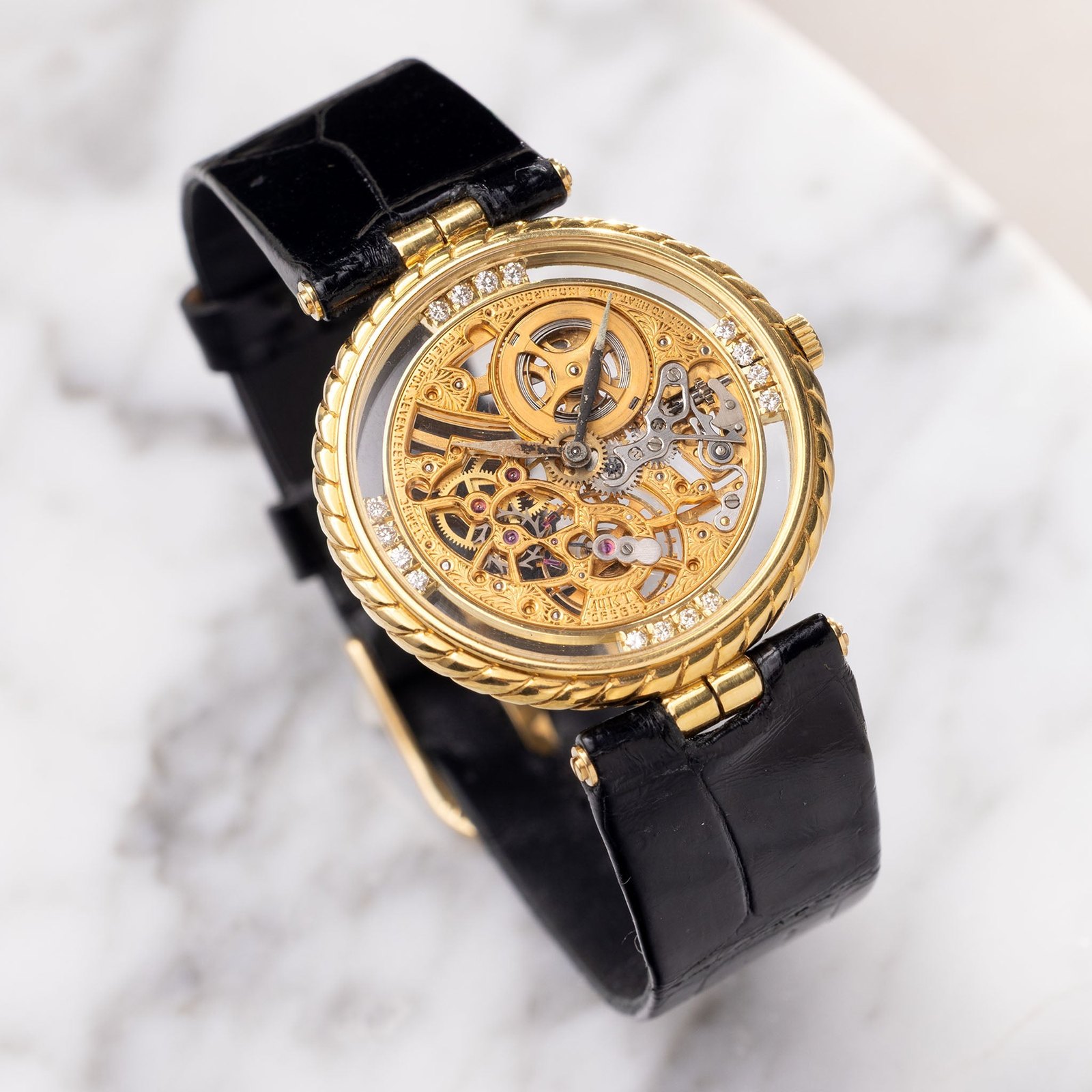
Audemars Piguet 4257/002BA Skeleton Dress Watch in 18k Yellow Gold with Box and Original Guarantee Booklet, mid 1980
- Maker / attribution
- Audemars Piguet (maker)
- Date
- mid 1980
- Historical period
- Quartz Revolution (1969 – 1990)
- Country of origin
- Switzerland
- Object type
- Wristwatch
- Materials / technique
- 18k yellow gold
- Dimensions
- Case 30 mm
- Stock no.
- W-3936
- Credit line
- Dealer listing, Bulang & Sons (W-3936)
- Catalogue title (original)
- Audemars Piguet 4257/002BA Skeleton Dress Watch in 18k Yellow Gold with Box and Original Guarantee Booklet (English)
View the source record (dealer listing) ↗ (opens another website in a new tab)Suggest a correction
Record summary
Catalogued by Bulang & Sons (dealer), Copenhagen (stock number W-3936), this is a wristwatch by Audemars Piguet, made in Switzerland, dated mid 1980. The Atlas places it in the Quartz Revolution period (1969 – 1990) of its Wristwatches collection. Materials and techniques recorded by the source: 18k yellow gold. Recorded dimensions: Case 30 mm. The record is illustrated with 6 photographs.
Assembled from the source record's structured fields. Dates and attributions are given as the source states them; where a field is missing the Atlas leaves it blank rather than estimating.
Catalogue description
Dealer description — Bulang & Sons
Audemars Piguet was founded in 1875 in Le Brassus, in the Vallée de Joux, by childhood friends Jules-Louis Audemars and Edward-Auguste Piguet. From the beginning, the manufacture focused on complicated and highly finished mechanical watches, developing a reputation for technical innovation and exceptional craftsmanship. Throughout the 20th century, Audemars Piguet became particularly renowned for ultra-thin movements, perpetual calendars, minute repeaters and skeletonised watches. Today, Audemars Piguet remains one of the few major Swiss watch manufacturers still independently owned by its founding families, continuing its long tradition of combining technical innovation with exceptional hand-finishing. Audemars Piguet began experimenting with skeletonised movements during the early 20th century, when the technique was still an extremely specialised form of decorative watchmaking. By removing much of the material from the bridges and plates, watchmakers could reveal the inner workings of the movement while transforming the remaining structure into a miniature piece of architecture. The brand’s expertise really developed during the 1930s and 1940s, with increasingly elaborate skeletonised movements incorporating hand-bevelled edges, polished surfaces and intricate engraving. These watches were produced in very small numbers and were aimed at collectors who appreciated the combination of mechanical complexity and artistic craftsmanship. Audemars Piguet continued to develop the art throughout the second half of the 20th century. Particularly important were its ultra-thin skeleton watches, where the challenge was not simply to open up the movement, but to remove material without compromising its structural integrity. The result was an extraordinary combination of technical precision and decorative craftsmanship. For collectors, vintage AP skeleton watches are therefore interesting for two reasons: they showcase one of the maison’s oldest decorative traditions while also demonstrating just how far traditional hand-finishing can be pushed. Every bridge, cut-out and polished edge had to be finished by hand, turning the movement into almost as much of a work of art as the watch itself. And here we have a beautiful example. Housed in an elegant 30 mm case crafted from 18k yellow gold, the watch features wonderfully refined Vendôme-style lugs and exquisite hand-finished detailing. There is no conventional dial here — just a crystal offering an unobstructed view of the extraordinary movement beneath. Entirely hand-engraved and sculpted, the movement is executed in 14k gold and is a wonderful display of the craftsmanship for which Audemars Piguet became so renowned. Adding another touch of elegance, the area where the movement meets the case is tastefully decorated with a delicate row of diamonds. The watch is paired with an original Audemars Piguet leather strap and its original 18k gold pin buckle. It comes complete with its original AP cardboard box, leather watch holder, leather guarantee and booklet holder, and original guarantee booklet, confirming a sale in Hong Kong in 1987. There is even an AP hang tag carrying the watch’s serial number. And this is where things get particularly interesting! A wonderfully tasteful AP with the kind of movement that will make someone stop, look twice and ask, “What is that?” Get in touch!! Specifications: Audemars Piguet Skeleton ultra-thin dress watch reference 4257/002BA 30mm 18k yellow gold hand engraved case, Vendome style lugs Case no. C60xx dating to the mid 1980’s No lume leaf style hands Hand finished engraved 14k gold ultra thin movement AP leather strap and 18 k yellow gold AP pin buckle Outer AP card board box, leather watch holder, hangtag with serial leather paper holder Certificate of origine and guarantee stating a sale in 1987, Hongkong Fully serviced by our watchmaker
Historical context
Quartz Revolution (1969 – 1990)
Seiko's Astron begins mass quartz timekeeping; traditional industries contract sharply.
Quartz and digital watches transformed the market after 1969. Swiss employment collapsed, Japanese and Hong Kong production soared, and the Swatch (1983) helped the Swiss industry recover; mechanical watches survived as luxury goods.
Read the period in the timelineMore wristwatches from this periodEarlier: Modern Mechanical Horology
Atlas type guide
Wristwatches
Bracelet watches were worn by women from the early nineteenth century — Breguet made one for Caroline Murat, Queen of Naples, in 1810–12 — but the wristwatch only became a man's instrument with military use and aviation in the early twentieth century. Between the World Wars it overtook the pocket watch; the 1920s and 1930s brought rectangular Art Deco cases, water-resistant cases and the first automatic winding systems.
After 1945 the wristwatch became a carrier of identity — dress watches, sports and dive watches, chronographs, calendars — produced by Swiss, American, Japanese, German, Soviet and Chinese industries. The quartz revolution after 1969 and the mechanical renaissance since the 1990s, including the rise of independent watchmakers, complete the story.
What to look for
- The reference number (between the lugs or inside the case back) and serial number, the starting point for dating.
- The calibre: its maker and number are often stamped under the dial or on the bridge.
- Originality of dial, hands and crown — refinished ('redial') dials are common.
- Case material marks: 18K/750, 14K/585, stainless steel, gold-filled, plated.
Dating clues
- Wire-lug cases: before c. 1925.
- Water-resistant screw-down cases: from 1926.
- Quartz movements: from 1969; sapphire crystals widespread after c. 1980.
General guidance written by the Atlas editors about this kind of object. It is not a statement about this particular piece; for that, rely on the source record above and on physical examination.
Related records

Clocks · c. 1990s
Audemars Piguet Royal Oak, c. 1990s
Antiquorum auction archive, Geneva

Pocket Watches · c. 1960
Audemars Piguet ''couteau'', c. 1960
Antiquorum auction archive, Geneva
Pocket Watches · originally sold in November 1961 (per the lot record)
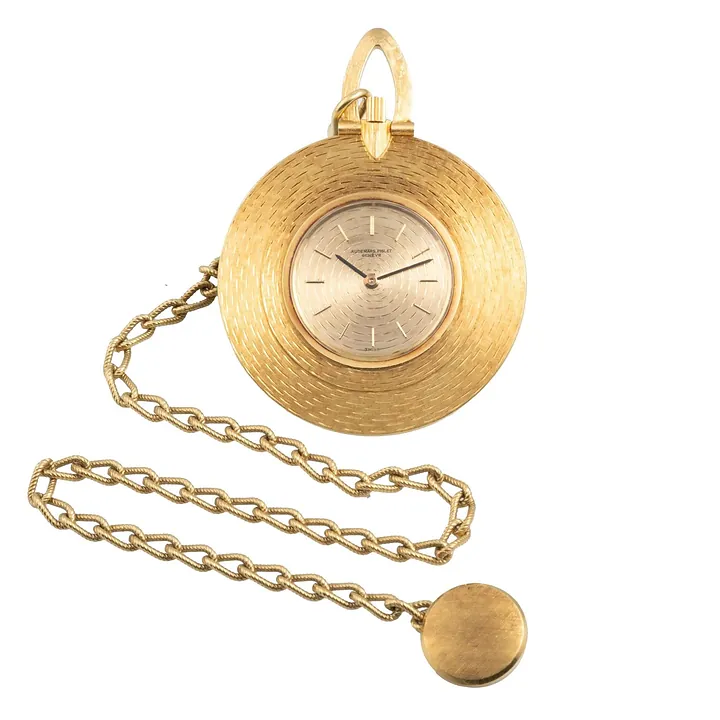
Audemars Piguet "extra Plate", ref. 5633 BA, originally sold in November 1961
Antiquorum auction archive, Geneva

Pocket Watches · c. 1980
Audemars Piguet pocket watch, c. 1980
Antiquorum auction archive, Geneva

Wristwatches · 1970
Wristwatch by Heno, Switzerland, 1970
Museum Rotterdam

Wristwatches · 1960–1986
'Tri-Compax' calendar chronograph wristwatch in gold case, by Universal, Geneva, Switzerland, 1960–1986.
Science Museum Group, London

Wristwatches · 1969–1970
Beta 21 Quartz wristwatch movement, made in Switzerland, 1970.
Science Museum Group, London

Wristwatches · c. 1969
Omega Speedmaster Moonwatch, ref. 145022-69st, c. 1969
Antiquorum auction archive, Geneva