
Clocks · Pedestal astronomical clock
Astronomical Clock by Samuel Watson
- Maker / attribution
- Samuel Watson (source attribution)
- Date
- 1690–1710
- Historical period
- Early Modern Horology (1600 – 1750)
- Country of origin
- England
- Object type
- Pedestal astronomical clock
- Holding institution
- Science Museum Group Collection
- Accession / object no.
- astronomical-clock-by-samuel-watson-3af7373ee8
- Credit line
- Science Museum Group Collection
- Catalogue title (original)
- Astronomical clock by Samuel Watson | Science Museum Group Collection (English)
View the source record ↗ (opens another website in a new tab)Suggest a correction
Record summary
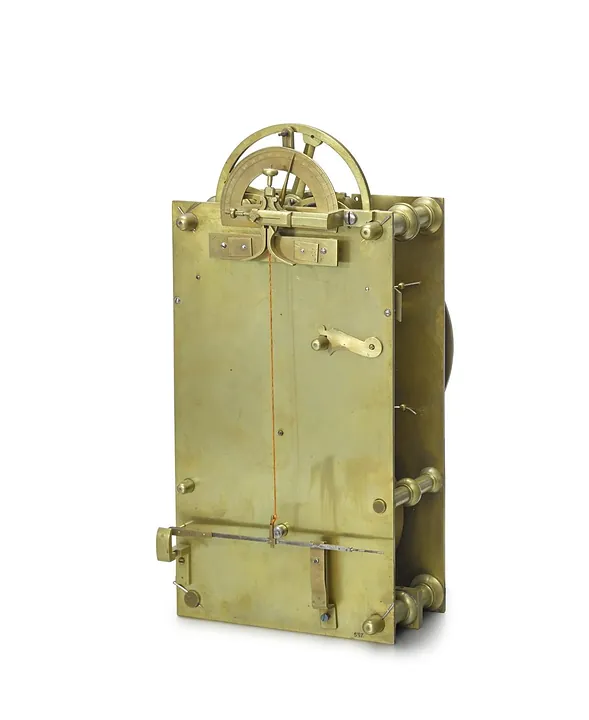
Held and catalogued by Science Museum Group Collection (object number astronomical-clock-by-samuel-watson-3af7373ee8), this is a pedestal astronomical clock attributed to Samuel Watson, made in England, dated 1690–1710. The Atlas places it in the Early Modern Horology period (1600 – 1750) of its Clocks collection. The record is illustrated with 1 photograph.
Assembled from the source record's structured fields. Dates and attributions are given as the source states them; where a field is missing the Atlas leaves it blank rather than estimating.
Catalogue description
Original object description
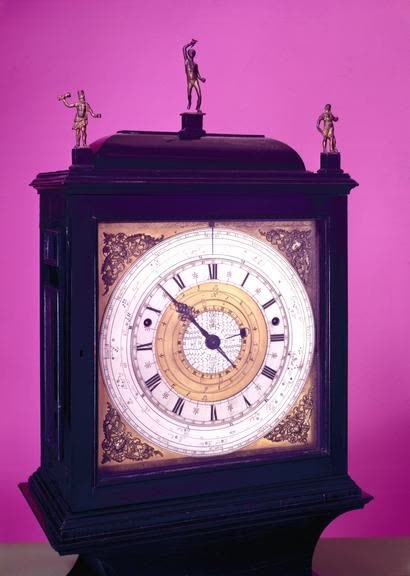
Preserved by the Science Museum Group, this astronomical pendulum timepiece with spring drive was crafted in London by Samuel Watson circa 1695, within an overall production bracket of 1690 to 1710. The ebonised housing is surmounted by classical metal figures. According to museum documentation, it represents the earliest surviving English astronomical clock designed around the Copernican heliocentric model. The instrument records standard civil time, the calendar, the passage of the Sun through the Zodiac, lunar phases, lunar latitude for predicting eclipses, tidal highs at London Bridge, as well as the moments of sunrise, moonrise, and moonset.
Original object description
Bearing the signature of London maker Samuel Watson, this clock is museum-dated to around 1695, falling within his working period between 1690 and 1710. Born in Coventry circa 1635, Watson pursued his trade locally prior to moving to London around 1690, where he remained active until his death circa 1710. The institution identifies the piece as the earliest English astronomical timepiece operating on the Copernican premise of a stationary sun. Accompanying collection notes state that Watson constructed an even more intricate astronomical clock for King Charles II between 1683 and 1690, an instrument now housed in the Royal Library at Windsor Castle.
Original object description
Resting upon a pedestal base, the ebonised housing contains a glazed door and supports three classical statuettes acting as finials across the upper crest. Inventory records for component 1970-25 Pt1 list its constituents as unidentified timber, bronze, brass, glass, and steel. The main institutional summary registers overall proportions of 970 mm in height, 540 mm in width, and 340 mm in depth, weighing 31 kg; conversely, the individual entry for 1970-25 Pt1 logs the same 31 kg mass within dimensions of 1000 mm by 570 mm by 340 mm. Surviving accessories include two case keys and a single crank key for winding.
Original object description
Pierced corner spandrels depicting winged cherubs amidst scrollwork frame the square brass dial. Multiple concentric engraved bands present Roman hour numerals, calendar intervals, and zodiacal markers. Blued steel pointers are set at the arbor, comprising an ornate hour hand and a pointer pierced with an aperture that registers against an inner revolving disc. Museum entries confirm that these displays collectively track standard time, dates, solar zodiacal progression, moonrise and moonset, sunrise, tidal peaks at London Bridge, and lunar phases alongside latitude for eclipse calculations.
Historical context
Early Modern Horology (1600 – 1750)
Huygens' pendulum and balance spring transform accuracy; English makers develop the anchor and deadbeat escapements.
Huygens's pendulum (1656–57) improved clock accuracy from about a quarter of an hour to under a minute a day. The anchor escapement (c. 1670) and the long seconds pendulum created the longcase clock; London makers such as Fromanteel, Knibb, Tompion and Quare led European clockmaking, and French makers created the Boulle pendule.
Read the period in the timelineMore clocks from this periodEarlier: Renaissance Horology
Atlas type guide
Astronomical, musical and automaton clocks
Astronomical clocks display more than the hour: the positions of the sun and moon in the zodiac, the phase of the moon, the calendar, sometimes the planets and eclipses. From Richard of Wallingford's and Giovanni de' Dondi's fourteenth-century clocks to the Prague Orloj and the Strasbourg cathedral clocks, they demonstrated the order of the cosmos. Renaissance makers in Augsburg and Nuremberg built celestial globe clocks and monstrance clocks as princely treasures.
Automaton and musical clocks entertained as well as informed: figures move, birds sing, organs and carillons play tunes from pinned cylinders. The eighteenth-century trade with China ('sing-songs') and Ottoman Turkey created a market for elaborate English, Swiss and French automata.
What to look for
- Subsidiary dials for moon phase, calendar, zodiac and planetary positions.
- Celestial globes or armillary spheres turned by the movement.
- Pinned cylinders, bellows and pipes or bells for music.
- Figures on cams and levers; separate trains for automaton work.
Dating clues
- Renaissance astronomical table and globe clocks: c. 1550–1650.
- English and Swiss automaton clocks for the Chinese market: c. 1760–1820.
- Picture clocks (clockwork pictures) are mostly nineteenth century.
General guidance written by the Atlas editors about this kind of object. It is not a statement about this particular piece; for that, rely on the source record above and on physical examination.
Read next:Verge escapementFusee
Related records
Clocks · c. 1700–1710
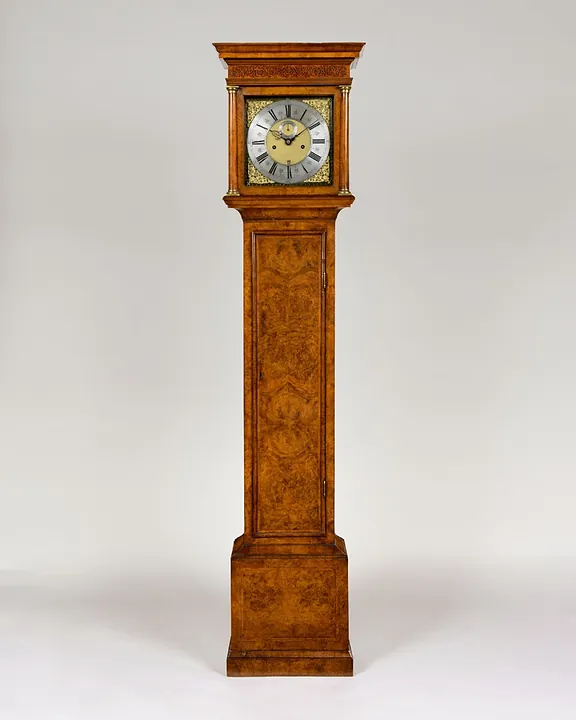
Longcase clock by Samuel Watson, London, c. 1700–1710
Howard Walwyn Fine Antique Clocks (dealer), London
Clocks · 1598–1603
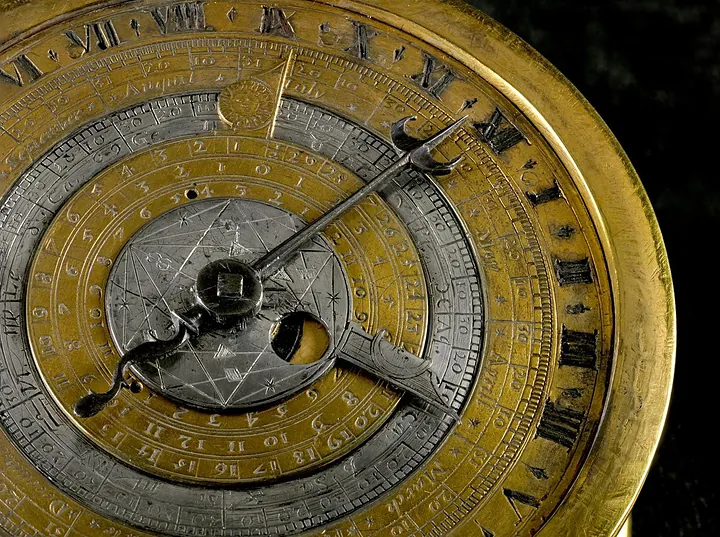
Circular table-clock with calendrical and lunar indications made by Nicholas Vallin in London between 1598 and 1603.
Science Museum Group, London
Clocks · 1611
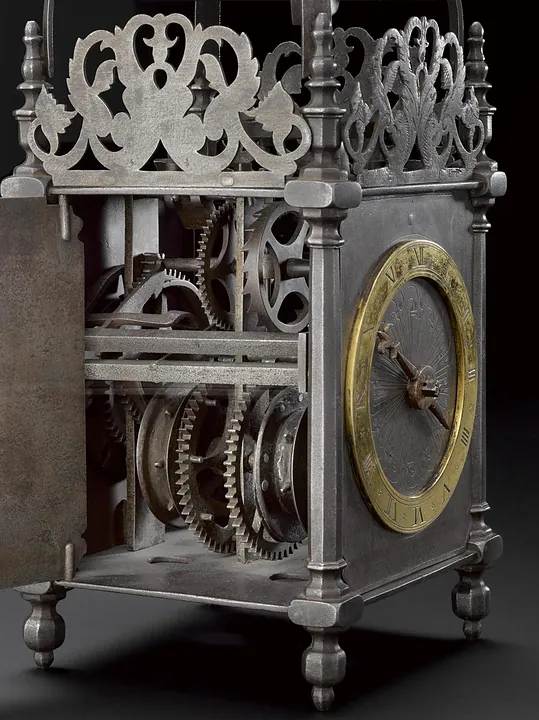
English iron lantern clock, with wheel balance, by John Holloway, Market Lavington, Wiltshire, England, 1611.
Science Museum Group, London
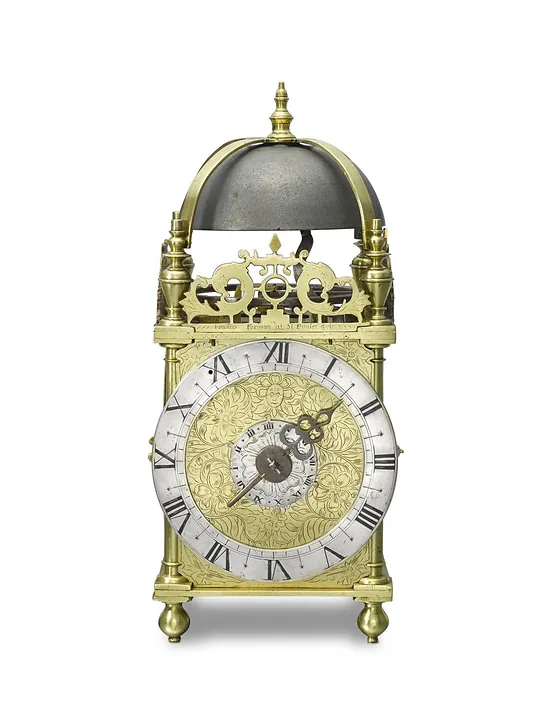
Clocks · 1630
Lantern clock by Francis Forman, England, 1630
Science Museum Group, London
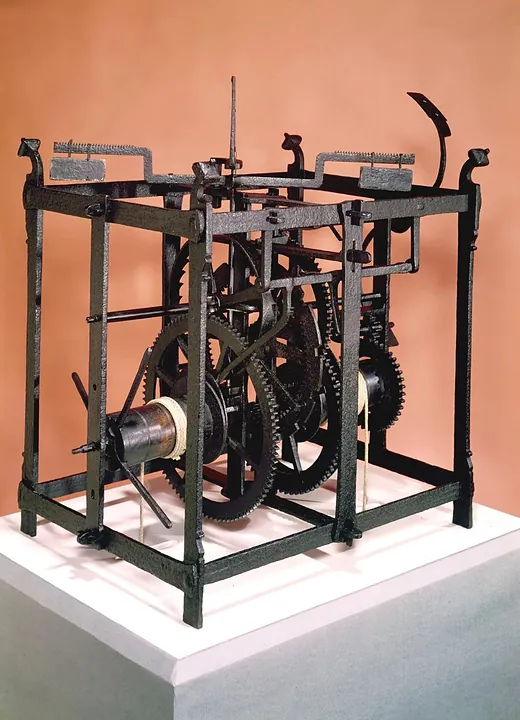
Clocks · 1632–1640
Turret clock, England, 1632–1640
Science Museum Group, London
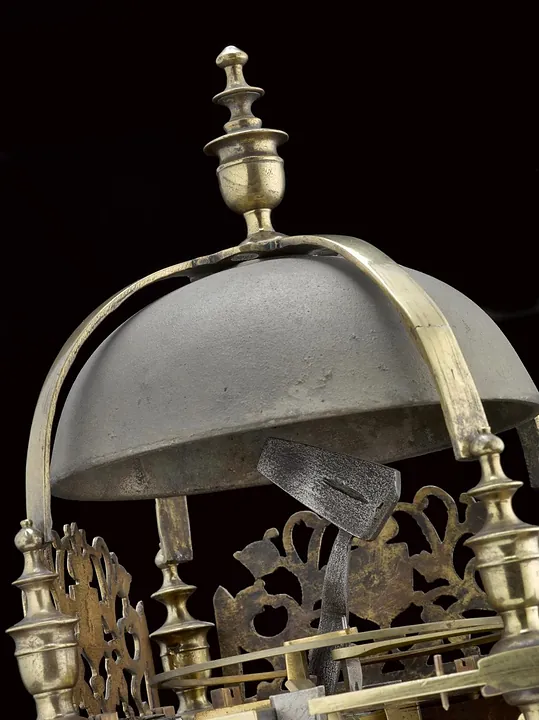
Clocks · 1645–1655
Balance-wheel brass lantern clock, with two driving weights and one counterweight, by Thomas Knifton, Cross Keys, Lothbury, London, England, 1645–1655.
Science Museum Group, London
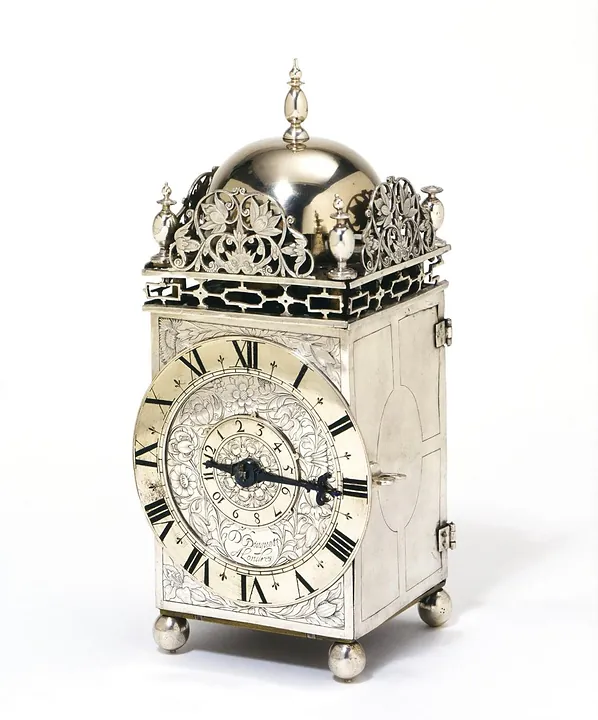
Clocks · c. 1650
Lantern alarm clock, silver, by David Bouquet, circa 1650
Victoria and Albert Museum, London
Clocks · 1650–1660
Lantern clock by Peter Closon, England, 1650–1660
Science Museum Group, London