
Instruments · Ship's marine chronometer
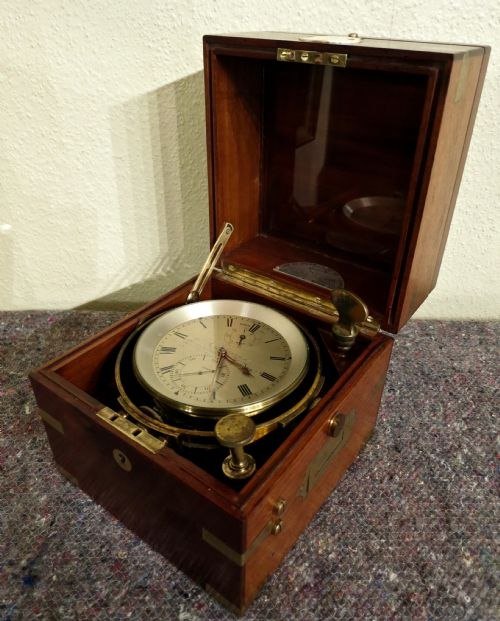
Asmus Johanneson 56-Hour Ship's Marine Chronometer
- Maker / attribution
- Asmus Johanneson (source attribution)
- Date
- 1900–1920
- Historical period
- Golden Age of Mechanical Watchmaking (1900 – 1945)
- Country of origin
- England
- Object type
- Ship's marine chronometer
- Holding institution
- Quiet Street Antiques of Bath
- Accession / object no.
- SA522445
- Credit line
- Quiet Street Antiques of Bath
- Catalogue title (original)
- 56-Hour Ship's Marine Chronometer | Sellingantiques.co.uk (English)
View the source record ↗ (opens another website in a new tab)Suggest a correction
Record summary
Held and catalogued by Quiet Street Antiques of Bath (object number SA522445), this is a ship's marine chronometer attributed to Asmus Johanneson, made in England, dated 1900–1920. The Atlas places it in the Golden Age of Mechanical Watchmaking period (1900 – 1945) of its Instruments collection. The record is illustrated with 1 photograph.
Assembled from the source record's structured fields. Dates and attributions are given as the source states them; where a field is missing the Atlas leaves it blank rather than estimating.
Catalogue description
Original object description
Dealer documentation attributes this marine chronometer to the London horologist Asmus Johanneson. The 56-hour instrument is gimbal-mounted within a three-level mahogany deck chest bound with brass, featuring an internal lock and inset lateral carrying handles. On the engraved silvered face, Roman hours are accompanied by an 'Up-and-Down' power reserve dial situated below the XII marker and a subsidiary dial for running seconds. An original ratcheted winding tool is secured within an upper interior corner. Sized at 19 cm high, 19 cm wide, and 17 cm deep, the unit is estimated by the vendor to date from roughly 1900 to 1920.
Original object description
A brass bowl cradles the mechanism, suspended on gimbal rings inside the wooden housing. Across the silvered dial, time is read via black Roman numerals, supplemented by an auxiliary running seconds register and a winding indicator placed directly below the twelve o'clock position. Beside the gimbal structure in the upper corner rests a slotted, ratcheted key, while an adjacent clamp lever serves to secure the assembly against movement during sea transit.
Original object description
Formed in three sections from mahogany, the outer container is reinforced with brass angle brackets, visible hinges, and an escutcheon plate over the upper keyhole. Drop handles mounted flush into brass side plates on the lowest section facilitate marine storage. Measurements reported by the seller record the chest at 17 cm in depth, 19 cm in width, and 19 cm in height.
Original object description
The seller attributes the timepiece to Asmus Johanneson, based at 149 The Minories in London, assigning a date range of circa 1900–1920 or the 1900s and noting that the firm supplied instruments to the British Admiralty between 1890 and 1910. However, the listing lacks serial stamps, internal views, plate engravings, or escapement descriptions; assertions of Admiralty procurement, movement integrity, and mechanical functionality rest entirely on unsupported vendor statements.
Historical context
Golden Age of Mechanical Watchmaking (1900 – 1945)
The wristwatch displaces the pocket watch; waterproof cases, self-winding and grand complications.
Timing instruments became electrical and specialised: industrial time recorders, sports timers and aviation instruments.
Read the period in the timelineMore instruments from this periodEarlier: Industrial Revolution
Atlas type guide
Marine chronometers
A marine chronometer is a precision timekeeper carried at sea to find longitude: the navigator compares local noon, observed with a sextant, with the time at a reference meridian kept by the chronometer. Each hour of difference corresponds to fifteen degrees of longitude. John Harrison proved the method in the 1760s; Pierre Le Roy, Ferdinand Berthoud, John Arnold and Thomas Earnshaw then developed the detent escapement and the compensation balance that made chronometers practical to manufacture.
By the nineteenth century London, Liverpool, Le Locle and Glashütte supplied navies and merchant fleets. A typical box chronometer has a spring-detent escapement, a fusee to equalise mainspring torque, a bimetallic compensation balance with a helical balance spring, and is mounted in gimbals inside a wooden box so that it stays level.
What to look for
- Gimbals and a three-tier wooden box with a glazed inner lid.
- A power-reserve ('up and down') indicator on the dial, usually showing 56 hours on two-day instruments.
- Spring-detent escapement and a cylindrical (helical) balance spring visible through the movement.
- Admiralty or navy marks (broad arrow), and rating certificates from observatories.
- The maker's number on the dial and movement; many makers' registers survive, allowing dating.
Dating clues
- Earnshaw-type spring-detent chronometers became standard after about 1800.
- Auxiliary compensation devices on the balance appear from the mid-nineteenth century.
- Quartz and radio time signals ended routine use of mechanical chronometers in the 1970s and 1980s.
General guidance written by the Atlas editors about this kind of object. It is not a statement about this particular piece; for that, rely on the source record above and on physical examination.
Read next:Spring detent (chronometer) escapementFuseeBalance spring (hairspring)Detent escapement
Related records
Instruments · 1890–1950
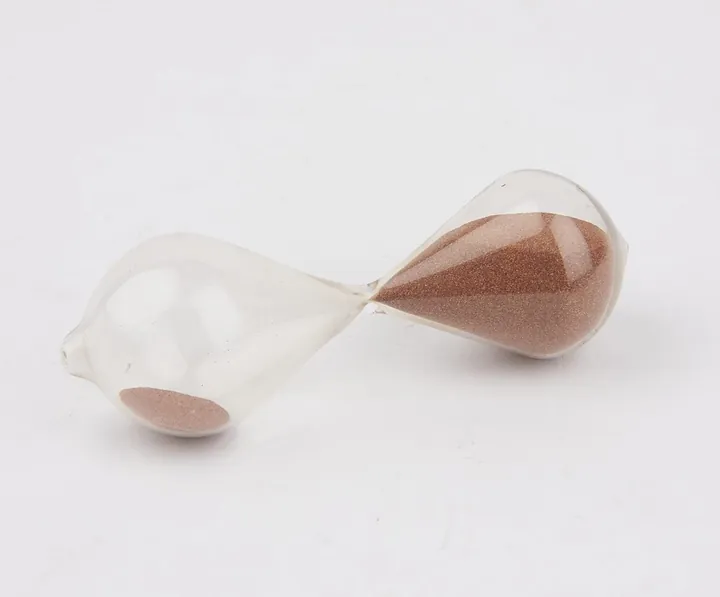
Single sand-glass unmounted, showing complete seal. 15 mins. Abbot Horne. No. Type C., 1890–1950
Science Museum Group, London
Instruments · 1890–1950
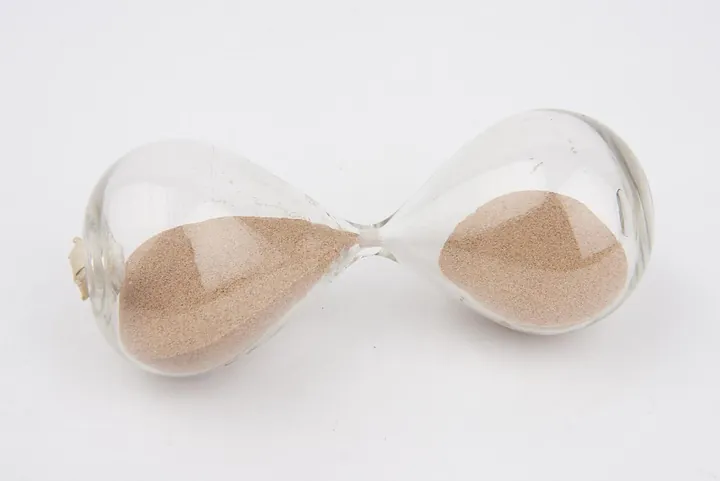
Single sand-glass unmounted, showing corked entry hole. 2 1/2 mins. Abbot Horne. Type B, 1890–1950
Science Museum Group, London
Instruments · 1904–1910
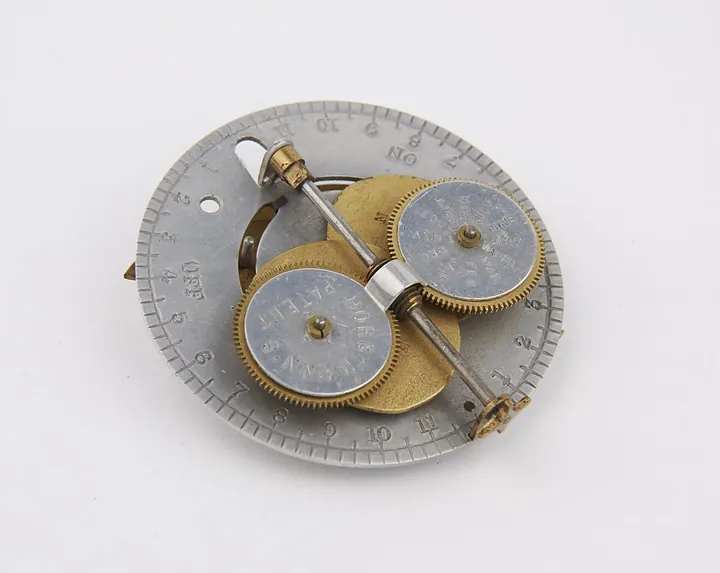
Solar dial from Horstmann patent clockwork street light controller, Horstmann, British, 1904–1910.
Science Museum Group, London
Instruments · 1912
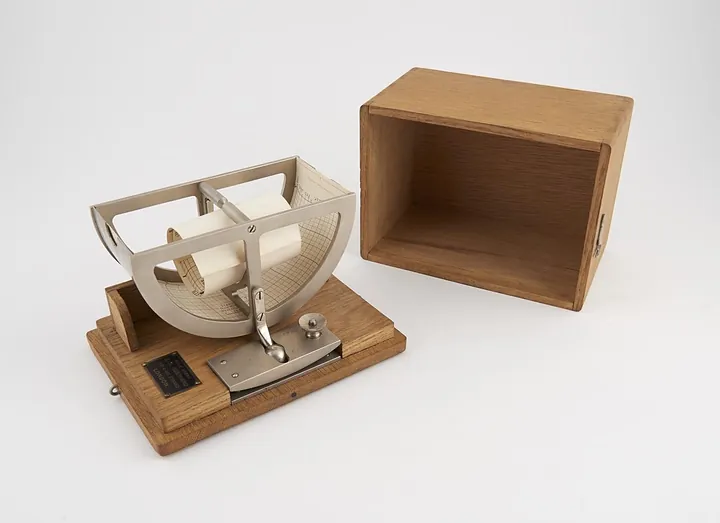
Ferguson solar chronometer and astronomical compass, No. 124G with spare chart, by J.H. Steward, London, England. c.1912. Lacks alidad
Science Museum Group, London
Instruments · 1920–1935 (cast of an original of c. 670 CE)
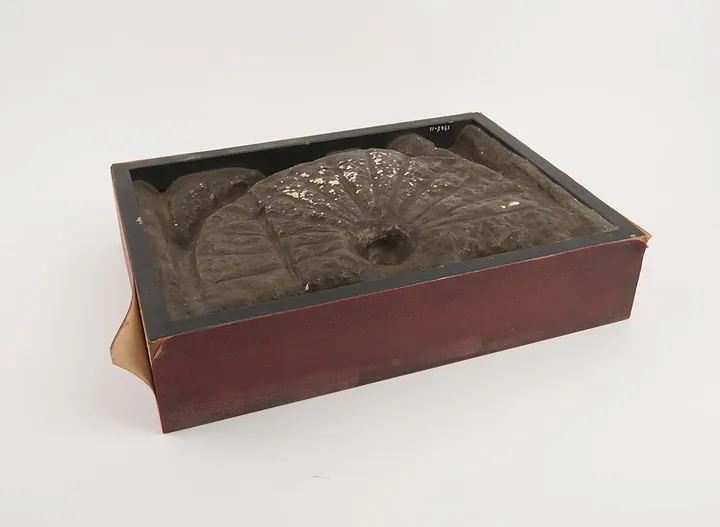
Plaster cast of an early English sundial, 1920–1935 (original c. 670 CE)
Science Museum Group, London
Instruments · 1925–1930
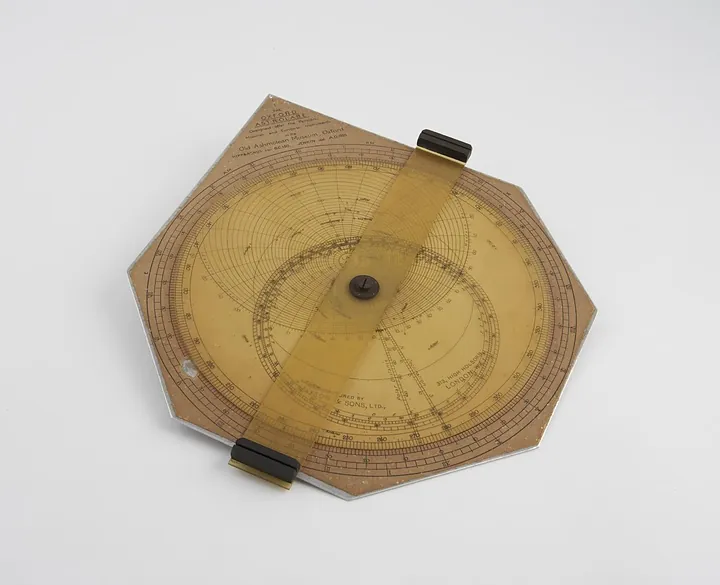
"Oxford" Astrolabe with celluloid rete designed by Professor Jenkin 1925.
Science Museum Group, London
Instruments · c. 1935
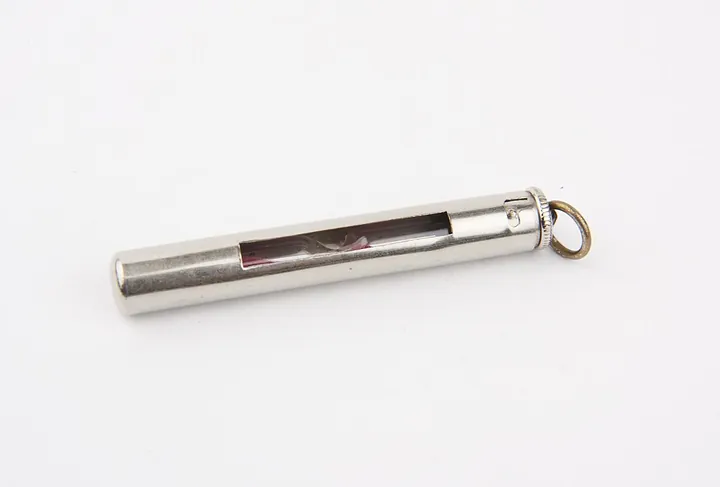
Single sandglass in metal case, 30 seconds running time, used as a pulse glass by a nurse (Muriel Rosebury) at Westwood Hospital, Oldham, 1935-1945.
Science Museum Group, London
Instruments · 1930–1959
Stopwatch / timer by I.B.M. UK Ltd., England, 1930–1959
Science Museum Group, London