
Clocks · Alarm clock
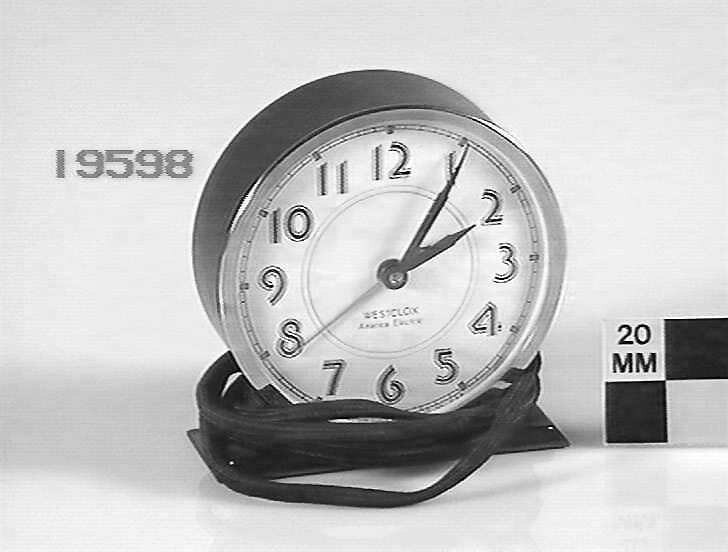
Alarm Clock - Western Clock Co, 'America Electric', 1934
- Maker / attribution
- Unrecorded in source
- Date
- 1934
- Historical period
- Golden Age of Mechanical Watchmaking (1900 – 1945)
- Country of origin
- Unrecorded in source
- Object type
- Alarm clock
- Dimensions
- 5 cm (Width), 11 cm (Outside Diameter)
- Holding institution
- Museums Victoria, Melbourne
- Accession / object no.
- ST 19598
- Catalogue title (original)
- Alarm Clock - Western Clock Co, 'America Electric', 1934 (English)
View the source record ↗ (opens another website in a new tab)Suggest a correction
Record summary
Held and catalogued by Museums Victoria, Melbourne (object number ST 19598), this is an alarm clock, dated 1934. The Atlas places it in the Golden Age of Mechanical Watchmaking period (1900 – 1945) of its Clocks collection. Recorded dimensions: 5 cm (Width), 11 cm (Outside Diameter). The record is illustrated with 1 photograph.
Assembled from the source record's structured fields. Dates and attributions are given as the source states them; where a field is missing the Atlas leaves it blank rather than estimating.
Catalogue description
Summary — Museums Victoria
Alarm clock, electric, 'America Electric', Western Clock Co, USA, 1934. Western Clock Co introduced the synchronous electric motor to some of its clock range in 1931. The 'America Electric' was produced 1932-1936. General Time Corporation, which owned the Western Clock Co and Seth Thomas, purchased the Hamilton-Sangamo Corporation in 1930 in order to gain an exclusive license to use their synchronous motor design.
Physical description — Museums Victoria
Alarm clock with round black metal case on flat metal stand. White cardboard dial with red dots to mark hours. Two black hands, and gilt sweep seconds hand. Electric synchronous motor.
Inscriptions & marks
Dial is marked 'Westclox America Electric' and 'Made by Western Clock Co, La Salle, Ill. USA'. Back of case is marked 'Made by makers of 'Big Ben'.
Provenance
Loan & Subsequent Bequest from Mr John Askew, 03 May 1934
Historical context
Golden Age of Mechanical Watchmaking (1900 – 1945)
The wristwatch displaces the pocket watch; waterproof cases, self-winding and grand complications.
Between 1900 and 1945 clocks were electrified: master-clock systems ran factories and offices, synchronous mains clocks entered homes, and the Shortt free-pendulum clock set new standards of accuracy before the first quartz clocks (1927). Art Deco design reshaped mantel and table clocks.
Read the period in the timelineMore clocks from this periodEarlier: Industrial Revolution
Atlas type guide
Alarm clocks
Alarm work is among the oldest clock functions: monastic clocks woke monks for night prayers, and Renaissance table clocks often carried an alarm disc set by a pin. A separate spring or weight is released at the set time and drives a hammer against a bell. Some early alarms also lit a candle by striking a flint — the 'tinder pistol' alarm.
The cheap, mass-produced alarm clock arrived in the second half of the nineteenth century. American firms such as Seth Thomas and Westclox (the 'Big Ben' of 1910) and German makers such as Junghans and Kienzle made millions of drum-shaped alarms with pin-pallet escapements. Electric, quartz and digital alarm clocks followed in the twentieth century.
What to look for
- A separate alarm-setting dial or disc and an extra winding key.
- Twin bells on top (common after c. 1920) or a bell enclosed in the base.
- Pin-pallet escapements in inexpensive factory alarms.
- Trademarks and patent dates on dial or back.
Dating clues
- Renaissance alarm table clocks: sixteenth to seventeenth centuries.
- Drum alarm clocks: from the 1870s.
- Luminous dials with radium paint: c. 1910–1960.
General guidance written by the Atlas editors about this kind of object. It is not a statement about this particular piece; for that, rely on the source record above and on physical examination.
Related records
Clocks · 1890–1930
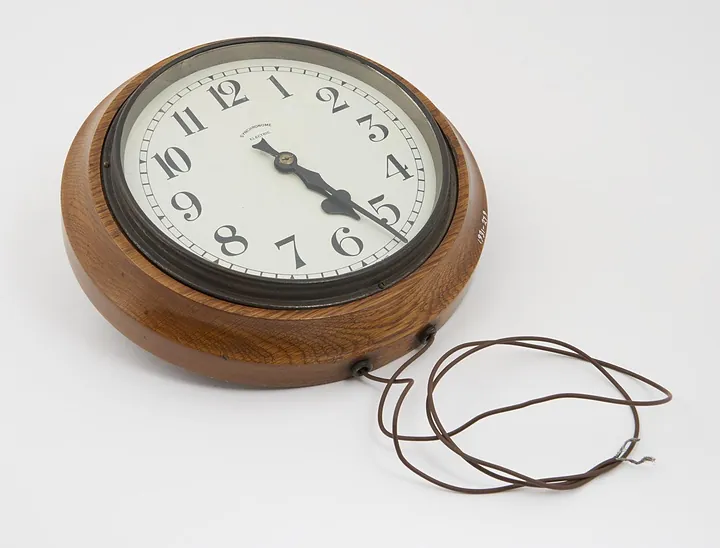
Clock with 8-inch impulse dial, by the Synchronome Company Limited, England, 1890–1930.
Science Museum Group, London
Clocks · c.1900
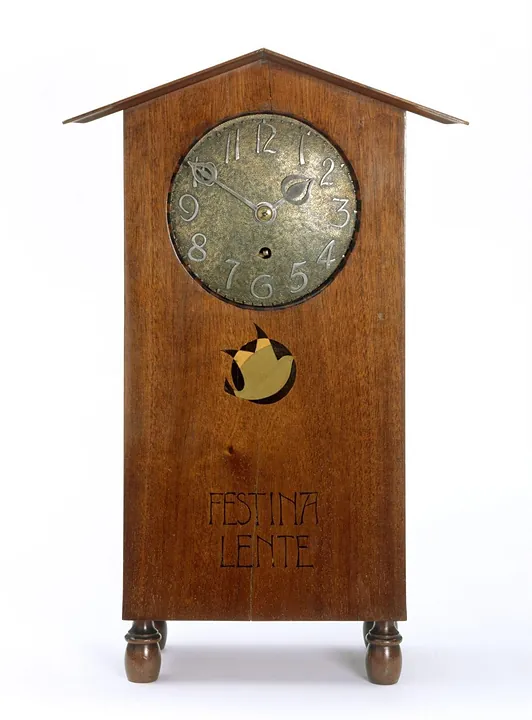
Clock by Mackay Hugh Baillie Scott, Bedfordshire, c.1900
Victoria and Albert Museum, London
Clocks · c. 1900
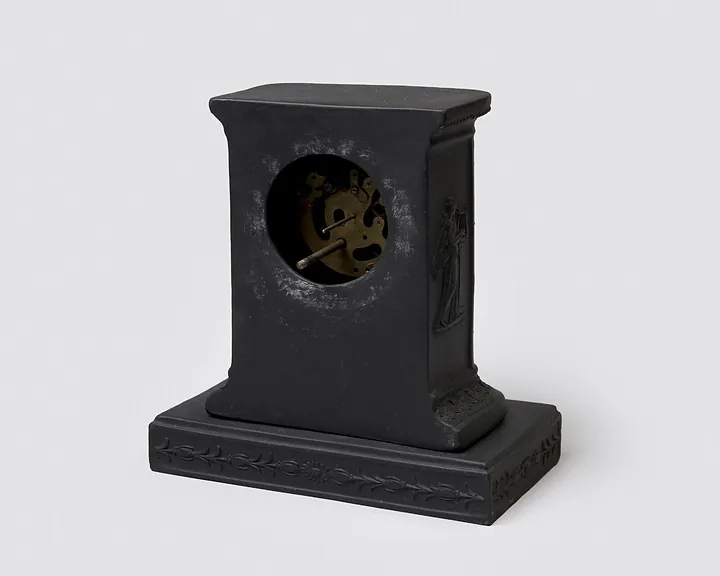
Clock, black basalt, brass, Josiah Wedgwood and Sons, Etruria, c. 1900
Victoria and Albert Museum, London
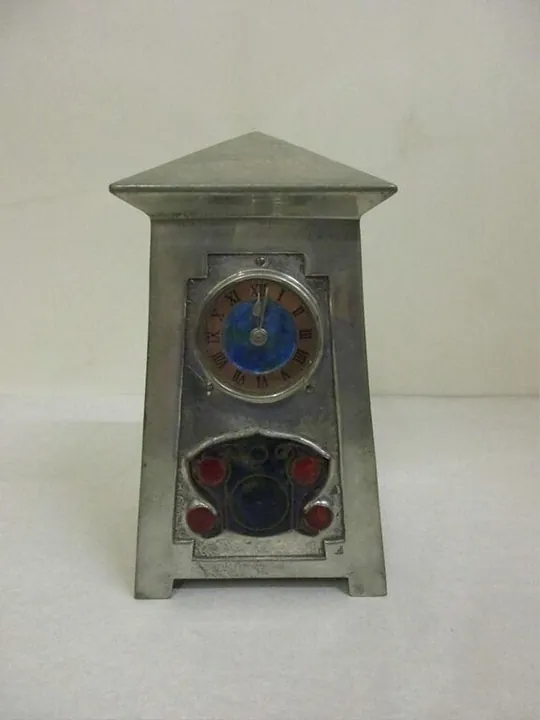
Clocks · c.1903-1904
Clock, pewter, made for Liberty& Co., England. 1903-4.
Victoria and Albert Museum, London
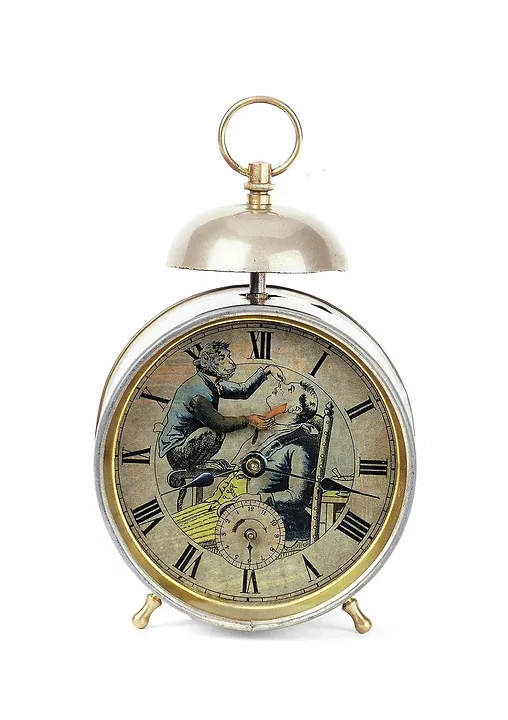
Clocks · c. 1900
Alarm clock by Union Clock Company, Germany, c. 1900
German Clock Museum
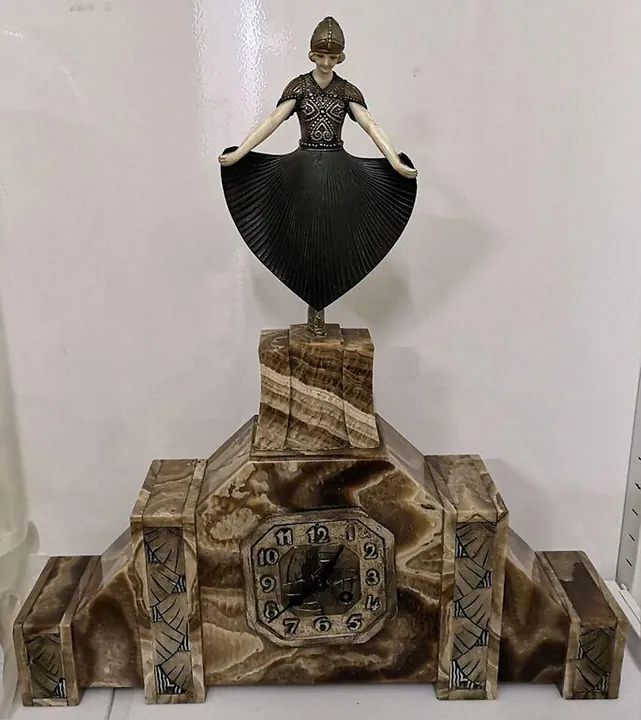
Clocks · 20th century
Base Metal, 20th c. Bronze, marble and ivory clock by Chiparus
Victoria and Albert Museum, London
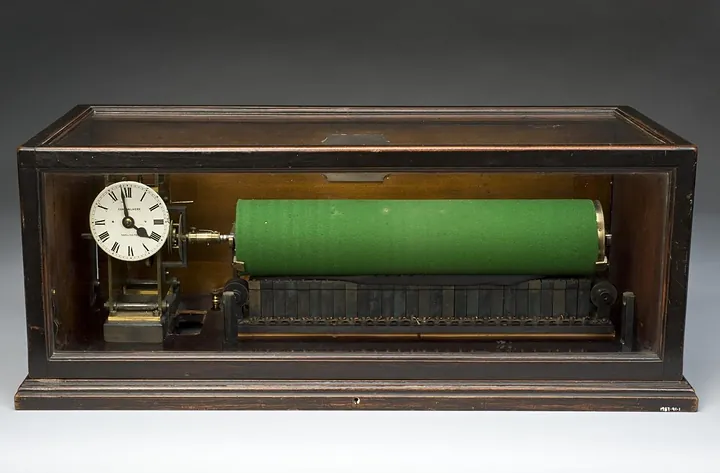
Clocks · 1900–1939
Clock by Cox-Walkers of Darlington, England, 1900–1939
Science Museum Group, London
Clocks · 1900–1999
Clock by Französisch (Schule), 1900–1999
Fine Arts Museum Vienna