
Clocks · Alarm clock
Alarm Clock - England, c. 1880
- Maker / attribution
- Unrecorded in source
- Date
- c. 1880
- Historical period
- Industrial Revolution (1850 – 1900)
- Country of origin
- England
- Object type
- Alarm clock
- Dimensions
- 6 cm (Outside Diameter)
- Holding institution
- Museums Victoria, Melbourne
- Accession / object no.
- ST 23012
- Catalogue title (original)
- Alarm Clock - England, circa 1880 (English)
View the source record ↗ (opens another website in a new tab)Suggest a correction
Record summary
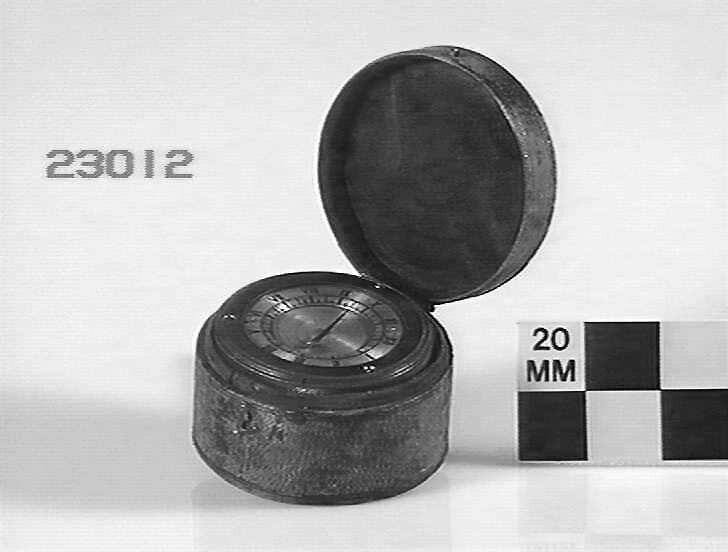
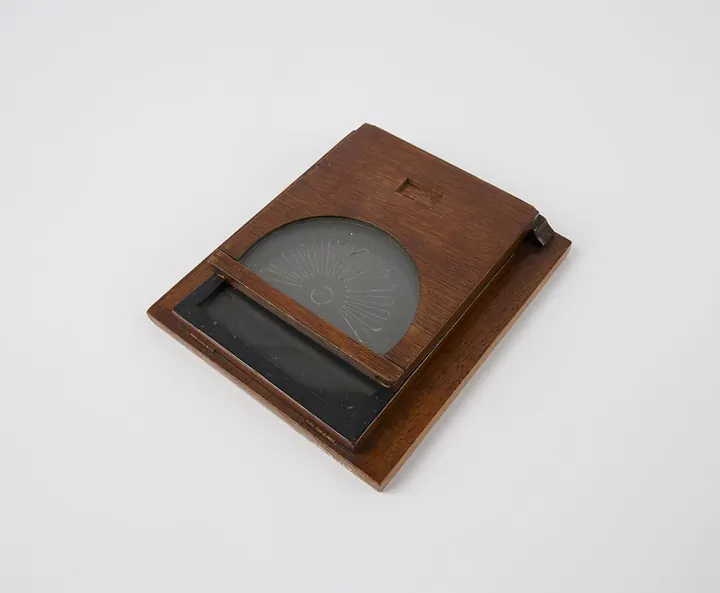
Held and catalogued by Museums Victoria, Melbourne (object number ST 23012), this is an alarm clock, made in England, dated c. 1880. The Atlas places it in the Industrial Revolution period (1850 – 1900) of its Clocks collection. Recorded dimensions: 6 cm (Outside Diameter). The record is illustrated with 1 photograph.
Assembled from the source record's structured fields. Dates and attributions are given as the source states them; where a field is missing the Atlas leaves it blank rather than estimating.
Catalogue description
Summary — Museums Victoria
Alarm clock, England, late 19th century, in cylindrical padded case. Does not tell the time but is set for a selected period.
Physical description — Museums Victoria
Cylindrical brass case with a horizontal face. The dial has a silver chapter and one hand painted on a central disc. Clock fits into a cylindrical padded case with lid. Spring wound; lever escapement.
Inscriptions & marks
Instructions on base of case.
Provenance
Donation from Joseph Lowy, 08 Nov 1948
Historical context
Industrial Revolution (1850 – 1900)
American interchangeable-parts manufacture; railroad time standards; Swiss and German factory systems.
Factory production transformed the clock into an everyday object. American makers (Seth Thomas, Ansonia, Waterbury) and German factories (Junghans, Gustav Becker, Lenzkirch) sold millions of shelf, wall and alarm clocks worldwide; France produced standardised Paris movements and carriage clocks; electric time distribution began.
Read the period in the timelineMore clocks from this periodEarlier: Precision & Scientific Horology
Atlas type guide
Alarm clocks
Alarm work is among the oldest clock functions: monastic clocks woke monks for night prayers, and Renaissance table clocks often carried an alarm disc set by a pin. A separate spring or weight is released at the set time and drives a hammer against a bell. Some early alarms also lit a candle by striking a flint — the 'tinder pistol' alarm.
The cheap, mass-produced alarm clock arrived in the second half of the nineteenth century. American firms such as Seth Thomas and Westclox (the 'Big Ben' of 1910) and German makers such as Junghans and Kienzle made millions of drum-shaped alarms with pin-pallet escapements. Electric, quartz and digital alarm clocks followed in the twentieth century.
What to look for
- A separate alarm-setting dial or disc and an extra winding key.
- Twin bells on top (common after c. 1920) or a bell enclosed in the base.
- Pin-pallet escapements in inexpensive factory alarms.
- Trademarks and patent dates on dial or back.
Dating clues
- Renaissance alarm table clocks: sixteenth to seventeenth centuries.
- Drum alarm clocks: from the 1870s.
- Luminous dials with radium paint: c. 1910–1960.
General guidance written by the Atlas editors about this kind of object. It is not a statement about this particular piece; for that, rely on the source record above and on physical examination.
Related records
Clocks · 1830–1870
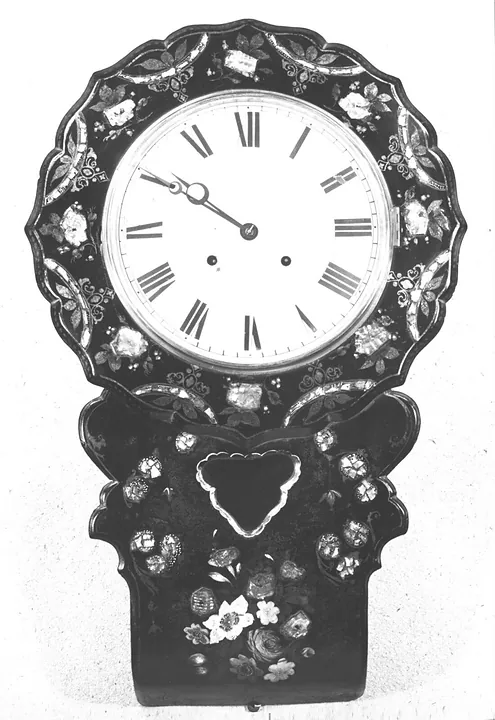
Wall clock in a papier mâché case with painted decoration. English, mid 19th century.
Victoria and Albert Museum, London
Clocks · 1840–1900
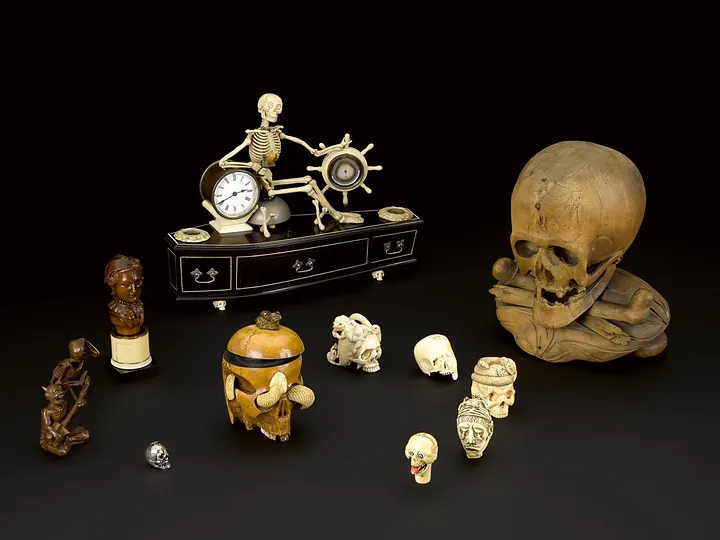
Alarm clock, mounted on model of coffin with skeleton, probably English, 1840–1900
Science Museum Group, London
Clocks · 1840–1880
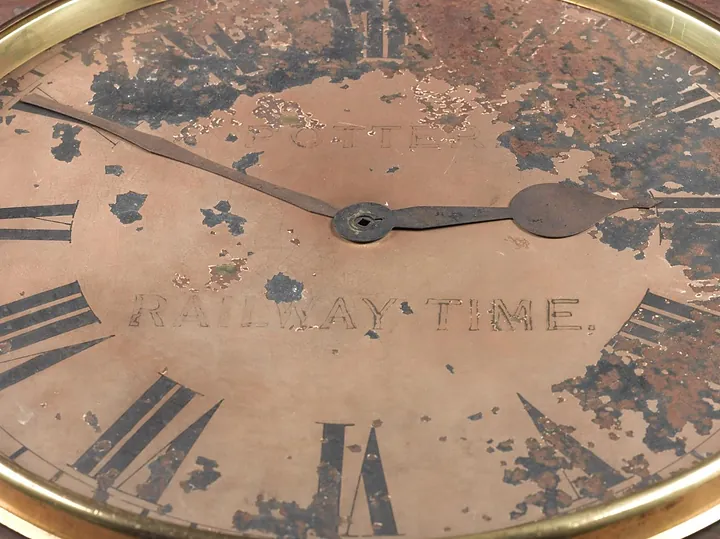
Clock dial marked "Potter, Railway Time" with two hands, unknown maker, British, 1840–1880
Science Museum Group, London
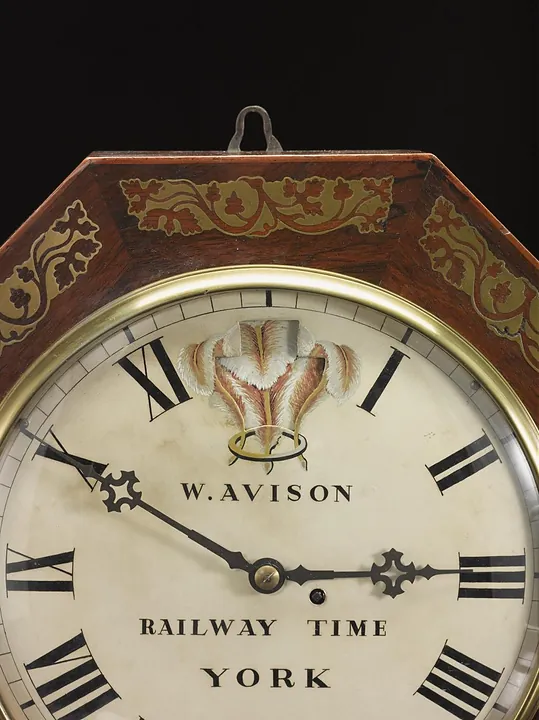
Clocks · 1840–1880
Wall Clock in octagonal case with Prince of Wales Feathers above makers name "W. Avison, Railway Time, York", made by William Avison, England, 1840–1880.
Science Museum Group, London
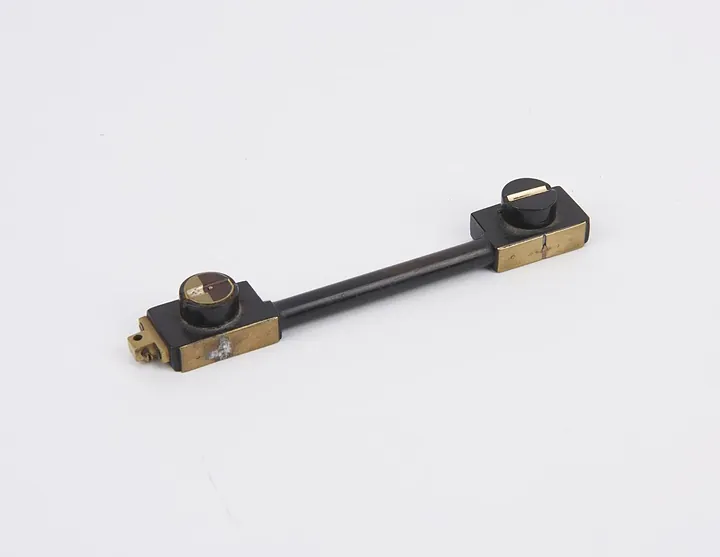
Clocks · 1841–1870
Contact bar from electric clock, unsigned, London, England, 1841–1870
Science Museum Group, London
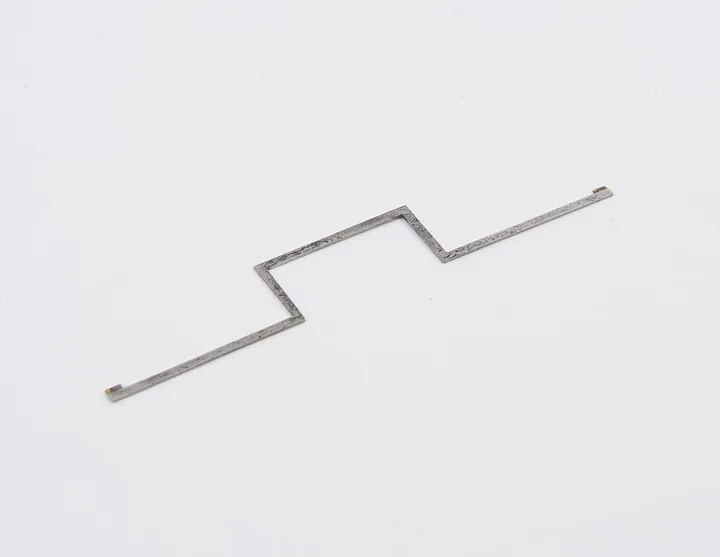
Clocks · 1841–1870
Contactor from electric clock, unsigned, London, England, 1841–1870
Science Museum Group, London
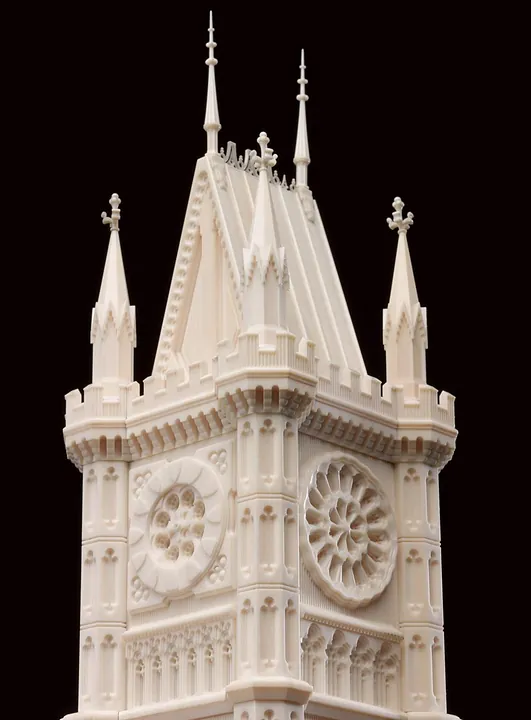
Clocks · 1843–1884
One ivory gothic clock tower & travelling case, by Holtzapffel and Company, London, England, 1843–1884
Science Museum Group, London
Clocks · 1845–1855
Clock by W. H. Darker, England, 1845–1855
Science Museum Group, London