
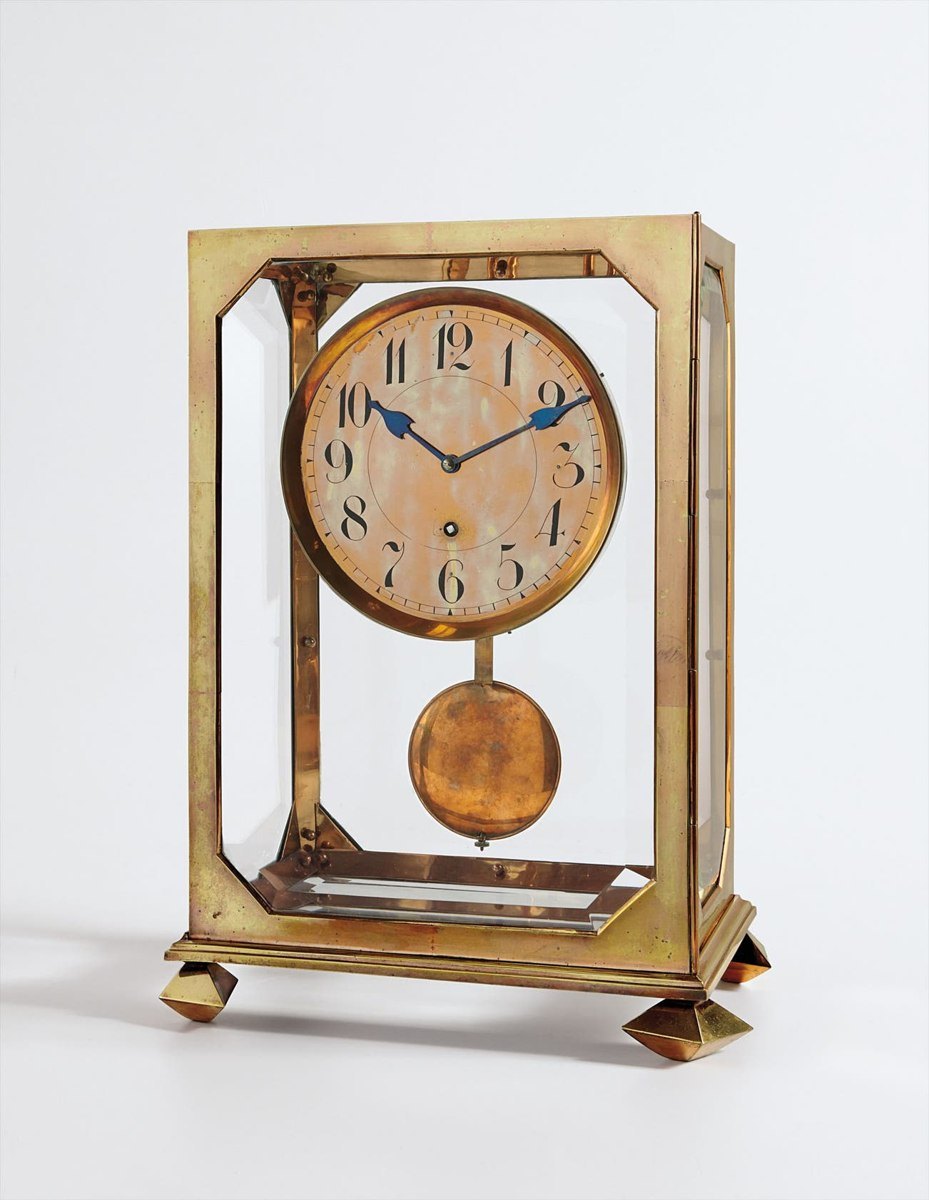
Clocks · Table clock
Adolf Loos Early Table Clock
- Maker / attribution
- Adolf Loos (source attribution); case probably Johannes Heeg (source attribution)
- Date
- c. 1900
- Historical period
- Golden Age of Mechanical Watchmaking (1900 – 1945)
- Country of origin
- Austria
- Object type
- Table clock
- Materials / technique
- Copper-plated brass, brass, steel, beveled crystal
- Dimensions
- 21 3/8 x 16 1/4 x 10 1/4 in. (54.3 x 41.3 x 26 cm)
- Holding institution
- Phillips
- Accession / object no.
- 1
- Credit line
- Phillips
- Catalogue title (original)
- 阿道夫·路斯 The Collector: Icons of Design (English)
View the source record ↗ (opens another website in a new tab)Suggest a correction
Record summary
Held and catalogued by Phillips (object number 1), this is a table clock attributed to Adolf Loos, made in Austria, dated c. 1900. The Atlas places it in the Golden Age of Mechanical Watchmaking period (1900 – 1945) of its Clocks collection. Materials and techniques recorded by the source: Copper-plated brass, brass, steel, beveled crystal. Recorded dimensions: 21 3/8 x 16 1/4 x 10 1/4 in. (54.3 x 41.3 x 26 cm). The record is illustrated with 1 photograph.
Assembled from the source record's structured fields. Dates and attributions are given as the source states them; where a field is missing the Atlas leaves it blank rather than estimating.
Catalogue description
Original object description
Designed around 1900 by the Viennese architect Adolf Loos, this early mantel clock takes the form of an upright display case fabricated from steel, brass, and copper-plated brass, fully paneled with beveled crystal glass. Its internal frame incorporates chamfered corners representative of Loos's projects prior to 1906, mounted on a stepped plinth that rests upon four angled feet of faceted, crystal-form metal. Suspended inside the glazed volume, the circular metal dial displays Arabic numerals and blued spade hands, with its reverse bearing an inscribed date of December 15, 1911. A circular pendulum bob swings beneath the dial, pinned near the back glass panel. The production of the case is linked to metal craftsman Johannes Heeg of Vienna, though an absence of maker stamps leaves workshop associations across Loos pieces unconfirmed. The clock is accompanied by a winding key and a double-ended case.
Historical context
Golden Age of Mechanical Watchmaking (1900 – 1945)
The wristwatch displaces the pocket watch; waterproof cases, self-winding and grand complications.
Between 1900 and 1945 clocks were electrified: master-clock systems ran factories and offices, synchronous mains clocks entered homes, and the Shortt free-pendulum clock set new standards of accuracy before the first quartz clocks (1927). Art Deco design reshaped mantel and table clocks.
Read the period in the timelineMore clocks from this periodEarlier: Industrial Revolution
Atlas type guide
Bracket, table and spring-driven clocks
Spring-driven clocks freed timekeeping from the hanging weight. The coiled mainspring, documented from the fifteenth century, made portable table clocks possible; to even out its declining force, makers used the fusee, a conical pulley connected to the barrel by a gut line or chain. Renaissance table clocks from Augsburg and Nuremberg — drum-shaped, square or tower-shaped in gilt brass — were luxury scientific objects, often with astronomical dials and alarms.
After the pendulum, English makers developed the bracket clock: a wooden case with a carrying handle, a short pendulum with a verge escapement, and often repeating work to sound the hours on demand at night. Later examples use the anchor escapement. In the nineteenth century, 'table clock' became a broad term for spring clocks of every nationality.
What to look for
- A fusee in the movement (cone-shaped pulley) and the type of line — gut or chain.
- Verge escapement with a short bob pendulum, often with a decoratively engraved backplate.
- Repeat cords or buttons that make the clock strike again on demand.
- Gilt-brass engraved cases and horizontal dials on Renaissance pieces.
- Case shapes: inverted bell, bell top, break-arch, lancet or balloon.
Dating clues
- Drum and tower table clocks: c. 1520–1650.
- Ebony veneered English bracket clocks with verge escapements: c. 1670–1800.
- Engraved backplates were usual on English clocks until c. 1800, then generally plain.
General guidance written by the Atlas editors about this kind of object. It is not a statement about this particular piece; for that, rely on the source record above and on physical examination.
Related records
Clocks · c. 1904
Adolf Loos Rare longcase clock
Phillips
Clocks · 1909–1910
Table clock, Austria, 1909–1910
MAK – Museum of Applied Arts
Clocks · 1901–1933
Clock, Austria, 1901–1933
Lázaro Galdiano Museum
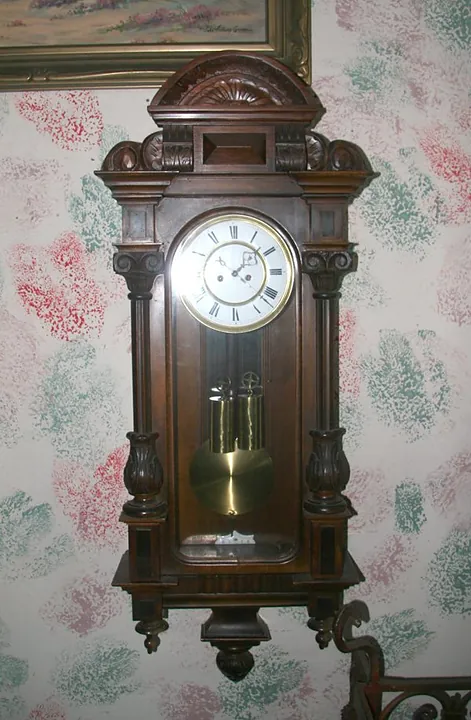
Clocks · c. 1900
Antique Vienna 2 Weight Regulator Clock - circa 1900
LiveAuctioneers auction archive
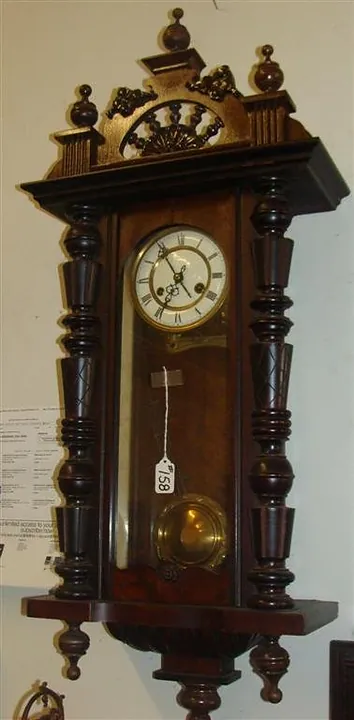
Clocks · c. 1900
Vienna Regulator Wall Clock, Spring Driven, Time &, c. 1900
LiveAuctioneers auction archive
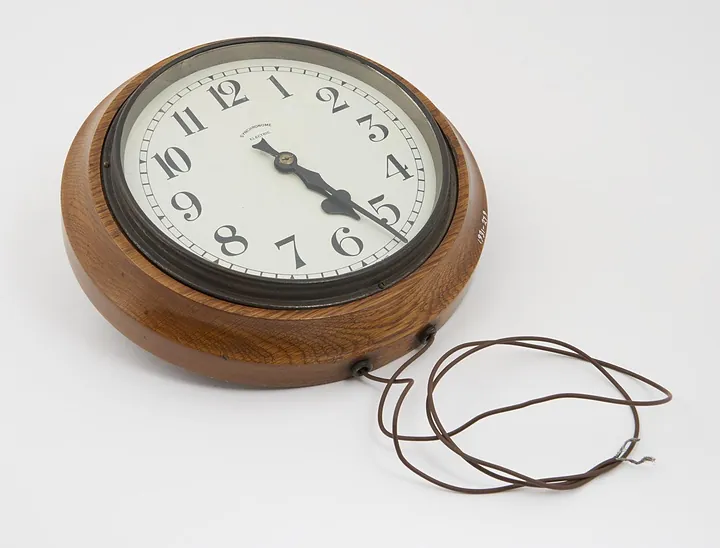
Clocks · 1890–1930
Clock with 8-inch impulse dial, by the Synchronome Company Limited, England, 1890–1930.
Science Museum Group, London
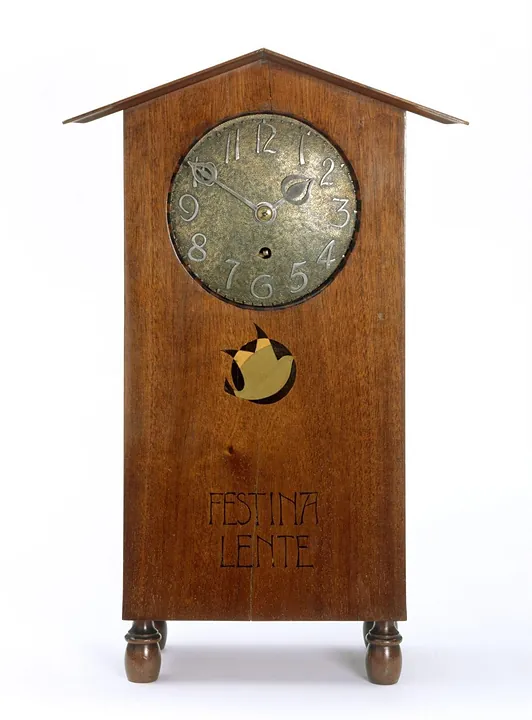
Clocks · c.1900
Clock by Mackay Hugh Baillie Scott, Bedfordshire, c.1900
Victoria and Albert Museum, London
Clocks · c. 1900
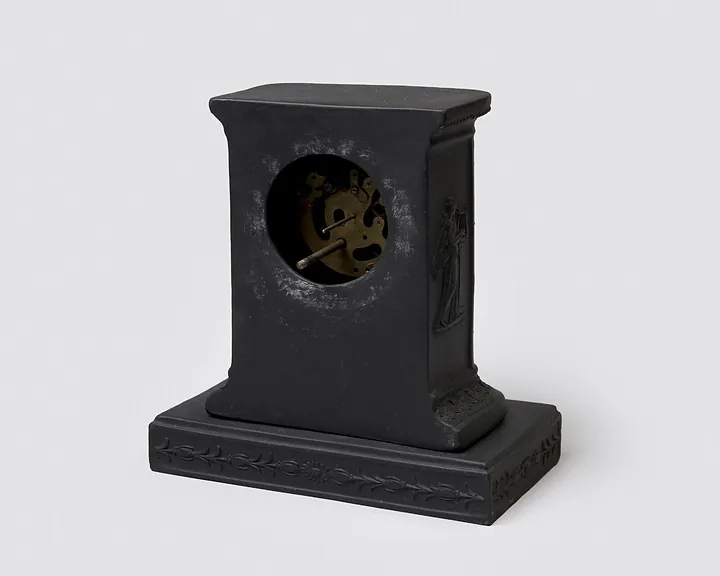
Clock, black basalt, brass, Josiah Wedgwood and Sons, Etruria, c. 1900
Victoria and Albert Museum, London