
Clocks · Longcase clock
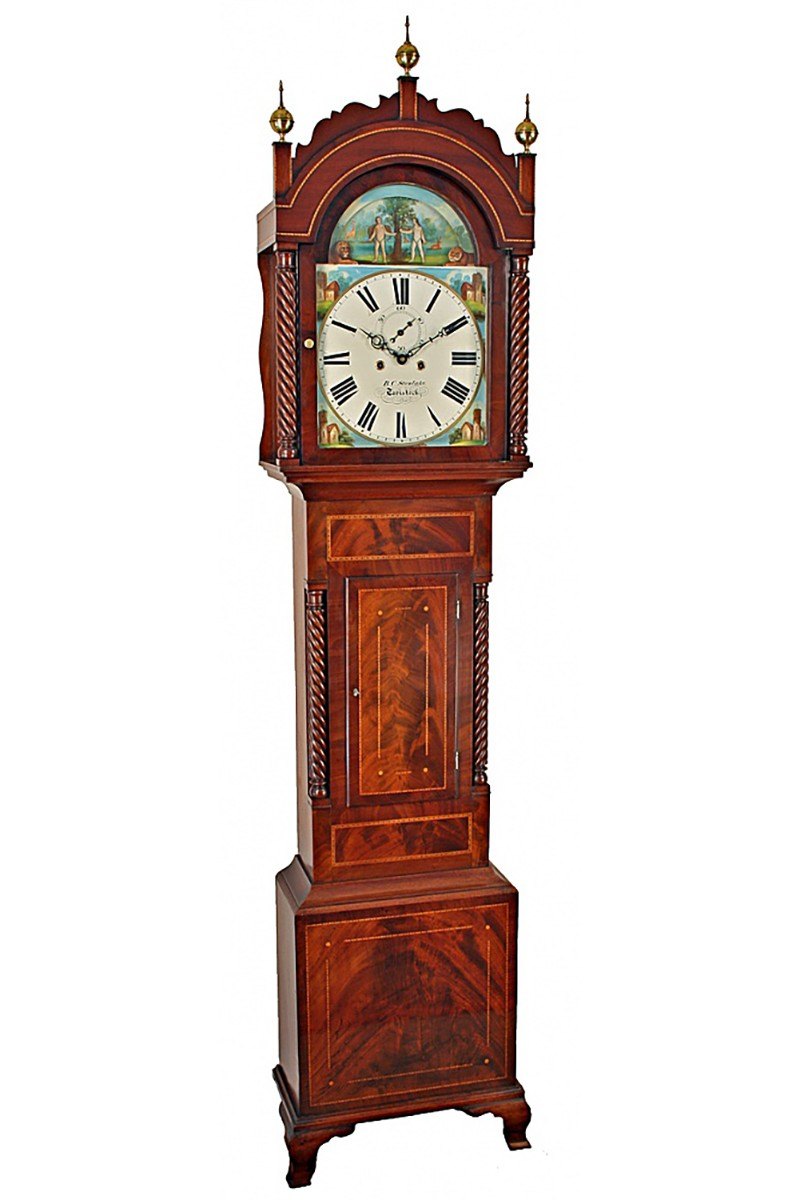
Adam & Eve automata longcase clock by Stenlake, Tavistock, c. 1850
- Maker / attribution
- Stenlake (maker)
- Date
- c. 1850
- Historical period
- Industrial Revolution (1850 – 1900)
- Country of origin
- England
- Place
- Tavistock
- Object type
- Longcase clock
- Materials / technique
- mahogany, ebony
- Dimensions
- Height 7 ft 8 in (234 cm)
- Stock no.
- Product 67
- Credit line
- Dealer listing, P A Oxley (product 67)
- Catalogue title (original)
- Adam & Eve Automata Longcase Clock by Stenlake of Tavistock (English)
View the source record (dealer listing) ↗ (opens another website in a new tab)Suggest a correction
Record summary
Catalogued by P A Oxley (dealer), Wiltshire (stock number Product 67), this is a longcase clock by Stenlake, made in Tavistock, England, dated c. 1850. The Atlas places it in the Industrial Revolution period (1850 – 1900) of its Clocks collection. Materials and techniques recorded by the source: mahogany, ebony. Recorded dimensions: Height 7 ft 8 in (234 cm). The record is illustrated with 6 photographs.
Assembled from the source record's structured fields. Dates and attributions are given as the source states them; where a field is missing the Atlas leaves it blank rather than estimating.
Catalogue description
Dealer description — P A Oxley
An excellent West Country mahogany longcase clock with Adam & Eve Automata. The 8 day duration movement striking the hours on a bell and with an arched white dial displaying a Roman chapter ring, seconds, blued steel hands and the makers names and place of work above number VI. The arch depicting in automata form the moment when Eve offers Adam the forbidden fruit in the Garden of Eden. Both arms move as the clock ticks. The arch is also painted with wild animals which include a lion, tiger, giraffe, an elephant and two stags. Also with churches painted to the four corners. The richly figured flame mahogany veneered case with boxwood and ebony inlay throughout and the trunk door flanked by spiral columns with wooden capitals. The hood also with wooden capitals, spiral columns and topped with a crested pediment with three brass finials. The base with similar veneers and inlay and large ogee shaped feet to the front of the clock. Note: Automata longcase clocks are very rare and we have only had a handful of Adam & Eve examples over the years. This particular clock has what appears to be an interesting history due to the original delivery note still pinned to the backboard of the clock. The note reads ....Mr Robert Davidge, Beer Town, WITH CARE, to be left at the publick house, Holes Hole till called for...... The maker Benjamin Couch Stenlake is listed as working in the Market Place, Tavistock in 1849. Maker Stenlake of Tavistock
Historical context
Industrial Revolution (1850 – 1900)
American interchangeable-parts manufacture; railroad time standards; Swiss and German factory systems.
Factory production transformed the clock into an everyday object. American makers (Seth Thomas, Ansonia, Waterbury) and German factories (Junghans, Gustav Becker, Lenzkirch) sold millions of shelf, wall and alarm clocks worldwide; France produced standardised Paris movements and carriage clocks; electric time distribution began.
Read the period in the timelineMore clocks from this periodEarlier: Precision & Scientific Horology
Atlas type guide
Longcase (tall-case or grandfather) clocks
The longcase clock was born from two seventeenth-century innovations: Christiaan Huygens's pendulum (1656–57) and the anchor escapement (c. 1670). A long seconds pendulum, nearly a metre long, swings with a small arc, and enclosing it together with the driving weights in a tall wooden case protected the mechanism and created a new piece of furniture. London makers such as Ahasuerus Fromanteel, Thomas Tompion and Joseph Knibb set the pattern.
By the eighteenth century longcase clocks were made throughout Britain, the Netherlands, Scandinavia (the Swedish Mora clock), France (the Comtoise from the Franche-Comté), Germany and colonial America. Eight-day movements with two weights became standard in better clocks; thirty-hour clocks with one weight and a rope or chain were cheaper alternatives.
What to look for
- Winding holes in the dial: two (eight-day, going and striking) or none (thirty-hour, pulled up by a chain).
- Brass dials with applied chapter rings (earlier) versus painted iron 'white' dials (after c. 1770 in Britain).
- Moon-phase arches, date apertures, seconds dials and maker's name on the dial.
- Case woods and style: ebonised, walnut marquetry, lacquer, oak or mahogany; regional styles from London, Lancashire, Scotland or America.
- Whether the movement and dial match the case — 'marriages' are common.
Dating clues
- Square brass dials suggest c. 1670–1720; arched brass dials c. 1715–1790.
- Painted (white) dials were made by Birmingham dial-makers from about 1772.
- Comtoise clocks with repoussé pendulums are mostly nineteenth century.
General guidance written by the Atlas editors about this kind of object. It is not a statement about this particular piece; for that, rely on the source record above and on physical examination.
Read next:Anchor (recoil) escapementDeadbeat escapementAnchor escapement
Related records
Clocks · 1830–1870
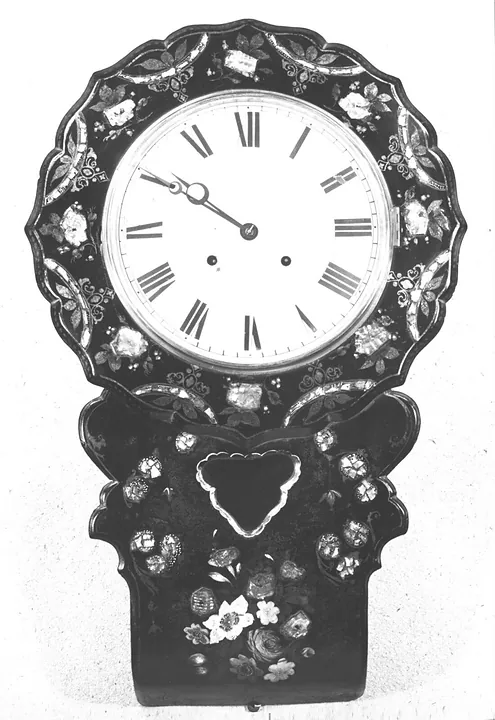
Wall clock in a papier mâché case with painted decoration. English, mid 19th century.
Victoria and Albert Museum, London
Clocks · 1840–1900
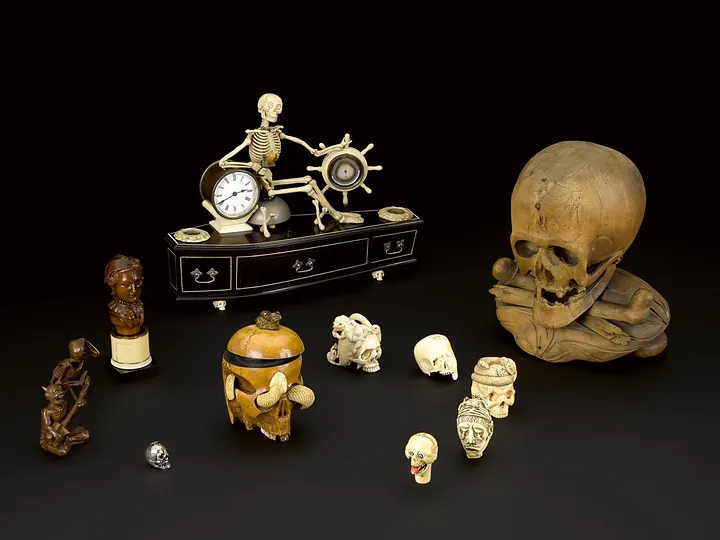
Alarm clock, mounted on model of coffin with skeleton, probably English, 1840–1900
Science Museum Group, London
Clocks · 1840–1880
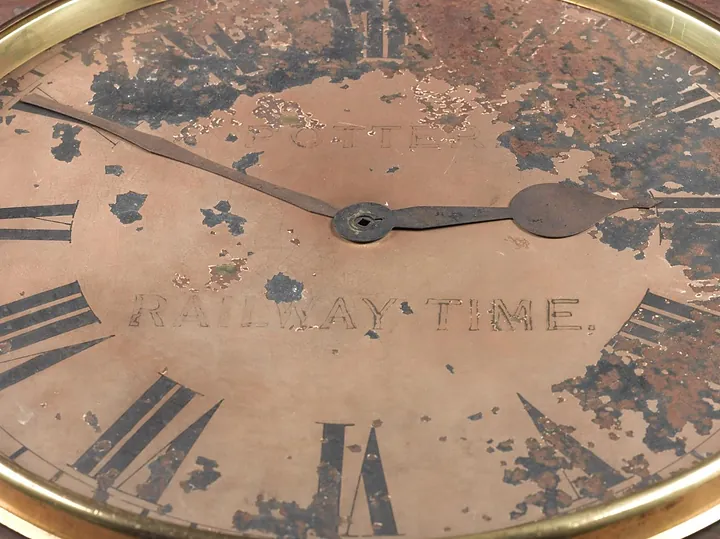
Clock dial marked "Potter, Railway Time" with two hands, unknown maker, British, 1840–1880
Science Museum Group, London
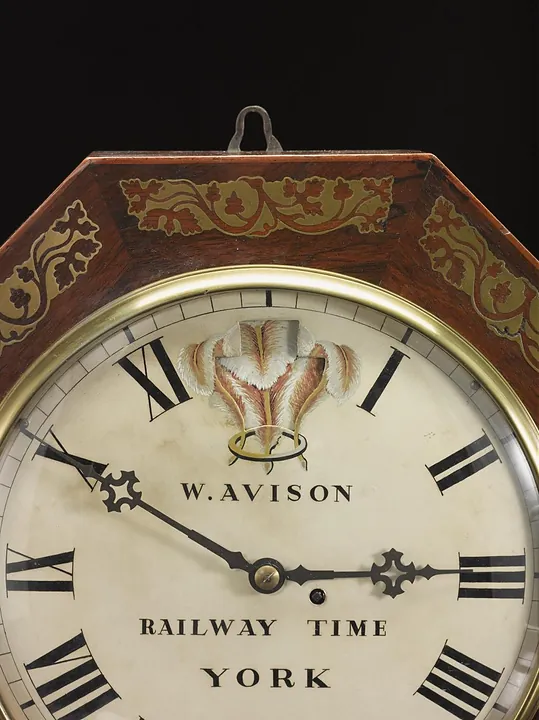
Clocks · 1840–1880
Wall Clock in octagonal case with Prince of Wales Feathers above makers name "W. Avison, Railway Time, York", made by William Avison, England, 1840–1880.
Science Museum Group, London
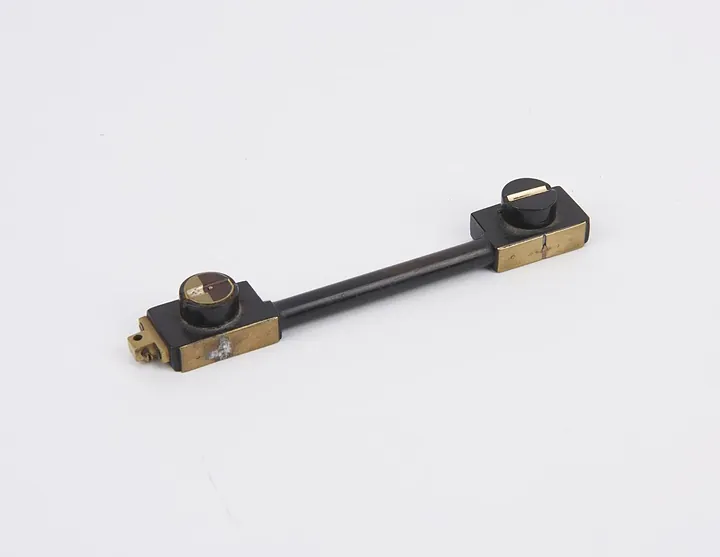
Clocks · 1841–1870
Contact bar from electric clock, unsigned, London, England, 1841–1870
Science Museum Group, London
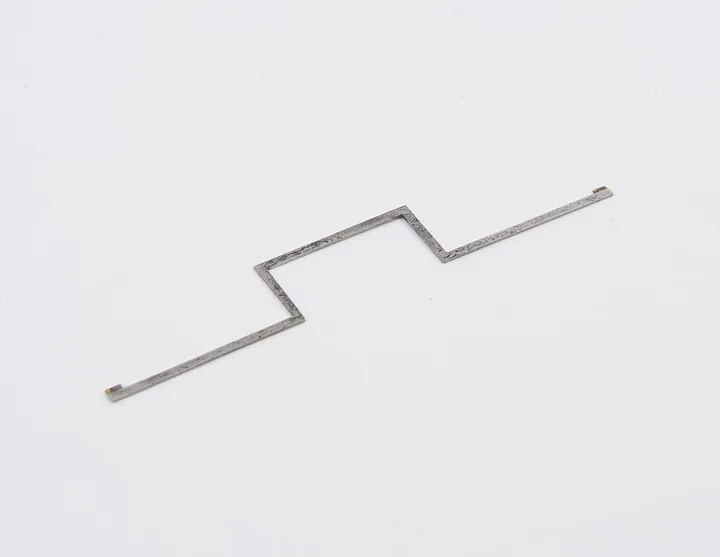
Clocks · 1841–1870
Contactor from electric clock, unsigned, London, England, 1841–1870
Science Museum Group, London
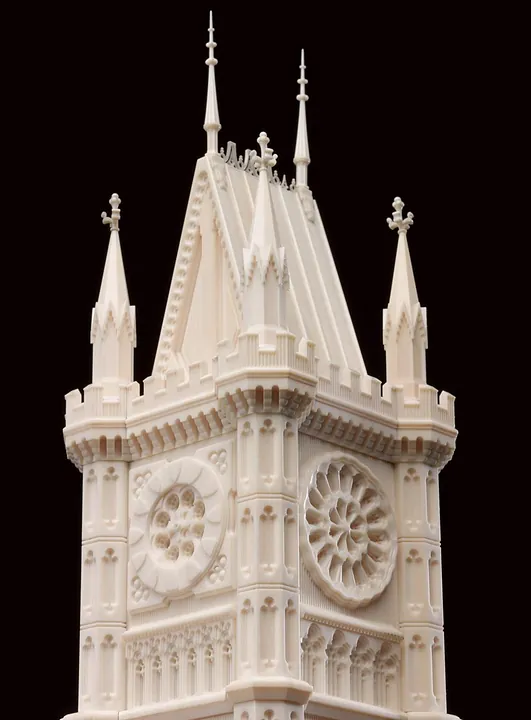
Clocks · 1843–1884
One ivory gothic clock tower & travelling case, by Holtzapffel and Company, London, England, 1843–1884
Science Museum Group, London
Clocks · 1845–1855
Clock by W. H. Darker, England, 1845–1855
Science Museum Group, London