
Wristwatches · Wristwatch
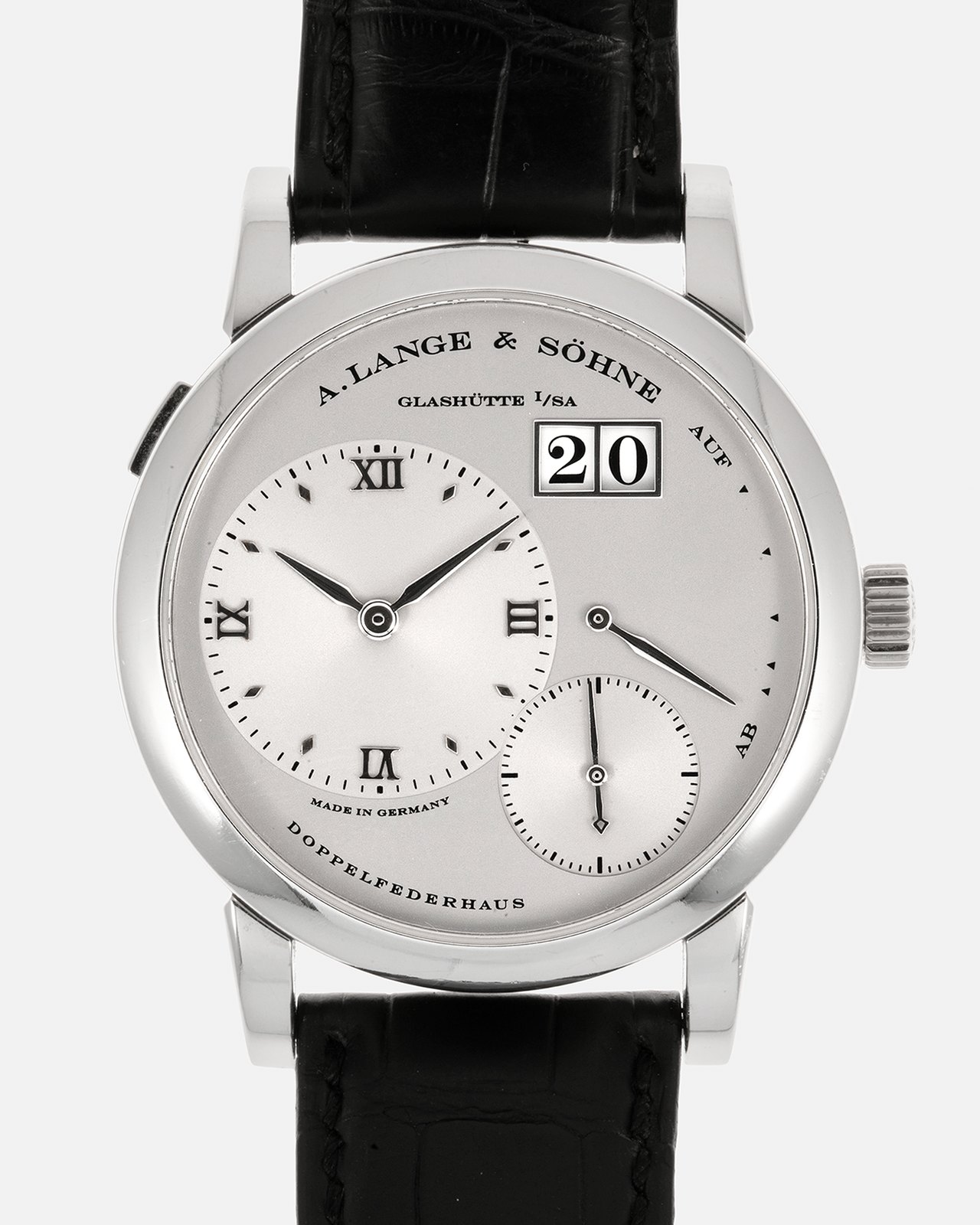
A. Lange & Sohne Lange 1 101.025 Stealth Platinum, 2000s
- Maker / attribution
- A. Lange & Sohne (maker)
- Date
- 2000s
- Historical period
- Mechanical Renaissance (1990 – 2010)
- Country of origin
- Germany
- Object type
- Wristwatch
- Materials / technique
- platinum
- Dimensions
- Case 38.5 mm
- Stock no.
- Product 6943722831959
- Credit line
- Dealer listing, S.Song Watches (product 6943722831959)
- Catalogue title (original)
- A. Lange & Sohne Lange 1 101.025 Stealth Platinum (English)
View the source record (dealer listing) ↗ (opens another website in a new tab)Suggest a correction
Record summary
Catalogued by S.Song Watches (dealer), Seattle (stock number Product 6943722831959), this is a wristwatch by A. Lange & Sohne, made in Germany, dated 2000s. The Atlas places it in the Mechanical Renaissance period (1990 – 2010) of its Wristwatches collection. Materials and techniques recorded by the source: platinum. Recorded dimensions: Case 38.5 mm. The record is illustrated with 6 photographs.
Assembled from the source record's structured fields. Dates and attributions are given as the source states them; where a field is missing the Atlas leaves it blank rather than estimating.
Catalogue description
Dealer description — S.Song Watches
Released in 1994 shortly after their resurgence, the Lange 1 is widely considered to be one of the most recognizable watches to come out of A. Lange & Söhne's hallowed halls. Known for its archetypal Lange design, the Lange 1 combines dressy aesthetics with an unusual asymmetrical dial arrangement to create what has since become a true icon as a stalwart of the brand. Created during A. Lange & Söhne's re-establishment in the '90s, the Lange 1 was among the first batch of novelties released to mark the Saxon brand's return to watchmaking, following the cessation of their operations in 1948. The purpose of the Lange 1 was to surprise watch experts, garner unanimous approval and address the question of what a modern A. Lange & Söhne watch would look like if the company never ceased to exist all those years ago. Beginning with its construction, this A. Lange & Söhne Lange 1 Ref. 101.005 ‘Stealth’ that I have here features a beautifully crafted 38.5mm platinum 950 case that stands 9.8mm tall and retains the classic dress watch aesthetic that Lange has been known for its entire existence. Circular with rounded edges and elegant flared lugs, the hefty platinum case is a perfect canvas for its beautiful German silver dial. It is also worth noting that collectors have coined this reference the ‘Stealth’ due to the monochromatic visual that arises from the colour combination of platinum and the German silver dial. A very fitting nickname, if you ask me. Standing out against that muted silver dial, the Lange 1's asymmetrical layout is all the more captivating with its off-centre outsize date indication - inspired by the Five-Minute Clock in the Semper Opera House and adding a large area of contrast to the otherwise slightly darker tone of the dial. To top it off, the dial also hosts a set of faceted hands with applied Roman numerals. Furthermore, a pusher at 10 o’clock allows the user to easily jump the date, adding usability to the watch. With an asymmetrically positioned hour and minute sub-dial, seconds sub-dial at 5 o'clock, and a power-reserve indicator between 2 and 4 o'clock (here: AB means empty, and AUF means full), the Lange 1 has become a staple within the brand's portfolio of iconic timepieces with a surprising level of utility for a dress watch. One of the best things about owning a timepiece from A. Lange & Söhne is the opportunity to admire the movement from behind. Powering this complexity lies Lange's manual-wind Cal. L901.0 movement. Methodically beating away at 21,600 BPH, this movement provides an impressive 72 hours of power reserve and is proudly displayed behind the Lange 1's exhibition caseback. With its emphatic finishing throughout featuring anglage and exceptional hand-finished chamfers, a stunning ¾ plate, charming German silver architecture, and beautifully engraved balance cock - as is A. Lange & Söhne's signature, the Cal. L901.0 is a fitting tribute to the incredible watch it powers. In essence, the A. Lange & Söhne Lange 1 Ref. 101.025 'Stealth' stands as a masterpiece of German horological craftsmanship, eloquently exemplifying the brand’s unwavering commitment to impeccable watch design and construction. In the current resurgence of neo-vintage watches, it comes as no surprise that the initial 38.5mm Lange 1 models hold a special place in this trend. While there is an earlier version, the Ref. 101.005, featuring a closed caseback, my preference gravitates towards this particular variant for obvious reasons.
Historical context
Mechanical Renaissance (1990 – 2010)
Mechanical watches return as cultural objects; independent watchmaking flourishes.
Mechanical watches returned as cultural and luxury objects. Complications, tourbillons and new materials proliferated; independent watchmakers such as George Daniels, F.P. Journe and Philippe Dufour revived artisanal watchmaking; collecting vintage watches became a major field.
Read the period in the timelineMore wristwatches from this periodEarlier: Quartz Revolution
Atlas type guide
Wristwatches
Bracelet watches were worn by women from the early nineteenth century — Breguet made one for Caroline Murat, Queen of Naples, in 1810–12 — but the wristwatch only became a man's instrument with military use and aviation in the early twentieth century. Between the World Wars it overtook the pocket watch; the 1920s and 1930s brought rectangular Art Deco cases, water-resistant cases and the first automatic winding systems.
After 1945 the wristwatch became a carrier of identity — dress watches, sports and dive watches, chronographs, calendars — produced by Swiss, American, Japanese, German, Soviet and Chinese industries. The quartz revolution after 1969 and the mechanical renaissance since the 1990s, including the rise of independent watchmakers, complete the story.
What to look for
- The reference number (between the lugs or inside the case back) and serial number, the starting point for dating.
- The calibre: its maker and number are often stamped under the dial or on the bridge.
- Originality of dial, hands and crown — refinished ('redial') dials are common.
- Case material marks: 18K/750, 14K/585, stainless steel, gold-filled, plated.
Dating clues
- Wire-lug cases: before c. 1925.
- Water-resistant screw-down cases: from 1926.
- Quartz movements: from 1969; sapphire crystals widespread after c. 1980.
General guidance written by the Atlas editors about this kind of object. It is not a statement about this particular piece; for that, rely on the source record above and on physical examination.
Related records
Wristwatches · originally sold on 16 December 2001 (per the lot record)
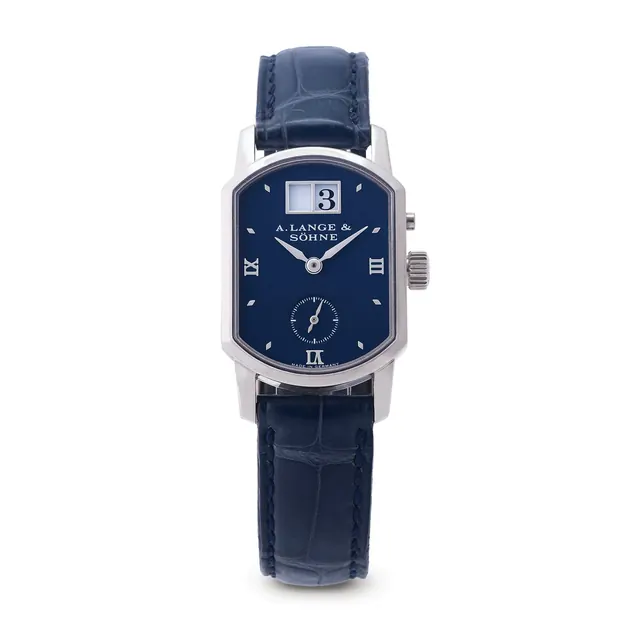
A. Lange & Sohne wristwatch, ref. 103.027, Arkade, originally sold on 16 December 2001
Antiquorum auction archive, Geneva
Instruments · c. 1942
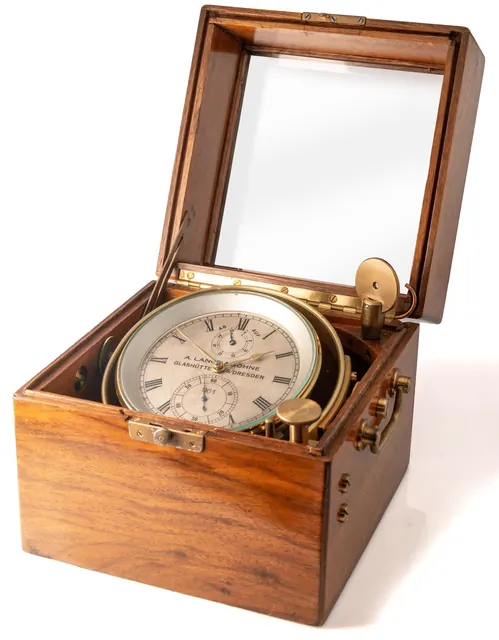
A. Lange & Sohne marine chronometer, Germany Wood, circa 1942
Antiquorum auction archive, Geneva
Wristwatches · 2004
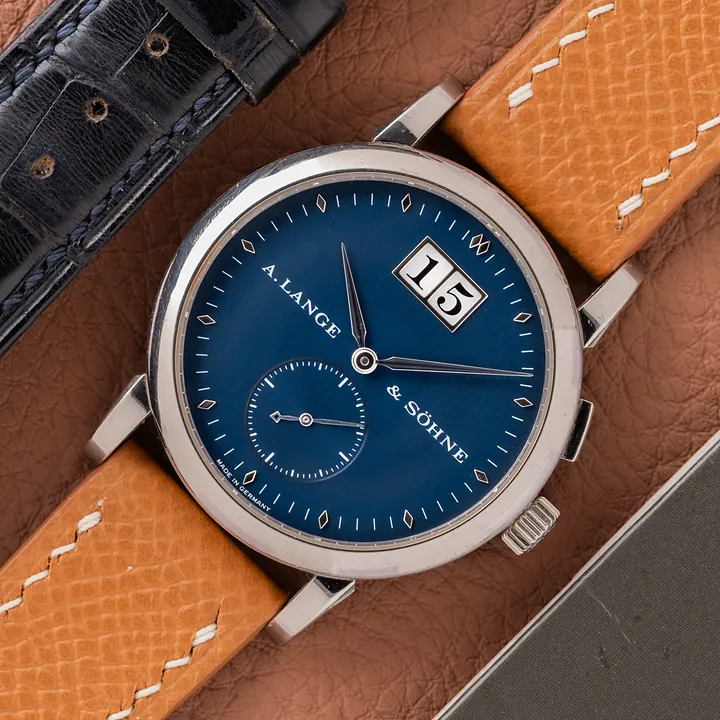
A. Lange & Söhne Saxonia Oversized Date Blue (Ref. 105.027), 2004
Huntington Company (dealer)
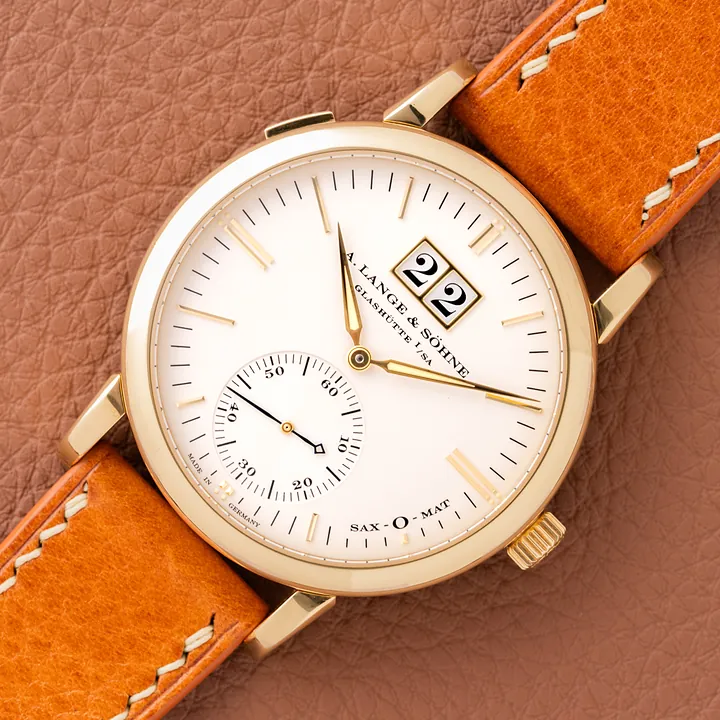
Wristwatches · 2000s
A. Lange & Söhne Langematik Oversized Date (Ref. 308.021), 2000s
Huntington Company (dealer)
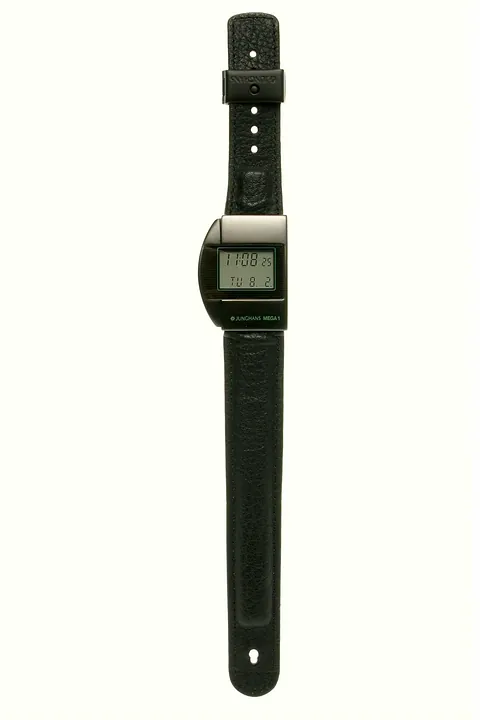
Wristwatches · c. 1990
Wristwatch, Germany, c. 1990 (no. 29875)
German Clock Museum
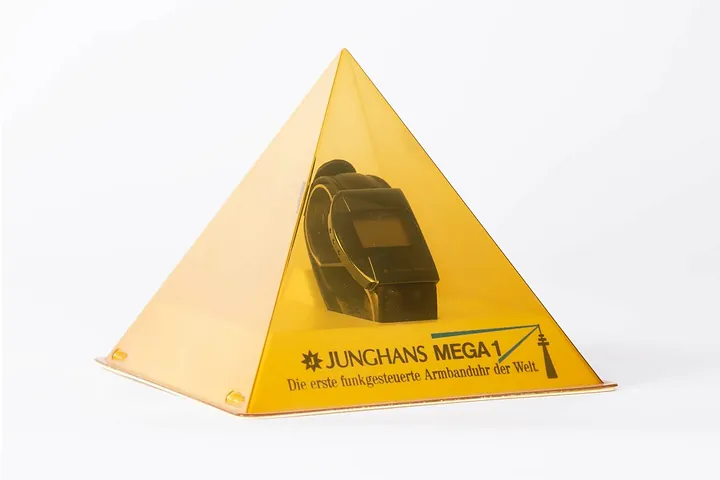
Wristwatches · 1990
Wristwatch, Germany, 1990 (no. 59620)
German Clock Museum
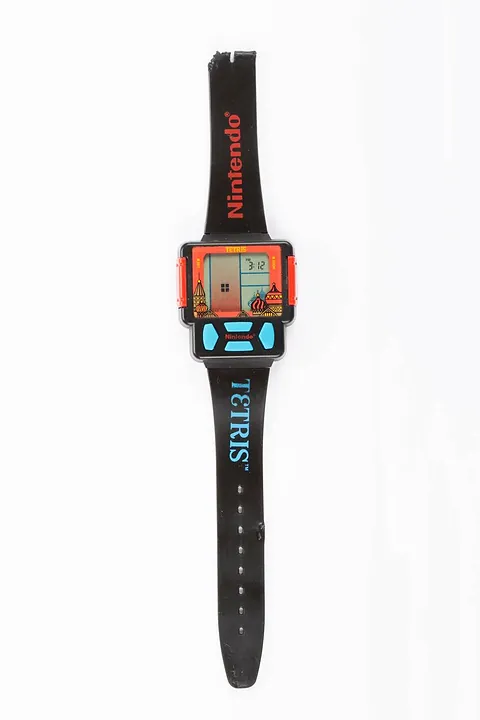
Wristwatches · c. 1991
Wristwatch by EM-Entertainment München, Merchandising, Film und Fernseh GmbH, Germany, c. 1991
German Clock Museum
Wristwatches · c. 2000
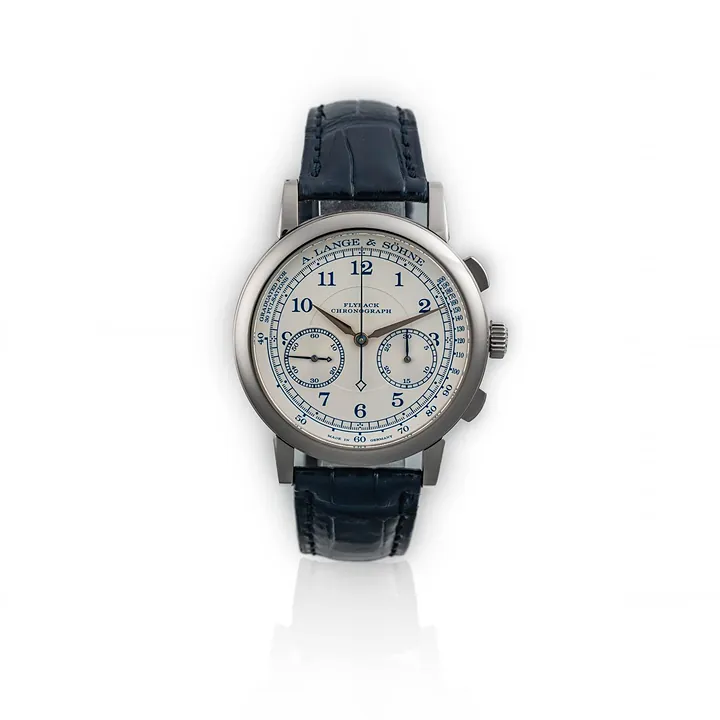
A.Lange & Söhne 1815 Chronograph, ref. 414.026, c. 2000
Antiquorum auction archive, Geneva