
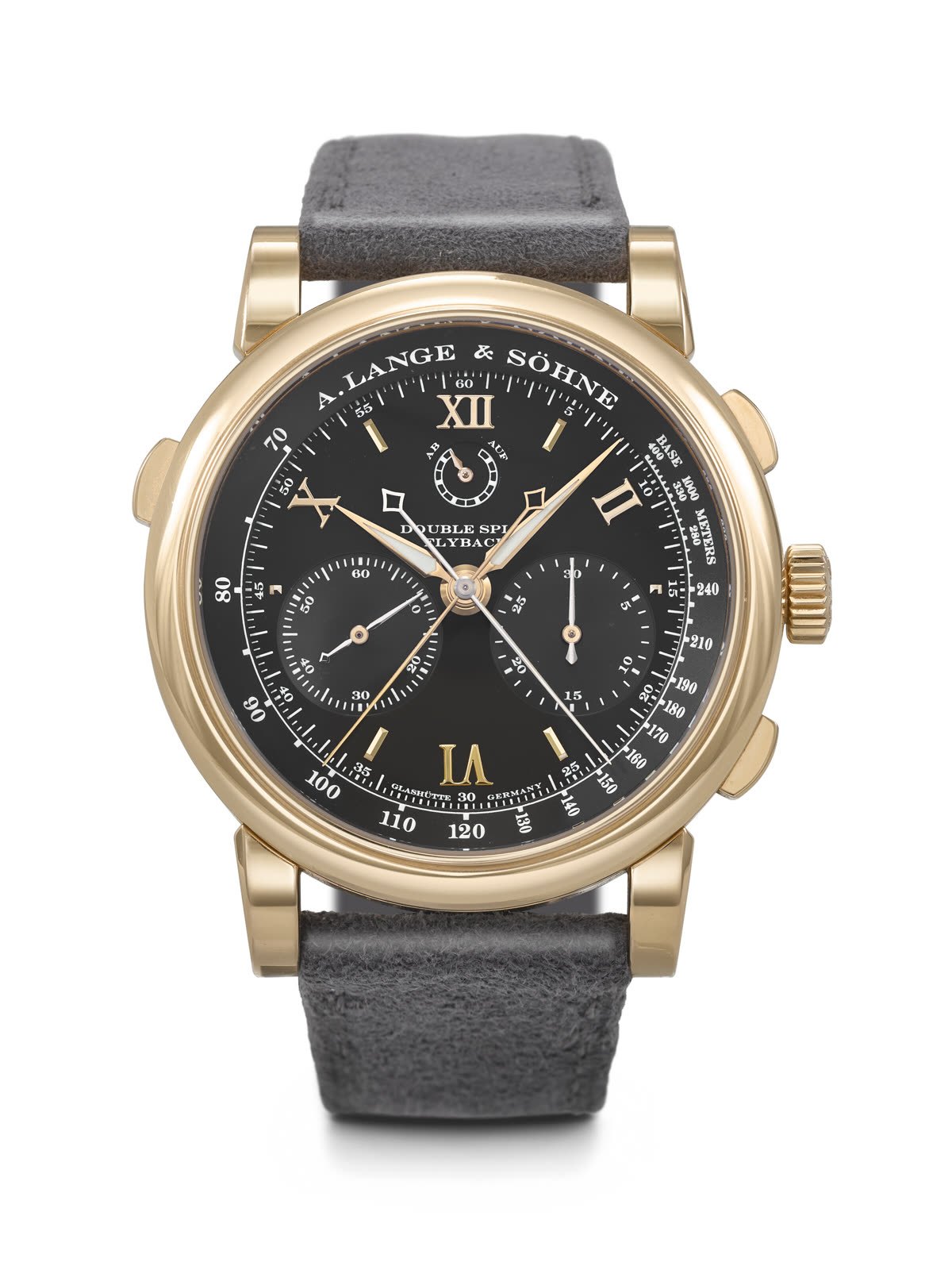
Wristwatches · Split-seconds flyback chronograph wristwatch
A. Lange & Söhne Double Split Flyback Ref. 404.047F
- Maker / attribution
- A. Lange & Söhne (source attribution)
- Date
- c. 2005
- Historical period
- Mechanical Renaissance (1990 – 2010)
- Country of origin
- Germany
- Object type
- Split-seconds flyback chronograph wristwatch
- Dimensions
- 43 mm
- Auction house
- Christie's
- Lot
- 55
- Credit line
- Christie's
- Catalogue title (original)
- A. LANGE & SÖHNE. AN IMPRESSIVE 18K PINK GOLD LIMITED EDITION DOUBLE SPLIT SECONDS FLYBACK CHRONOGRAPH WRISTWATCH WITH POWER RESERVE INDICATION, MADE FOR THE SINCERE WATCH COMPANY, DOUBLE SPLIT FLYBAC (English)
View the source record (auction lot) ↗ (opens another website in a new tab)Suggest a correction
Record summary
Catalogued by Christie's (lot 55), this is a split-seconds flyback chronograph wristwatch attributed to A. Lange & Söhne, made in Germany, dated c. 2005. The Atlas places it in the Mechanical Renaissance period (1990 – 2010) of its Wristwatches collection. Recorded dimensions: 43 mm. The record is illustrated with 1 photograph.
Assembled from the source record's structured fields. Dates and attributions are given as the source states them; where a field is missing the Atlas leaves it blank rather than estimating.
Catalogue description
Original object description
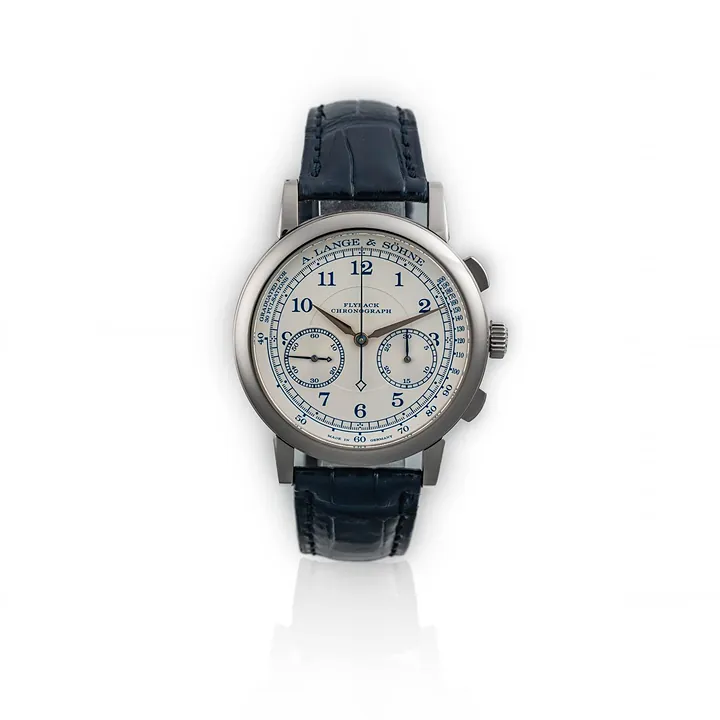
Originating from a private collection and assigned a circa 2005 production date, this A. Lange & Söhne Double Split Flyback (reference 404.047F, case number 163'803) is one of ten examples manufactured for Singapore retailer Sincere Watch Company, following their 50th-anniversary platinum edition (reference 404.036) in 2004. Its 43 mm round case is rendered in 18k pink gold, fitted with a textured grey strap, a 3 o'clock crown for winding and setting, and chronograph pushers placed at 2, 4, and 10 o'clock. Diverging from traditional white subdials, the dial is finished in a uniform black scheme with matching dark registers at 4 and 8 o'clock. The dial layout includes applied Roman numerals at XII and VI, an 'AUF/AB' indicator positioned beneath 12 o'clock, an outer tachymetric track, and centrally mounted superimposed hands serving the double rattrapante function. Christie's notes that the hand-wound caliber L001.1 is assembled from 465 hand-finished parts, operates at 21,600 vibrations per hour, integrates a proprietary balance spring, and provides a 38-hour power reserve. Stated accompaniments include a Proof of Origin certificate and a pink gold deployant clasp, though auxiliary components and the movement are unphotographed.
Inscriptions & marks
163'803
Historical context
Mechanical Renaissance (1990 – 2010)
Mechanical watches return as cultural objects; independent watchmaking flourishes.
Mechanical watches returned as cultural and luxury objects. Complications, tourbillons and new materials proliferated; independent watchmakers such as George Daniels, F.P. Journe and Philippe Dufour revived artisanal watchmaking; collecting vintage watches became a major field.
Read the period in the timelineMore wristwatches from this periodEarlier: Quartz Revolution
Atlas type guide
Chronographs and split-seconds watches
A chronograph is a watch with an additional seconds hand that can be started, stopped and returned to zero independently of the timekeeping. Louis Moinet built an early example in 1816 and Nicolas Rieussec a recording 'chronographe' in 1821; Adolphe Nicole's heart-shaped reset cam (patented 1862) made the modern return-to-zero possible. Split-seconds (rattrapante) chronographs add a second hand that can be stopped for intermediate times; flyback chronographs restart instantly.
Chronographs were essential tools for doctors (pulsometer scales), artillery (telemeter), engineers and sport. In wristwatches, Valjoux, Venus, Lemania and later the automatic chronographs of 1969 (Zenith El Primero, the Chronomatic Calibre 11 group and Seiko 6139) are milestones.
What to look for
- Push-pieces on the case band or a single button in the crown (monopusher).
- Subsidiary registers for minutes and hours; tachymeter, telemeter or pulsometer scales.
- Column wheel versus cam control visible in the movement.
- Calibre markings of specialist makers (Valjoux, Lemania, Venus, Landeron).
Dating clues
- Pocket chronographs with heart cam reset: after 1862.
- Wrist chronographs: from c. 1910; two-button designs from the 1930s.
- Automatic chronographs: from 1969.
General guidance written by the Atlas editors about this kind of object. It is not a statement about this particular piece; for that, rely on the source record above and on physical examination.
Read next:Chronograph
Related records
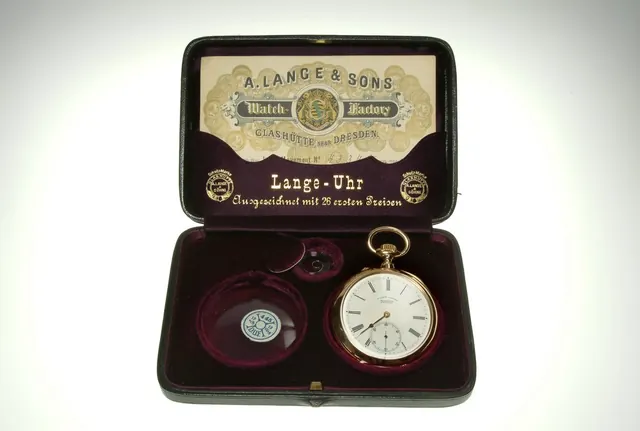
Movements & Components · 1900
Pocket watch by A. Lange & Söhne, Germany, 1900
Kulturstiftung Sachsen-Anhalt - Museum Schloss Neuenburg
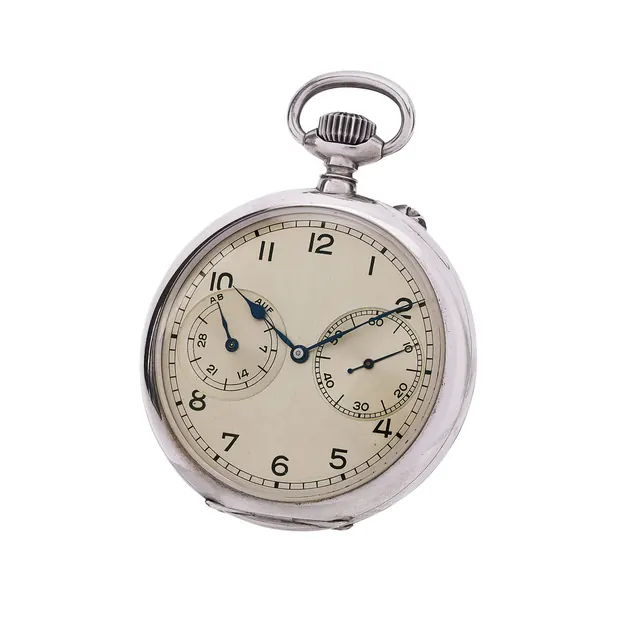
Pocket Watches · c. 1941
A. Lange & Söhne pocket watch, Observation Pocket Watch, circa 1941
Antiquorum auction archive, Geneva
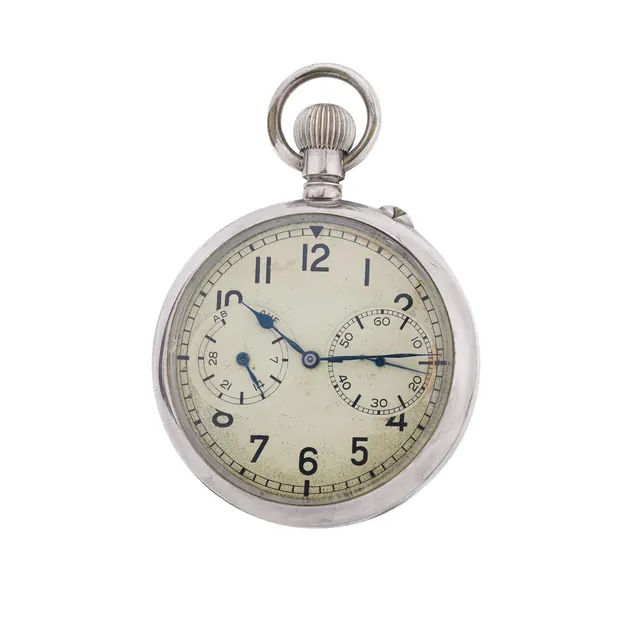
Pocket Watches · c. 1946
A. Lange & Söhne pocket watch, Military Observation Pocket Watch, circa 1946
Antiquorum auction archive, Geneva
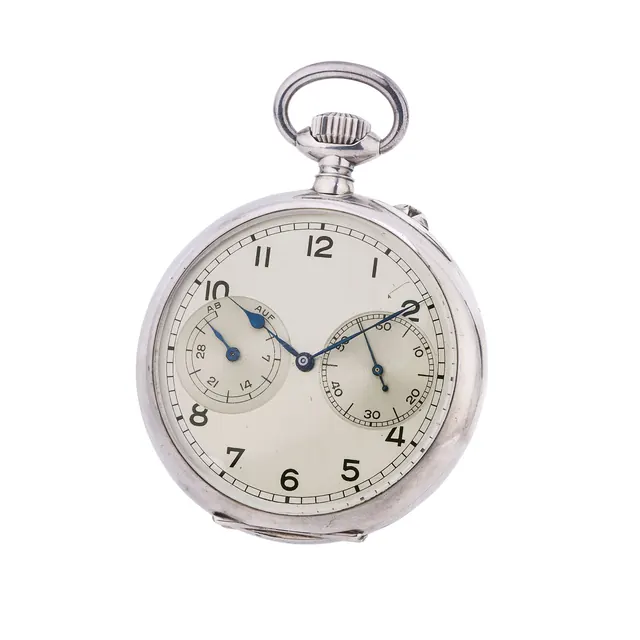
Pocket Watches · c. 1942
A. Lange & Söhne pocket watch, Military Observation Pocket Watch, circa 1942
Antiquorum auction archive, Geneva
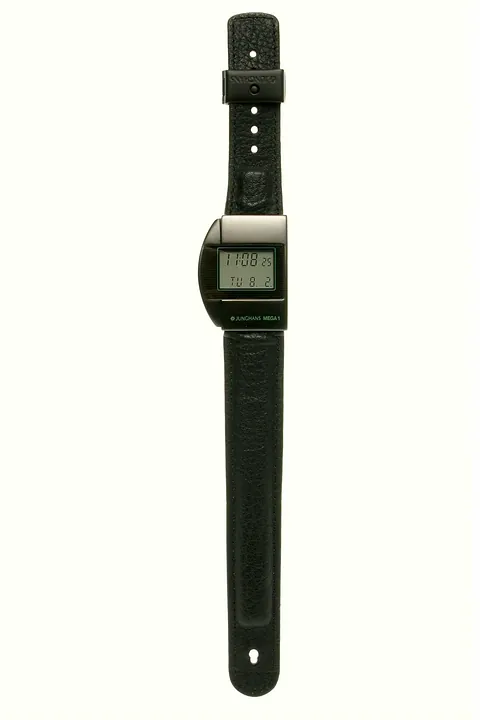
Wristwatches · c. 1990
Wristwatch, Germany, c. 1990 (no. 29875)
German Clock Museum
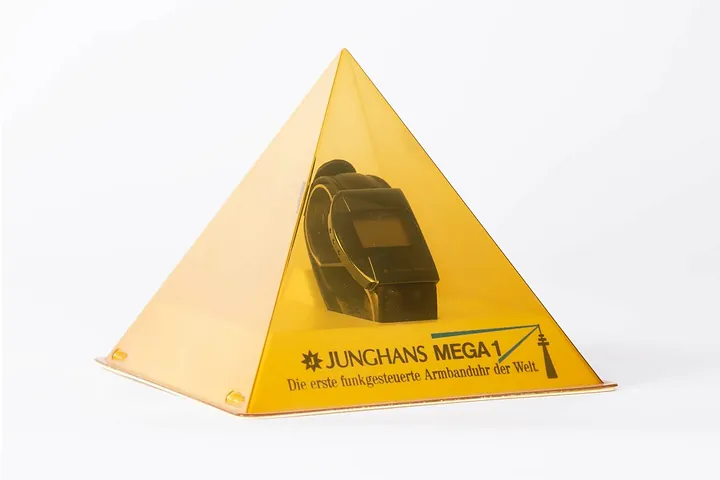
Wristwatches · 1990
Wristwatch, Germany, 1990 (no. 59620)
German Clock Museum
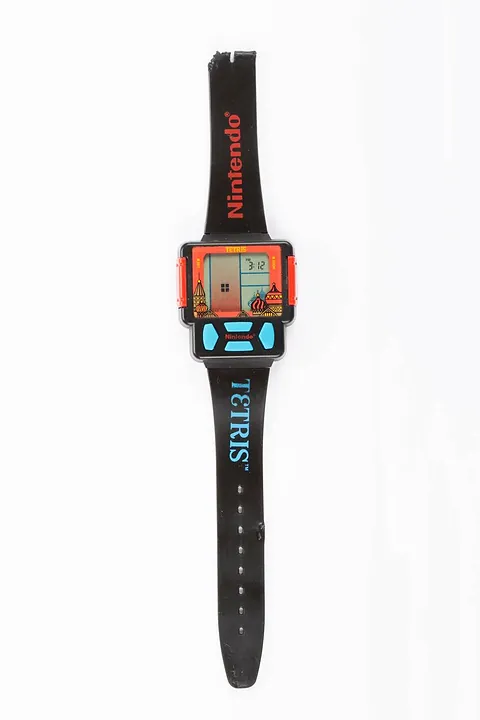
Wristwatches · c. 1991
Wristwatch by EM-Entertainment München, Merchandising, Film und Fernseh GmbH, Germany, c. 1991
German Clock Museum
Wristwatches · c. 2000
A.Lange & Söhne 1815 Chronograph, ref. 414.026, c. 2000
Antiquorum auction archive, Geneva