
Wristwatches · Wristwatch
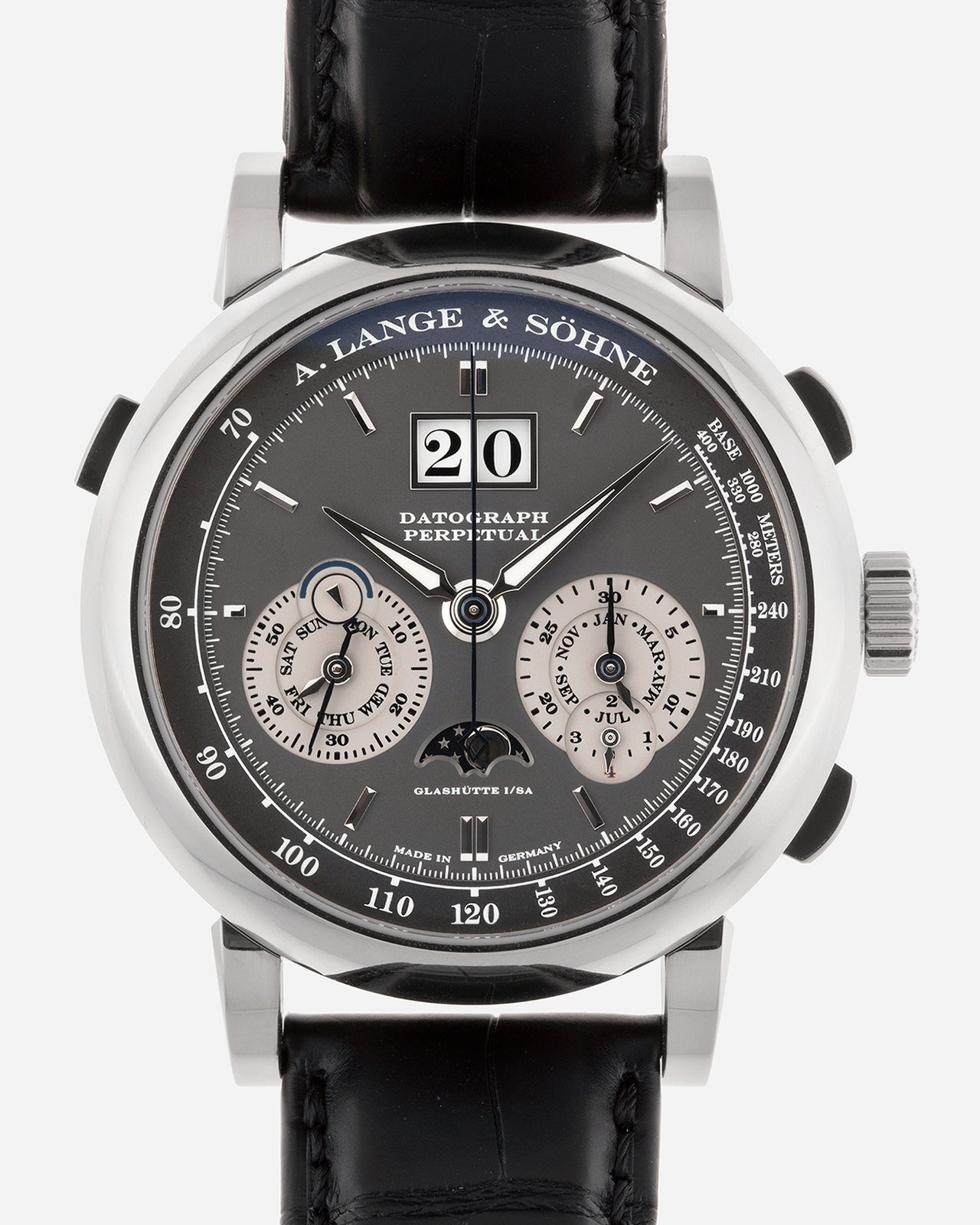
A. Lange & Sohne Datograph Perpetual Grey, 2019
- Maker / attribution
- A. Lange & Sohne (maker)
- Date
- 2019
- Historical period
- Contemporary Horology (2010 – Present)
- Country of origin
- Germany
- Object type
- Wristwatch
- Dimensions
- Case 41 mm
- Stock no.
- Product 4625310613591
- Credit line
- Dealer listing, S.Song Watches (product 4625310613591)
- Catalogue title (original)
- A. Lange & Sohne Datograph Perpetual Grey (English)
View the source record (dealer listing) ↗ (opens another website in a new tab)Suggest a correction
Record summary
Catalogued by S.Song Watches (dealer), Seattle (stock number Product 4625310613591), this is a wristwatch by A. Lange & Sohne, made in Germany, dated 2019. The Atlas places it in the Contemporary Horology period (2010 – Present) of its Wristwatches collection. Recorded dimensions: Case 41 mm. The record is illustrated with 6 photographs.
Assembled from the source record's structured fields. Dates and attributions are given as the source states them; where a field is missing the Atlas leaves it blank rather than estimating.
Catalogue description
Dealer description — S.Song Watches
When thinking of the real heavyweights in Haute Horlogerie, only a few big names come to mind- Patek Philippe, Vacheron Constantin, Audemars Piguet, and of course, the Germans next door, A. Lange & Sohne. While many see Swiss watches as the pinnacle of watchmaking, Lange serves as a reminder that this isn’t the case. In fact, one can say that in some areas, Lange is considered much better than its Swiss counterparts. Everything said in the introduction predominantly revolves around one aspect of watchmaking- the chronograph. A. Lange & Sohne today is seen as the undisputed king of chronographs and there is a good reason why- the in-house Datograph. First introduced in 1999, it sent shockwaves through the watch industry as creating an in-house chronograph was no easy feat, let alone for some young German brand. Remember, this was a time when houses like Patek Philippe and Vacheron Constantin were still using Lemania movements for their chronographs, and Lange wasn’t even a decade old. The Datograph was a very traditional, super high-end, manually wound chronograph made in Germany and not only was it a technical marvel, but it was finished to the highest standards and looked beautiful too. Imagine how the Swiss felt when this happened! Architecturally, the Datograph movement had an amazing three-dimensional look to it, with an intricately engraved balance cock and bridges and plates made out of German silver. The finishing was the best in the industry and there was just this warm glow to the movement from the German Silver that Swiss movements just didn’t have. It wasn’t until 2010 that Patek caught up and released their own in-house manually wound chronograph and it took another 5 years after that for Vacheron to catch up. Since then, there have been variations of Lange’s chronograph movement and this is one of them. The Datograph Perpetual was first released in 2006 and was a natural progression after the standard Datograph. The perpetual calendar chronograph has always been seen as a flagship complication for any brand and it was imperative that Lange did so too. With a 41mm 18k white gold case, the comparisons to the Patek Philippe 5270 was always inevitable and largely seen as a big rivalry between two of the biggest watch manufactures. With it’s iconic jumping big date at 12 o’clock though, it is unmistakably a Lange. It goes without saying that the L952.1 caliber is a sight to behold and even people who don’t know about watches can tell just how good it is. Just like every perpetual calendar chronograph watch, this Datograph Perpetual uses a calendar module fitted atop the chronograph watch to complete the complication. The movement is incredibly hand finished with thick bevelling and deep Glashütte ribbing on every surface. The Datograph Perpetual has always been very conservative in its design, being made only with a white dial in either a white gold or rose gold case but in 2018 they released this example- fitted with a beautiful grey dial. The grey is quite enigmatic and ethereal in its nature as it varies in tone depending on the light source. While blue dials are all the rage these days I was very happy to see Lange buck the trend with this fantastic grey dial. Despite the huge rivalry between the other Swiss brands, there is no doubt that A. Lange & Sohne is at the top of its game, with this Datograph Perpetual as one of its flagships. Even the legend Philippe Dufour himself owns a Datograph and routinely cites Lange as the best in terms of movement finishing in mainstream watchmaking.
Historical context
Contemporary Horology (2010 – Present)
Silicon components, connected watches, optical-lattice research clocks and a thriving independent scene.
Smartwatches became the world's best-selling watches, while mechanical watchmaking focuses on craft, innovation (silicon components, new escapements) and independent makers.
Read the period in the timelineMore wristwatches from this periodEarlier: Mechanical Renaissance
Atlas type guide
Calendar, moon-phase and perpetual calendar watches
Calendar complications range from a simple date to the perpetual calendar, which automatically allows for months of different lengths and leap years until 2100. Pocket watches with perpetual calendars were made in the eighteenth and nineteenth centuries; Patek Philippe made the first perpetual calendar wristwatch in 1925, and series production followed in 1941. The annual calendar (Patek Philippe, 1996) needs correction only once a year.
Moon-phase displays use a disc with two moons and 59 teeth advanced daily, approximating the 29.5-day lunation; more precise trains reduce the error to one day in over a century.
What to look for
- Apertures or subsidiary dials for day, date, month and leap year.
- Moon disc under a 'bosom' shaped aperture.
- Recessed correctors on the case band for setting the calendar.
Dating clues
- Triple-date wristwatches: popular c. 1940–1955.
- Perpetual calendar wristwatches: from 1925 (unique) and 1941 (series).
General guidance written by the Atlas editors about this kind of object. It is not a statement about this particular piece; for that, rely on the source record above and on physical examination.
Related records
Wristwatches · originally sold on 16 December 2001 (per the lot record)
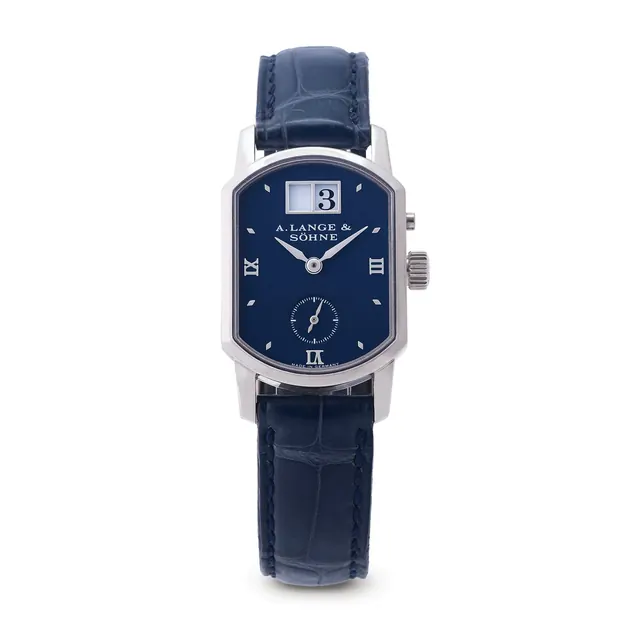
A. Lange & Sohne wristwatch, ref. 103.027, Arkade, originally sold on 16 December 2001
Antiquorum auction archive, Geneva
Instruments · c. 1942
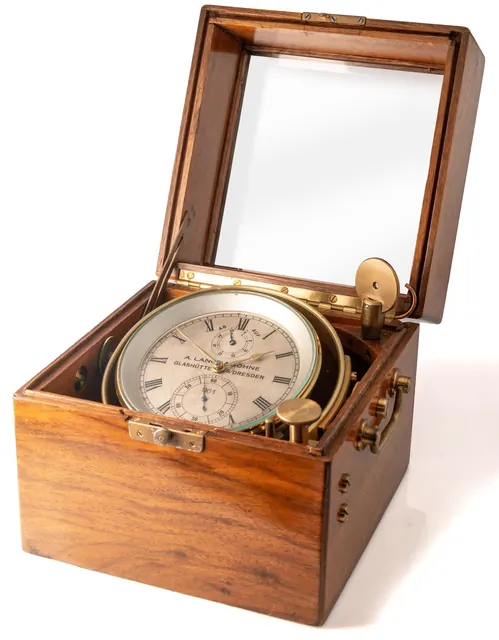
A. Lange & Sohne marine chronometer, Germany Wood, circa 1942
Antiquorum auction archive, Geneva
Wristwatches · 2004
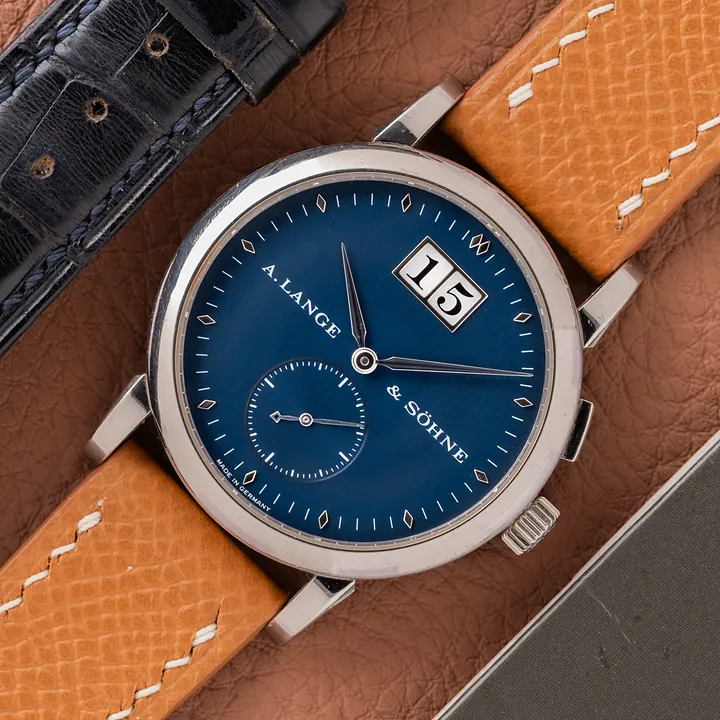
A. Lange & Söhne Saxonia Oversized Date Blue (Ref. 105.027), 2004
Huntington Company (dealer)
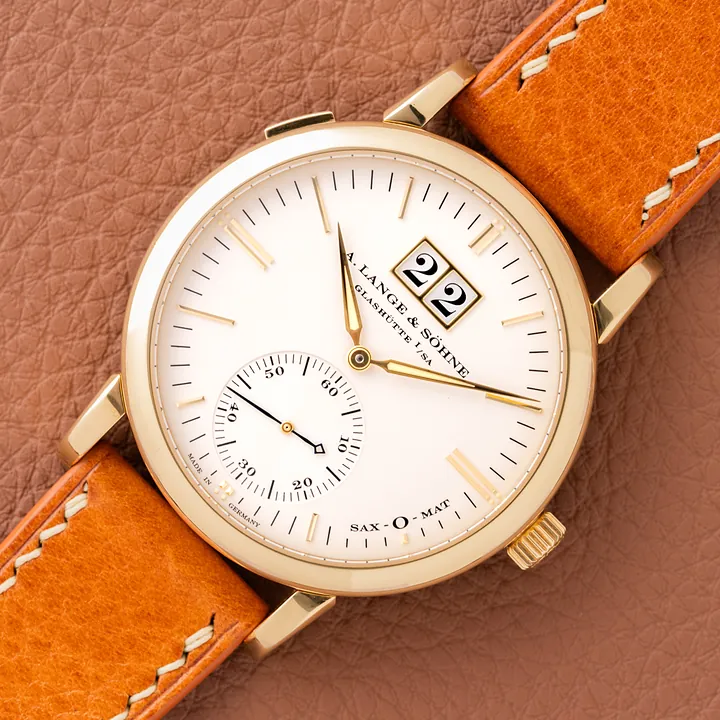
Wristwatches · 2000s
A. Lange & Söhne Langematik Oversized Date (Ref. 308.021), 2000s
Huntington Company (dealer)
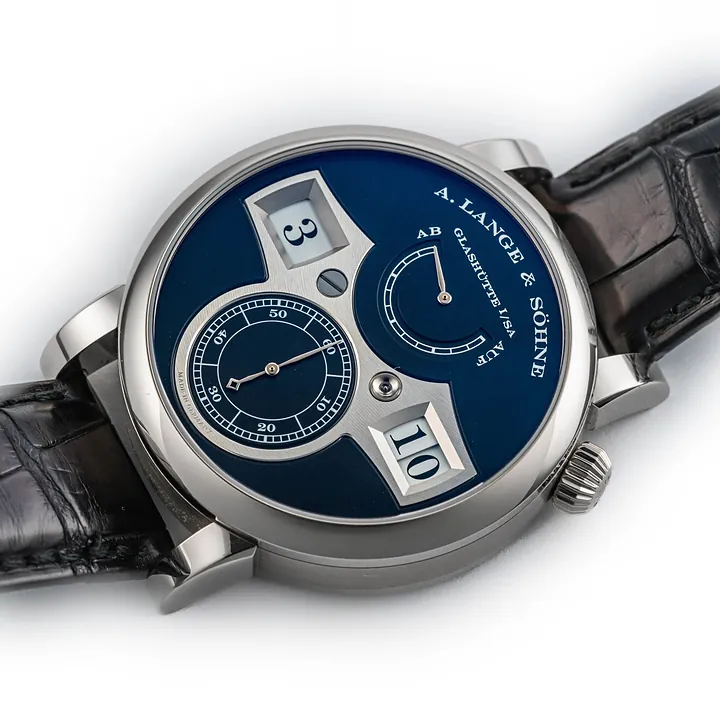
Wristwatches · c. 2018
A.Lange & Söhne Zeitwerk, ref. 140.029, c. 2018
Antiquorum auction archive, Geneva
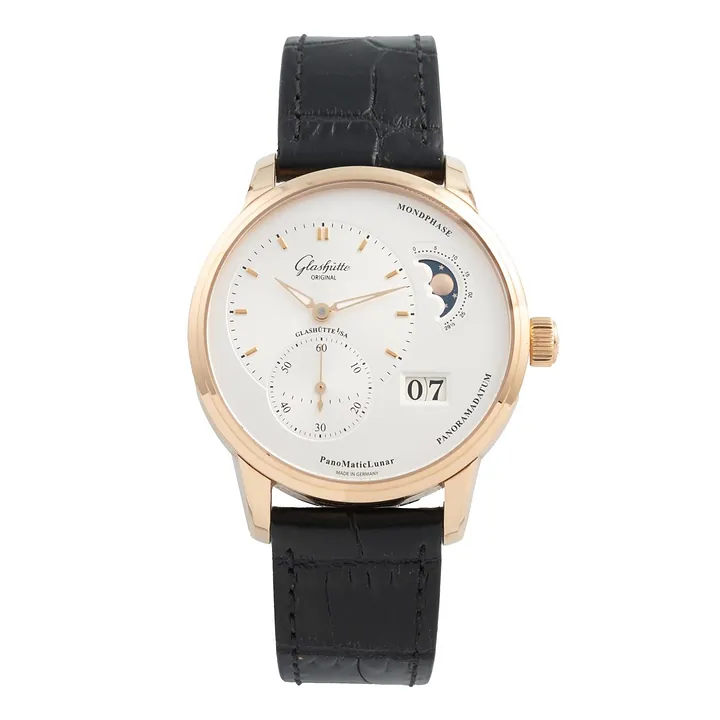
Wristwatches · originally sold in April 2022 (per the lot record)
Glashã¼tte Original Panomaticlunar, ref. 1-90-02-45-35-04, originally sold in April 2022
Antiquorum auction archive, Geneva
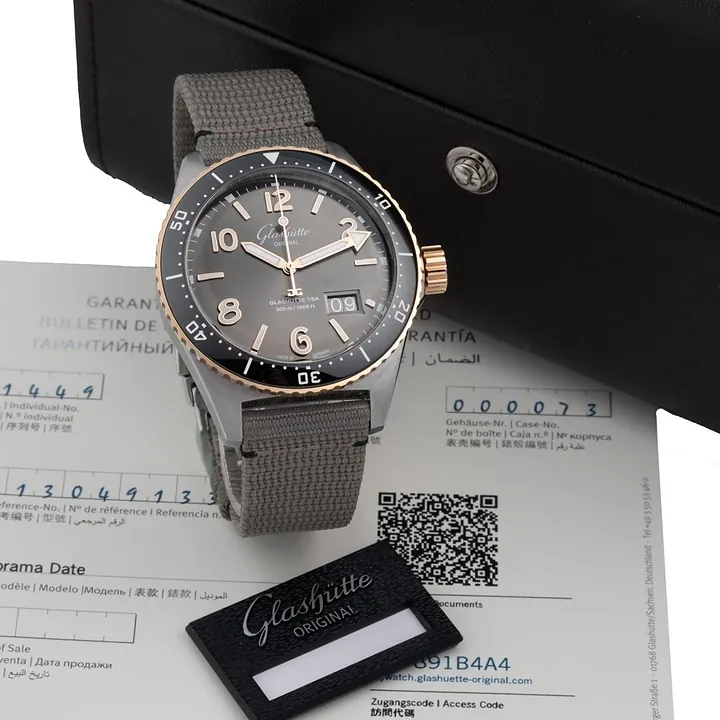
Wristwatches · c. 2022
Glashütte Original Seaq Panorama Date, ref. 1-36-13-04-91-33, c. 2022
Antiquorum auction archive, Geneva
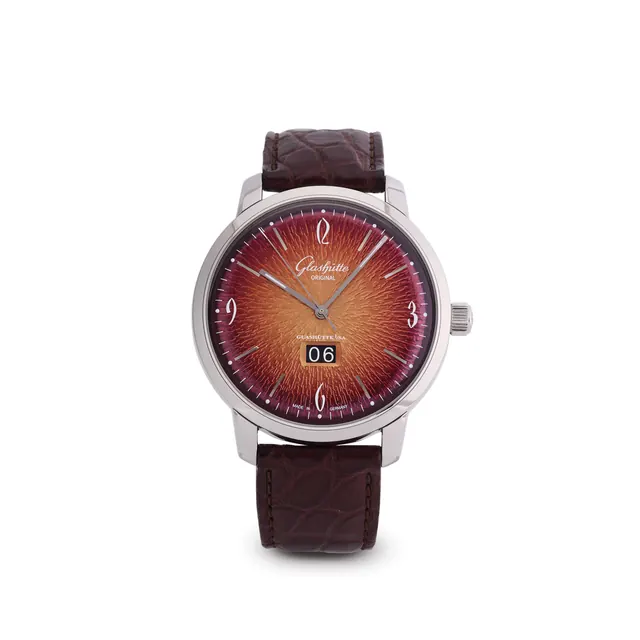
Wristwatches · originally sold in December 2021 (per the lot record)
Glashütte Original wristwatch, ref. W23947090204, Sixities Panorama Date Annual Edition, originally sold in December 2021 (per the lot record)
Antiquorum auction archive, Geneva