
Wristwatches · Wristwatch
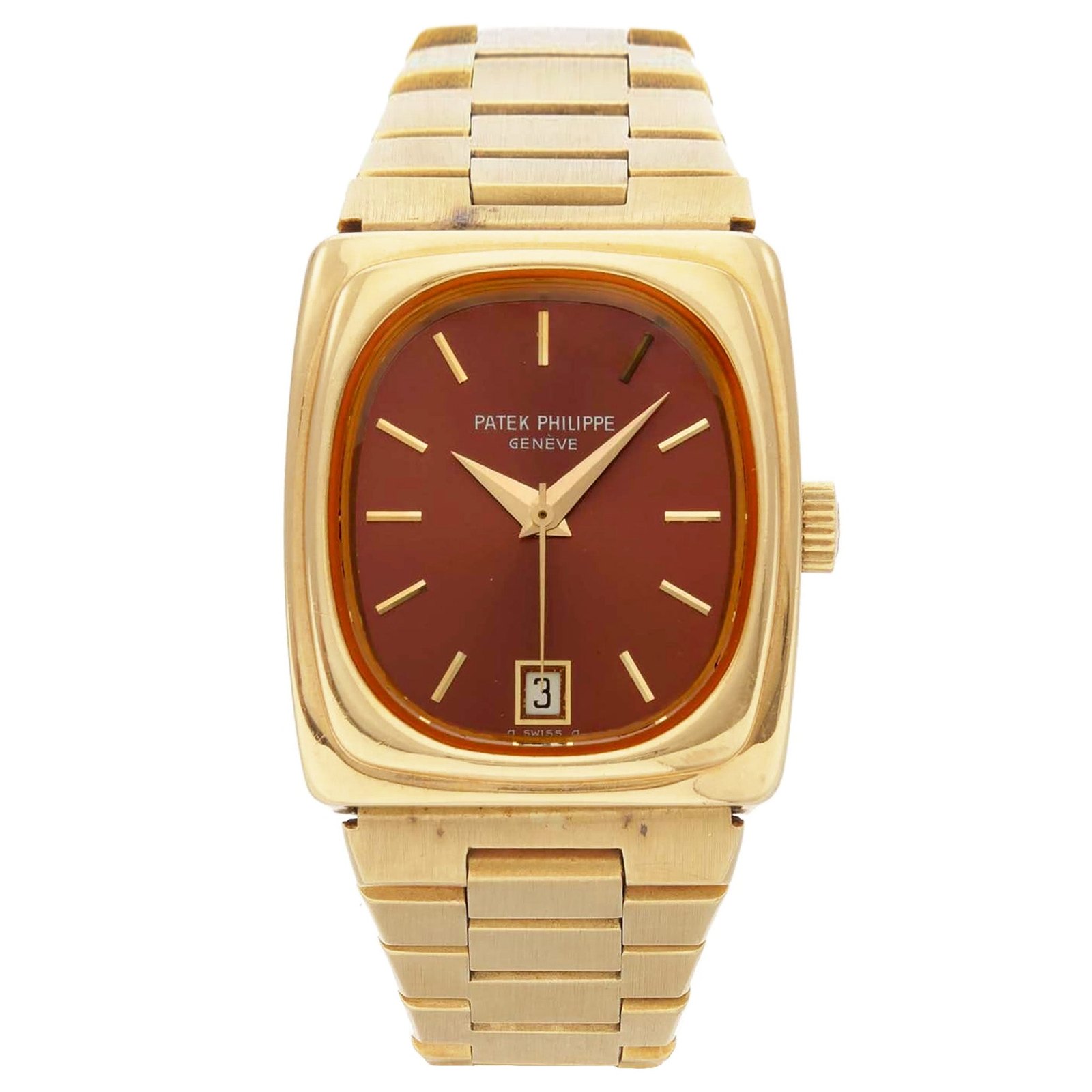
18ct yellow gold Patek Philippe ref. 3603/1 BETA 21 bracelet watch, 1974
- Maker / attribution
- Patek Philippe (maker)
- Date
- 1974
- Historical period
- Quartz Revolution (1969 – 1990)
- Country of origin
- Switzerland
- Object type
- Wristwatch
- Materials / technique
- yellow gold
- Dimensions
- Case 37.5 mm
- Stock no.
- G2885
- Credit line
- Dealer listing, Somlo Antiques (G2885)
- Catalogue title (original)
- 18ct yellow gold Patek Philippe ref. 3603/1 BETA 21 bracelet watch. Made 1974 (English)
View the source record (dealer listing) ↗ (opens another website in a new tab)Suggest a correction
Record summary
Catalogued by Somlo Antiques (dealer), London (stock number G2885), this is a wristwatch by Patek Philippe, made in Switzerland, dated 1974. The Atlas places it in the Quartz Revolution period (1969 – 1990) of its Wristwatches collection. Materials and techniques recorded by the source: yellow gold. Recorded dimensions: Case 37.5 mm. The record is illustrated with 3 photographs.
Assembled from the source record's structured fields. Dates and attributions are given as the source states them; where a field is missing the Atlas leaves it blank rather than estimating.
Catalogue description
Dealer description — Somlo Antiques
The piezoelectric properties of quartz were discovered by Jacques and Pierre Curie in 1880, and subsequently the vacuum tube oscillator was invented in 1912. An electrical oscillator was first used to sustain the motion of a tuning fork by the British physicist William Eccles in 1919. his achievement removed much of the damping associated with mechanical devices and maximised the stability of the vibration's frequency and the first quartz crystal oscillator was built by Walker G. Cady in 1921. In1923, D.W.Dye at the National Physical Laboratory in the United Kingdom and Warren Marrison at Bell Telephone Laboratories produced sequences of precision time signals with quartz oscillators. The first quartz clock was invented in 1928 by Bell Labs, and due to the sheer size of early quartz clocks, were mostly restricted to use in labs as reference timekeepers. Quartz experimentation continued through the decades and by the early 1960s quartz movements had been miniaturized enough to allow for them to be used in marine chronometers. It was at this time, that the major Swiss watch brands caught wind of this new technology and approximately 20 maisons created the Centre Electronique Horloger (CEH) in 1962 in Neuchâtel. The purpose of the C.E.H. was to focus on researching, creating, and producing a quartz movement efficient enough, reliable enough, and accurate enough for the next generation of watchmaking. After six years of research the first prototype, the Beta-1, was produced in 1966, using a 8192 Hz quartz oscillator mounted in an in-house integrated circuit. Shortly thereafter in 1967, the Beta-2 was produced and was awarded first prize at the "Concours Chronométrique International de l'Observatoire de Neuchâtel," setting a new record for accuracy over the test period of only .0003 seconds variation in rate per day (as opposed to the 3-10 seconds typical of wristwatch chronometers of the day). The Beta-21 was created in 1969 and it was agreed by the 20 Swiss houses to produce 6,000 of these movements. Later that year, a few hundred of the Beta-21 watches were released at Basel, setting a new record at the Fair. The Beta-21 movement was accurate to 5 seconds per month, which was far superior to any automatic and manual-winding watch at the time. The design for the Beta-21 watches were also very characteristic of the era --they were generally thick, angular, and even chunky (partly out of necessity as the first generation of quartz movements were comparatively large.) Brand: Patek Philippe Made: 1974 Model: N/A Reference: 3603/1 Calibre: BETA 21 Movement: Quartz Material: 18ct yellow gold Features/complications: Rectangular case Dial: Ruby coloured ellipse dial with applied gold mirror polished baton hour indices and gold Dauphine hands with centre seconds and date at 6 o'clock Case dimensions: 33.5 x 37.5 mm Bracelet/strap: 18ct yellow gold bracelet , length approximately 185mm Accessories: Extract from the Archives SKU: 2885
Historical context
Quartz Revolution (1969 – 1990)
Seiko's Astron begins mass quartz timekeeping; traditional industries contract sharply.
Quartz and digital watches transformed the market after 1969. Swiss employment collapsed, Japanese and Hong Kong production soared, and the Swatch (1983) helped the Swiss industry recover; mechanical watches survived as luxury goods.
Read the period in the timelineMore wristwatches from this periodEarlier: Modern Mechanical Horology
Atlas type guide
Quartz, digital and electronic watches
Electronic watches arrived in three steps. The Hamilton Electric 500 (1957) was the first battery-powered wristwatch, still with a balance; Bulova's Accutron (1960) used a tuning fork. On 25 December 1969 Seiko released the Astron 35SQ, the first quartz wristwatch, closely followed by the Swiss Beta 21 group. In 1972 Hamilton's Pulsar introduced the LED digital watch, and LCD displays soon made digital watches cheap.
The 'Quartz Crisis' that followed devastated the Swiss mechanical industry, which lost two-thirds of its workforce between 1970 and 1984 before recovering with the Swatch (1983) and the luxury mechanical revival. Solar, radio-controlled, kinetic and connected smartwatches continue the electronic line.
What to look for
- Battery hatch in the case back and calibre markings with 'Quartz' or a crystal frequency.
- Display technology: LED (red, push-button) versus LCD (always-on).
- Tuning-fork hum and a smoothly sweeping seconds hand on Accutrons.
- Model and reference numbers, often printed on the back.
Dating clues
- Electric balance watches: from 1957.
- Tuning-fork watches: 1960–c. 1977.
- Quartz analogue: from December 1969; LED digital: 1972–c. 1978; LCD from 1973.
General guidance written by the Atlas editors about this kind of object. It is not a statement about this particular piece; for that, rely on the source record above and on physical examination.
Read next:Seiko calibre 35A (Astron)
Related records

Clocks · 1965–1975
Quartz master clock QM 1, with movement by Patek Phillippe, Switzerland, 1965–1975. Supplied by English Clock Systems.
Science Museum Group, London

Instruments · 1965–1984
Chronometer by Patek Philippe and Kelvin Hughes, England, 1965–1984
Science Museum Group, London

Pocket Watches · c. 1895
Patek Philippe pocket watch, c. 1895
Antiquorum auction archive, Geneva

Pocket Watches · c. 1900
Patek Philippe Chronometro Gondolo, c. 1900
Antiquorum auction archive, Geneva

Wristwatches · 1970
Wristwatch by Heno, Switzerland, 1970
Museum Rotterdam

Wristwatches · 1960–1986
'Tri-Compax' calendar chronograph wristwatch in gold case, by Universal, Geneva, Switzerland, 1960–1986.
Science Museum Group, London

Wristwatches · 1969–1970
Beta 21 Quartz wristwatch movement, made in Switzerland, 1970.
Science Museum Group, London

Wristwatches · c. 1969
Omega Speedmaster Moonwatch, ref. 145022-69st, c. 1969
Antiquorum auction archive, Geneva