
Horological History · Historical feature
Finding Longitude: Harrison, Arnold, Earnshaw and the Marine Chronometer
How a navigational problem became a horological one — and why the instrument that solved it at sea was not the one that won the prize.
Atlas Editorial · · 9 min read
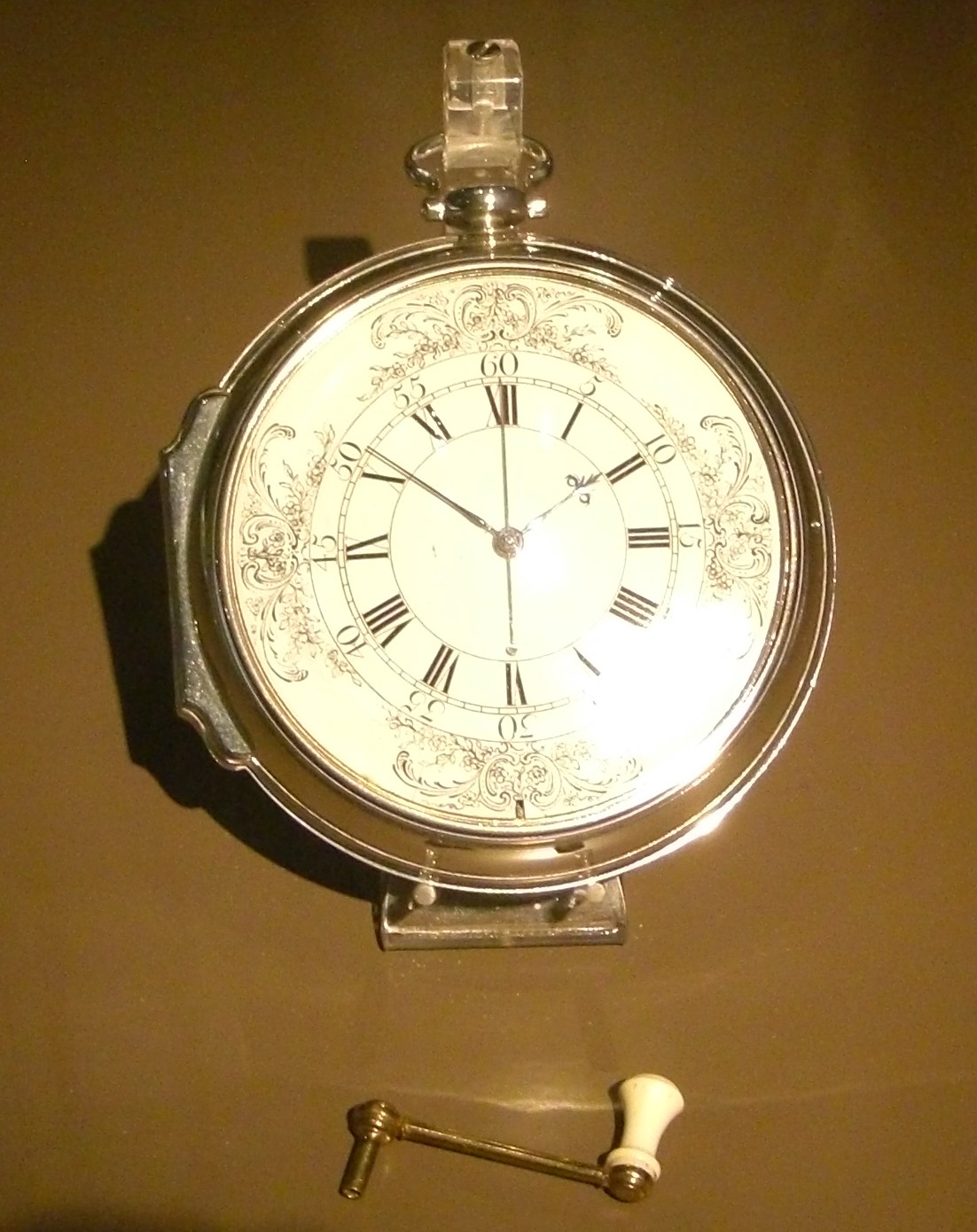
Colonel Warden at en.wikipedia · CC BY-SA 3.0 · source (opens another website in a new tab)
A ship's latitude can be found from the sky with an instrument and a table: measure the height of the Sun at noon, or of the Pole Star at night, and the angle gives your distance north or south of the equator. Longitude is different. The Earth turns through 360 degrees in a day, so one hour of time corresponds to 15 degrees of longitude. To know how far east or west you are of a reference meridian, you need to know two times at once — the local time where you are, and the time at the reference place at that same instant. Local time can be found from the Sun. The reference time has to be carried.
For most of the history of ocean navigation, it could not be carried accurately enough. Sailors estimated position by dead reckoning — speed, heading and elapsed time — and the errors accumulated. Ships ran aground on coasts they believed were far away, or sailed past islands they were trying to find. The problem was political as well as technical: navies, trading companies and governments all wanted it solved, and several states offered rewards.
The problem and the prize
In 1714 the British Parliament passed the Longitude Act, offering rewards for a 'practicable and useful' method of determining longitude at sea: £10,000 for a method accurate to within one degree, £15,000 for two-thirds of a degree and £20,000 for half a degree, judged on a voyage to the West Indies. A body of commissioners, later known as the Board of Longitude, was appointed to assess proposals. Half a degree at the latitude of the Caribbean is roughly thirty nautical miles; to achieve it with a timekeeper over a six-week voyage, the clock needed to keep time to within about three seconds a day.
Many scientists thought the answer lay in astronomy rather than mechanics. The Moon moves against the background stars by about its own diameter every hour, and if its position could be predicted precisely, an observer could compare the observed angle between the Moon and a star with tabulated values and work out the reference time. This 'lunar distance' method demanded accurate lunar theory, good instruments and laborious calculation. It became practical in the 1760s, and from 1767 the Nautical Almanac, published under the direction of the Astronomer Royal Nevil Maskelyne, supplied the necessary tables.
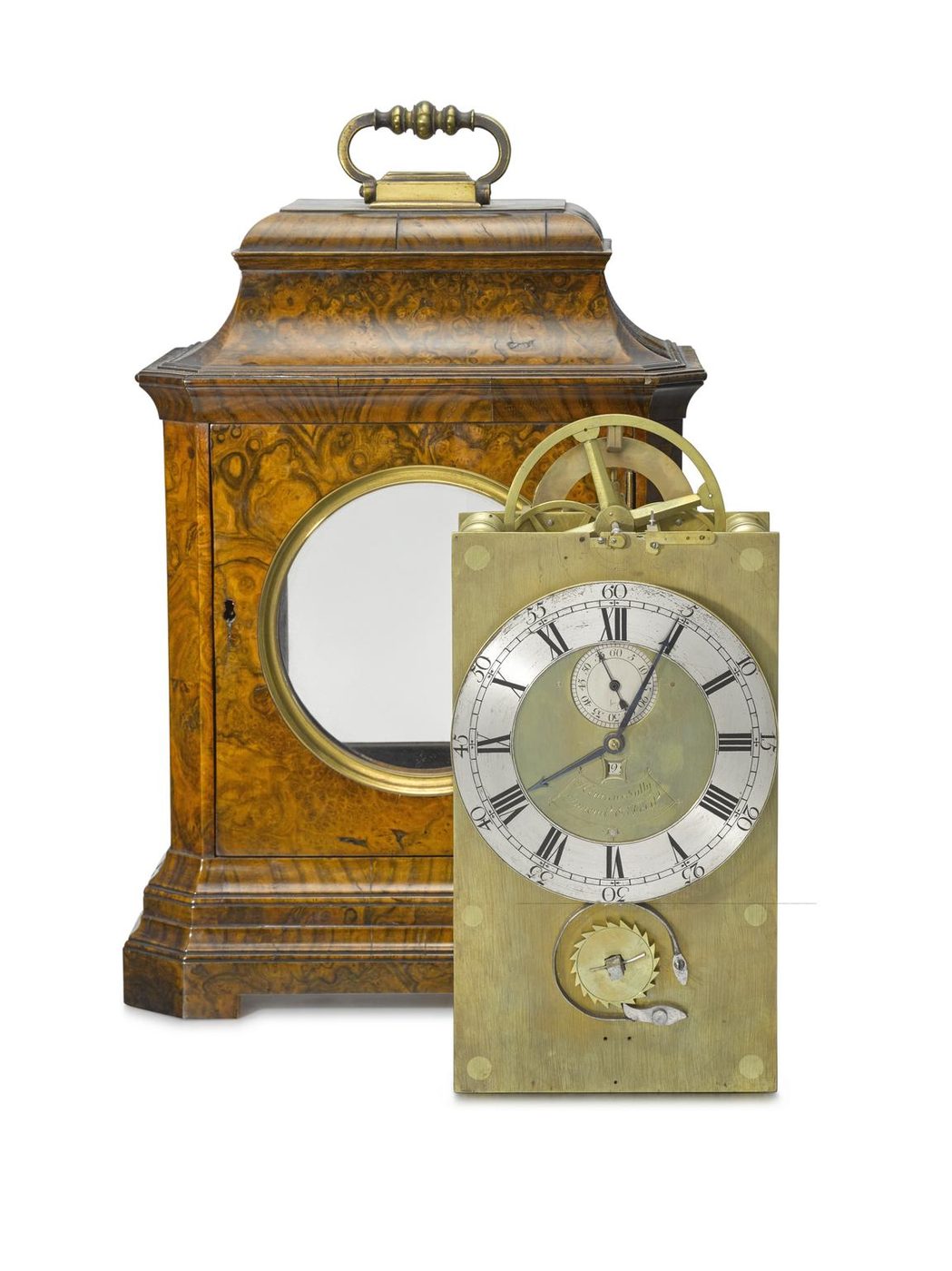
A mechanical timekeeper offered a far simpler routine at sea — find local time from the Sun, read the chronometer, subtract. But a clock on a ship faces almost every enemy of accuracy at once: pitching and rolling, changes of temperature and humidity, salt air, and the impossibility of using a pendulum on a moving deck. Christiaan Huygens and others had tried marine pendulum clocks in the 17th century with mixed results. In 1724 the English-born maker Henry Sully, working in France, built a marine clock with a balance regulated by a weighted lever; it was ingenious but did not keep sufficient time.
John Harrison's four timekeepers
John Harrison (1693–1776), a carpenter and self-taught clockmaker from Lincolnshire, had already built wooden regulators of extraordinary accuracy, using his grasshopper escapement and gridiron pendulum, when he turned to the longitude problem. His first marine timekeeper, now known as H1, was completed in the mid-1730s. It replaced the pendulum with two large linked balances that swung in opposite directions, so that the ship's motion affected them equally and cancelled out, and it compensated for temperature with a gridiron of brass and steel rods. On a trial voyage to Lisbon and back in 1736 it performed well enough for the Board to grant Harrison money to continue.
H2 and H3 followed over the next two decades. H3 alone occupied Harrison for nearly twenty years and introduced two inventions that outlived the clocks themselves: the bimetallic strip, used to correct the balance spring for temperature, and the caged roller bearing. But the large balances of the sea clocks never achieved the stability Harrison wanted. Meanwhile, a pocket watch made for him by John Jefferys showed him that a small, fast-beating balance could be more stable than a large slow one.
The result was H4, completed around 1759: a silver-cased watch about 13 centimetres across, with a verge escapement given diamond pallets of a special shape, a fast-beating balance, a remontoire to equalise the driving force and a bimetallic compensation curb. On its first official trial, to Jamaica aboard HMS Deptford in 1761–62, it was found on arrival to be about five seconds slow after allowance for its known rate — an error equivalent to little more than a minute of longitude. A second trial to Barbados in 1764 also gave a result within the limits of the Act.
| Timekeeper | Completed | Form | Key features |
|---|---|---|---|
| H1 | c. 1735 | Sea clock | Two linked dumb-bell balances; gridiron compensation; wooden wheels; grasshopper escapement |
| H2 | c. 1739–41 | Sea clock | Brass construction; improved linked balances; remontoire |
| H3 | c. 1757 | Sea clock | Circular balances; first bimetallic strip; caged roller bearing |
| H4 | c. 1759 | Large watch | High-frequency balance; verge with diamond pallets; remontoire; compensation curb |
| H5 | c. 1770 | Large watch | Further refinement of H4, tested privately with royal support |
Why the prize was never simply 'won'
The Board of Longitude did not hand Harrison £20,000 after the Jamaica trial. Its members questioned whether the result was luck, whether the watch's rate had been properly established, and — crucially — whether the method was 'practicable and useful': one watch, made over years by its inventor, was not a navigational system. The Board required Harrison to disclose the construction of H4 and demanded that copies be made by other craftsmen to show that it could be reproduced.
In 1765, after the disclosure, Harrison received £10,000. The Board commissioned Larcum Kendall to make a copy, now known as K1, which James Cook carried on his second Pacific voyage (1772–75). Cook's journals record his growing confidence in it. Harrison, by then in his late seventies, petitioned the King and Parliament, and in 1773 Parliament voted him a further £8,750. The full award under the Act was never formally made to anyone. The episode is often told as a story of a lone genius wronged by establishment astronomers; recent scholarship, including the Board's own papers, presents a more complicated picture of a committee trying to judge a new technology against a legal standard written decades before.
From invention to instrument: Le Roy, Berthoud, Arnold and Earnshaw
Harrison's H4 showed that a portable timekeeper could do the job; it did not show how to make one that could be produced in numbers. That second achievement belongs to a group of French and English makers in the following decades. In France, Pierre Le Roy presented a marine timekeeper in 1766 that combined a detached escapement, a compensated balance and a balance spring adjusted for isochronism — the essential elements of the later chronometer — and Ferdinand Berthoud built a long series of marine clocks for the French navy.
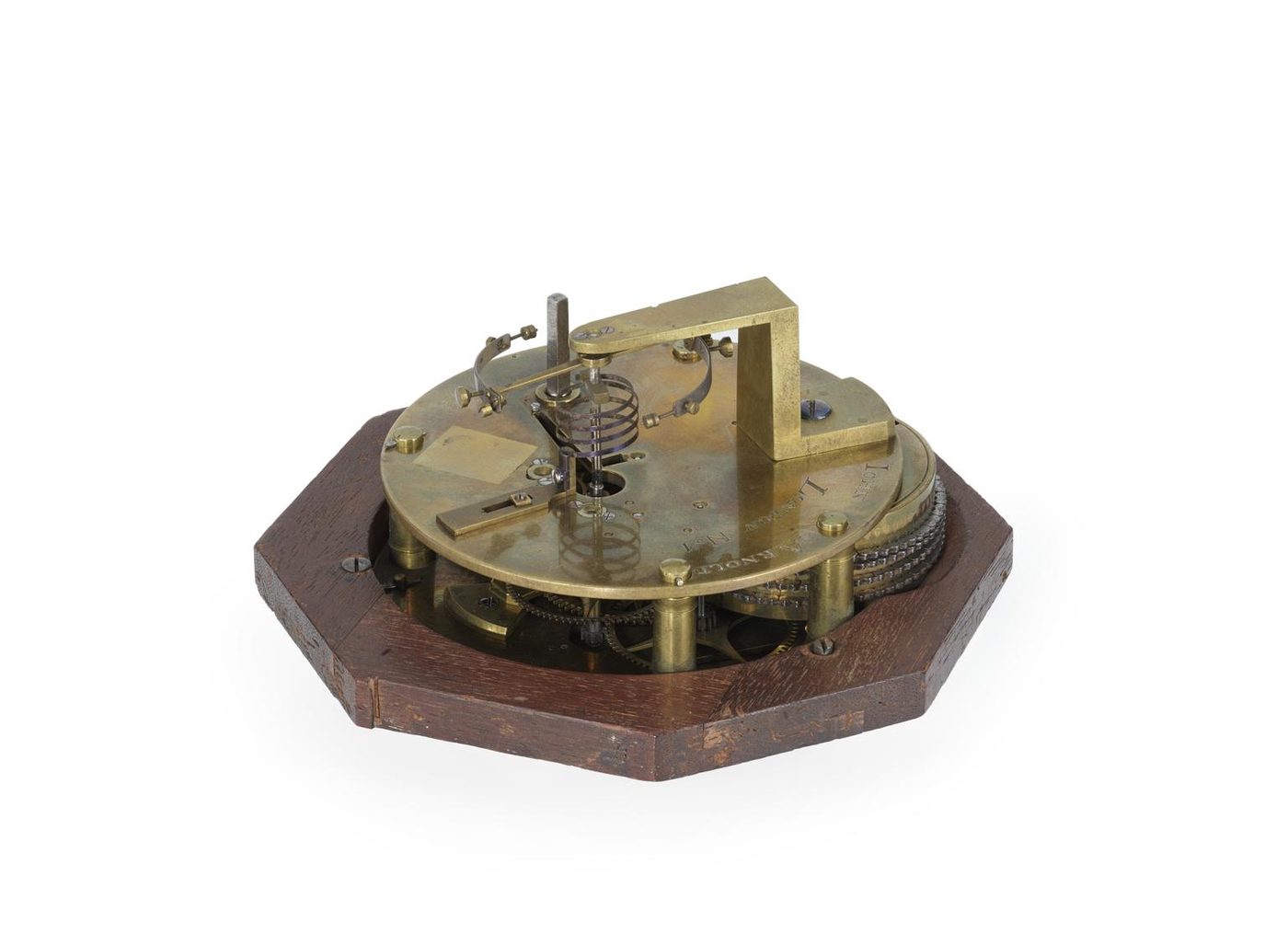
In London, John Arnold (1736–1799) developed a simpler detent escapement in which the balance is free of the train except for a brief moment of unlocking and impulse, a compensation balance with bimetallic rims, and a helical balance spring with shaped terminal curves. Arnold made chronometers in quantity, including small pocket chronometers, and did much to popularise the word 'chronometer' for such instruments, a term that had been used occasionally since the early 18th century. Thomas Earnshaw (1749–1829) devised the spring detent in the form that became standard, and simplified the compensation balance by fusing brass to steel. A bitter dispute between the two men over priority followed.
The elements of the standard marine chronometer
- A spring detent escapement, giving impulse to the balance once per oscillation and leaving it free for most of its swing.
- A compensation balance with bimetallic rims and adjustable weights, correcting for the effect of temperature on the balance spring.
- A helical (cylindrical) balance spring with terminal curves, to improve isochronism.
- A fusee and chain, to give an even driving force as the mainspring runs down.
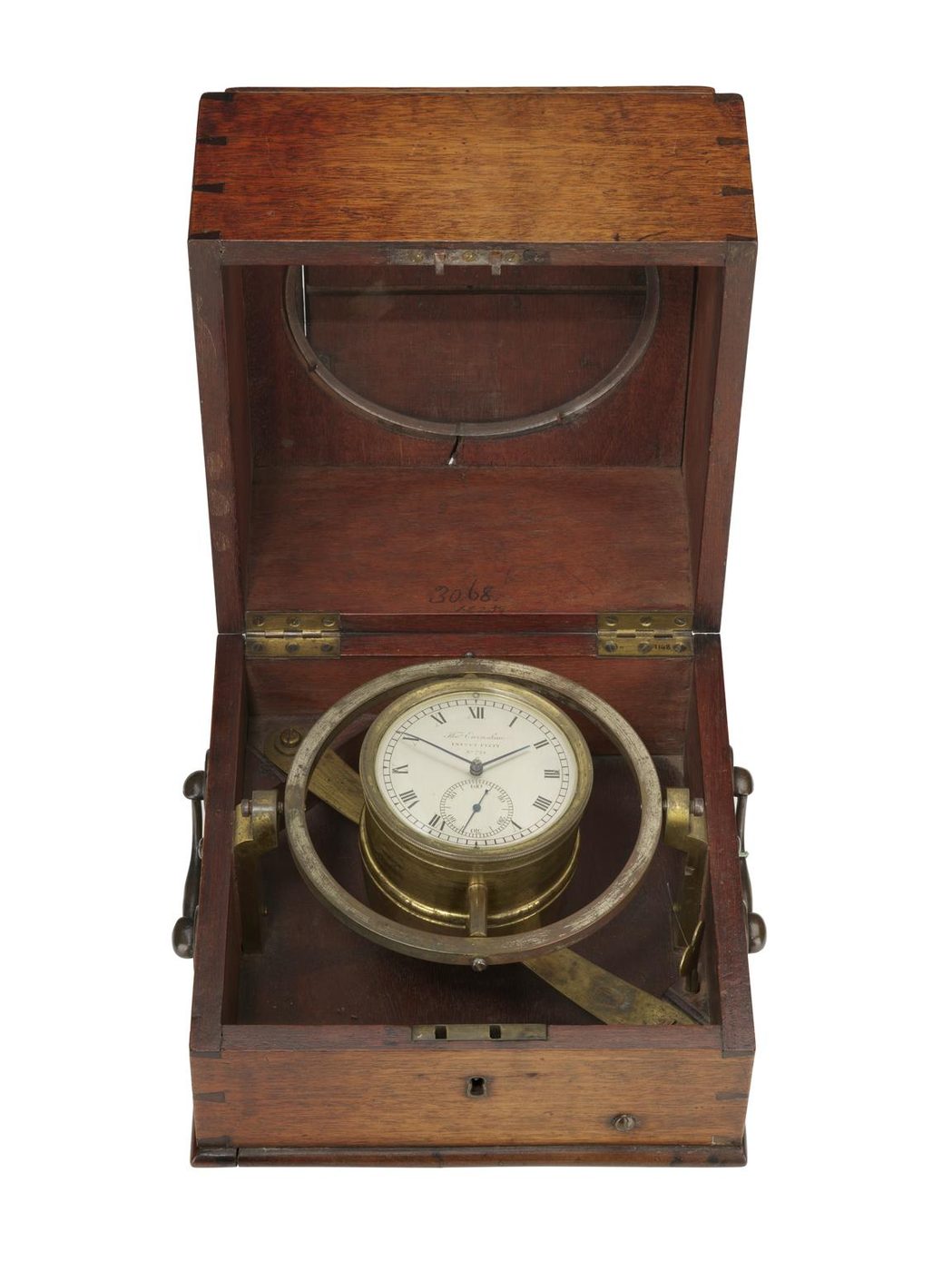
- A brass bowl hung in gimbals inside a wooden box, so that the movement stays horizontal as the ship moves.
- A two-day or eight-day going period, with an up-and-down indicator showing the state of wind.
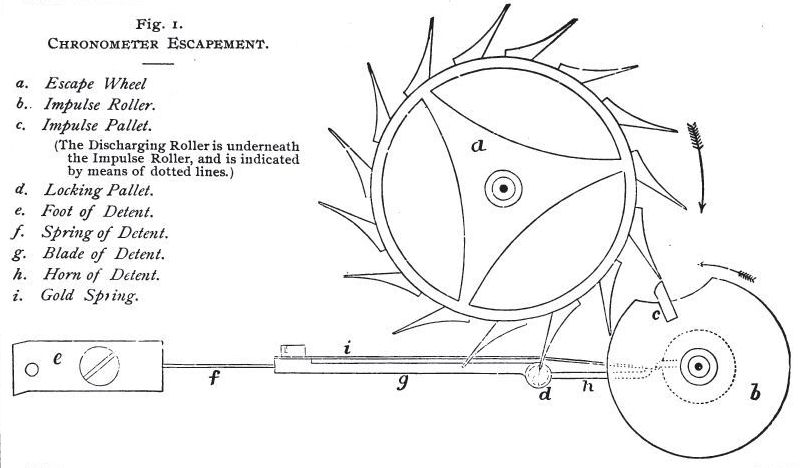
Rating, checking and using a chronometer
No chronometer kept perfect time; what made it useful was that it kept a predictable rate. Before a voyage the instrument was compared against an observatory clock for days or weeks, and its daily gain or loss — its rate — recorded. At sea the navigator applied the rate to the reading. A chronometer that consistently lost two seconds a day was more valuable than one that wandered between gaining and losing a second. Ships on long voyages often carried two or three chronometers so that one faulty instrument could be identified by comparison.
From the late 18th century, the Royal Observatory at Greenwich tested chronometers for the Royal Navy, and from 1822 annual trials there compared instruments from many makers, with the best purchased by the Admiralty. Similar testing grew up at observatories elsewhere. Chronometer making became a London speciality, with firms such as Frodsham, Dent, Kullberg and Mercer, and a substantial industry in Liverpool and other ports; in France, Breguet and successors, and later firms in Switzerland and Germany, supplied navies and merchant fleets.
| Lunar distances | Marine chronometer | |
|---|---|---|
| Principle | The Moon's position among the stars as a sky clock | A mechanical clock carrying reference time |
| Equipment | Sextant or octant, Nautical Almanac, tables | Rated chronometer (ideally two or more), sextant for local time |
| Calculation | Long: clearing the distance for refraction and parallax | Short: local time minus reference time |
| Weaknesses | Weather, skill, Moon not always observable | Cost, drift in rate, damage, need for regular checks |
| Period of main use | c. 1767 to mid-19th century | Late 18th century to the radio and satellite era |
After the chronometer
In the 20th century the chronometer's role changed. Radio time signals, broadcast from the first decade of the century onwards, allowed ships to check their timekeepers wherever they were, so a chronometer's rate mattered over days rather than months. During the Second World War, the demand for navigational timekeepers led the Hamilton Watch Company in the United States to produce marine chronometers in large numbers on industrial methods. Quartz chronometers followed after the war, and satellite navigation made the method itself obsolete for routine use. Chronometers remain in use as training instruments and backups, and many surviving examples are still rated and serviced by specialists.
Where to see them
- Harrison's H1–H4 are displayed at the Royal Observatory, Greenwich, part of Royal Museums Greenwich; H1–H3 are kept running.
- Arnold, Earnshaw and many 19th-century chronometers are held by the Science Museum Group and the British Museum.
- French marine timekeepers by Le Roy and Berthoud are held at the Musée des Arts et Métiers in Paris.
- The Atlas catalogue contains dozens of chronometers from several collections — use the Instruments collection or search for 'marine chronometer'.
What the record shows, and what it does not
The story of longitude is unusually well documented, thanks to the Board of Longitude's papers (now digitised by Cambridge University Library), Harrison's own published description of H4, and Gould's classic history of the marine chronometer. Even so, specific claims in popular retellings deserve care: exact trial figures vary slightly depending on how the rate is applied, and attributions of individual inventions to Arnold or Earnshaw were contested even in their lifetimes. Where the Atlas gives a date or a figure, it follows the published sources listed below; where sources disagree, we say so.
Sources & further reading
- The Marine Chronometer: Its History and Development — Rupert T. Gould, J. D. Potter (London), 1923.
- Harrison — Jonathan Betts, National Maritime Museum (London), 1993.
- A Description Concerning Such Mechanism as Will Afford a Nice, or True Mensuration of Time — John Harrison, London, 1775.
- Les longitudes par la mesure du temps — Ferdinand Berthoud, Paris, 1775.
- Longitude — Dava Sobel, Walker & Company (New York), 1995.
- Revolution in Time: Clocks and the Making of the Modern World — David S. Landes, Harvard University Press, 1983.