
Wristwatches · Wristwatch
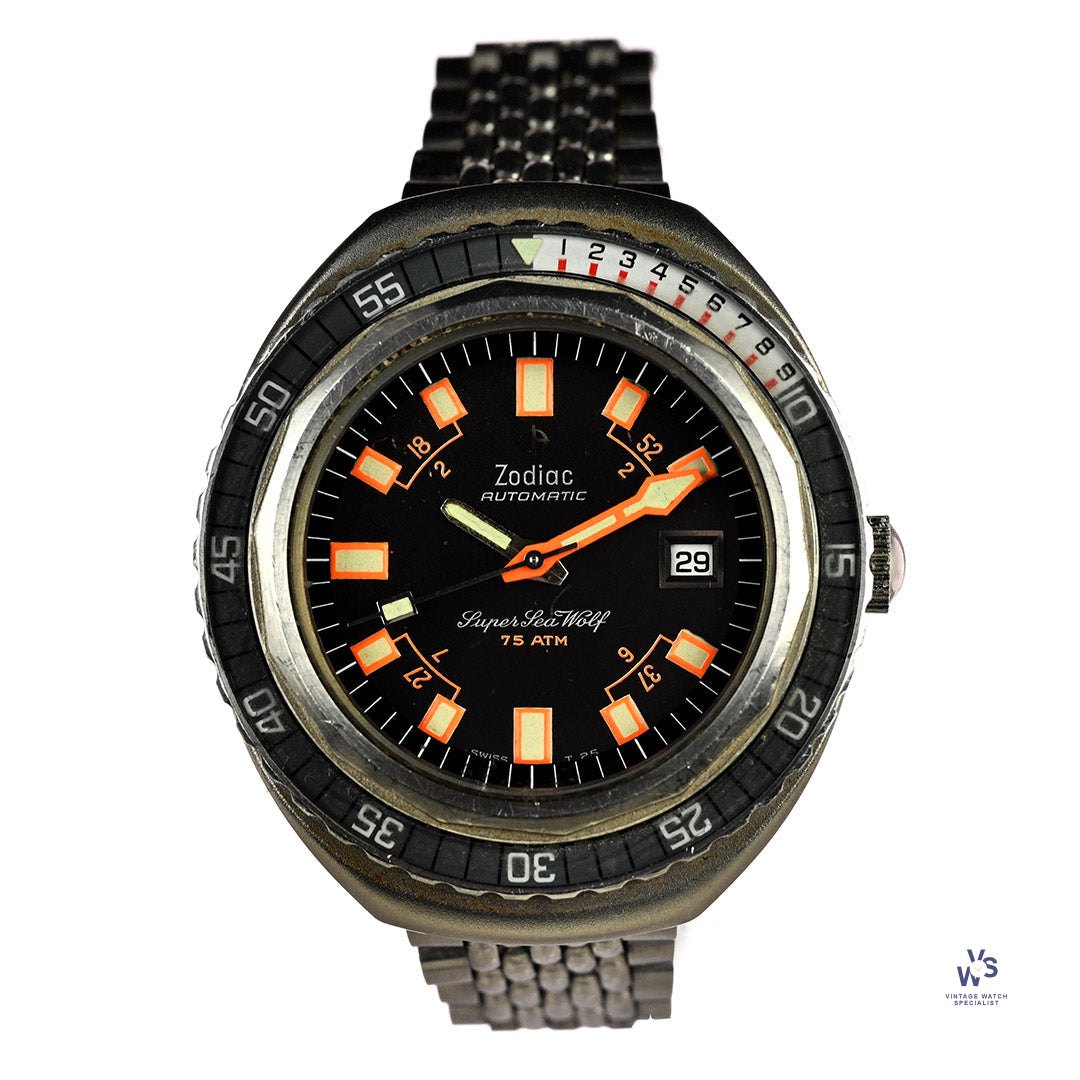
Zodiac Automatic Super Sea Wolf, Model 1342, circa 1970
- Maker / attribution
- Zodiac (maker)
- Date
- c. 1970
- Historical period
- Quartz Revolution (1969 – 1990)
- Country of origin
- Switzerland
- Object type
- Wristwatch
- Dimensions
- Case 43 mm
- Stock no.
- vws3639
- Credit line
- Dealer listing, Vintage Watch Specialist (vws3639)
- Catalogue title (original)
- Zodiac Automatic Super Sea Wolf - Model 1342 - 736 - c.1970 (English)
View the source record (dealer listing) ↗ (opens another website in a new tab)Suggest a correction
Record summary
Catalogued by Vintage Watch Specialist (dealer), United Kingdom (stock number vws3639), this is a wristwatch by Zodiac, made in Switzerland, dated c. 1970. The Atlas places it in the Quartz Revolution period (1969 – 1990) of its Wristwatches collection. Recorded dimensions: Case 43 mm. The record is illustrated with 6 photographs.
Assembled from the source record's structured fields. Dates and attributions are given as the source states them; where a field is missing the Atlas leaves it blank rather than estimating.
Catalogue description
Dealer description — Vintage Watch Specialist
A Very Cool Zodiac Automatic Super Sea Wolf (75 ATM) on its Original Bracelet in Superb Condition with a Black and Neon Orange Dial, c.1970 Zodiac watches, a revered name in the Swiss watchmaking industry, trace their origins back to 1882. Founded by Ariste Calame in Le Locle, Switzerland, Zodiac began as a family-operated business committed to crafting precision timepieces. By 1908, the brand had registered its name and showcased its innovative spirit with the introduction of the Zodiac caliber, marking its dedication to high-quality watch movements. The 1950s saw Zodiac cement its place in horological history with the launch of the Sea Wolf, one of the first purpose-built dive watches, which became a beloved tool among recreational divers and military personnel alike. Throughout the ensuing decades, Zodiac continued to innovate, creating bold and reliable watches, like the Astrographic, celebrated for its space-age design and unique time display. Today, Zodiac watches are prized for their blend of heritage, craftsmanship, and modern style. They remain a testament to the brand's enduring legacy in the world of watchmaking. What's on offer We are delighted to offer this ultra cool and totally retro Zodiac Super Sea Wolf for sale in such fantastic condition. The dial is in superb shape, just look at those chunky neon-framed hour markers and corresponding hands - the dial is complete by a subtle date aperture at 3 o'clock. The watch offers much in both style and substance and looks great on the wrist - and at 43mm it certainly has a presence! The bezel and case are in really good shape as is the original Zodiac folding clasp steel bracelet. The design of the rotatable bezel features a fascinating mechanism. To rotate the bezel, it needs to be pressed downward initially. This rotatable bezel includes an insert made of Bakelite. The initial 10 minutes on the bezel are both emphasized and divided into individual minute increments. A really well-preserved vintage dive watch with bags of character. Blink and you'll miss it, don't sleep on this one!
Historical context
Quartz Revolution (1969 – 1990)
Seiko's Astron begins mass quartz timekeeping; traditional industries contract sharply.
Quartz and digital watches transformed the market after 1969. Swiss employment collapsed, Japanese and Hong Kong production soared, and the Swatch (1983) helped the Swiss industry recover; mechanical watches survived as luxury goods.
Read the period in the timelineMore wristwatches from this periodEarlier: Modern Mechanical Horology
Atlas type guide
Automatic (self-winding) watches
Self-winding watches use the wearer's motion to wind the mainspring. Abraham-Louis Perrelet and Breguet made 'perpétuelle' pocket watches with oscillating weights in the late eighteenth century, but the principle only became practical in the wristwatch. John Harwood patented a bumper automatic in 1923; Rolex's Perpetual rotor (1931) winding in one direction, and later bidirectional rotors (Eterna, Felsa Bidynator), established the modern form. Micro-rotors (Universal Genève, Buren) and peripheral rotors made automatic watches thinner.
What to look for
- A semicircular rotor turning 360° over the movement, or a 'bumper' weight that rebounds between springs.
- 'Automatic', 'Perpetual' or 'Self-winding' on the dial.
- A sealed screw-back case, since automatic watches are wound less often by the crown.
Dating clues
- Bumper automatics: 1923–c. 1955.
- Full rotors: from 1931 (Rolex); widespread after c. 1950.
- Micro-rotors: from 1954–1958.
General guidance written by the Atlas editors about this kind of object. It is not a statement about this particular piece; for that, rely on the source record above and on physical examination.
Related records
Wristwatches · c. 1960
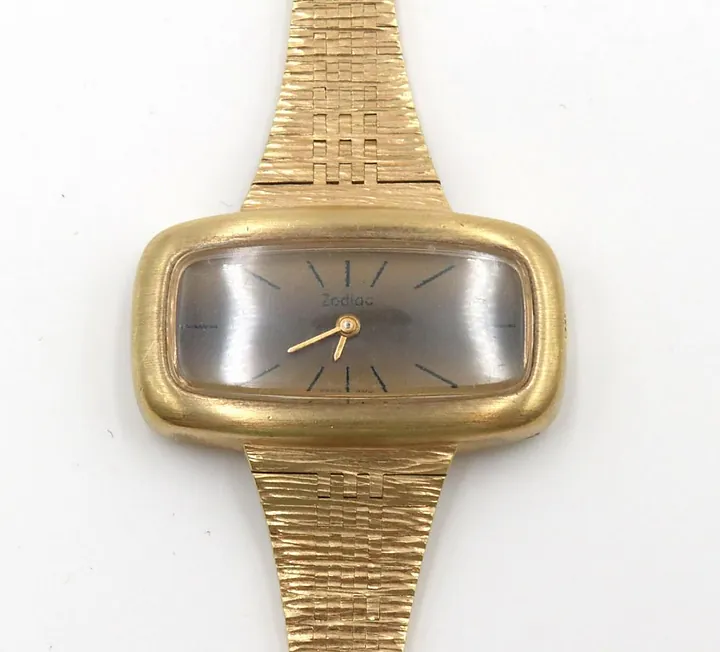
Unusual Shaped Ladies Zodiac Wristwatch, c. 1960
LiveAuctioneers auction archive
Wristwatches · c. 1960
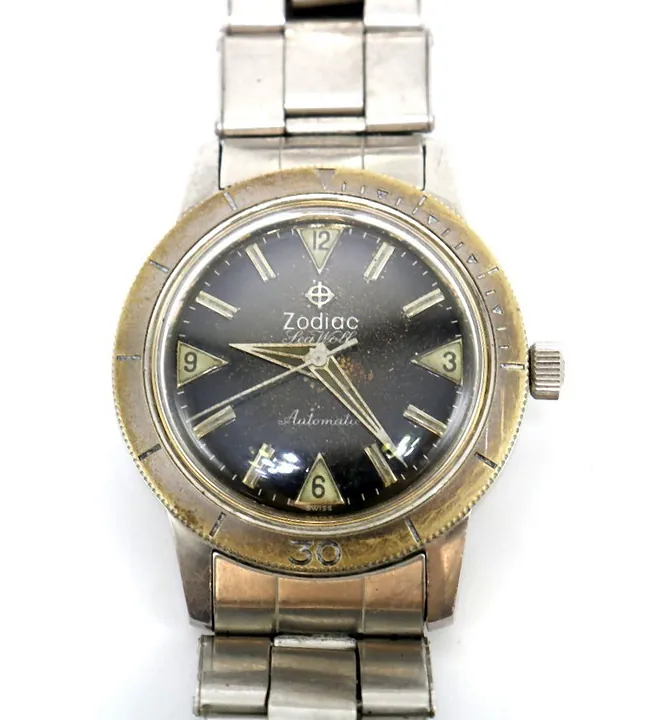
Zodiac Automatic Dive Stainless Steel Wristwatch, c. 1960
LiveAuctioneers auction archive
Wristwatches · 1970s
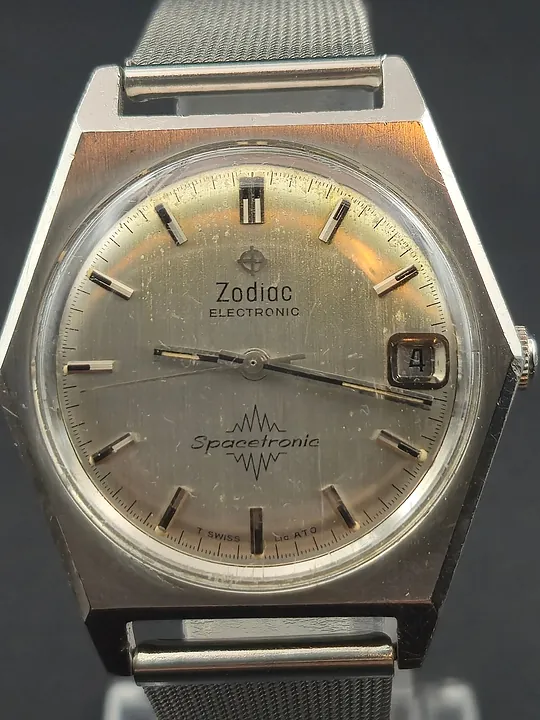
1970s Zodiac Spacetronic Electronic 36mm Men’s Watch Cal. 91 Runs
LiveAuctioneers auction archive
Wristwatches · 1960s
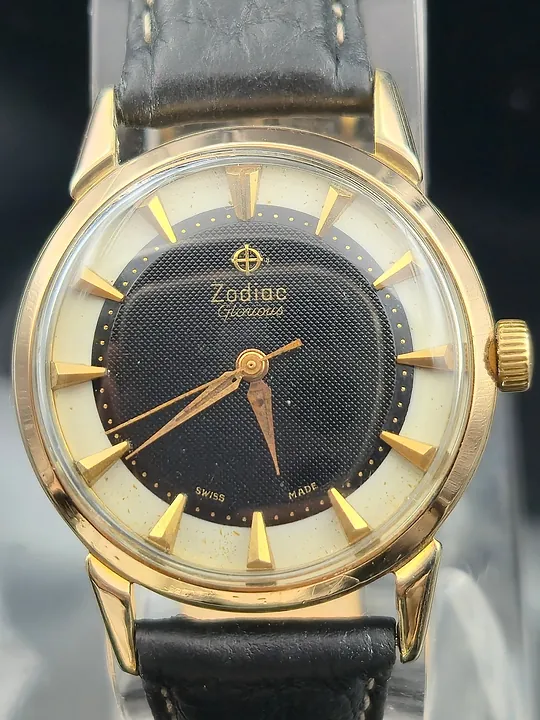
1960s Zodiac Glorious Cal. 1094 17J Gold-Tone Textured Dial Dress Watch
LiveAuctioneers auction archive

Wristwatches · 1970
Wristwatch by Heno, Switzerland, 1970
Museum Rotterdam

Wristwatches · 1960–1986
'Tri-Compax' calendar chronograph wristwatch in gold case, by Universal, Geneva, Switzerland, 1960–1986.
Science Museum Group, London

Wristwatches · 1969–1970
Beta 21 Quartz wristwatch movement, made in Switzerland, 1970.
Science Museum Group, London

Wristwatches · c. 1969
Omega Speedmaster Moonwatch, ref. 145022-69st, c. 1969
Antiquorum auction archive, Geneva