
Wristwatches · Wristwatch
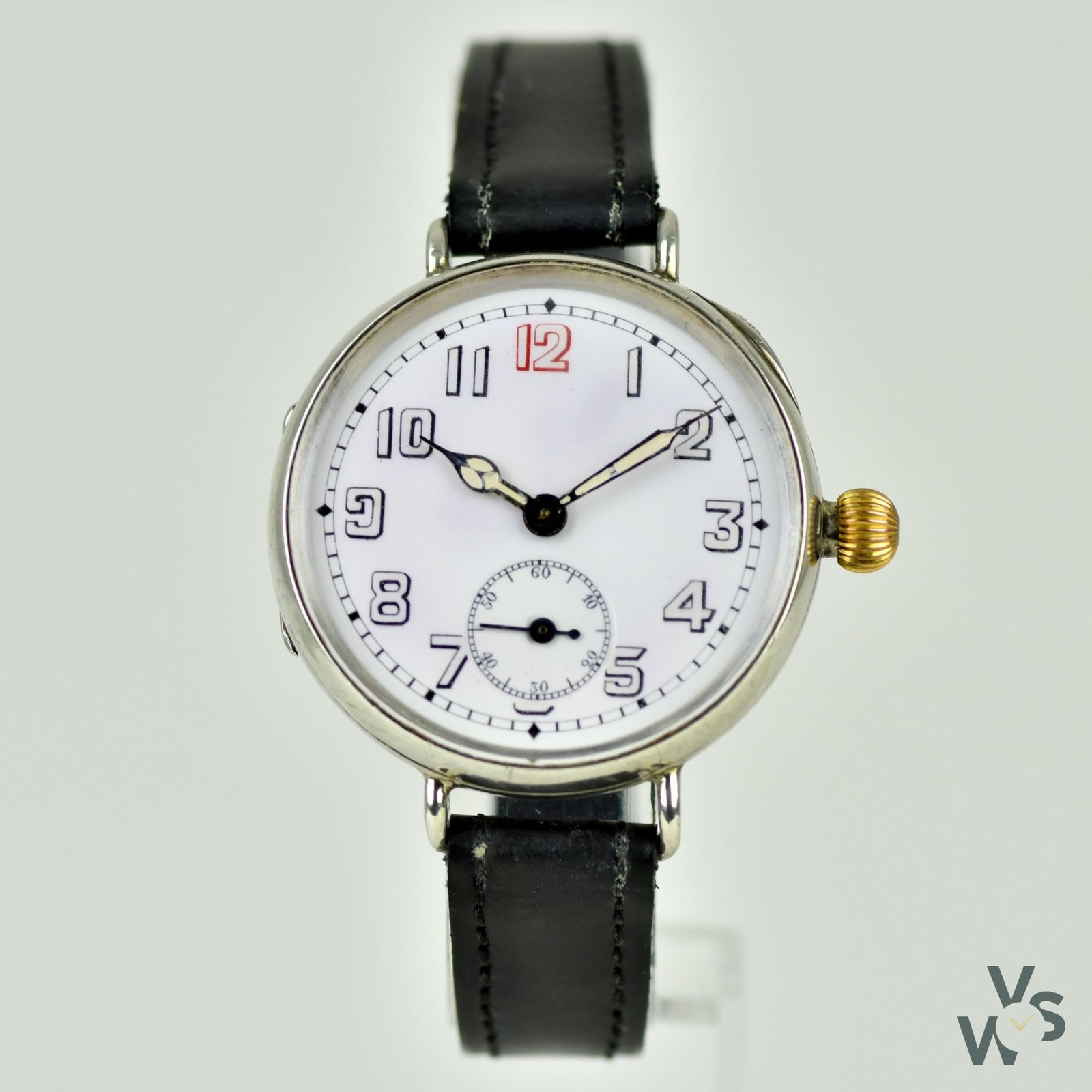
Zenith British Army WWI Silver Trench Watch, White dial, gold crown, circa 1914–1915
- Maker / attribution
- Zenith (maker)
- Date
- c. 1914–1915
- Historical period
- Golden Age of Mechanical Watchmaking (1900 – 1945)
- Country of origin
- Switzerland
- Object type
- Wristwatch
- Materials / technique
- gold
- Dimensions
- Case 32.5 mm
- Stock no.
- vws0630
- Credit line
- Dealer listing, Vintage Watch Specialist (vws0630)
- Catalogue title (original)
- Zenith British Army WWI Silver Trench Watch c.1914/1915 - White dial - gold crown (English)
View the source record (dealer listing) ↗ (opens another website in a new tab)Suggest a correction
Record summary
Catalogued by Vintage Watch Specialist (dealer), United Kingdom (stock number vws0630), this is a wristwatch by Zenith, made in Switzerland, dated c. 1914–1915. The Atlas places it in the Golden Age of Mechanical Watchmaking period (1900 – 1945) of its Wristwatches collection. Materials and techniques recorded by the source: gold. Recorded dimensions: Case 32.5 mm. The record is illustrated with 6 photographs.
Assembled from the source record's structured fields. Dates and attributions are given as the source states them; where a field is missing the Atlas leaves it blank rather than estimating.
Catalogue description
Dealer description — Vintage Watch Specialist
Rare Zenith silver WWI Military Trench Watch c.1914/1915 This may have been one of Zenith's first import watches to the UK. Likely commissioned by a private officer during WWI, Zenith set up shop in London in 1914 with the hope of importing and hallmarking their own movements and cases to outfit the British military who could afford such a timepiece. This piece was hallmarked by the Birmingham silver Assay office and can be accurately dated to either 1914 or 1915 (the same hallmark ran for two years), so sits firmly amongst Zenith's earliest British-hallmarked watches. As fighting intensified on the Western Front during the Great War, many higher-ranking (and earning) officers on their way to Belgium and France felt a need to equip themselves with a proper wristwatch. Commissioned on a private, individual basis, these watches were largely made in a similar style: a white porcelain dial, solid silver case with wire lugs (fixed for security) and 'Mercedes' hands with a small seconds dial at 6:00. This particular example is in stunning condition, and features a few stand-out elements to it. The watch undoubtedly remains close to the traditional trench watch format: the arabic numerals with the red '12', black and white chapter ring around the outer edge and a hinged case, however, the 32.5mm case sets this trench watch apart. Often, these trench-style watches can wear a bit small nowadays. Some of us like this: it's typical of the watchmaking style of that era, however it can often make watches wear a little smaller than we'd like compared to modern standards. Sitting in a notably bigger case, this trench watch, marked 'Z.W. Co (potentially Zenith of Switzerland), combines the best of both worlds with its entirely original historic condition and its larger, more modern-looking size. We hope you'll agree the dial is stunning: a crisp white porcelain face with hollow numerals in slight profile, typical of the era, which give the ornate impression that the numbers are 3D. The red '12' was likely a feature requested by military personnel for improved legibility and orientation with the watch face, though we think it now defines these beautiful watches' iconic aesthetic rather than purpose! The sub-seconds dial, which clips the 5, 6, and 7 hour numerals, is slightly sunk into the watch face, and features a stunning reflective blue tempered steel hand (likely also a military legibility feature). The glass is hinged, clipping on and off the watch face firmly. The same is applicable to the back, which can be removed in the same fashion. The case is hallmarked with an equilateral triangle- the Birmingham silver assay mark, the .925 sterling silver denotion and a 'P' in old english font which denotes a 1914/1915 watch. The ZWC triangle denotes Zenith, a world-famous watch manufacturer with a solid reputation. They set up a What's on offer For a trench watch from the Great War (1914-1918), this is in fantastic condition. It may have seen light refinishing to the hands to make sure their lume inserts look intact, though we believe this to be a historic service that was carried out professionally and in keeping with the watch. It's possible that the hand lumes were damaged in service and repainted at the time, as there is a vintage 'patina' effect to their tone and warmth which suggests age. Additional information: Made from Case: Sterling .925 Silver Dial: White ceramic, arabic numerals, red '12'. Crystal: Glass Bracelet: Black leather strap. Technical specifications Winding: Manual. Movement type: Manual winding. Waterproof: No. Purchase details Condition: Good, with signs of light wear. Model reference: Silver trench-style watch Year of issue: c.1914/1915 Guarantee Sold with a VWS 12-month guarantee. Dimensions Width (without crown) 32.5mm Height (lug to lug) 40mm Wrist size: Adjustable (strap).
Historical context
Golden Age of Mechanical Watchmaking (1900 – 1945)
The wristwatch displaces the pocket watch; waterproof cases, self-winding and grand complications.
The wristwatch overtook the pocket watch. Military use in the First World War, aviation, water-resistant cases (1926), automatic winding (1923–31), rectangular Art Deco designs and early chronographs and calendars defined the period.
Read the period in the timelineMore wristwatches from this periodEarlier: Industrial Revolution
Atlas type guide
Military, pilot and travel watches
The wristwatch owes much of its adoption by men to warfare and aviation. Wristlets — small pocket watches soldered with lugs and worn on a strap — were used in colonial campaigns and became standard equipment in the First World War, with protective grilles over the crystal ('shrapnel guards'). Louis Cartier's Santos (1904), designed for the aviator Alberto Santos-Dumont, is often cited as an early purpose-made pilot's watch.
In the Second World War governments specified watches in detail: the German B-Uhr observation watches, the American A-11, and the British 'W.W.W.' (the 'Dirty Dozen' set of 1945). After the war, jet travel brought GMT and world-time watches, which show two or more time zones at once — Louis Cottier's world-time mechanism and the Rolex GMT-Master (1955) are examples.
What to look for
- Military markings on the case back: broad arrow, issue numbers, 'W.W.W.', 'A.T.P.'
- High-legibility black dials with luminous Arabic numerals; oversized crowns for gloved hands.
- 24-hour hands and rotating 24-hour bezels or city rings on GMT/world-time watches.
- Wire lugs on early wristlets converted from pocket watches.
Dating clues
- Wire-lug wristlets: c. 1900–1925.
- Military specifications of the Second World War: 1939–1945.
- GMT and world-time wristwatches: mainly after 1950.
General guidance written by the Atlas editors about this kind of object. It is not a statement about this particular piece; for that, rely on the source record above and on physical examination.
Related records
Pocket Watches · 1900
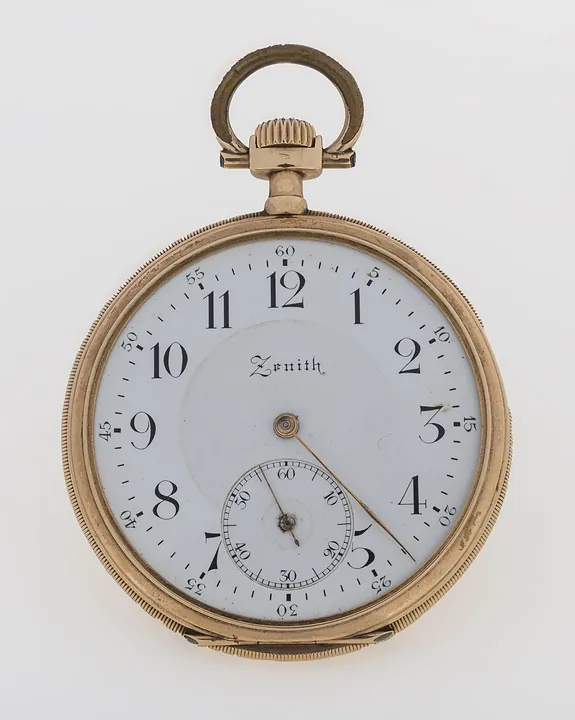
Pocket watch by Zenith, Switzerland, 1900
Museum Rotterdam
Pocket Watches · c. 1900s
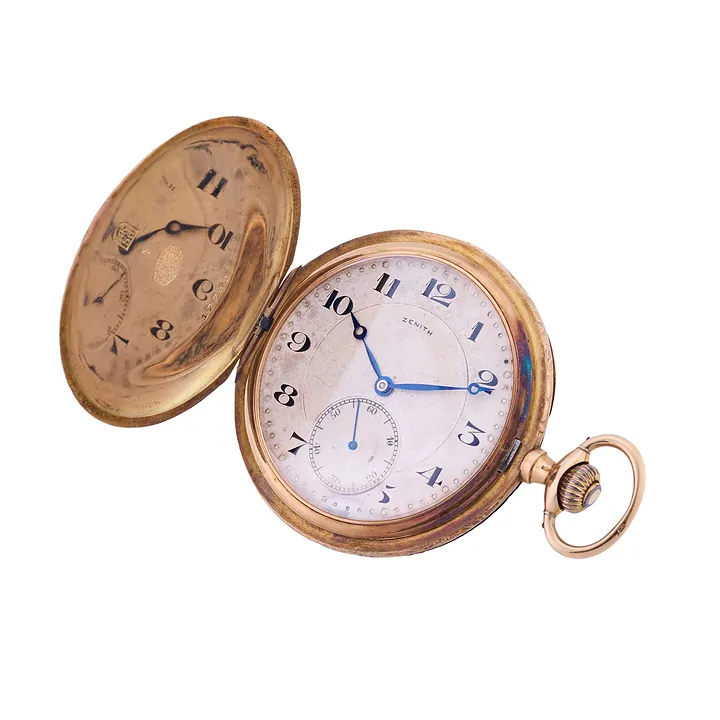
Zenith pocket watch, c. 1900s
Antiquorum auction archive, Geneva
Wristwatches · c. 1980s
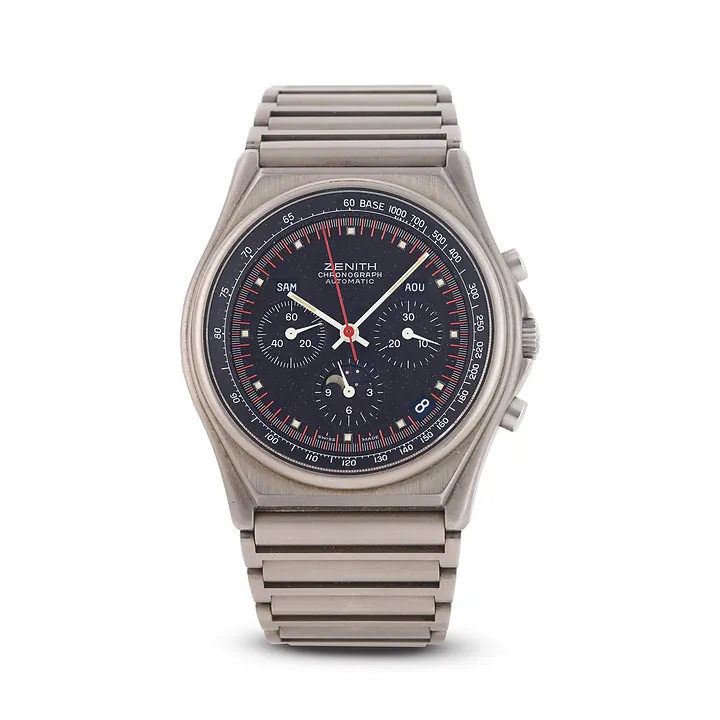
Zenith El Primero Triple Calendar Chronograph, ref. 95.0100.418, c. 1980s
Antiquorum auction archive, Geneva
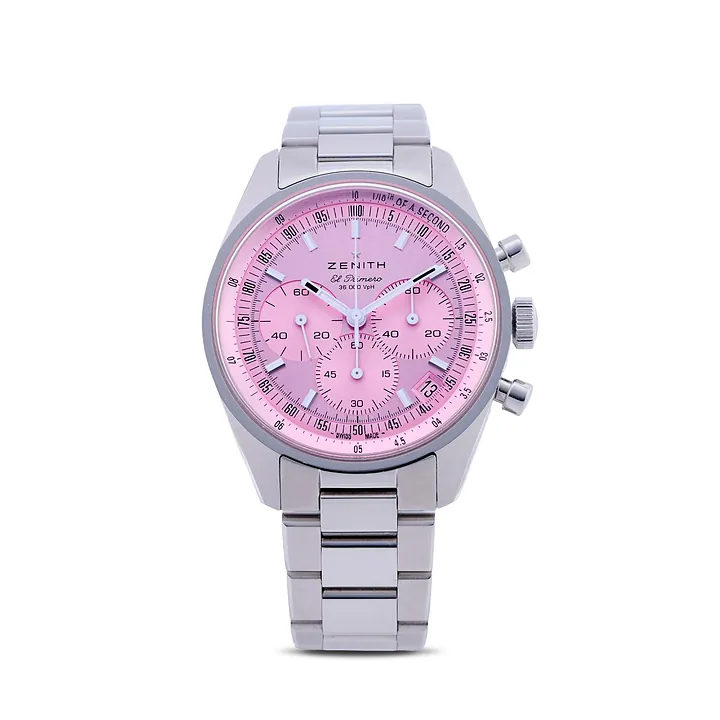
Wristwatches · originally sold in 2022 (per the lot record)
Zenith Chronomaster Original, ref. 03.3202.3600/33.M3200, originally sold in 2022
Antiquorum auction archive, Geneva

Wristwatches · 1931
Rolex 'Oyster Perpetual' rotor self-winding wrist-watch, lever escapement, in steel case with glass in back, Montres Rolex SA, Geneva, Switzerland, 1931
Science Museum Group, London

Wristwatches · 1900–1999
Wristwatch by Certina, Switzerland, 1900–1999
Nordic Museum Foundation

Wristwatches · 1900–1999
Wristwatch by Omega, Västerås, 1900–1999
Nordic Museum Foundation

Wristwatches · 1900–1999
Wristwatch by Universal, Switzerland, 1900–1999
Nordic Museum Foundation