
Wristwatches · Wristwatch
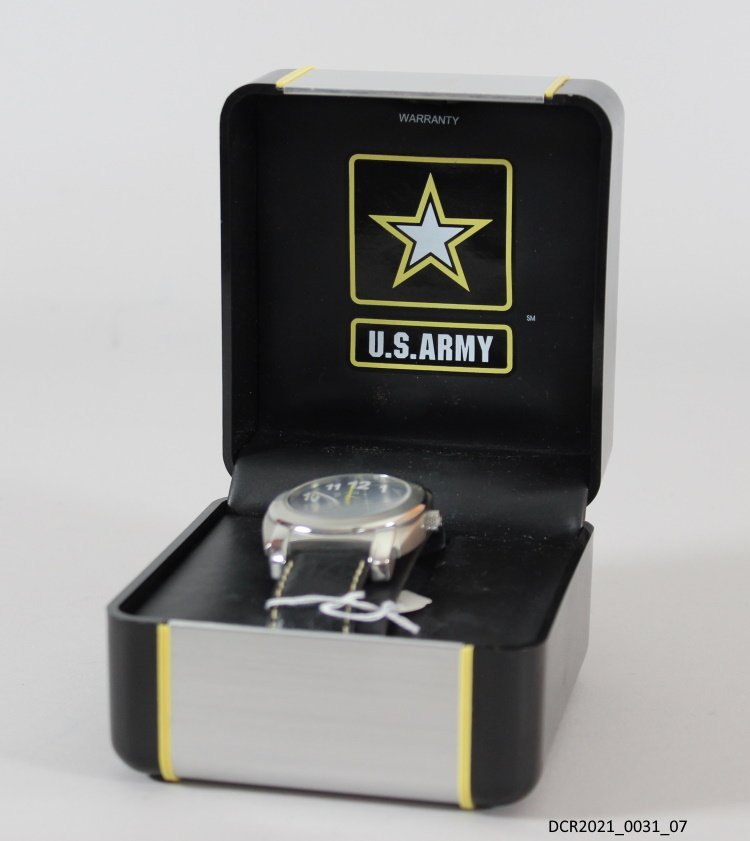
Wristwatch, United States, 1985–1987
- Maker / attribution
- Unrecorded in source
- Date
- 1985–1987
- Historical period
- Quartz Revolution (1969 – 1990)
- Country of origin
- United States
- Place
- United States of America
- Object type
- Wristwatch
- Materials / technique
- Leder, Kunststoff, Metall, Glas, bedruckt.
- Dimensions
- Schatulle: H 10,5 cm; B 10 cm; T 7,7, cm
- Holding institution
- "dc-r" docu center ramstein
- Accession / object no.
- DCR2021_0031_07
- Credit line
- "dc-r" docu center ramstein
- Catalogue title (original)
- Armbanduhr mit US Army Logo in Originalpräsentierschatulle (German)
View the source record ↗ (opens another website in a new tab)Suggest a correction
Record summary
Held and catalogued by "dc-r" docu center ramstein (object number DCR2021_0031_07), this is a wristwatch, made in United States of America, dated 1985–1987. The Atlas places it in the Quartz Revolution period (1969 – 1990) of its Wristwatches collection. Materials and techniques recorded by the source: Leder, Kunststoff, Metall, Glas, bedruckt. Recorded dimensions: Schatulle: H 10,5 cm; B 10 cm; T 7,7, cm. The record is illustrated with 1 photograph.
Assembled from the source record's structured fields. Dates and attributions are given as the source states them; where a field is missing the Atlas leaves it blank rather than estimating.
Catalogue description
Catalogue description from "dc-r" docu center ramstein (German)
Armbanduhr, Wasser dicht, mit Lederarmband in einer Präsentierschatulle mit US Army Logo und Garantie. Hersteller ist die Firma U.S. Army Watches aus L.I.C. New York (USA). Schatulle außen: THANK YOU FOR YOUR SUPPORT U.S. ARMY 415TH Base Support Battalion. Die Uhr wurde dem Schenker wegen der jahrelangen guten Kooperation mit der deutschen Polizei zum Dank überreicht.
Shown in the original language of the source catalogue. An editor-reviewed English translation has not yet been published; we do not publish machine translations as authoritative text.
Inscriptions & marks
Schatulle außen: THANK YOU FOR YOUR SUPPORT U.S. ARMY 415TH Base Support Battalion
Historical context
Quartz Revolution (1969 – 1990)
Seiko's Astron begins mass quartz timekeeping; traditional industries contract sharply.
Quartz and digital watches transformed the market after 1969. Swiss employment collapsed, Japanese and Hong Kong production soared, and the Swatch (1983) helped the Swiss industry recover; mechanical watches survived as luxury goods.
Read the period in the timelineMore wristwatches from this periodEarlier: Modern Mechanical Horology
Atlas type guide
Military, pilot and travel watches
The wristwatch owes much of its adoption by men to warfare and aviation. Wristlets — small pocket watches soldered with lugs and worn on a strap — were used in colonial campaigns and became standard equipment in the First World War, with protective grilles over the crystal ('shrapnel guards'). Louis Cartier's Santos (1904), designed for the aviator Alberto Santos-Dumont, is often cited as an early purpose-made pilot's watch.
In the Second World War governments specified watches in detail: the German B-Uhr observation watches, the American A-11, and the British 'W.W.W.' (the 'Dirty Dozen' set of 1945). After the war, jet travel brought GMT and world-time watches, which show two or more time zones at once — Louis Cottier's world-time mechanism and the Rolex GMT-Master (1955) are examples.
What to look for
- Military markings on the case back: broad arrow, issue numbers, 'W.W.W.', 'A.T.P.'
- High-legibility black dials with luminous Arabic numerals; oversized crowns for gloved hands.
- 24-hour hands and rotating 24-hour bezels or city rings on GMT/world-time watches.
- Wire lugs on early wristlets converted from pocket watches.
Dating clues
- Wire-lug wristlets: c. 1900–1925.
- Military specifications of the Second World War: 1939–1945.
- GMT and world-time wristwatches: mainly after 1950.
General guidance written by the Atlas editors about this kind of object. It is not a statement about this particular piece; for that, rely on the source record above and on physical examination.
Related records
Wristwatches · 1949–1992
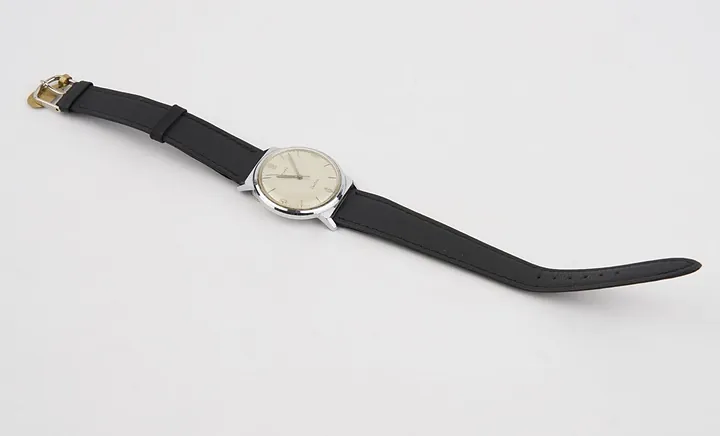
Timex `Electric' wristwatch, with electrically operated balance wheel mechanism, United States, 1949–1992
Science Museum Group, London
Wristwatches · 1972
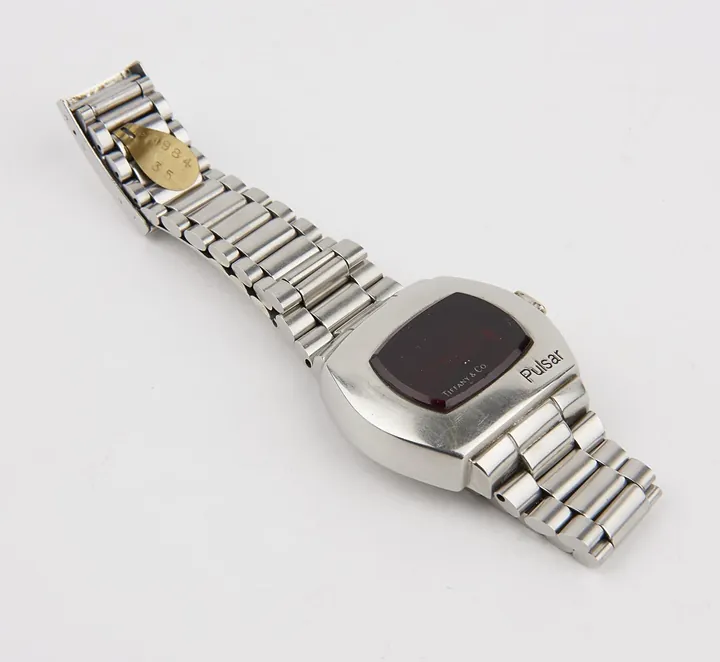
Wristwatch by Hamilton Watch Company and Electro-Data Inc, United States, 1972
Science Museum Group, London
Wristwatches · 1973–1974
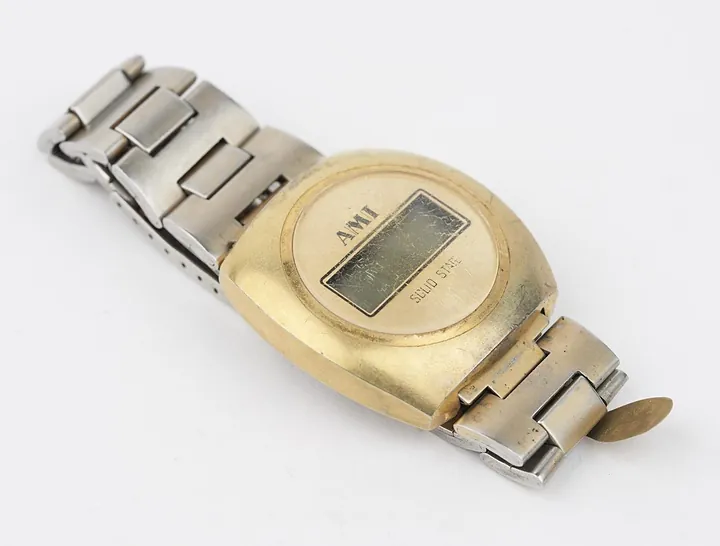
Quartz watch with liquid crystal digital display, made by American Microsystems Inc. (AMI) . 1973/74
Science Museum Group, London
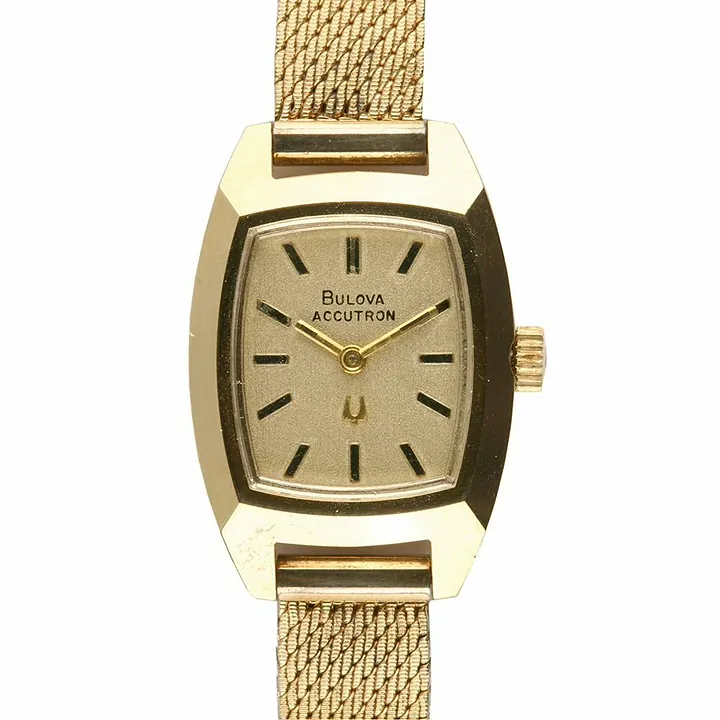
Wristwatches · c. 1973
Wristwatch by Josef Bulova, United States, c. 1973
German Clock Museum
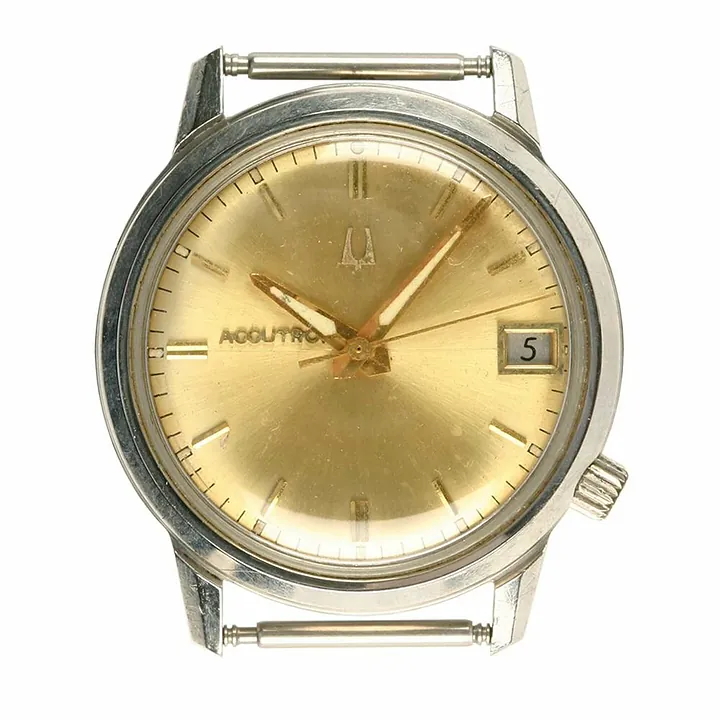
Wristwatches · 1975
Wristwatch by Josef Bulova, United States, 1975
German Clock Museum
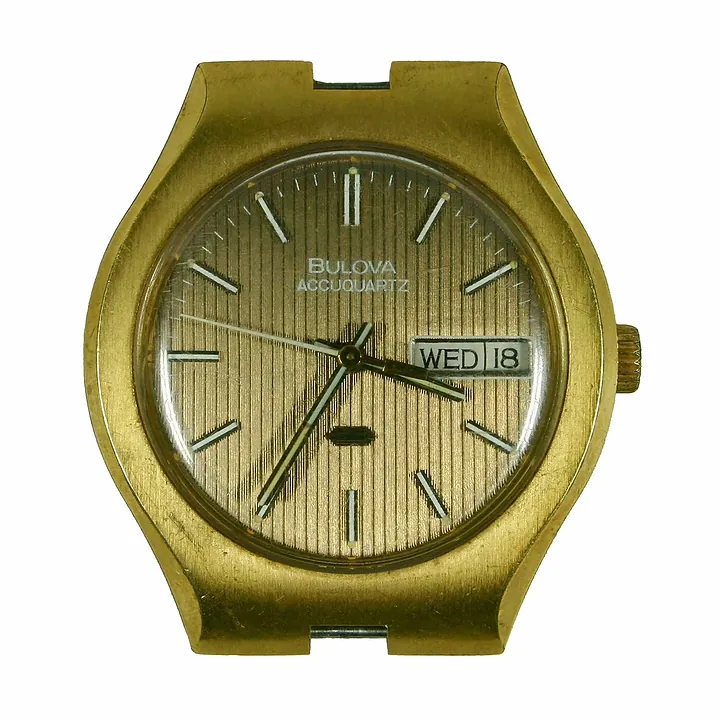
Wristwatches · 1976
Wristwatch by Josef Bulova, United States, 1976
German Clock Museum
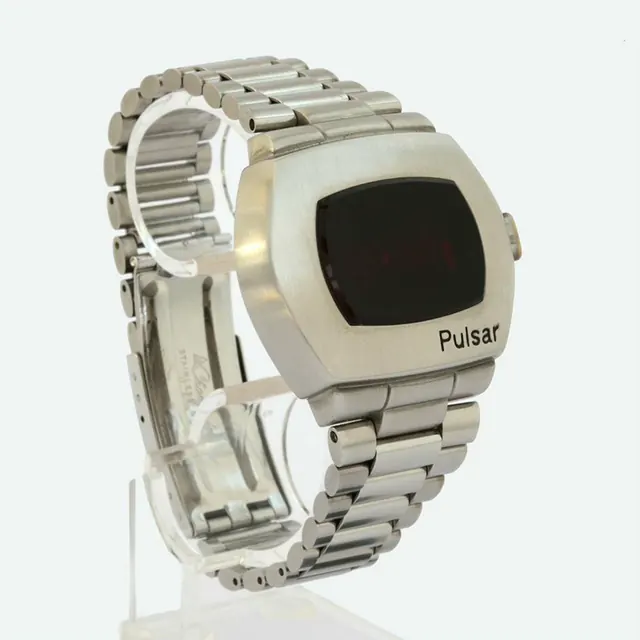
Wristwatches · 1973
Wristwatch by Hamilton Watch Company, United States, 1973
German Clock Museum
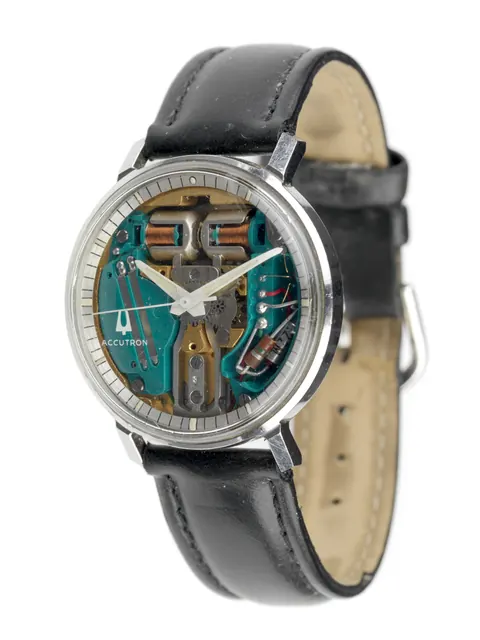
Wristwatches · c. 1969
Bulova 'Accutron' tuning-fork wristwatch by Bulova
Royal Museums Greenwich