
Wristwatches · Wristwatch
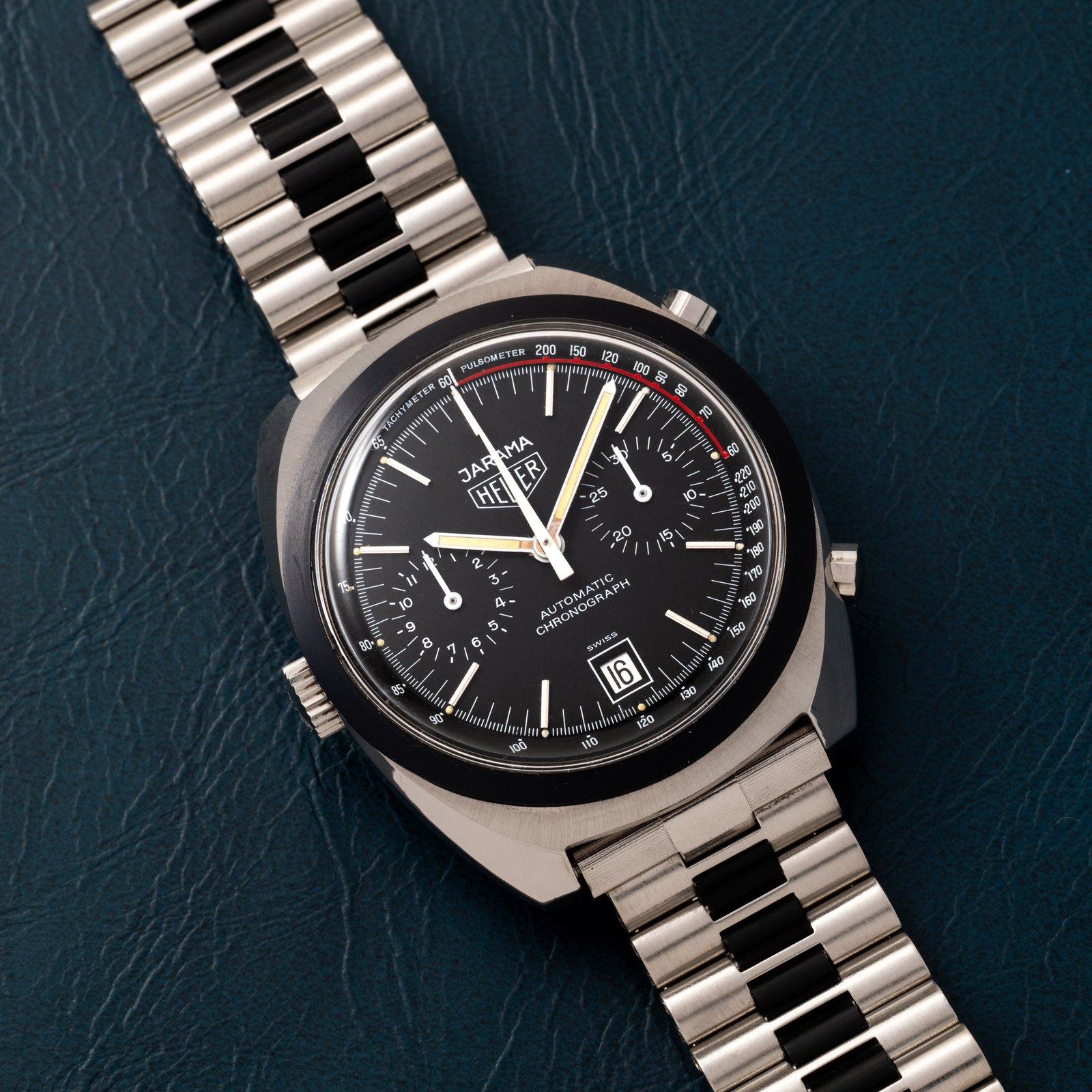
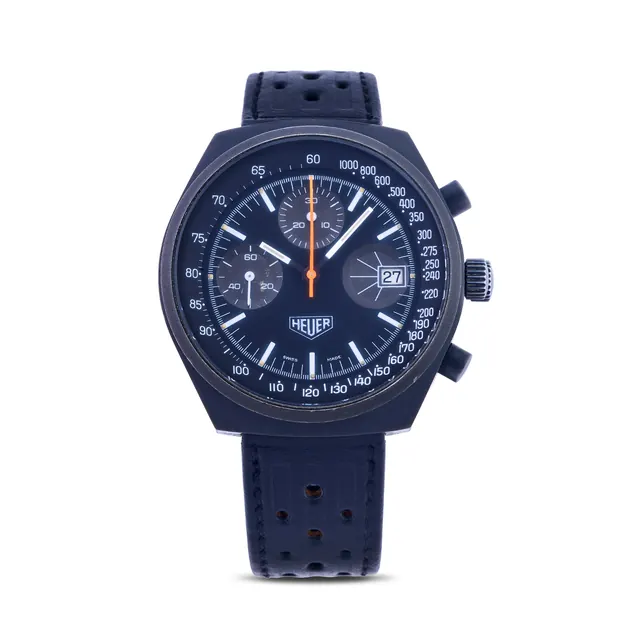
Wristwatch by Heuer, 1977
- Maker / attribution
- Heuer (maker)
- Date
- 1977
- Historical period
- Quartz Revolution (1969 – 1990)
- Country of origin
- Switzerland
- Object type
- Wristwatch
- Stock no.
- 40992492
- Credit line
- Dealer listing, Analog/Shift (40992492)
- Catalogue title (original)
- Heuer Jarama (English)
View the source record (dealer listing) ↗ (opens another website in a new tab)Suggest a correction
Record summary
Catalogued by Analog/Shift (dealer), New York (stock number 40992492), this is a wristwatch by Heuer, made in Switzerland, dated 1977. The Atlas places it in the Quartz Revolution period (1969 – 1990) of its Wristwatches collection. The record is illustrated with 6 photographs.
Assembled from the source record's structured fields. Dates and attributions are given as the source states them; where a field is missing the Atlas leaves it blank rather than estimating.
Catalogue description
Dealer description — Analog/Shift
For such a traditional art as watchmaking, the watch market is a fast-paced and ever-changing one. The 1960s in particular were a period of rapid growth, with Heuer leading the way in the category of sporting chronographs. In just five short decades, from the time the first wristwatch was invented to the time the Autavia debuted, wrist chronographs went from primitive mono pushers to the lean, mean timekeeping machine seen here. Freed from the economic constraints and austerity following World War II, the world roared into a future filled with promise. People turned from warlike pursuits to more sportsmanlike ones: flying, sailing, and, of course, driving. And it was in that last arena that Heuer led the pack. Heuer and racing have been intricately linked, ever since the earliest days of motorsports. Watches made by Heuer could be found mounted on the dashboards of race cars, or clutched in the hands of the officials who timed the laps. Many of these watches bore the name Autavia—a clever combination of AUTomotive and AVIAtion, the two arenas in which Heuer envisioned the watch would be used. But the Autavia was far from the only significant chronograph that Heuer made. Take this EXCEPTIONAL model that is seldom seen even in Heuer collecting circles -- a Jarama! Dating to 1977, this piece pays tribute to Circuit Del Jarama which hosted the Spanish Grand Prix from 1968 to 1981. Housed in a stainless steel cushion case, this piece features a blacked out bezel, charcoal black dial, and a date at 6 o'clock. Plus, it features a lovely very 70s cushion case with a signed, stainless steel bracelet with matching black coating, as well as its period-correct box! Lovely. If you love Heuer and want something different, and unique, the Heuer Jarama is undoubtedly one of the most compelling options we've ever seen!
Historical context
Quartz Revolution (1969 – 1990)
Seiko's Astron begins mass quartz timekeeping; traditional industries contract sharply.
Quartz and digital watches transformed the market after 1969. Swiss employment collapsed, Japanese and Hong Kong production soared, and the Swatch (1983) helped the Swiss industry recover; mechanical watches survived as luxury goods.
Read the period in the timelineMore wristwatches from this periodEarlier: Modern Mechanical Horology
Atlas type guide
Wristwatches
Bracelet watches were worn by women from the early nineteenth century — Breguet made one for Caroline Murat, Queen of Naples, in 1810–12 — but the wristwatch only became a man's instrument with military use and aviation in the early twentieth century. Between the World Wars it overtook the pocket watch; the 1920s and 1930s brought rectangular Art Deco cases, water-resistant cases and the first automatic winding systems.
After 1945 the wristwatch became a carrier of identity — dress watches, sports and dive watches, chronographs, calendars — produced by Swiss, American, Japanese, German, Soviet and Chinese industries. The quartz revolution after 1969 and the mechanical renaissance since the 1990s, including the rise of independent watchmakers, complete the story.
What to look for
- The reference number (between the lugs or inside the case back) and serial number, the starting point for dating.
- The calibre: its maker and number are often stamped under the dial or on the bridge.
- Originality of dial, hands and crown — refinished ('redial') dials are common.
- Case material marks: 18K/750, 14K/585, stainless steel, gold-filled, plated.
Dating clues
- Wire-lug cases: before c. 1925.
- Water-resistant screw-down cases: from 1926.
- Quartz movements: from 1969; sapphire crystals widespread after c. 1980.
General guidance written by the Atlas editors about this kind of object. It is not a statement about this particular piece; for that, rely on the source record above and on physical examination.
Related records
Pocket Watches · c. 1960
Heuer Racing SET, c. 1960
Antiquorum auction archive, Geneva
Wristwatches · c. 1980
Heuer Pasadena, ref. 750.501-3, c. 1980
Antiquorum auction archive, Geneva
Wristwatches · c. 1970s
Heuer wristwatch, ref. 110.633, Calculator, circa 1970s
Antiquorum auction archive, Geneva
Wristwatches · c. 1975
Heuer wristwatch, ref. 13/1, circa 1975
Antiquorum auction archive, Geneva

Wristwatches · 1970
Wristwatch by Heno, Switzerland, 1970
Museum Rotterdam

Wristwatches · 1960–1986
'Tri-Compax' calendar chronograph wristwatch in gold case, by Universal, Geneva, Switzerland, 1960–1986.
Science Museum Group, London

Wristwatches · 1969–1970
Beta 21 Quartz wristwatch movement, made in Switzerland, 1970.
Science Museum Group, London

Wristwatches · c. 1969
Omega Speedmaster Moonwatch, ref. 145022-69st, c. 1969
Antiquorum auction archive, Geneva