
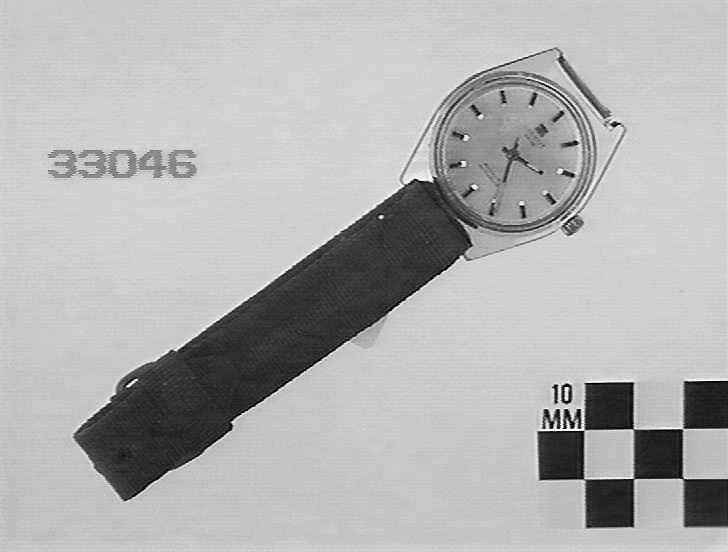
Wristwatches · Wrist watch
Wrist Watch - Tissot, 'Astrolon', Switzerland, c. 1973
- Maker / attribution
- Charles Tissot & Sons (Maker)
- Date
- c. 1973
- Historical period
- Quartz Revolution (1969 – 1990)
- Country of origin
- Switzerland
- Place
- Switzerland
- Object type
- Wrist watch
- Dimensions
- 1.1 cm (Width), 4 cm (Outside Diameter)
- Holding institution
- Museums Victoria, Melbourne
- Accession / object no.
- ST 33046
- Catalogue title (original)
- Wrist Watch - Tissot, 'Astrolon', Switzerland, circa 1973 (English)
View the source record ↗ (opens another website in a new tab)Suggest a correction
Record summary
Held and catalogued by Museums Victoria, Melbourne (object number ST 33046), this is a wrist watch by Charles Tissot & Sons, made in Switzerland, dated c. 1973. The Atlas places it in the Quartz Revolution period (1969 – 1990) of its Wristwatches collection. Recorded dimensions: 1.1 cm (Width), 4 cm (Outside Diameter). The record is illustrated with 1 photograph.
Assembled from the source record's structured fields. Dates and attributions are given as the source states them; where a field is missing the Atlas leaves it blank rather than estimating.
Catalogue description
Summary — Museums Victoria
Gents wrist watch, plastic movement, nickel plated case with stainless steel back, 'Astrolon', Tissot, Switzerland, circa 1973. Tissot developed this movement made almost entirely of injection-moulded plastic in 1971. The number of parts was reduced from 90 in a standard Swiss watch to 52 parts. The watch was not repairable and was designed to be thrown away if it broke down. This watch therefore predated the highly-successful Swatch watch by some 14 years. But Tissot did not successfully market the watch, and the Swiss watchmaking industry was under huge pressure form Asian-made cheap watches.
Physical description — Museums Victoria
Brass case plated with nickel and with stainless steel back. Silvered dial has silvered hands and centre sweep seconds hand. Silvered metal markers for hours and is marked with a 'T' in raised square. Clear plastic back plate. Spring wound; lever escapement. Plastic disposable movement; main train of white plastic, escapement of blue plastic.
Inscriptions & marks
Inside back is marked 'Fond Acier Inoxydable, Chs Tissot & Fils'. Shield is marked 'Tissot Fab. Suisse, Swiss Made' and '81030-2'. Dial marked 'Tissot, Swiss, Autolus, Actualis'.
Provenance
Donation from A. Bunston, 30 Sep 1982
Historical context
Quartz Revolution (1969 – 1990)
Seiko's Astron begins mass quartz timekeeping; traditional industries contract sharply.
Quartz and digital watches transformed the market after 1969. Swiss employment collapsed, Japanese and Hong Kong production soared, and the Swatch (1983) helped the Swiss industry recover; mechanical watches survived as luxury goods.
Read the period in the timelineMore wristwatches from this periodEarlier: Modern Mechanical Horology
Atlas type guide
Wristwatches
Bracelet watches were worn by women from the early nineteenth century — Breguet made one for Caroline Murat, Queen of Naples, in 1810–12 — but the wristwatch only became a man's instrument with military use and aviation in the early twentieth century. Between the World Wars it overtook the pocket watch; the 1920s and 1930s brought rectangular Art Deco cases, water-resistant cases and the first automatic winding systems.
After 1945 the wristwatch became a carrier of identity — dress watches, sports and dive watches, chronographs, calendars — produced by Swiss, American, Japanese, German, Soviet and Chinese industries. The quartz revolution after 1969 and the mechanical renaissance since the 1990s, including the rise of independent watchmakers, complete the story.
What to look for
- The reference number (between the lugs or inside the case back) and serial number, the starting point for dating.
- The calibre: its maker and number are often stamped under the dial or on the bridge.
- Originality of dial, hands and crown — refinished ('redial') dials are common.
- Case material marks: 18K/750, 14K/585, stainless steel, gold-filled, plated.
Dating clues
- Wire-lug cases: before c. 1925.
- Water-resistant screw-down cases: from 1926.
- Quartz movements: from 1969; sapphire crystals widespread after c. 1980.
General guidance written by the Atlas editors about this kind of object. It is not a statement about this particular piece; for that, rely on the source record above and on physical examination.
Read next:Identification Centre
Related records

Wristwatches · 1970
Wristwatch by Heno, Switzerland, 1970
Museum Rotterdam

Wristwatches · 1960–1986
'Tri-Compax' calendar chronograph wristwatch in gold case, by Universal, Geneva, Switzerland, 1960–1986.
Science Museum Group, London

Wristwatches · 1969–1970
Beta 21 Quartz wristwatch movement, made in Switzerland, 1970.
Science Museum Group, London

Wristwatches · c. 1969
Omega Speedmaster Moonwatch, ref. 145022-69st, c. 1969
Antiquorum auction archive, Geneva
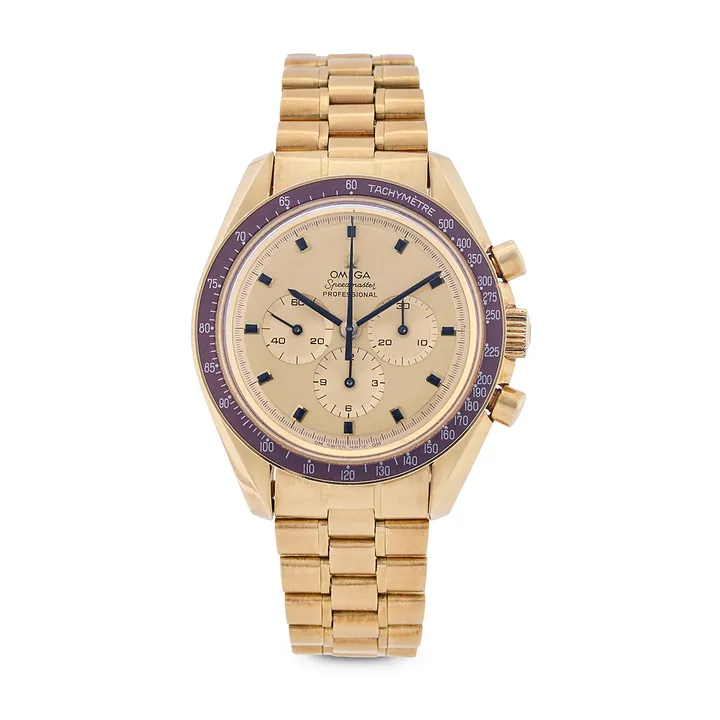
Wristwatches · c. 1969
Omega Speedmaster Professional Apollo XI, ref. 145.022-69, c. 1969
Antiquorum auction archive, Geneva
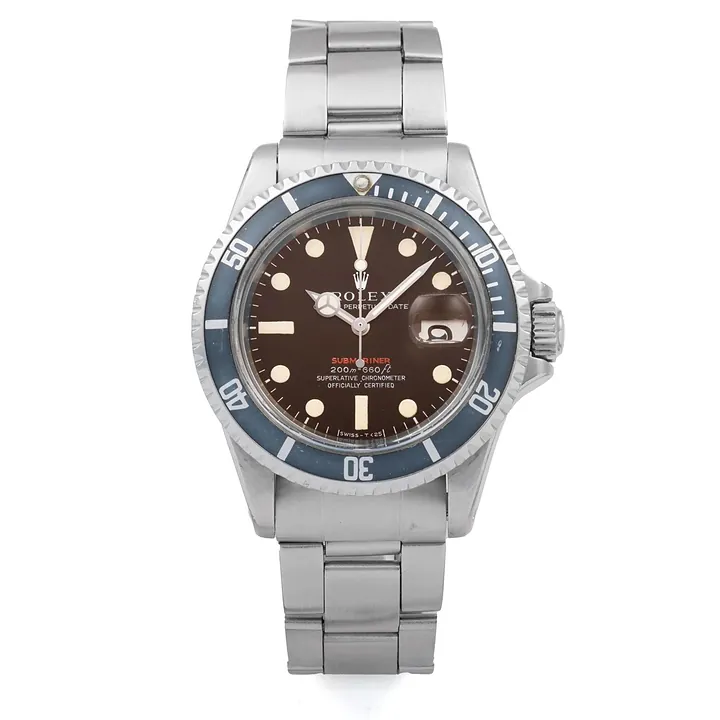
Wristwatches · 1969
Rolex "red" Submariner, ref. 1680, 1969
Antiquorum auction archive, Geneva
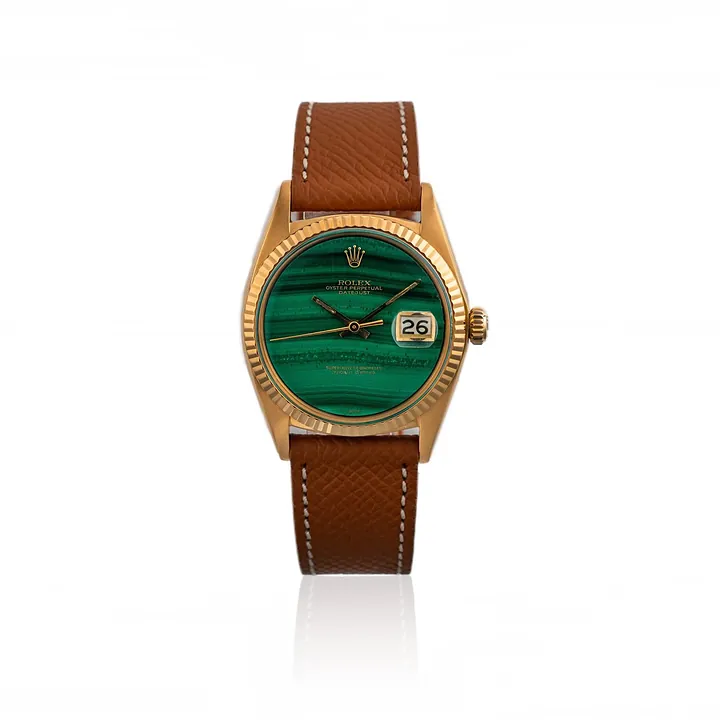
Wristwatches · c. 1969
Rolex Date Just, ref. 1601, c. 1969
Antiquorum auction archive, Geneva
Wristwatches · 1969
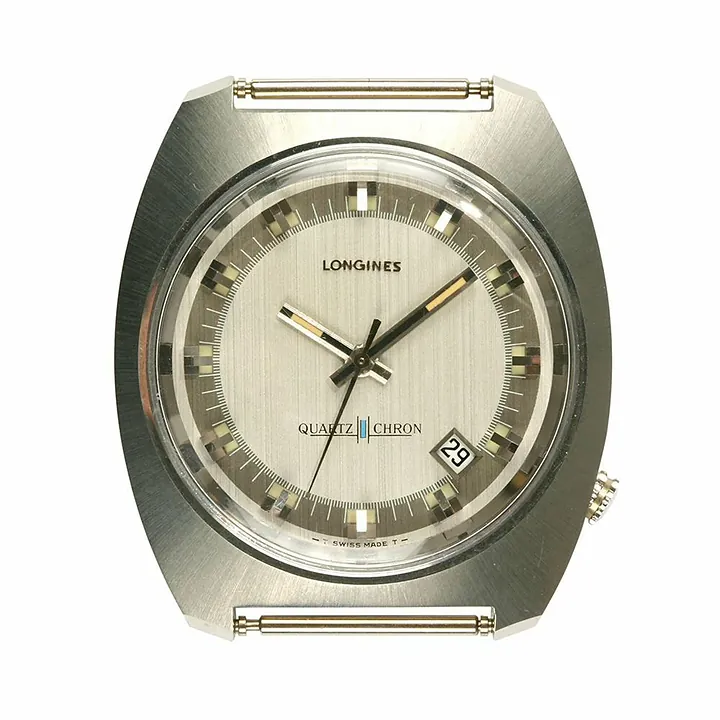
Wristwatch by Francillon und Cie (Longines), Switzerland, 1969
German Clock Museum