
Wristwatches · Wrist watch
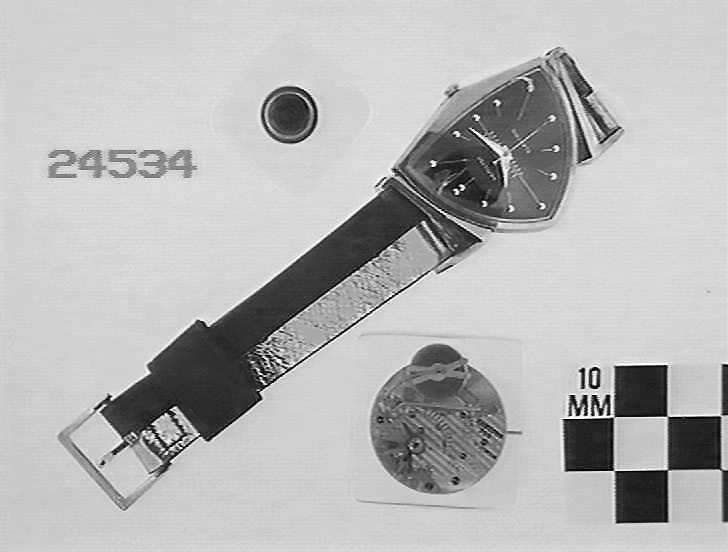
Wrist Watch - Hamilton Electric, Lancaster, Pennsylvania, 1956
- Maker / attribution
- Hamilton Watch Co (Maker)
- Date
- 1956
- Historical period
- Modern Mechanical Horology (1945 – 1969)
- Country of origin
- United States
- Place
- Lancaster, Pennsylvania, United States of America
- Object type
- Wrist watch
- Dimensions
- 3.5 cm (Length), 3 cm (Width), 1.2 cm (Height); 230 mm (Length), 35 mm (Width), 15 mm (Height)
- Holding institution
- Museums Victoria, Melbourne
- Accession / object no.
- ST 24534
- Catalogue title (original)
- Wrist Watch - Hamilton Electric, Lancaster, Pennsylvania, 1956 (English)
View the source record ↗ (opens another website in a new tab)Suggest a correction
Record summary
Held and catalogued by Museums Victoria, Melbourne (object number ST 24534), this is a wrist watch by Hamilton Watch Co, made in Lancaster, Pennsylvania, United States of America, dated 1956. The Atlas places it in the Modern Mechanical Horology period (1945 – 1969) of its Wristwatches collection. Recorded dimensions: 3.5 cm (Length), 3 cm (Width), 1.2 cm (Height); 230 mm (Length), 35 mm (Width), 15 mm (Height). The record is illustrated with 1 photograph.
Assembled from the source record's structured fields. Dates and attributions are given as the source states them; where a field is missing the Atlas leaves it blank rather than estimating.
Catalogue description
Summary — Museums Victoria
Gents electric watch, triangular case, Hamilton Watch Co, Lancaster, Pennsylvania, USA, 1956. One of a small number of pilot lots produced by the company prior to its commercial release in 1957. The company donated samples from the pilot lots to museums in 1958. Hamilton released the 'World's First Electric Watch' at a press conference on 3 January 1957. The asymmetric styling of the case accentuated the non-traditional movement inside. Production ended in 1969, with new mass-production techniques and innovations superseding the Hamilton electric watch.
Physical description — Museums Victoria
Black dial has hours marked by gold dots and lines. Works and battery have been removed and placed in plastic. Battery powered electric movement. See also Trade Literature. Contents from List of Parts Field: Trade Literature
Significance — Museums Victoria
The beginnings of the wristwatch revolution can be traced to the first battery-powered watch. Hamilton Watch Company, Lancaster, Pennsylvania, announced the Hamilton Electric 500 in January 1957. Although it had a balance and hairspring, the new movement replaced the mainspring with a tiny battery. Key players in developing the technology of the electric watch were Hamilton's director of research John Van Horn, the firm's chief physicist Philip Biemiller, and master technician James Reese. The new Hamilton watches even looked revolutionary on the outside, thanks to designs from Richard Arbib. Although the first production model, the Van Horn, was conventional in appearance, other models like the Ventura, the Victor, and the Spectra were asymmetrical and futuristic. Hamilton electrics suffered from technical problems, but they remained in the firm's product line until 1970.
Inscriptions & marks
Dial is marked 'Hamilton Electric'.
Provenance
Donation from Hamilton Watch Co, Jan 1959
Historical context
Modern Mechanical Horology (1945 – 1969)
Tool watches for divers, pilots and astronauts; electric watches anticipate the electronic age.
The classic era of the mechanical wristwatch: dive watches, chronographs for motor racing and space flight, GMT watches for jet travel, slim dress watches, automatic calendars, and the rise of Japanese manufacturers alongside Swiss, American, German and Soviet industries.
Read the period in the timelineMore wristwatches from this periodEarlier: Golden Age of Mechanical Watchmaking
Atlas type guide
Quartz, digital and electronic watches
Electronic watches arrived in three steps. The Hamilton Electric 500 (1957) was the first battery-powered wristwatch, still with a balance; Bulova's Accutron (1960) used a tuning fork. On 25 December 1969 Seiko released the Astron 35SQ, the first quartz wristwatch, closely followed by the Swiss Beta 21 group. In 1972 Hamilton's Pulsar introduced the LED digital watch, and LCD displays soon made digital watches cheap.
The 'Quartz Crisis' that followed devastated the Swiss mechanical industry, which lost two-thirds of its workforce between 1970 and 1984 before recovering with the Swatch (1983) and the luxury mechanical revival. Solar, radio-controlled, kinetic and connected smartwatches continue the electronic line.
What to look for
- Battery hatch in the case back and calibre markings with 'Quartz' or a crystal frequency.
- Display technology: LED (red, push-button) versus LCD (always-on).
- Tuning-fork hum and a smoothly sweeping seconds hand on Accutrons.
- Model and reference numbers, often printed on the back.
Dating clues
- Electric balance watches: from 1957.
- Tuning-fork watches: 1960–c. 1977.
- Quartz analogue: from December 1969; LED digital: 1972–c. 1978; LCD from 1973.
General guidance written by the Atlas editors about this kind of object. It is not a statement about this particular piece; for that, rely on the source record above and on physical examination.
Read next:Seiko calibre 35A (Astron)
Related records
Instruments · c. 1942
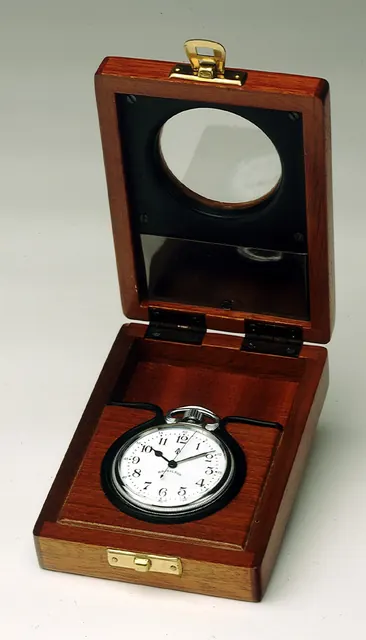
Deck watch no. 739 by Hamilton Watch Co
Royal Museums Greenwich
Instruments · 1942
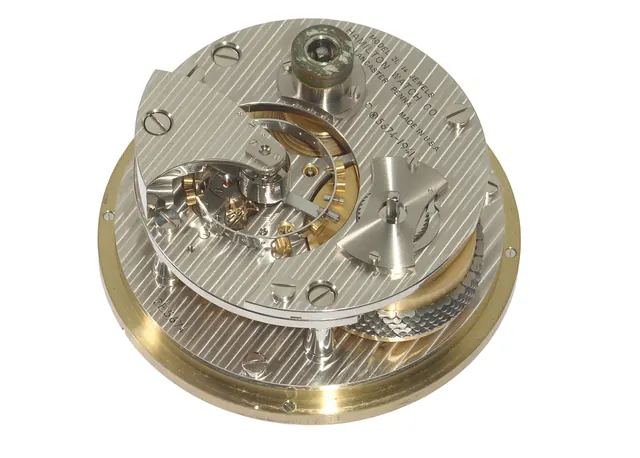
Marine chronometer no. 5674 by Hamilton Watch Co
Royal Museums Greenwich
Instruments · 1942
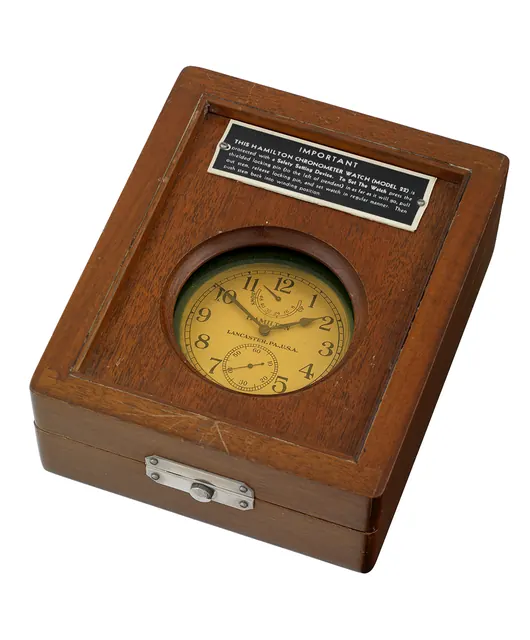
Deck watch no. 13531 by Hamilton Watch Co
Royal Museums Greenwich
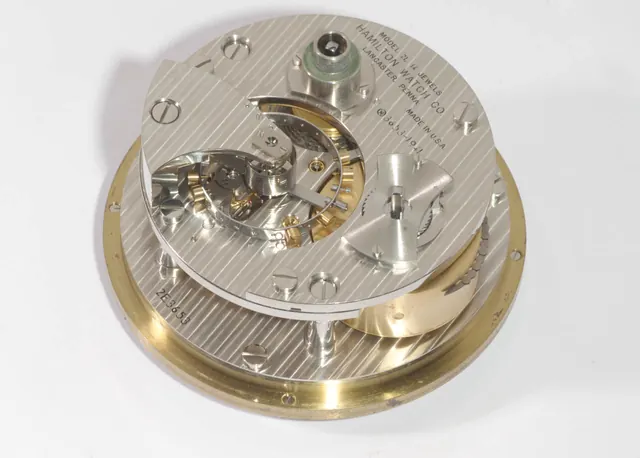
Instruments · 1942
Marine chronometer no. 3653 by Hamilton Watch Co
Royal Museums Greenwich
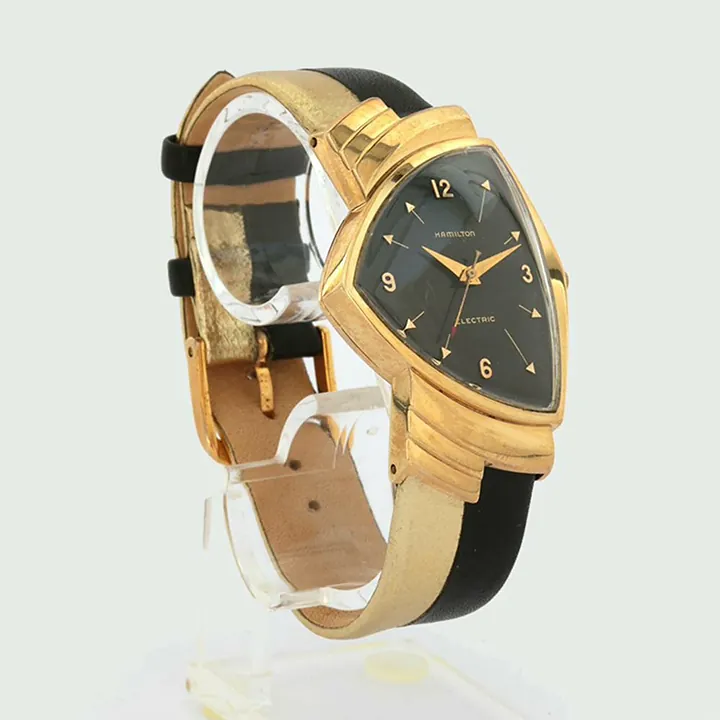
Wristwatches · c. 1957
Wristwatch by Richard H. Arbib, United States, c. 1957
German Clock Museum
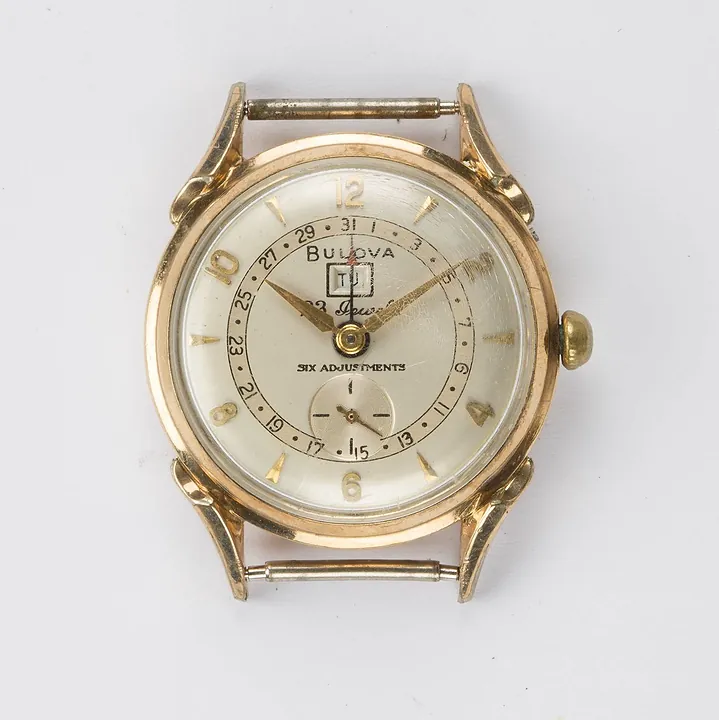
Wristwatches · 1959
Wristwatch by Josef Bulova, United States, 1959
German Clock Museum
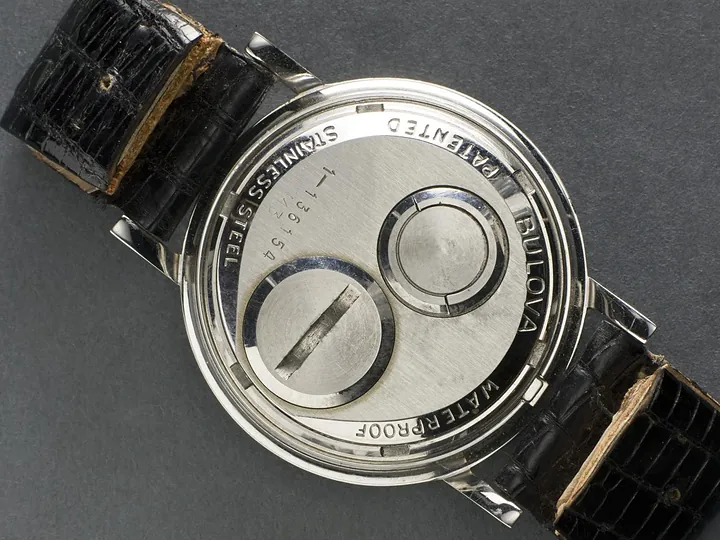
Wristwatches · 1960–1963
Bulova Accutron tuning-fork wristwatch on a demonstration stand, designed by Max Hetzel, United States, 1960–1963
Science Museum Group, London
Wristwatches · 1964
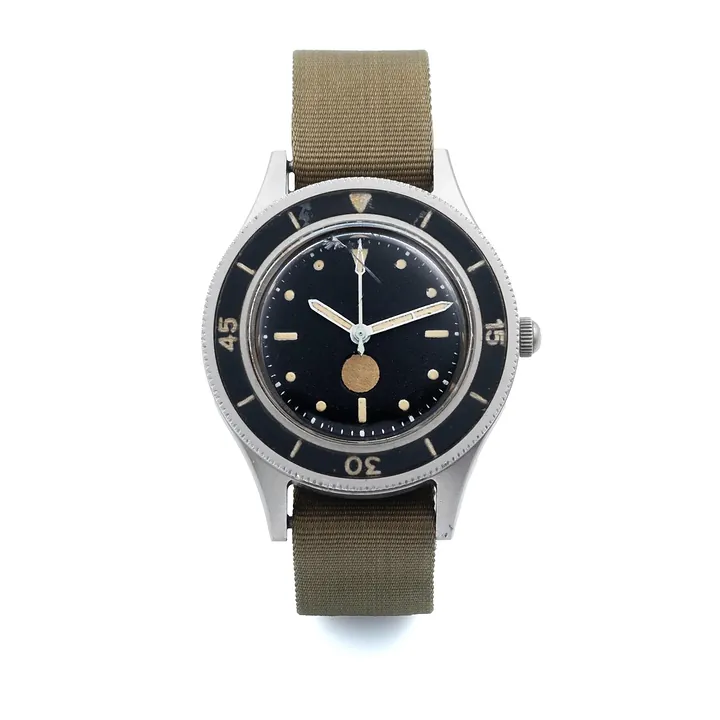
Tornek-Rayville wristwatch, ref. TR 900, 1964
Antiquorum auction archive, Geneva