
Pocket Watches · Pocket watch
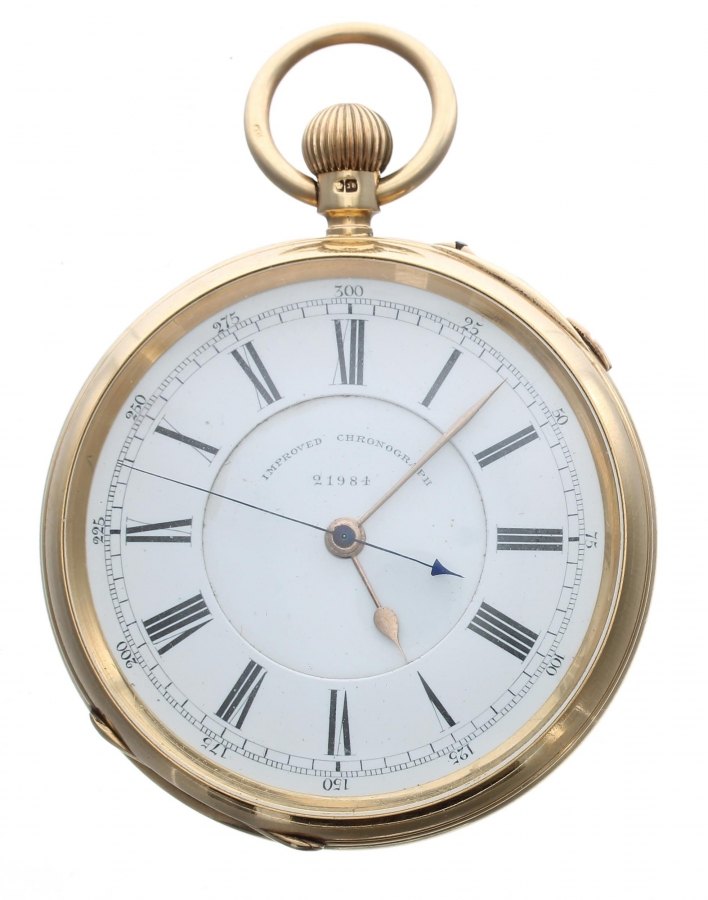
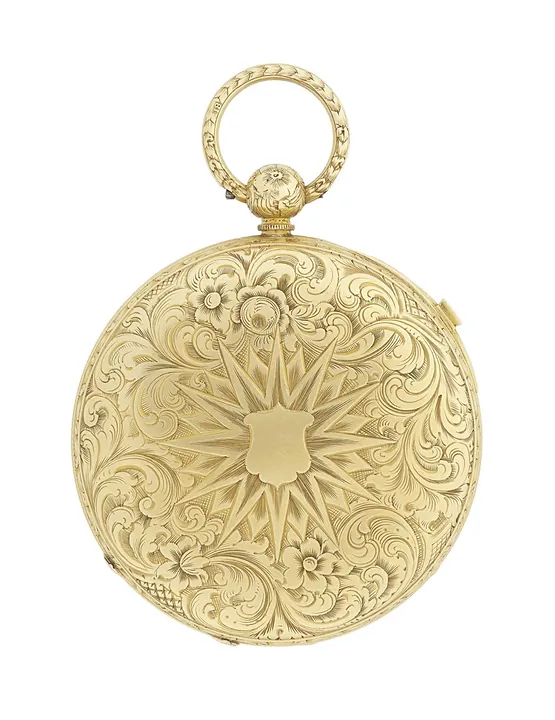
Victorian 18ct Centre Seconds Chronograph lever pocket watch, hallmarked London 1887
- Maker / attribution
- Unrecorded in source
- Date
- 1887 (hallmarked London)
- Historical period
- Industrial Revolution (1850 – 1900)
- Country of origin
- England
- Object type
- Pocket watch
- Dimensions
- Diameter 57 mm
- Auction house
- Gardiner Houlgate (auction house), Corsham
- Lot
- Sale 41, lot 101
- Credit line
- Auction lot record: lot 101, Watches, Gardiner Houlgate (28th June 2023)
- Catalogue title (original)
- Victorian 18ct Centre Seconds Chronograph lever pocket watch, London 1887, the gilt three quarter plate movement signed W.J. Story, Dewsbury, no. 21984, with bi-metallic compensated balance and regula (English)
View the source record (auction lot) ↗ (opens another website in a new tab)Suggest a correction
Record summary
Catalogued by Gardiner Houlgate (auction house), Corsham (lot Sale 41, lot 101), this is a pocket watch, made in England, dated 1887 (hallmarked London). The Atlas places it in the Industrial Revolution period (1850 – 1900) of its Pocket Watches collection. Recorded dimensions: Diameter 57 mm. The record is illustrated with 1 photograph.
Assembled from the source record's structured fields. Dates and attributions are given as the source states them; where a field is missing the Atlas leaves it blank rather than estimating.
Catalogue description
Lot description — Gardiner Houlgate
Victorian 18ct Centre Seconds Chronograph lever pocket watch, London 1887, the gilt three quarter plate movement signed W.J. Story, Dewsbury, no. 21984, with bi-metallic compensated balance and regulator, the dial inscribed 'Improved Chronograph' and numbered 21984, with Roman numerals, minute track, 25/300 scale and centre chronograph seconds, chronograph lever at the two position, within a plain case with engraved monogram, 137.0gm, 57mm
Historical context
Industrial Revolution (1850 – 1900)
American interchangeable-parts manufacture; railroad time standards; Swiss and German factory systems.
Machine production with interchangeable parts, pioneered by Waltham (1850s) and adopted by Elgin, Longines, Omega and others, made reliable lever watches widely affordable. Keyless winding became standard, railroad watch standards were introduced (1890s), and Swiss and American industries competed globally.
Read the period in the timelineMore pocket watches from this periodEarlier: Precision & Scientific Horology
Atlas type guide
Chronographs and split-seconds watches
A chronograph is a watch with an additional seconds hand that can be started, stopped and returned to zero independently of the timekeeping. Louis Moinet built an early example in 1816 and Nicolas Rieussec a recording 'chronographe' in 1821; Adolphe Nicole's heart-shaped reset cam (patented 1862) made the modern return-to-zero possible. Split-seconds (rattrapante) chronographs add a second hand that can be stopped for intermediate times; flyback chronographs restart instantly.
Chronographs were essential tools for doctors (pulsometer scales), artillery (telemeter), engineers and sport. In wristwatches, Valjoux, Venus, Lemania and later the automatic chronographs of 1969 (Zenith El Primero, the Chronomatic Calibre 11 group and Seiko 6139) are milestones.
What to look for
- Push-pieces on the case band or a single button in the crown (monopusher).
- Subsidiary registers for minutes and hours; tachymeter, telemeter or pulsometer scales.
- Column wheel versus cam control visible in the movement.
- Calibre markings of specialist makers (Valjoux, Lemania, Venus, Landeron).
Dating clues
- Pocket chronographs with heart cam reset: after 1862.
- Wrist chronographs: from c. 1910; two-button designs from the 1930s.
- Automatic chronographs: from 1969.
General guidance written by the Atlas editors about this kind of object. It is not a statement about this particular piece; for that, rely on the source record above and on physical examination.
Read next:Flyback chronographChronograph
Related records
Pocket Watches · 1835–1875
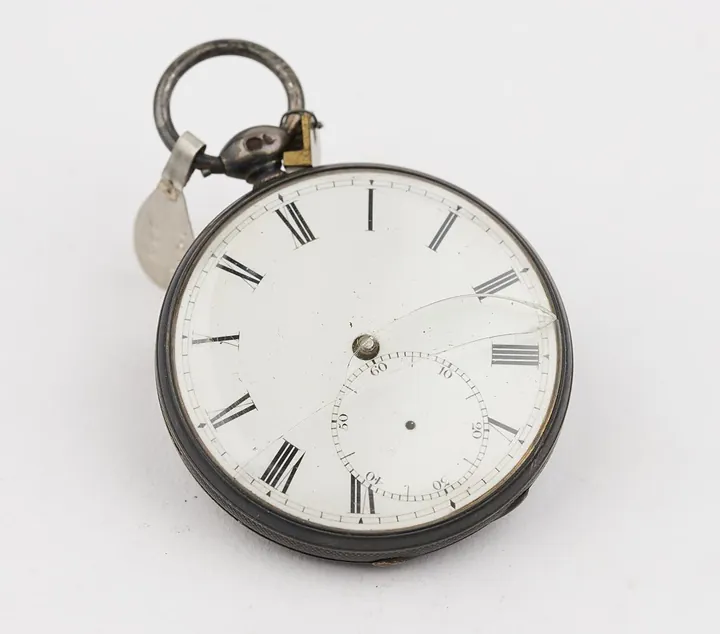
Pocket watch by Cornelius Brooks Holliday, England, 1835–1875
Science Museum Group, London
Pocket Watches · c. 1849–50
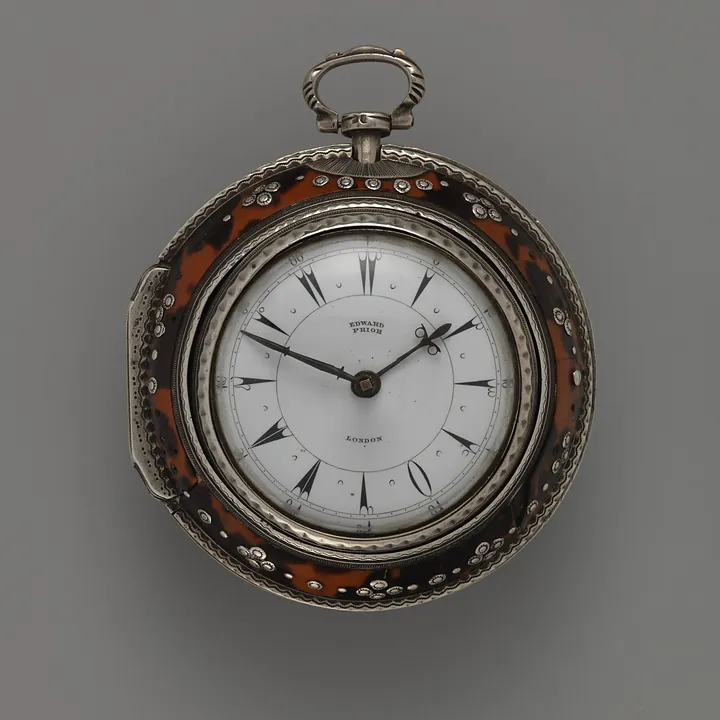
Watch by Edward Prior, England, c. 1849–50
The Metropolitan Museum of Art, New York
Pocket Watches · 1850-1862; hallmarked 1862
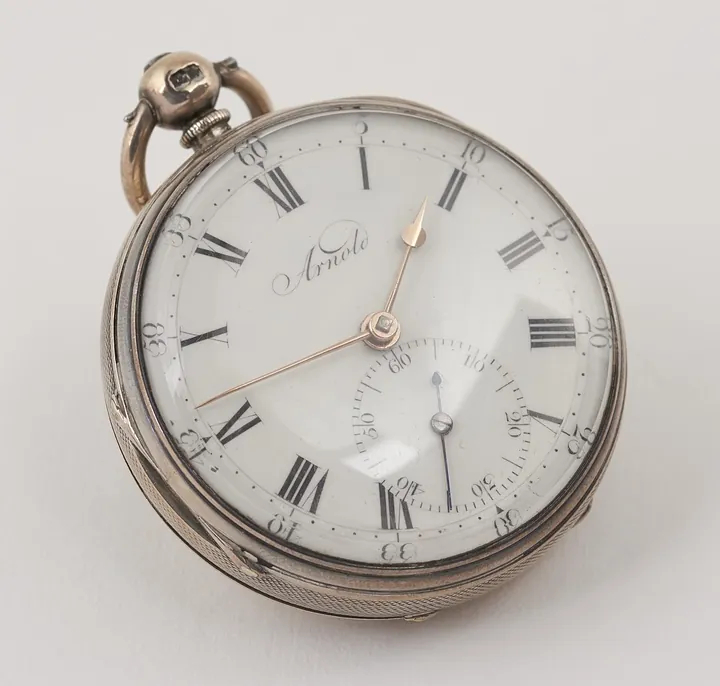
Cylinder watch in silver case by Jno. R. Arnold, London, no.3636, compensated curb, hall marked 1862
Science Museum Group, London
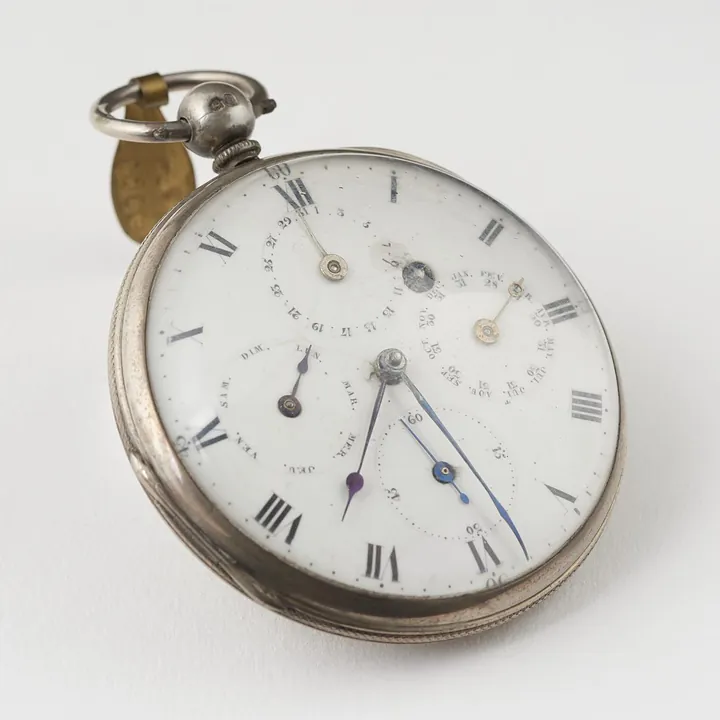
Pocket Watches · hallmarked 1860; 1850-1890
Cylinder watch in silver case, calendar, balance under dial, R.Q., in case. Hall marked 1860
Science Museum Group, London
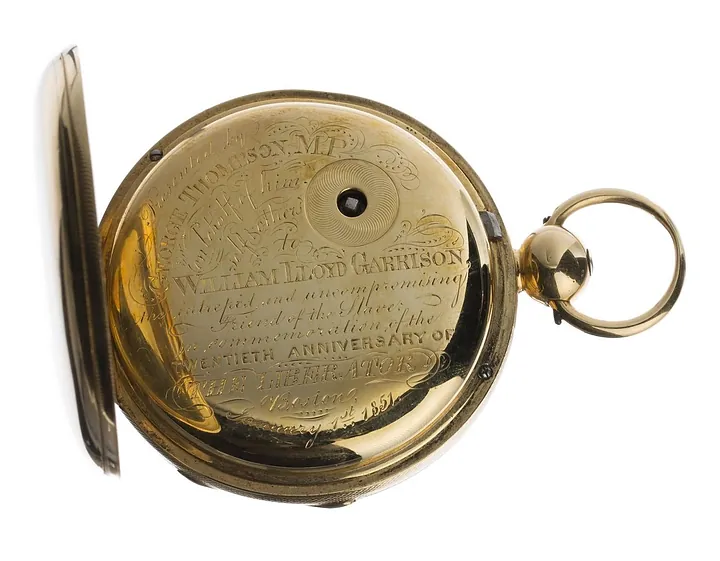
Pocket Watches · 1850
Gold half-hunter pocket watch presented to William Lloyd Garrison, England, 1850
National Museum of African American History and Culture, Smithsonian Institution, Washington DC
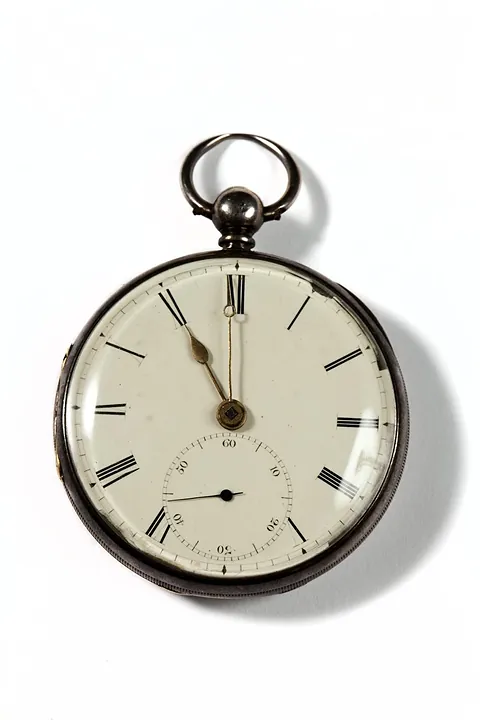
Pocket Watches · 1850–1860
Sterling silver lever pocket watch in original case, made by Thomas & John Ollivant, Manchester, around 1851.
Science Museum Group, London
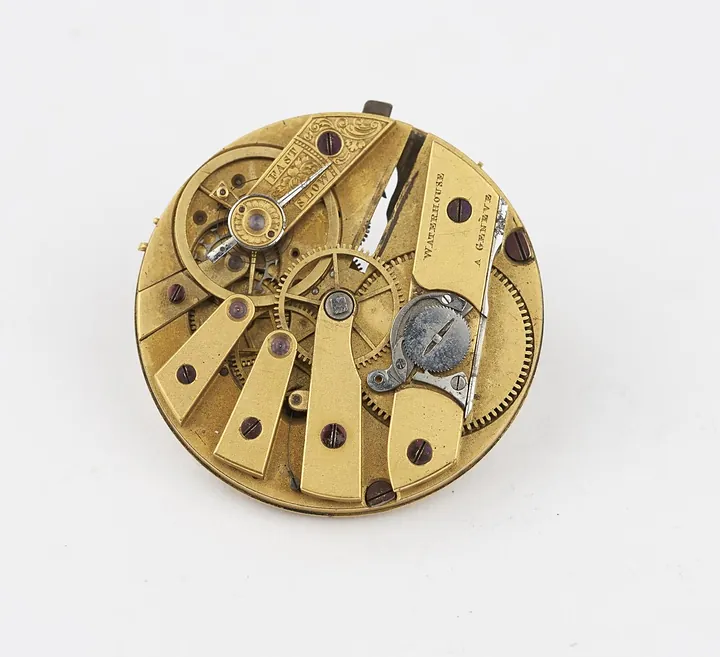
Pocket Watches · 1850
Watch movement with pumping keyless winding mechanism, by G. Waterhouse, London, England, 1845-1851.
Science Museum Group, London
Pocket Watches · 1851
Pocket watch by Alexander Watkins, England, 1851
Science Museum Group, London