
Clocks · Clock
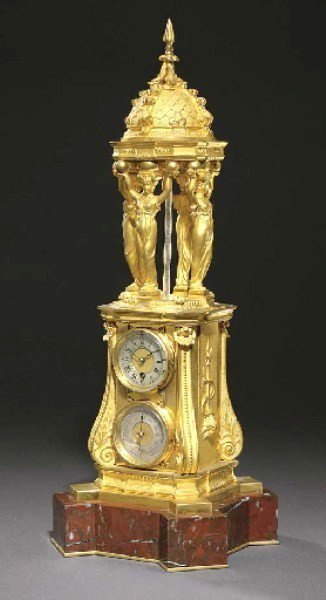
Very Rare "Wallace Fountain" Clock, c. 1890
- Maker / attribution
- Unrecorded in source
- Date
- c. 1890
- Historical period
- Industrial Revolution (1850 – 1900)
- Country of origin
- Unrecorded in source
- Object type
- Clock
- Materials / technique
- marble, ormolu
- Auction house
- LiveAuctioneers auction archive
- Lot
- Item 10754796
- Credit line
- Auction lot record: lot 181, Rare Art Books, Clocks, & Fine Antiques, Preston Hall Gallery (2012), via LiveAuctioneers
- Catalogue title (original)
- Very Rare "Wallace Fountain" Clock (English)
View the source record (auction lot) ↗ (opens another website in a new tab)Suggest a correction
Record summary
Catalogued by LiveAuctioneers auction archive (lot Item 10754796), this is a clock, dated c. 1890. The Atlas places it in the Industrial Revolution period (1850 – 1900) of its Clocks collection. Materials and techniques recorded by the source: marble, ormolu. The record is illustrated with 4 photographs.
Assembled from the source record's structured fields. Dates and attributions are given as the source states them; where a field is missing the Atlas leaves it blank rather than estimating.
Catalogue description
Lot description — Preston Hall Gallery
A French ormolu and rouge griotte marble clock with barometer and automaton fountain by Denlau & Borius, Paris, No. 582. Circa 1890. The cupola top supported by four caryatids and having a central revolving spiral-twist glass rod. Single barrel movement with independent single barrel automaton movement. H. 22 inches. Excellent condition. Lot Notes: For comparisons, see: Pierre Kjellberg, "L'encyclopedie de la Pendule Francaise", 1997, p. 487. Also, Christie's London, "Important Clocks and Marine Chronometers", July 5, 2006, lot 89; Sotheby's New York, "The Joseph M. Meraux Collection of Rare and Unusual Clocks," June 28, 1993, lot 47.
Historical context
Industrial Revolution (1850 – 1900)
American interchangeable-parts manufacture; railroad time standards; Swiss and German factory systems.
Factory production transformed the clock into an everyday object. American makers (Seth Thomas, Ansonia, Waterbury) and German factories (Junghans, Gustav Becker, Lenzkirch) sold millions of shelf, wall and alarm clocks worldwide; France produced standardised Paris movements and carriage clocks; electric time distribution began.
Read the period in the timelineMore clocks from this periodEarlier: Precision & Scientific Horology
Atlas type guide
Domestic clocks
A clock combines four systems: a source of power (falling weight, coiled spring, or later electricity), a gear train that divides time, an escapement and oscillator that regulate it (foliot, pendulum or balance), and an indicating system of dial and hands or a bell. Its history runs from the large iron weight-driven clocks of the late thirteenth century to Renaissance spring-driven table clocks, the pendulum revolution of 1656, the factory clocks of the nineteenth century and electric and quartz clocks of the twentieth.
Domestic clocks also reflect regional furniture and decorative traditions — English longcase and bracket clocks, French pendules, Viennese regulators, Black Forest and American shelf clocks — and therefore record changing tastes as much as technical progress.
What to look for
- How the clock is powered: weights, spring barrel, fusee, electric coil.
- The oscillator: foliot, short pendulum, long seconds pendulum or balance.
- Whether it strikes: hour only (count wheel) or hours and quarters (rack striking).
- The maker or retailer's name on dial and movement, and any factory trademarks.
- Signs of alteration — replaced dials, converted escapements, 'married' cases.
Dating clues
- Before 1656 clocks used foliots or balances; after, most domestic clocks have pendulums.
- Anchor escapements spread after c. 1670; minute hands became common at the same time.
- Factory production in America and Germany transformed prices after c. 1840.
General guidance written by the Atlas editors about this kind of object. It is not a statement about this particular piece; for that, rely on the source record above and on physical examination.
Related records
Clocks · 1830–1870
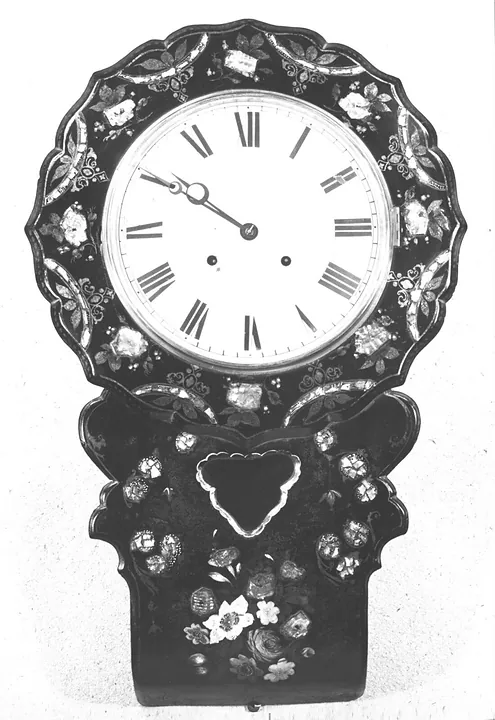
Wall clock in a papier mâché case with painted decoration. English, mid 19th century.
Victoria and Albert Museum, London
Clocks · 1840–1900
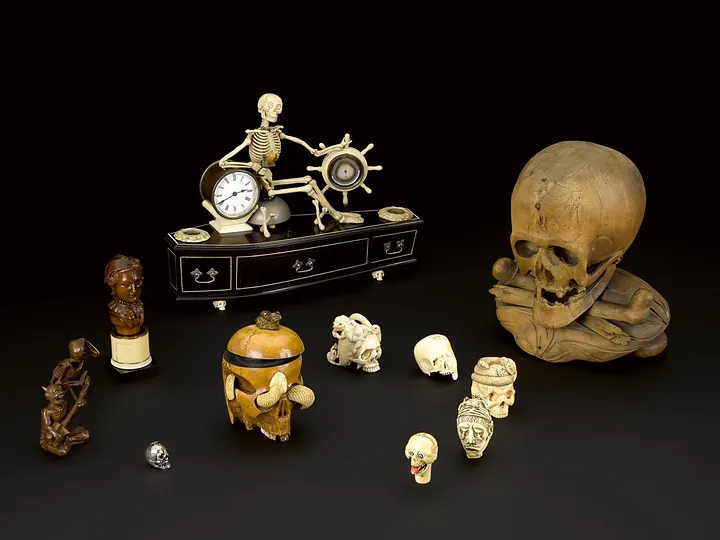
Alarm clock, mounted on model of coffin with skeleton, probably English, 1840–1900
Science Museum Group, London
Clocks · 1840–1880
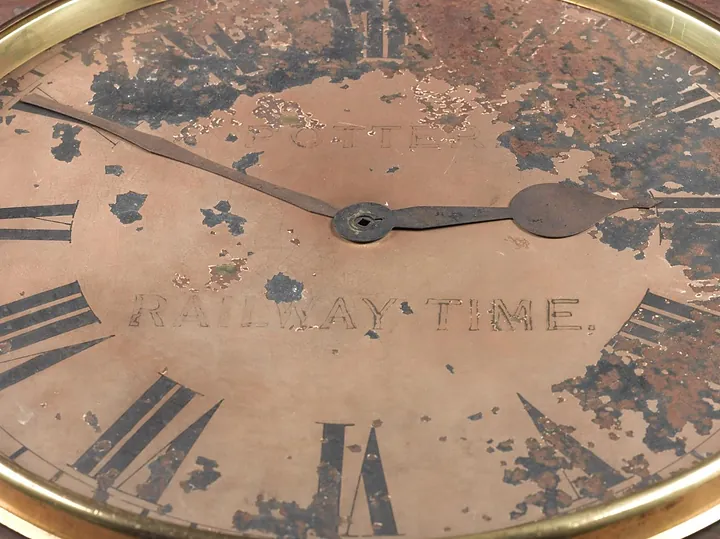
Clock dial marked "Potter, Railway Time" with two hands, unknown maker, British, 1840–1880
Science Museum Group, London
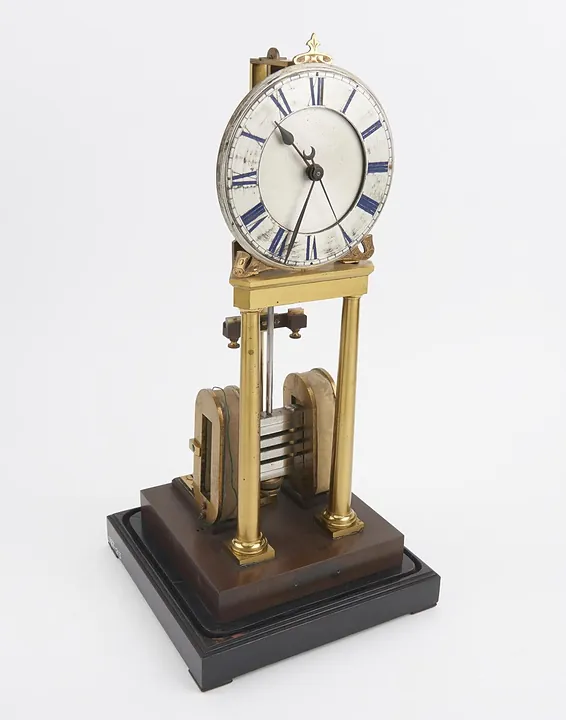
Clocks · 1840–1877
Electric clock of the Bain type
Science Museum Group, London
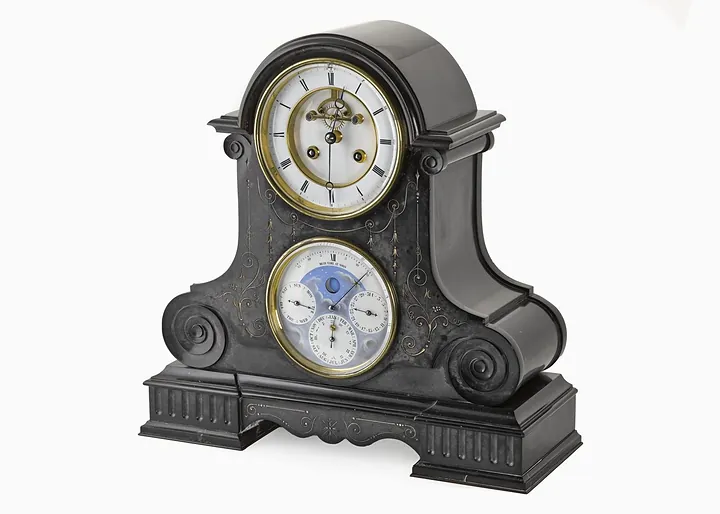
Clocks · 1840–1878
Mantel clock by A. Brocot, France, 1840–1878
Science Museum Group, London
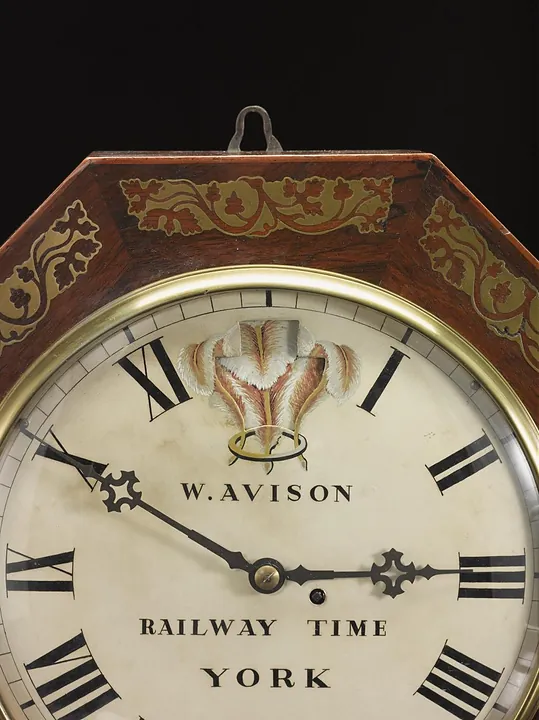
Clocks · 1840–1880
Wall Clock in octagonal case with Prince of Wales Feathers above makers name "W. Avison, Railway Time, York", made by William Avison, England, 1840–1880.
Science Museum Group, London
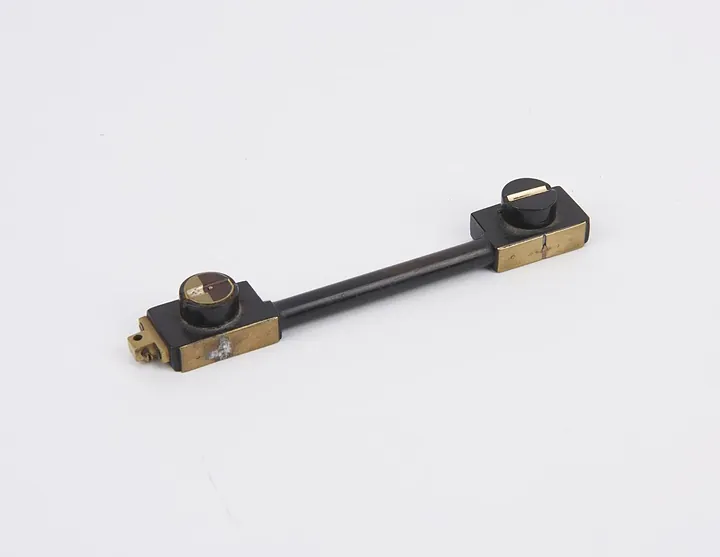
Clocks · 1841–1870
Contact bar from electric clock, unsigned, London, England, 1841–1870
Science Museum Group, London
Clocks · 1841–1870
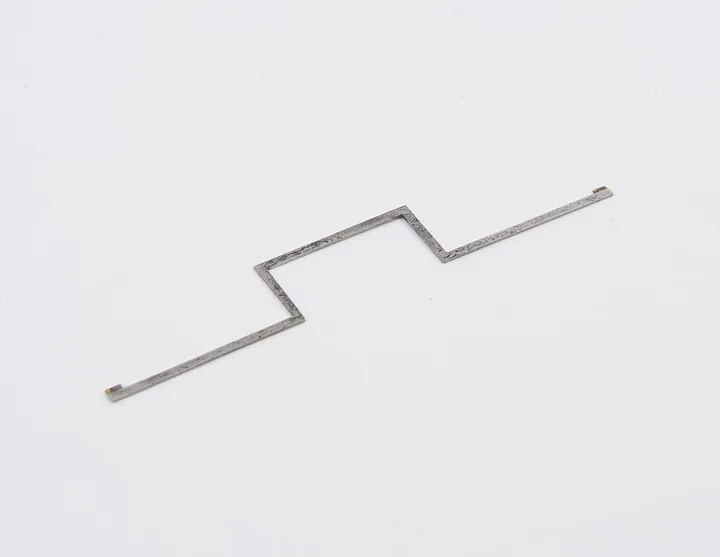
Contactor from electric clock, unsigned, London, England, 1841–1870
Science Museum Group, London