
Wristwatches · Wristwatch
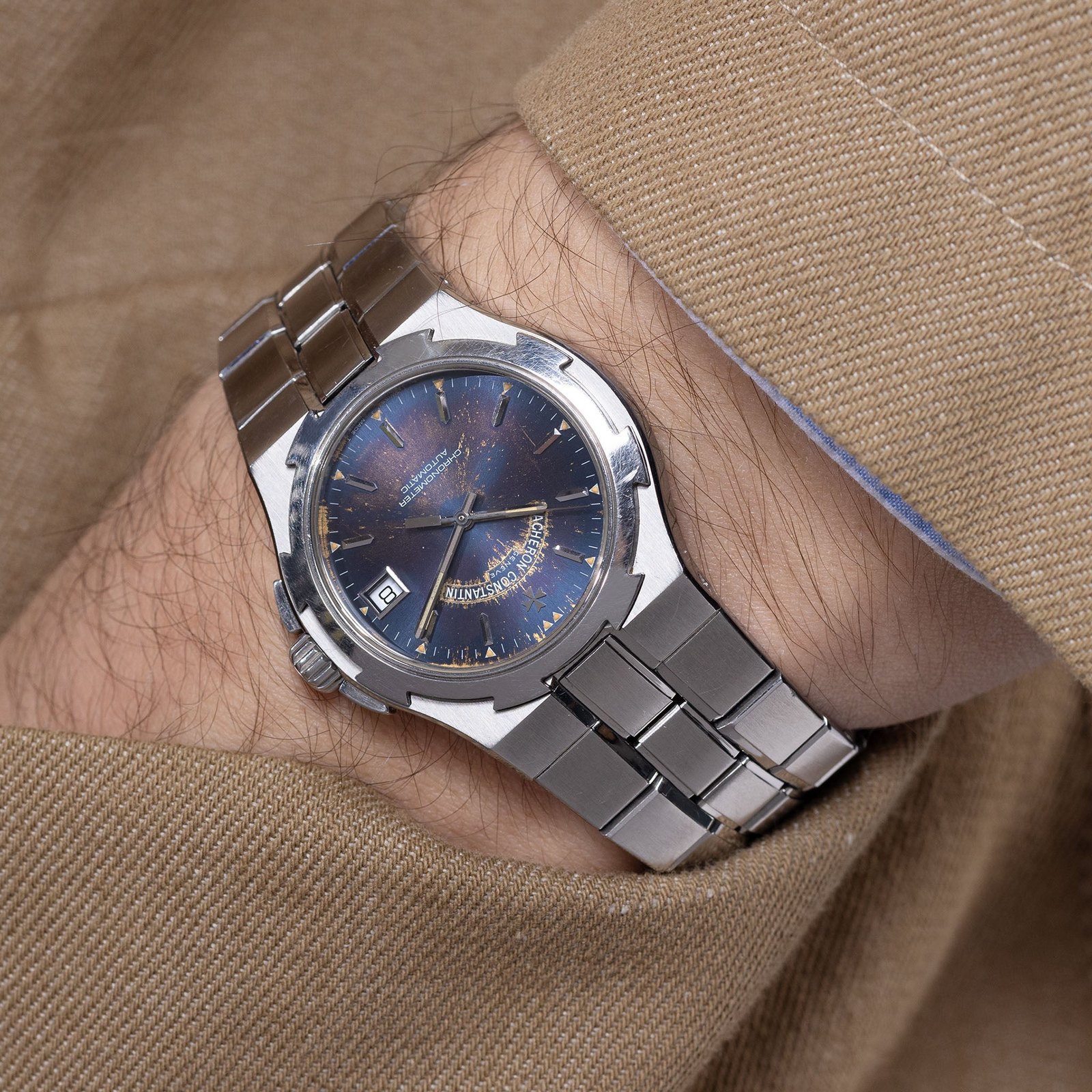
Vacheron Constantin Overseas 42040 Tropical Dial in Steel with Box and Original Guarantee Papers, 1990
- Maker / attribution
- Vacheron Constantin (maker)
- Date
- 1990
- Historical period
- Mechanical Renaissance (1990 – 2010)
- Country of origin
- Switzerland
- Object type
- Wristwatch
- Materials / technique
- steel
- Dimensions
- Case 37 mm
- Stock no.
- W-3540
- Credit line
- Dealer listing, Bulang & Sons (W-3540)
- Catalogue title (original)
- Vacheron Constantin Overseas 42040 Tropical Dial in Steel with Box and Original Guarantee Papers (English)
View the source record (dealer listing) ↗ (opens another website in a new tab)Suggest a correction
Record summary
Catalogued by Bulang & Sons (dealer), Copenhagen (stock number W-3540), this is a wristwatch by Vacheron Constantin, made in Switzerland, dated 1990. The Atlas places it in the Mechanical Renaissance period (1990 – 2010) of its Wristwatches collection. Materials and techniques recorded by the source: steel. Recorded dimensions: Case 37 mm. The record is illustrated with 6 photographs.
Assembled from the source record's structured fields. Dates and attributions are given as the source states them; where a field is missing the Atlas leaves it blank rather than estimating.
Catalogue description
Dealer description — Bulang & Sons
Presented in 1972, the Audemars Piguet Royal Oak completely transformed the high-end Swiss watch industry. Gérald Genta’s avant-garde creation was a sporty yet elegant steel wristwatch with a bold octagonal bezel and an integrated bracelet—one continuous architectural form rather than separate case and strap. Despite early criticism, Genta’s revolutionary idea became an international success, effectively creating an entirely new category of luxury timepieces. The Royal Oak’s impact inspired several other iconic steel sports watches with integrated bracelets, including the Patek Philippe Nautilus and the IWC Ingenieur—both also penned by Genta. Not to be outdone, Vacheron Constantin—the world’s oldest continuously operating watchmaker, now 270 years old—introduced its own interpretation of the luxury sports watch. To celebrate its 222nd anniversary, Vacheron unveiled the “222,” designed by a young Jörg Hysek. While the 222 echoed some of Genta’s design cues, it carried its own identity: a slim, barrel-shaped case, a notched round bezel, and a Maltese cross inset at 5 o’clock. The 222 would be followed by the octagonal 333 and the round-cased Phidias, both featuring integrated bracelets. Vacheron’s true breakthrough came in 1996 with the launch of the Overseas—the direct spiritual successor to the 222. Like its predecessor, the Overseas features a tonneau-shaped case and a fluted bezel inspired by the Maltese cross, extended by a sculptural, integrated bracelet that blends elegance and sportiness to perfection. And that brings us to what we’re excited to offer you today: a Vacheron Constantin Overseas reference 42040, housed in a perfectly sized 37 mm steel case. The iconic case is in excellent condition, as is the integrated bracelet, which fits wrists up to 18.5 cm. The dial—originally blue—has aged into a rich purple tropical tone, with subtle hints of underlying copper peeking through. It features a date window, crisp white printing, and charming small triangular tritium markers that have aged to a warm beige patina. This unexpected, almost utilitarian twist gives the watch a bold edge—adding character rarely seen on an Overseas. A rare, characterful, early Overseas—ready for the next chapter in its journey ! Specifications: Vacheron Constantin Overseas reference 42040 /423A 37mm steel case Overseas signature bezel Serial 688xxx dates to the 1990's Original blue dial discoloured to tropical purple and copper tones Sailing boat case back engraving Calibre VC1310 automatic chronometer movement Integrated steel bracelet Inner and outer boxes Booklets and Certificate of Origin stating a sale in 1998 Fully serviced by our watchmaker
Historical context
Mechanical Renaissance (1990 – 2010)
Mechanical watches return as cultural objects; independent watchmaking flourishes.
Mechanical watches returned as cultural and luxury objects. Complications, tourbillons and new materials proliferated; independent watchmakers such as George Daniels, F.P. Journe and Philippe Dufour revived artisanal watchmaking; collecting vintage watches became a major field.
Read the period in the timelineMore wristwatches from this periodEarlier: Quartz Revolution
Atlas type guide
Wristwatches
Bracelet watches were worn by women from the early nineteenth century — Breguet made one for Caroline Murat, Queen of Naples, in 1810–12 — but the wristwatch only became a man's instrument with military use and aviation in the early twentieth century. Between the World Wars it overtook the pocket watch; the 1920s and 1930s brought rectangular Art Deco cases, water-resistant cases and the first automatic winding systems.
After 1945 the wristwatch became a carrier of identity — dress watches, sports and dive watches, chronographs, calendars — produced by Swiss, American, Japanese, German, Soviet and Chinese industries. The quartz revolution after 1969 and the mechanical renaissance since the 1990s, including the rise of independent watchmakers, complete the story.
What to look for
- The reference number (between the lugs or inside the case back) and serial number, the starting point for dating.
- The calibre: its maker and number are often stamped under the dial or on the bridge.
- Originality of dial, hands and crown — refinished ('redial') dials are common.
- Case material marks: 18K/750, 14K/585, stainless steel, gold-filled, plated.
Dating clues
- Wire-lug cases: before c. 1925.
- Water-resistant screw-down cases: from 1926.
- Quartz movements: from 1969; sapphire crystals widespread after c. 1980.
General guidance written by the Atlas editors about this kind of object. It is not a statement about this particular piece; for that, rely on the source record above and on physical examination.
Related records
Pocket Watches · c. 1896
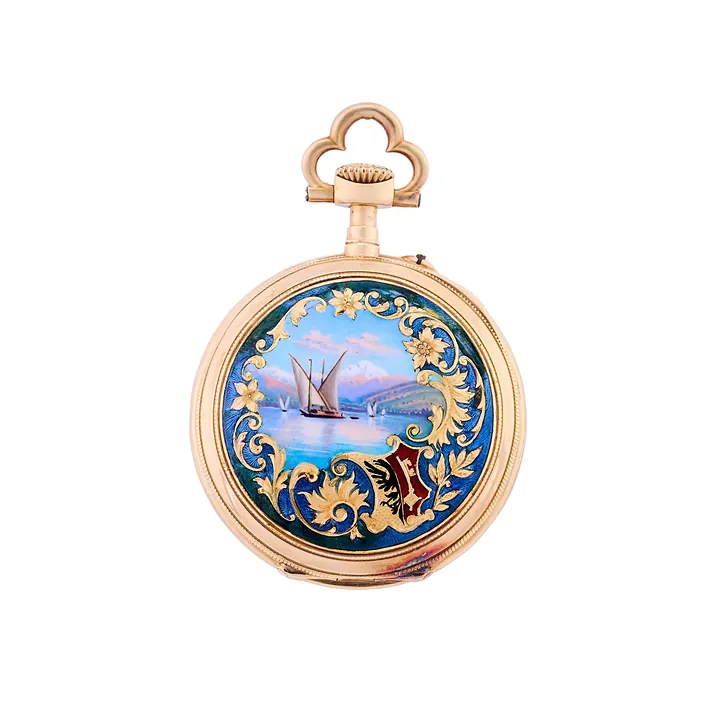
Vacheron Constantin “grand TIR de L’exposition Nationale, Genève 1896, c. 1896
Antiquorum auction archive, Geneva
Pocket Watches · c. 1940
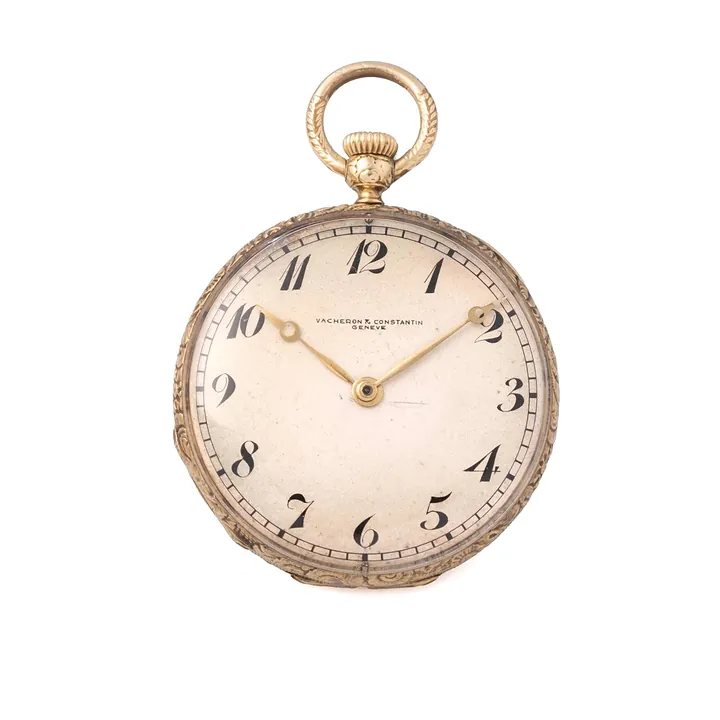
Vacheron Constantin pocket watch, ref. 345, c. 1940
Antiquorum auction archive, Geneva
Pocket Watches · c. 1945
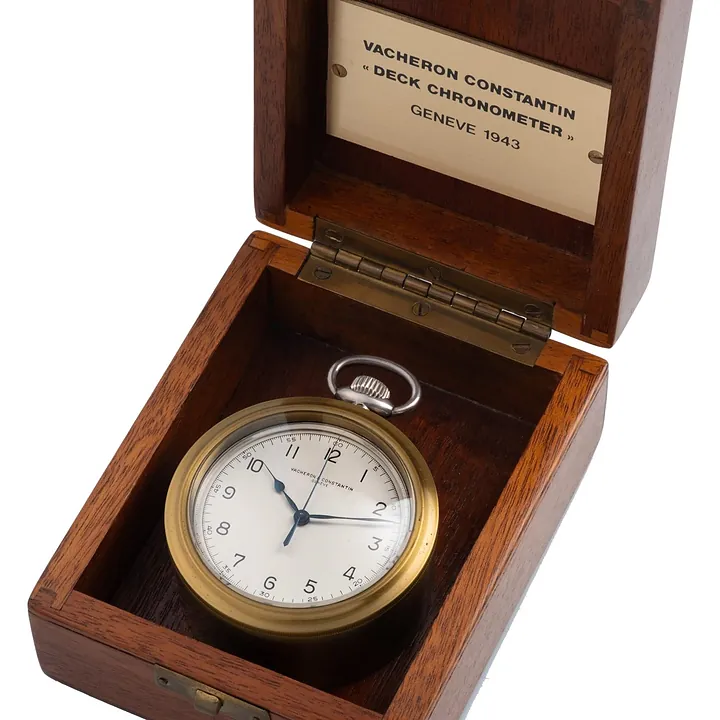
Vacheron Constantin pocket chronometer, c. 1945
Antiquorum auction archive, Geneva
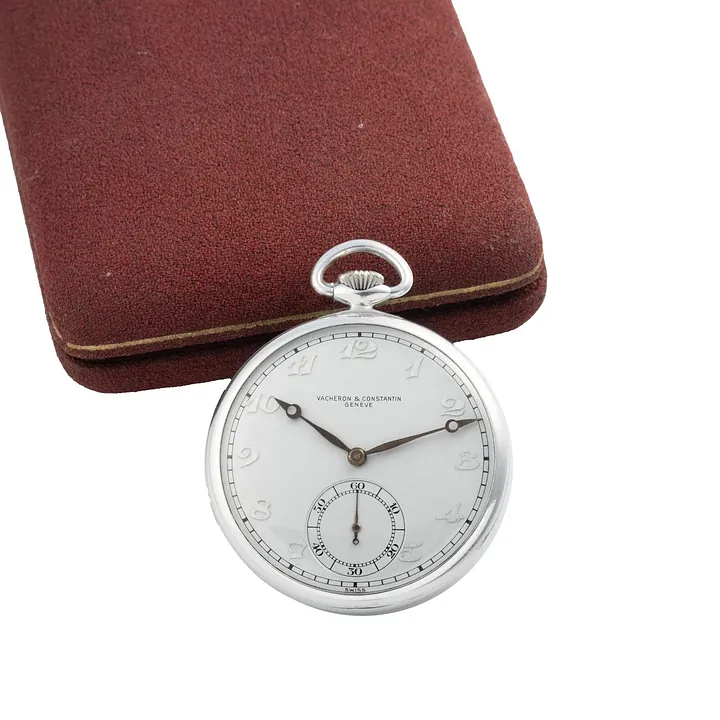
Pocket Watches · c. 1945
Vacheron Constantin watch, c. 1945
Antiquorum auction archive, Geneva

Wristwatches · 2008
Wristwatch by Breitling?, 2008
Museum Rotterdam

Wristwatches · c. 1990s
Audemars Piguet Bamboo, c. 1990s
Antiquorum auction archive, Geneva

Wristwatches · c. 1990
Audemars Piguet Huitieme Perpetual Calendar, ref. 25696PT, c. 1990
Antiquorum auction archive, Geneva

Wristwatches · c. 1990
Breitling Chronomat, ref. b13050.1, c. 1990
Antiquorum auction archive, Geneva