
Wristwatches · Wristwatch
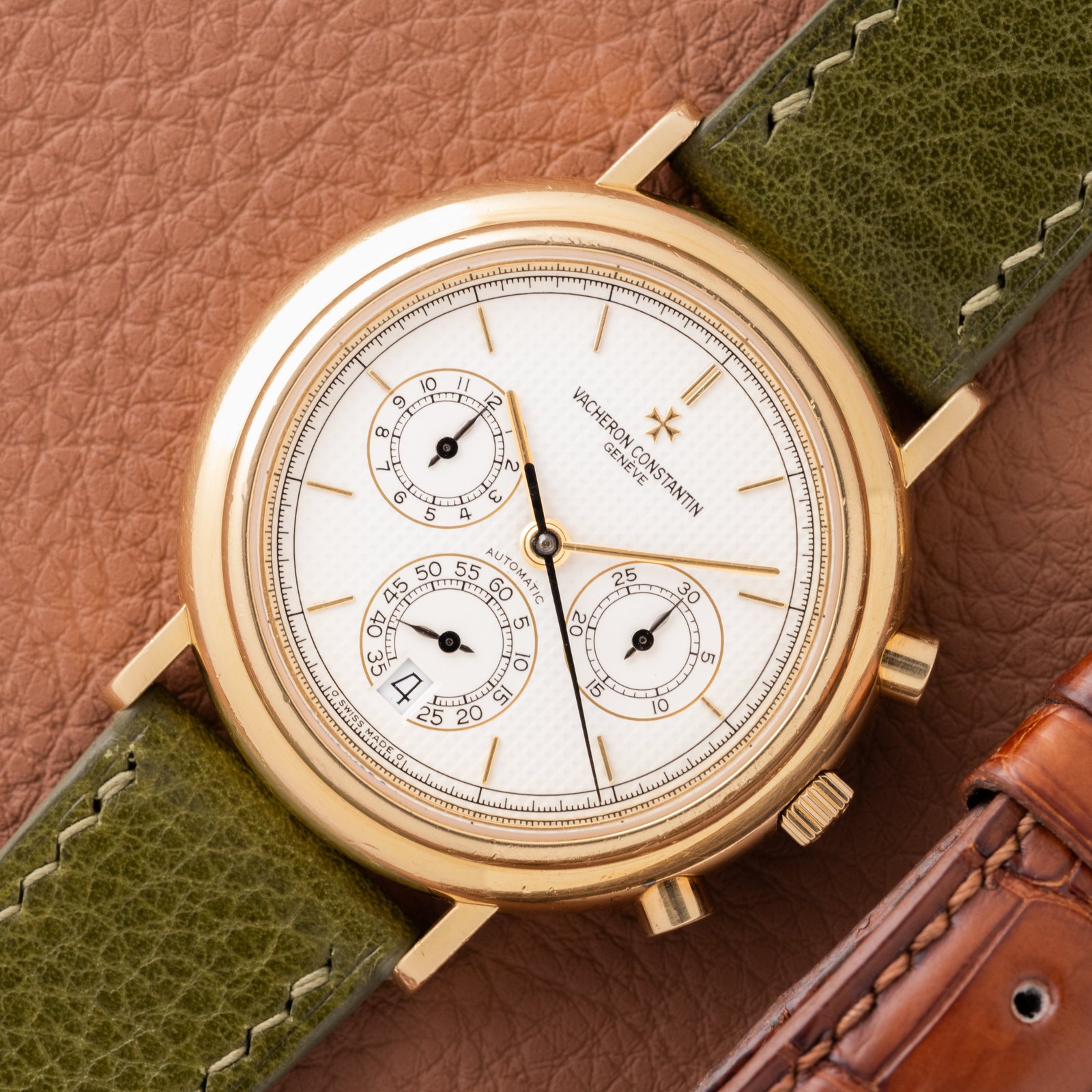
Vacheron Constantin Gold Patrimony Chronograph (Ref. 49003), 1990s
- Maker / attribution
- Vacheron Constantin (maker)
- Date
- 1990s
- Historical period
- Mechanical Renaissance (1990 – 2010)
- Country of origin
- Switzerland
- Object type
- Wristwatch
- Materials / technique
- gold
- Dimensions
- Case 38 mm
- Stock no.
- Product 8791996989623
- Credit line
- Dealer listing, Huntington Company (product 8791996989623)
- Catalogue title (original)
- 1990s Vacheron Constantin Gold Patrimony Chronograph (Ref. 49003) (English)
View the source record (dealer listing) ↗ (opens another website in a new tab)Suggest a correction
Record summary
Catalogued by Huntington Company (dealer) (stock number Product 8791996989623), this is a wristwatch by Vacheron Constantin, made in Switzerland, dated 1990s. The Atlas places it in the Mechanical Renaissance period (1990 – 2010) of its Wristwatches collection. Materials and techniques recorded by the source: gold. Recorded dimensions: Case 38 mm. The record is illustrated with 6 photographs.
Assembled from the source record's structured fields. Dates and attributions are given as the source states them; where a field is missing the Atlas leaves it blank rather than estimating.
Catalogue description
Dealer description — Huntington Company
History and Significance The reference 49003 comes from a period of Vacheron Constantin that feels increasingly interesting today. During the 1990s, the manufacture was still producing complicated watches with a distinctly traditional sensibility, before larger cases and more overtly contemporary styling became common across the industry. The Patrimony Chronograph fits naturally into that era. It takes one of the most functional complications in watchmaking and presents it with the restraint of a proper Vacheron dress watch. The dial is where that balance becomes especially apparent. Chronographs can become visually busy very quickly, but the reference 49003 keeps the information organized and remarkably elegant. The registers sit comfortably within the dial rather than dominating it, while the applied markers and slender hands retain the formality expected from the Patrimony family. There is enough happening to make the watch interesting, but never enough to make it feel crowded. That approach says quite a bit about Vacheron Constantin during this period. Complication did not necessarily mean spectacle. A chronograph could still be thin, refined, and designed to disappear beneath a cuff rather than announce itself across a room. The reference 49003 feels rooted in the same traditional Geneva watchmaking that defined the manufacture's simpler dress watches, only with another layer of mechanical interest underneath. Writer's Thoughts There is something particularly good about a chronograph that does not look like it was designed around speed. No tachymeter is needed, no oversized pushers are fighting for attention, and nothing about the reference 49003 feels remotely sporty. Instead, Vacheron Constantin treated the chronograph as another traditional complication and gave it the same elegance expected from the rest of the Patrimony family. That is what makes this watch so appealing. It has enough going on mechanically and visually to reward attention, but the overall impression remains quiet. The yellow gold and classical dial give it an old-world quality that feels especially appropriate for Vacheron Constantin. It is a complicated watch for someone who does not need the complication to be the first thing anybody notices. Our Promise Every watch is thoroughly vetted, carefully described with complete transparency, and guaranteed authentic. Each piece is offered in honest condition, ensuring collectors receive a timepiece that reflects both originality and integrity. Specifications Brand: Vacheron Constantin Model: Patrimony Chronograph Reference: 49003 Year: 1990s Case Material: 18k yellow gold Case Size: 38mm Dial: White chronograph dial Movement: Automatic chronograph Strap/Buckle: New H.C. leather strap; original Vacheron Constantin strap included Buckle/Clasp: Original Vacheron Constantin 18k yellow gold buckle Contents: Original Vacheron Constantin strap Condition Case: Presents attractively with signs of wear consistent with age and use. Dial: Presents cleanly with well-defined printing, registers, and applied markers. Hands: Present well with a clean overall appearance. Crystal: Presents well overall with light signs of wear. Strap/Buckle: Fitted to a new H.C. leather strap, with the original Vacheron Constantin strap included. Buckle/Clasp: Original Vacheron Constantin 18k yellow gold buckle.
Historical context
Mechanical Renaissance (1990 – 2010)
Mechanical watches return as cultural objects; independent watchmaking flourishes.
Mechanical watches returned as cultural and luxury objects. Complications, tourbillons and new materials proliferated; independent watchmakers such as George Daniels, F.P. Journe and Philippe Dufour revived artisanal watchmaking; collecting vintage watches became a major field.
Read the period in the timelineMore wristwatches from this periodEarlier: Quartz Revolution
Atlas type guide
Chronographs and split-seconds watches
A chronograph is a watch with an additional seconds hand that can be started, stopped and returned to zero independently of the timekeeping. Louis Moinet built an early example in 1816 and Nicolas Rieussec a recording 'chronographe' in 1821; Adolphe Nicole's heart-shaped reset cam (patented 1862) made the modern return-to-zero possible. Split-seconds (rattrapante) chronographs add a second hand that can be stopped for intermediate times; flyback chronographs restart instantly.
Chronographs were essential tools for doctors (pulsometer scales), artillery (telemeter), engineers and sport. In wristwatches, Valjoux, Venus, Lemania and later the automatic chronographs of 1969 (Zenith El Primero, the Chronomatic Calibre 11 group and Seiko 6139) are milestones.
What to look for
- Push-pieces on the case band or a single button in the crown (monopusher).
- Subsidiary registers for minutes and hours; tachymeter, telemeter or pulsometer scales.
- Column wheel versus cam control visible in the movement.
- Calibre markings of specialist makers (Valjoux, Lemania, Venus, Landeron).
Dating clues
- Pocket chronographs with heart cam reset: after 1862.
- Wrist chronographs: from c. 1910; two-button designs from the 1930s.
- Automatic chronographs: from 1969.
General guidance written by the Atlas editors about this kind of object. It is not a statement about this particular piece; for that, rely on the source record above and on physical examination.
Read next:Flyback chronographChronograph
Related records
Pocket Watches · c. 1896
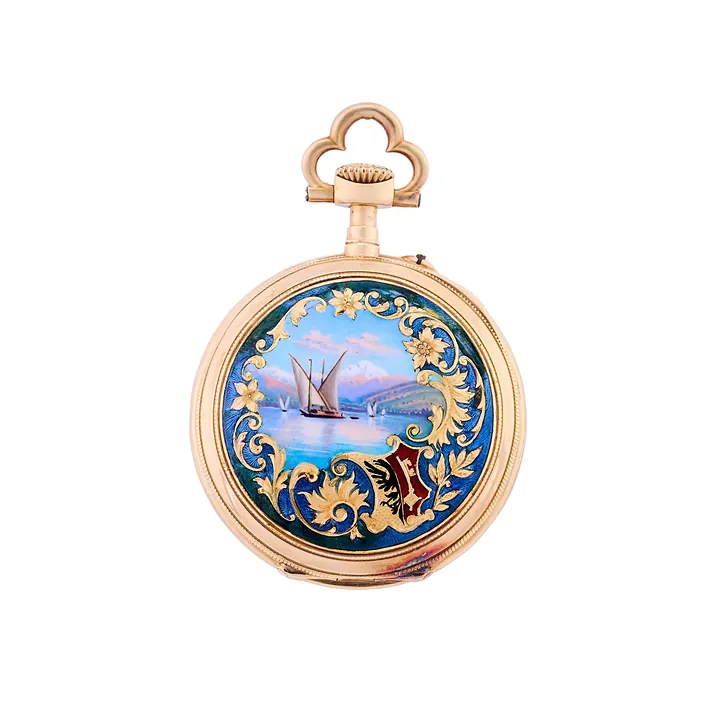
Vacheron Constantin “grand TIR de L’exposition Nationale, Genève 1896, c. 1896
Antiquorum auction archive, Geneva
Pocket Watches · c. 1940
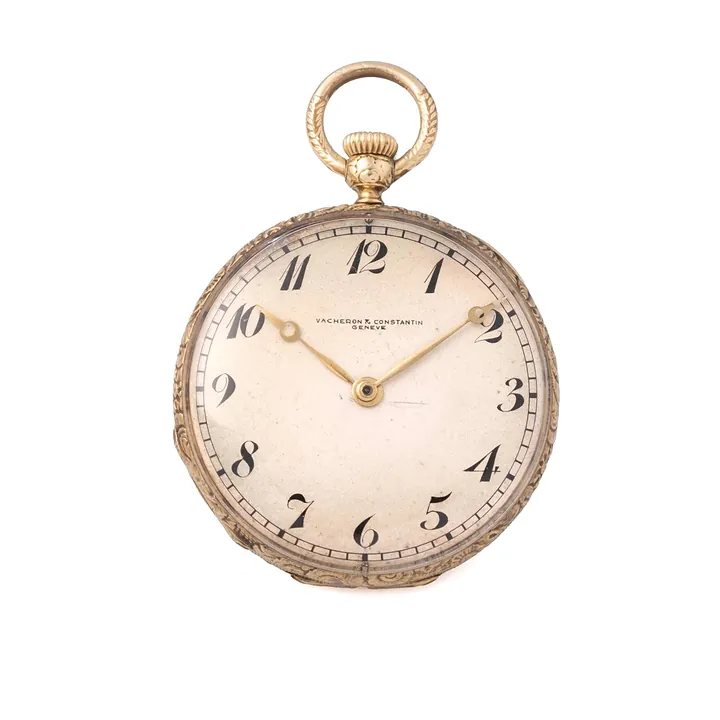
Vacheron Constantin pocket watch, ref. 345, c. 1940
Antiquorum auction archive, Geneva
Pocket Watches · c. 1945
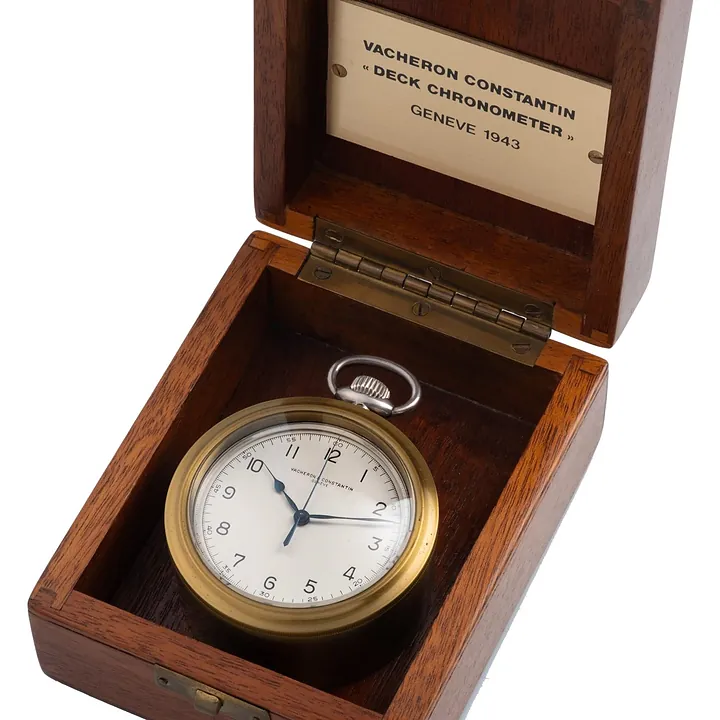
Vacheron Constantin pocket chronometer, c. 1945
Antiquorum auction archive, Geneva
Pocket Watches · c. 1945
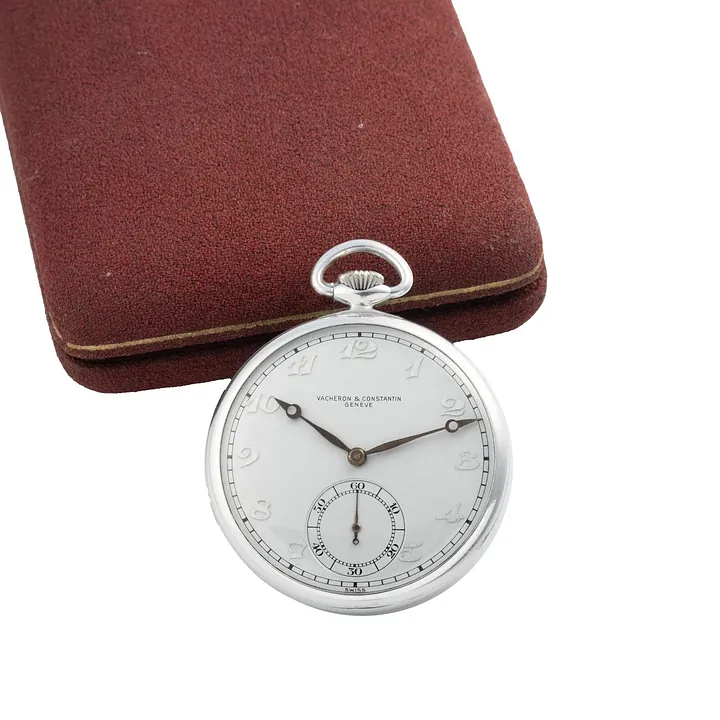
Vacheron Constantin watch, c. 1945
Antiquorum auction archive, Geneva

Wristwatches · 2008
Wristwatch by Breitling?, 2008
Museum Rotterdam

Wristwatches · c. 1990s
Audemars Piguet Bamboo, c. 1990s
Antiquorum auction archive, Geneva

Wristwatches · c. 1990
Audemars Piguet Huitieme Perpetual Calendar, ref. 25696PT, c. 1990
Antiquorum auction archive, Geneva

Wristwatches · c. 1990
Breitling Chronomat, ref. b13050.1, c. 1990
Antiquorum auction archive, Geneva