
Wristwatches · Wristwatch
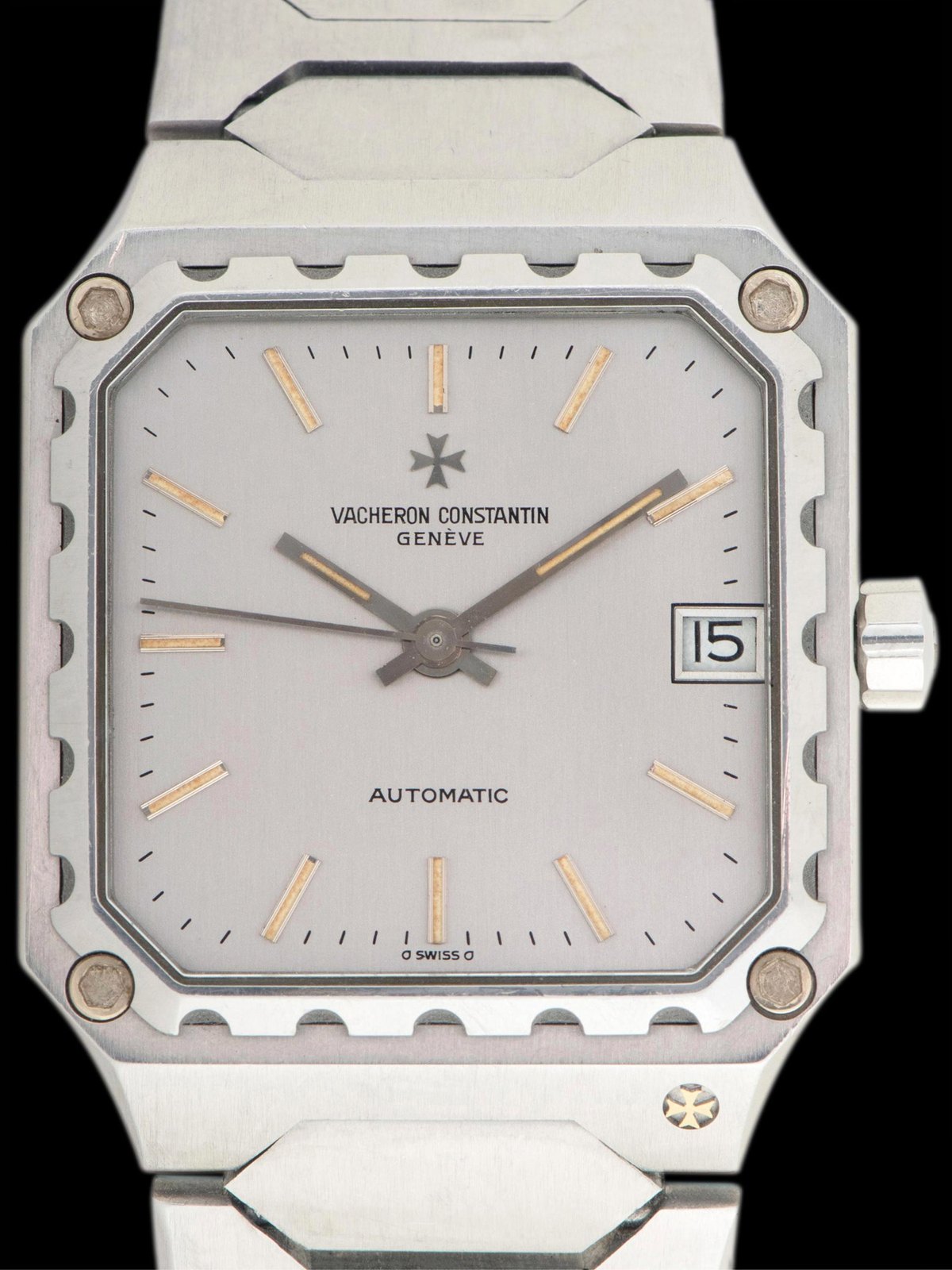
Vacheron Constantin 222 (Ref. 46004/411) "Square Case", 1982
- Maker / attribution
- Vacheron Constantin (maker)
- Date
- 1982
- Historical period
- Quartz Revolution (1969 – 1990)
- Country of origin
- Switzerland
- Object type
- Wristwatch
- Stock no.
- VC222
- Credit line
- Dealer listing, Craft & Tailored (VC222)
- Catalogue title (original)
- 1982 Vacheron Constantin 222 (Ref. 46004/411) "Square Case" W/ Extract From The Archives (English)
View the source record (dealer listing) ↗ (opens another website in a new tab)Suggest a correction
Record summary
Catalogued by Craft & Tailored (dealer), Los Angeles (stock number VC222), this is a wristwatch by Vacheron Constantin, made in Switzerland, dated 1982. The Atlas places it in the Quartz Revolution period (1969 – 1990) of its Wristwatches collection. The record is illustrated with 6 photographs.
Assembled from the source record's structured fields. Dates and attributions are given as the source states them; where a field is missing the Atlas leaves it blank rather than estimating.
Catalogue description
Dealer description — Craft & Tailored
Few watch brands are as respected or revered within the watch world as the 3rd oldest watchmaker, Vacheron Constantin, whose doors opened in 1755. Known most notably for their quality of craftsmanship and design whether it is an ultra-complicated moon phase calendar or a simple dress model. There is a reason Vacheron Constantin belongs to the “Holy Trinity” of watchmaking, and its the brand's precise execution that transcends generations and a devotion to innovation that has solidified its regaled position within horology. The 1970s have proved to be one of the most influential decades in modern watchmaking history, an era of experimentation and nuance, and this is seen across every major Swiss watchhouse in this era. The Vacheron Constantin 222 is a true reflection of the shift in watchmaking of this era, especially when considering it was the very first sports model introduced by Vacheron Constantin. The 222 is easy to compare to the other expensive stainless steel integrated bracelet sport model watches produced by brands predominantly known for complicated dress watches in the 1970s, i.e. the Royal Oak and Nautilus. Though this is no mistake as the 222 was born out of competition for the two other Genta-designed watches. And though the three models may seem very similar at first glance, it’s really only the use of integrated bracelets and the ultra-thin Jaeger-LeCoultre Cal. 920 movement that is similar between the models. The 222 is genuinely its own beast and is to be respected as such. Designed by Jorg Hysek and introduced in 1977, the 222 birthday of the watchmaking house, the 222 model feels distinctly Vacheron Constantin. The faceted bezel, the uniquely geometrical bracelet, and the simple yet sophisticated dial approach add up to a sports model that is dripping with elegance. The 222 was discontinued in 1985, making for a very brief production run. Within its brief tenure, the 222 was produced in a number of case sizes and shapes, as well as a number of metals including stainless steel, solid yellow gold, and two-tone. Stock # VC222 Brand Vacheron Constantin Style 222 Model 46004/411 Serial 54XXXX/70XXXX Size Men's Material Stainless Steel Dial Grey Millimeters 31x38 Bracelet Vacheron Constantin / Gay Freres Integrated Stainless Steel Bracelet CASE & BRACELET The beautifully faceted and finished square case retains all of its original factory angles, geometry, and brushing with honest signs of gentle use present. The bezel retains all of its original finishing in crisp condition with minimal signs of use present. The case retains its original VC-signed crown. The case back retains its original factory markings in crisp condition. The original stainless steel integrated Gay Freres bracelet is also in excellent condition, retaining 17 links on the watch that show almost no stretch and will fit up to a 6 3/4-inch wrist. The watch also comes with an additional link that increases the bracelet size to 7 inches. DIAL & HANDS The original slate grey dial takes the "less is more" approach with a simple and sophisticated design that is highly legible and functional. the dial itself shows no signs of aging and remains in virtually flawless condition. The tritium lume hands achieved a charming golden patina that accents the watch perfectly, under U.V. light inspection some of the lume plots show nominal degradation at the edges of the plots but all remain intact. The original tritium hands match the dial perfectly and show no degradation under U.V. light inspection. ACCESSORIES
Historical context
Quartz Revolution (1969 – 1990)
Seiko's Astron begins mass quartz timekeeping; traditional industries contract sharply.
Quartz and digital watches transformed the market after 1969. Swiss employment collapsed, Japanese and Hong Kong production soared, and the Swatch (1983) helped the Swiss industry recover; mechanical watches survived as luxury goods.
Read the period in the timelineMore wristwatches from this periodEarlier: Modern Mechanical Horology
Atlas type guide
Wristwatches
Bracelet watches were worn by women from the early nineteenth century — Breguet made one for Caroline Murat, Queen of Naples, in 1810–12 — but the wristwatch only became a man's instrument with military use and aviation in the early twentieth century. Between the World Wars it overtook the pocket watch; the 1920s and 1930s brought rectangular Art Deco cases, water-resistant cases and the first automatic winding systems.
After 1945 the wristwatch became a carrier of identity — dress watches, sports and dive watches, chronographs, calendars — produced by Swiss, American, Japanese, German, Soviet and Chinese industries. The quartz revolution after 1969 and the mechanical renaissance since the 1990s, including the rise of independent watchmakers, complete the story.
What to look for
- The reference number (between the lugs or inside the case back) and serial number, the starting point for dating.
- The calibre: its maker and number are often stamped under the dial or on the bridge.
- Originality of dial, hands and crown — refinished ('redial') dials are common.
- Case material marks: 18K/750, 14K/585, stainless steel, gold-filled, plated.
Dating clues
- Wire-lug cases: before c. 1925.
- Water-resistant screw-down cases: from 1926.
- Quartz movements: from 1969; sapphire crystals widespread after c. 1980.
General guidance written by the Atlas editors about this kind of object. It is not a statement about this particular piece; for that, rely on the source record above and on physical examination.
Related records
Pocket Watches · c. 1896
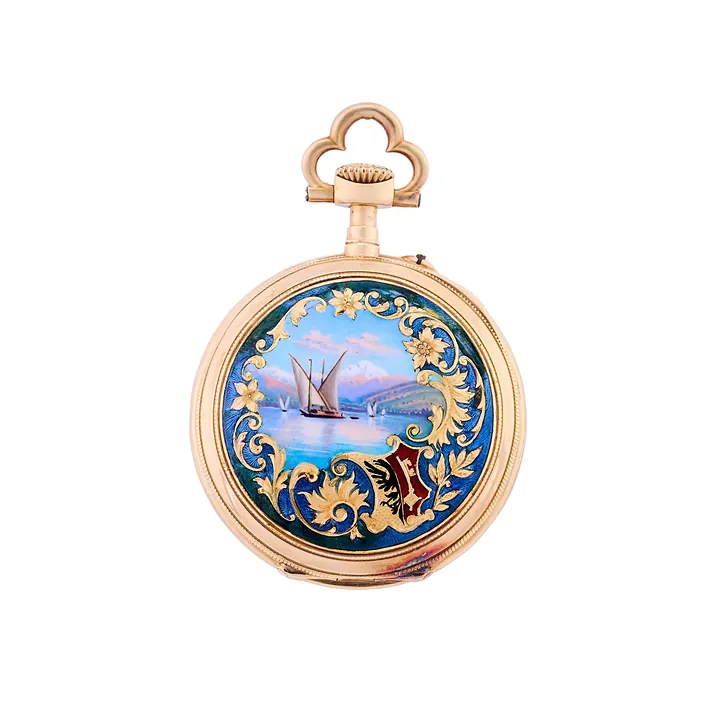
Vacheron Constantin “grand TIR de L’exposition Nationale, Genève 1896, c. 1896
Antiquorum auction archive, Geneva
Pocket Watches · c. 1940
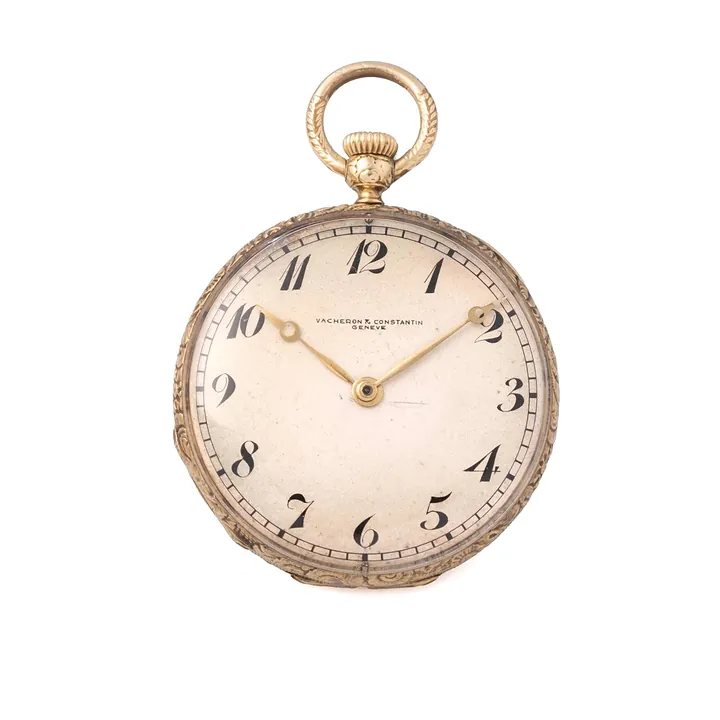
Vacheron Constantin pocket watch, ref. 345, c. 1940
Antiquorum auction archive, Geneva
Pocket Watches · c. 1945
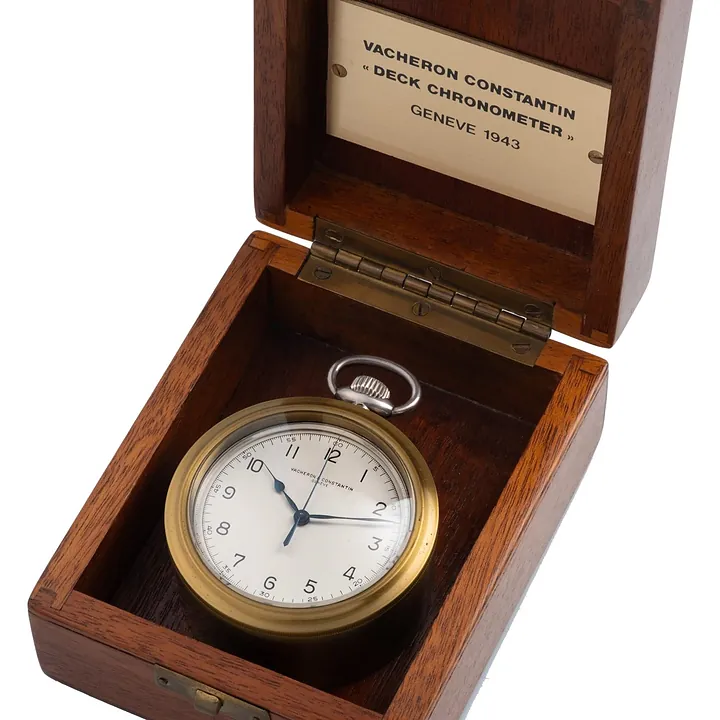
Vacheron Constantin pocket chronometer, c. 1945
Antiquorum auction archive, Geneva
Pocket Watches · c. 1945
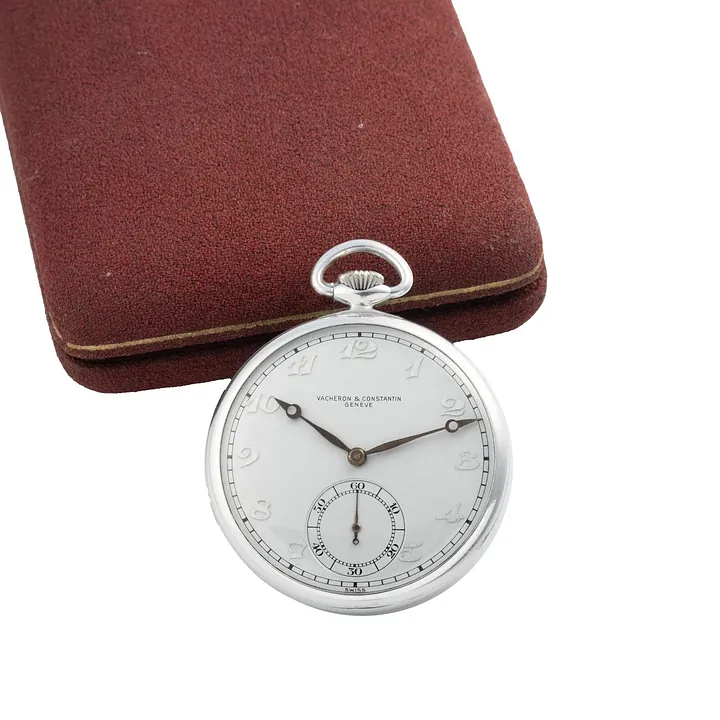
Vacheron Constantin watch, c. 1945
Antiquorum auction archive, Geneva

Wristwatches · 1970
Wristwatch by Heno, Switzerland, 1970
Museum Rotterdam

Wristwatches · 1960–1986
'Tri-Compax' calendar chronograph wristwatch in gold case, by Universal, Geneva, Switzerland, 1960–1986.
Science Museum Group, London

Wristwatches · 1969–1970
Beta 21 Quartz wristwatch movement, made in Switzerland, 1970.
Science Museum Group, London

Wristwatches · c. 1969
Omega Speedmaster Moonwatch, ref. 145022-69st, c. 1969
Antiquorum auction archive, Geneva